Ships & Wrecks · Journey file
Mutiny on the Bounty: 3,618 Miles in 41 Days, by Bligh’s Log
After the mutiny of 28 April 1789, William Bligh took an open boat to Timor and printed the noon positions that let the run be checked.
Keel, Rail & Spoke · Published
TL;DR
- Mutineers on HMS Bounty put Lieutenant William Bligh and 18 men into an open launch on 28 April 1789, near Tofoa, now Tofua, in Tonga.
- Bligh's 1790 narrative says the boat reached the coast of Timor “in forty-one days after leaving Tofoa,” having run “by our log, a distance of 3618 miles,” with no one lost on the way. John Norton had already been killed at Tofoa.
- Bligh does not name the kind of mile. His noon positions and straight links across the gaps come to about 6,689 km.
Leg card
- Departure
- Off Tofoa (Tofua), about 8 at night on sea date 3 May 1789 (2 May ashore). The mutiny was on 28 April
- Arrival
- Timor sighted at about 3 in the morning, 12 June 1789, his estimate after the watch stopped; Bligh's forty-one days. Off Coupang (Kupang) near daylight, 14 June
- Distance
- 3,618 miles by Bligh's log; he does not name the kind of mile. Recalculated: about 6,689 km from his noon positions and straight links across the gaps, with Booby Island standing in for his Shoal Cape
- Machine
- HMS Bounty's launch: open boat, 23 feet long, 6 feet 9 wide, 2 feet 9 deep, by the draught Bligh printed. Oars and lug sail
- Elapsed
- 41 days to the coast of Timor, by Bligh's count; about 40 days 7 hours by the clock times he gives. 47 days from the mutiny to Coupang
- Walking multiple
- about 1.4 (overall): about 6,689 km in 41 days at 5 km/h
- Repair radius
- on board. Fault: a rudder gudgeon lost at Restoration Island, replaced with a large staple found in the boat. The carpenter had his tool chest
- The last spare
- none exhausted: Bligh counted bread for eleven days on arrival and gave extra water on 11 June. Pork and dried clams ran out on the way and stopped nothing. His count, unchecked by another record read here
- Key source
- William Bligh, A Narrative of the Mutiny on Board His Majesty's Ship Bounty (1790)
Download this card (CSV) · Where this data came from
Data: William Bligh, A Narrative of the Mutiny on Board His Majesty's Ship Bounty (1790), public domain, https://www.gutenberg.org/ebooks/20337, retrieved 2026-11-08; William Bligh, A Voyage to the South Sea (1792), public domain, https://www.gutenberg.org/ebooks/15411, retrieved 2026-11-08; Wikidata coordinates (CC0), https://www.wikidata.org/, retrieved 2026-11-08
What the card means: walking multiple, repair radius, last spare.
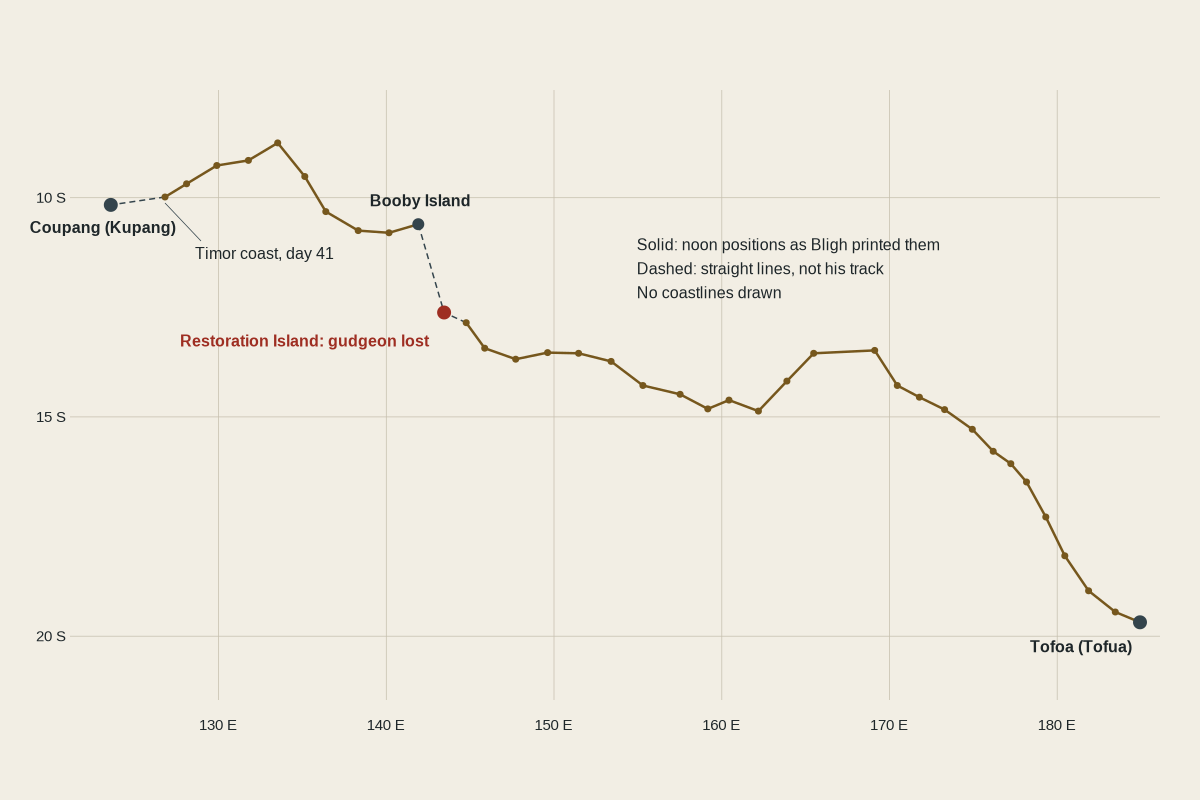
Bligh's noon positions, joined in order. His longitudes are measured from Tofoa, then from Shoal Cape, so the first stretch is hung on Tofua's modern position and the second on Booby Island's, which stands in for the cape because the sources used do not fix it. The dashed lines are straight links, not his track.
Keel, Rail & Spoke, CC BY 4.0
Data: William Bligh, A Narrative of the Mutiny on Board His Majesty's Ship Bounty (1790), public domain, https://www.gutenberg.org/ebooks/20337, retrieved 2026-11-08; Wikidata coordinates (CC0), https://www.wikidata.org/, retrieved 2026-11-08
Reuse this diagram: credit to copy
"The Bounty's launch: noon positions, Tofoa to Timor, 1789" by Keel, Rail & Spoke, https://keelrailandspoke.com/ships/mutiny-on-the-bounty/, licensed under CC BY 4.0 (https://creativecommons.org/licenses/by/4.0/).
Data behind this diagram: mutiny-on-the-bounty-launch-log.csv · Where this data came from
The Bounty's launch, an open boat 23 feet long, logged 3,618 miles from Tofoa to Timor. The figure is William Bligh's own, printed in his Narrative of 1790: “having in that time run, by our log, a distance of 3618 miles.” The same book gives a noon position for most days, and great-circle lines between them, with straight links across the gaps, come to about 6,689 km. That is a walking multiple of about 1.4 (overall), which is not much faster than a steady walk, although the boat kept it up across 41 days of stops, gales and open water. Bligh does not say which miles he meant.
Stops on this page (8)
When did the mutiny on the Bounty happen?
The mutiny came just before sunrise on 28 April 1789, among the Friendly Islands, with the ship 10 leagues or so from Tofoa. The Bounty, a vessel of 215 tons, was carrying 1,015 breadfruit plants from Otaheite, now Tahiti, meant for the West Indies. Fletcher Christian, the master's mate, came into Bligh's cabin with three other men and tied his hands behind his back.
Barrow, reading the court-martial minutes, puts the whole affair between the hours of four and eight that morning. Nineteen men went over the side into the launch. Another 25 stayed aboard, some of them, Bligh wrote, against their will. As the ship stood away he heard “Huzza for Otaheite,” which he took to mean that the mutineers were going back.
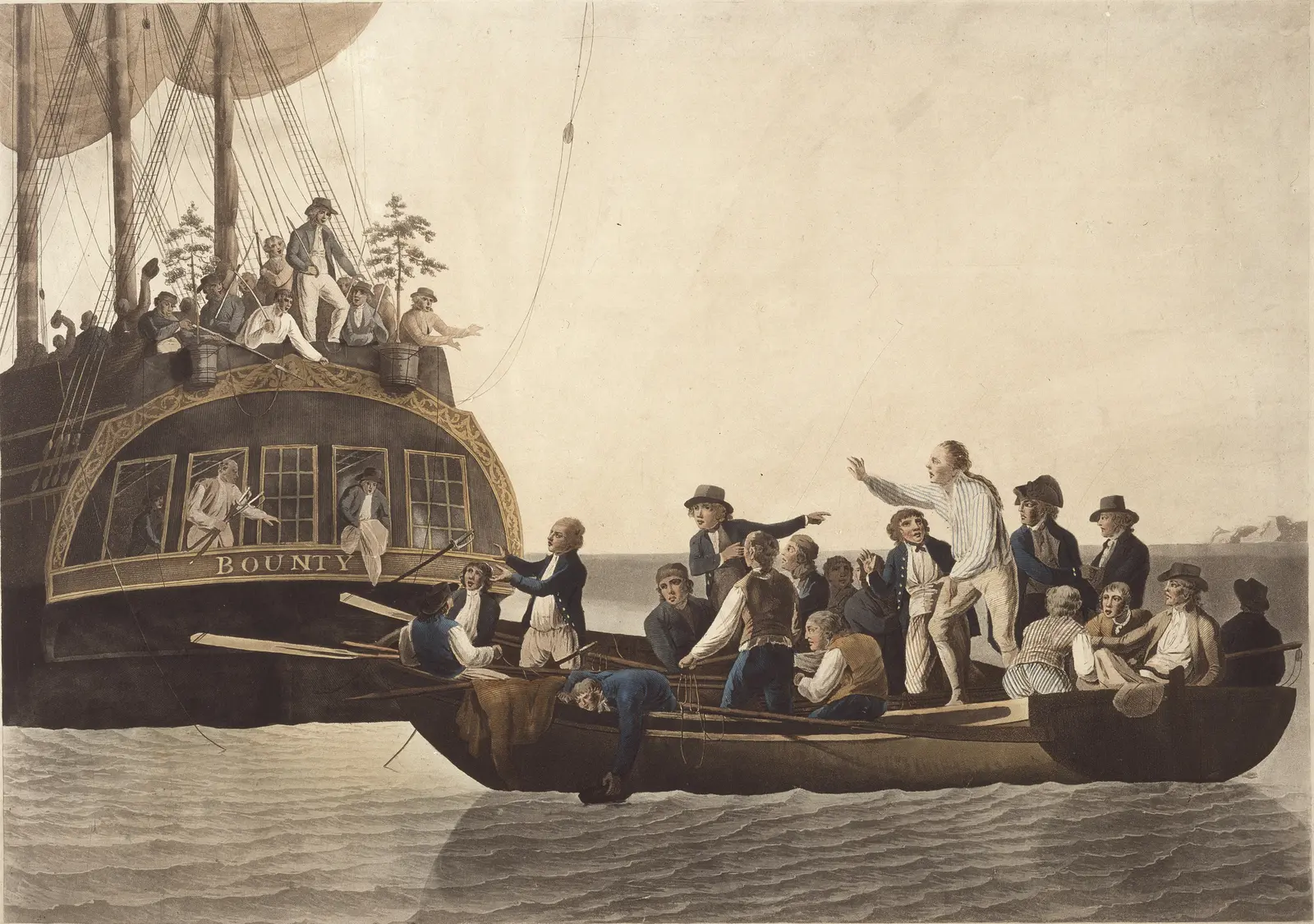
Robert Dodd's print of the scene, published in London on 2 October 1790, less than seven months after Bligh came home. Treat it as a print of the story, not a record of the scene. Cropped to remove the printed text below the image.
The Mutineers turning Lt Bligh and part of the Officers and Crew adrift from His Majesty's Ship the Bounty by Robert Dodd; State Library of New South Wales, DL Pf 137, Public domain
Full credit
"The Mutineers turning Lt Bligh and part of the Officers and Crew adrift from His Majesty's Ship the Bounty" by Robert Dodd; State Library of New South Wales, DL Pf 137 — https://commons.wikimedia.org/wiki/File:Mutiny_HMS_Bounty.jpg — Public domain (US: published 1790, before 1931; elsewhere: creator died 1815, life+70 term expired); modified: cropped: paper margin and printed text below the image removed; reduced to 2,400 px wide

The launch went first to Tofoa for food and water, and Bligh told his men to say that the ship had overset and sunk. For some days people there traded breadfruit, plantains and a little water for buttons and beads. Bligh names, in his own spellings, two chiefs who came to the cove, Maccaackavow and Eefow, and a young man he knew from Annamooka, Nageete.
Then the beach filled. On the evening the boat left, Bligh's account puts the attackers at about 200 men. John Norton, a quartermaster, ran back up the beach to free the stern line and was killed. The only account read here is Bligh's, because the sources used hold no record from the people of Tofoa.
The dates need one warning. Bligh explains that “the account of time is kept in the nautical way, each day ending at noon.” So the boat bore away at about 8 at night under the sea date 3 May, which was still 2 May ashore.
Why did the crew mutiny?
Bligh's printed answer was Tahiti, offered as a guess. He could “only conjecture,” he wrote, that the mutineers “had assured themselves of a more happy life among the Otaheiteans, than they could possibly have in England.” He also wrote that he had seen no sign of a grievance, “either real or imaginary.”
In the sources used here, the other side comes through John Barrow's The Eventful History of the Mutiny, published in 1831. Barrow had seen a manuscript journal by James Morrison, the boatswain's mate, who was convicted and pardoned, and he quotes it. Barrow's verdict on it is mixed: the dates look correct, but the story may be “somewhat too highly coloured.”
| Who says | What | Read through |
|---|---|---|
| Bligh, printed 1790 | No sign of grievance; life on Tahiti and “female connections” most probably the cause | His own Narrative |
| Morrison, manuscript | On 27 April Bligh accused the officers of stealing his coconuts and stopped their grog | Barrow's quotation |
| Fryer, the master, at the 1792 court-martial | Asked what Christian meant by hell: “From the frequent quarrels they had had, and the abuse which he had received from Mr. Bligh” | Barrow's quotation |
| Christian, by Morrison | “I have been used like a dog all the voyage” | Barrow's quotation |
| Christian, by Bligh | “I am in hell—I am in hell” | His own Narrative |
Was Bligh as bad as the story says?
The record says the two sides do not cancel out. Barrow quotes Bligh's own manuscript journal calling his officers a “neglectful set,” which supports the complaint about his tongue, and he reports Morrison's claim that a midshipman spent eleven weeks in irons. Against that stands the launch itself: all 18 in the boat came through the 41 days under his command.
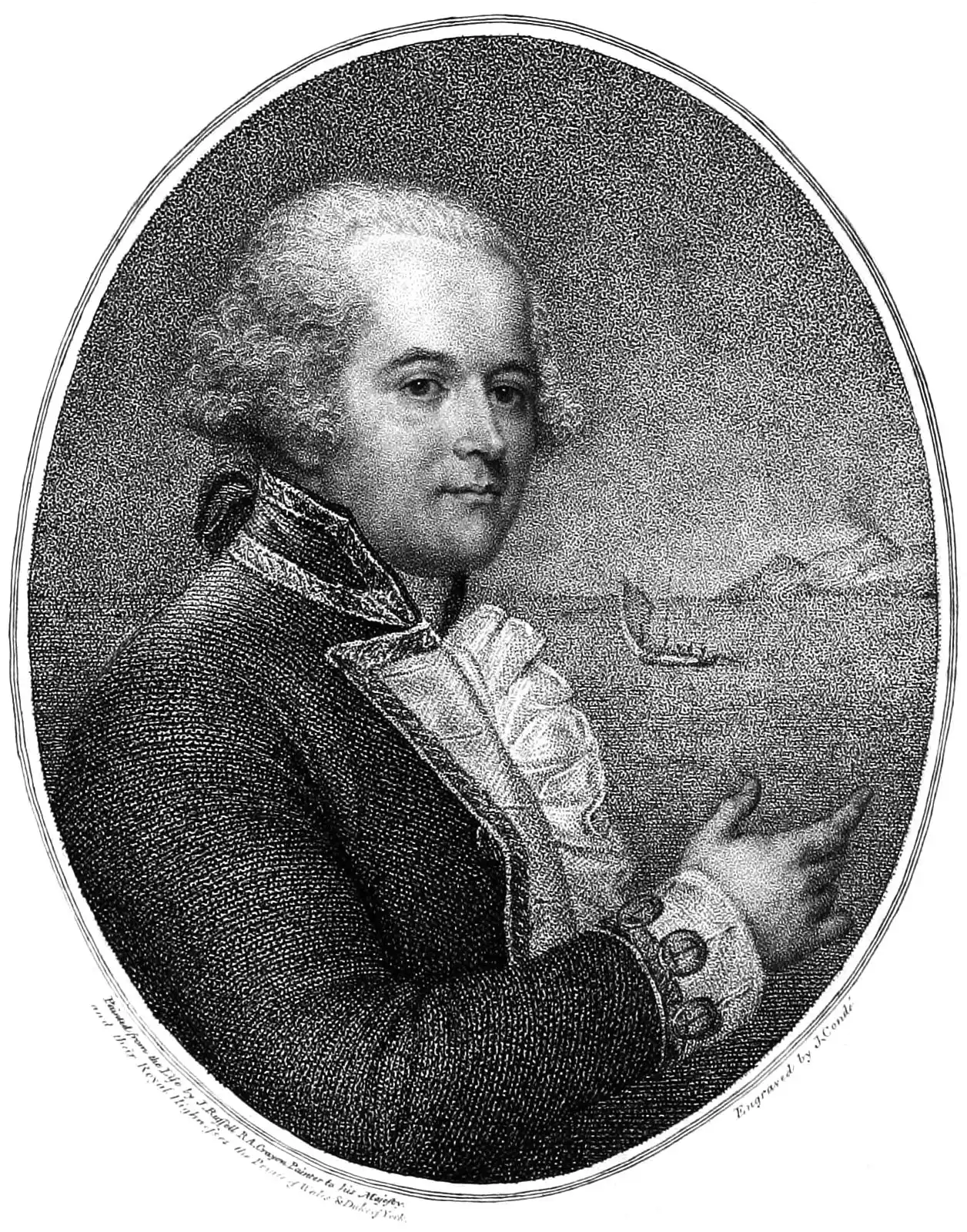
Bligh as the frontispiece of his 1792 book, A Voyage to the South Sea, which retells the voyage of the boat.
Portrait of William Bligh by J. Condé after J. Russell, Public domain
Full credit
"Portrait of William Bligh" by J. Condé after J. Russell — https://commons.wikimedia.org/wiki/File:William_Bligh_-_Project_Gutenberg_eText_15411.jpg — Public domain (US: published 1792, before 1931; elsewhere: frontispiece of Bligh's A Voyage to the South Sea, 1792, more than 200 years ago, every term expired)

His printed book also leaves things out: in the 1790 text, on Sunday Island, one unnamed man tells Bligh “he was as good a man as myself,” and Bligh makes him take up a cutlass. In the manuscript, as Barrow quotes it, the man is William Purcell, the carpenter, and John Fryer “very deliberately called out to the boatswain, to put me under an arrest.” Morrison, tried for his life, and Fryer, who quarreled with his captain in the boat, both had reasons to tell it their way. So did Bligh.
What kind of boat was the Bounty's launch?
The launch was a ship's boat with oars and a lug sail, and Bligh's 1792 text describes her on leaving Tofoa: “twenty-three feet long from stem to stern, deep laden with eighteen men.” The draught in the same book gives the rest: 23 feet long, 6 feet 9 inches wide and 2 feet 9 inches deep. A rectangle that size would give each of the 18 men about 8.6 square feet, and her tapered hull gave less, before any stores. On 10 May they raised her quarters about nine inches by nailing on the seats from the stern sheets, and rigged a canvas cloth to keep the sea out.
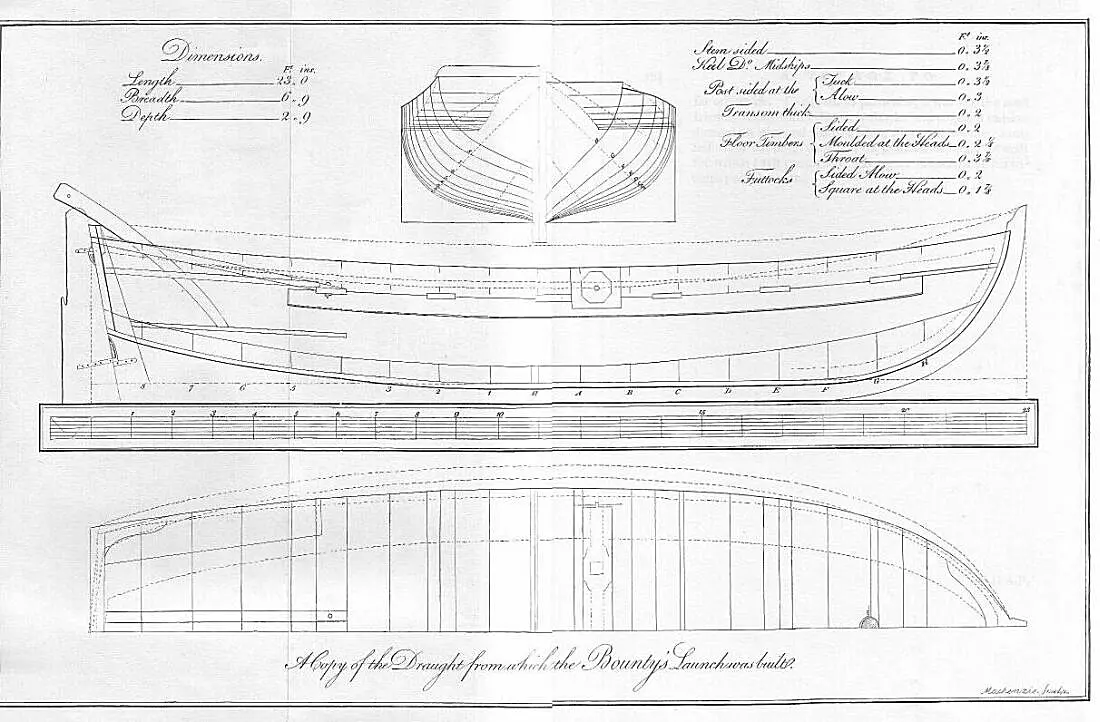
“A Copy of the Draught from which the Bounty's Launch was built,” from the 1792 book. The table at top left reads length 23 feet, breadth 6 feet 9, depth 2 feet 9.
A Copy of the Draught from which the Bounty's Launch was built by Mackenzie, engraver, Public domain
Full credit
"A Copy of the Draught from which the Bounty's Launch was built" by Mackenzie, engraver — https://commons.wikimedia.org/wiki/File:Bounty-launch.png — Public domain (US: published 1792, before 1931; elsewhere: published 1792 in Bligh's A Voyage to the South Sea, more than 200 years ago, every term expired)

For finding her way, she had a quadrant and a compass, a book of latitudes and longitudes, and no chart, because the mutineers kept back the time-keeper and the sextant. The log-line, the knotted cord that measures a boat's speed, came late. Bligh had none marked until 5 May, when the men also practiced counting seconds to time it, and he says he could scarcely keep an account of the run before then. The opening figures in his 3,618 are therefore rougher than the rest.
The repair radius for the rudder failure Bligh records is on board. On the first morning at Restoration Island, a gudgeon, one of the fittings that hang the rudder, was found to have come out and been lost, and Bligh wrote that at sea this “would probably have been the cause of our perishing.” The repair took what was in the boat: “by great good luck we found a large staple in the boat that answered the purpose.” Vasa had a shipyard about 0.45 km away, while the launch had a carpenter's chest and what was in the boat.
How did the launch cross to the reef?
The crossing to the reef took more than 25 days of running before a following sea, with no landing. On the first morning out the gale was so heavy that the men baled without stopping, threw clothes and spare sails overboard to lighten the boat, and moved the bread into the carpenter's chest to keep it dry. By 6 May they were among the islands Bligh took to be Feejee, and on 7 May, off the land to the west, two large sailing canoes came after them. One of the canoes got within two miles, and Bligh, who could not judge what its crew meant, had his men row until it gave up in the afternoon.
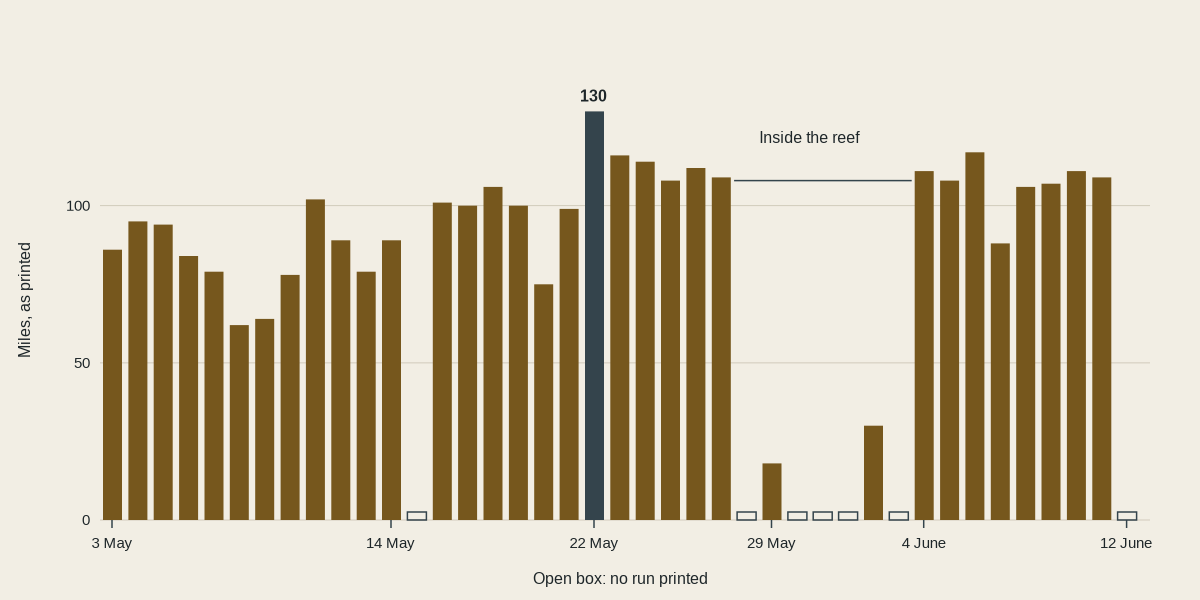
The run Bligh printed for each sea day. The long days fall in the gales of late May, and the gap in the middle is the coast inside the reef, where he stopped to find food. Every run is listed in a table further down.
Keel, Rail & Spoke, CC BY 4.0
Data: William Bligh, A Narrative of the Mutiny on Board His Majesty's Ship Bounty (1790), public domain, https://www.gutenberg.org/ebooks/20337, retrieved 2026-11-08
Reuse this diagram: credit to copy
"Miles Bligh printed for each sea day, 1789" by Keel, Rail & Spoke, https://keelrailandspoke.com/ships/mutiny-on-the-bounty/, licensed under CC BY 4.0 (https://creativecommons.org/licenses/by/4.0/).
Data behind this diagram: mutiny-on-the-bounty-launch-log.csv · Where this data came from
Then came the rain, which gave the men water and took away their warmth. Bligh counts 16 days of heavy and almost continual rain, and on 22 May he had to be propped up in the boat to take the latitude. At one in the morning on 28 May the man at the helm heard breakers a quarter of a mile to leeward, and by noon the boat was inside the reef, through a gap about a quarter of a mile wide.
The coast gave them six days of oysters, clams, a few birds and rest. Bligh named Restoration Island for the date, 29 May, the anniversary of the restoration of Charles II. When armed people appeared on the opposite shore and called to the boat, he chose not to land among them and kept moving north.
At Sunday Island, and at a key he reached on 1 June, parties went out for food, and Robert Lamb later admitted at Java that he had eaten nine birds on the key after leaving the other two men. At about 8 in the evening the boat left Booby Island for the open ocean, and Bligh told them that eight or ten days might bring them to safety. Timor came in sight about eight days and seven hours later.
Which miles did Bligh log?
The popular version says Bligh logged 3,618 nautical miles, and it has a real source, since Barrow's 1831 book quotes him as writing “three thousand six hundred and eighteen nautical miles.” The record says otherwise, as far as print goes. Both the 1790 and the 1792 text read “3618 miles,” so nautical appears in Barrow's version and in neither of Bligh's books. Barrow's wording differs in other small ways too, and he had Bligh's manuscript journal, which was not read here, so he may or may not have added the word himself.
Bligh's figures still point the same way, and three checks show it.
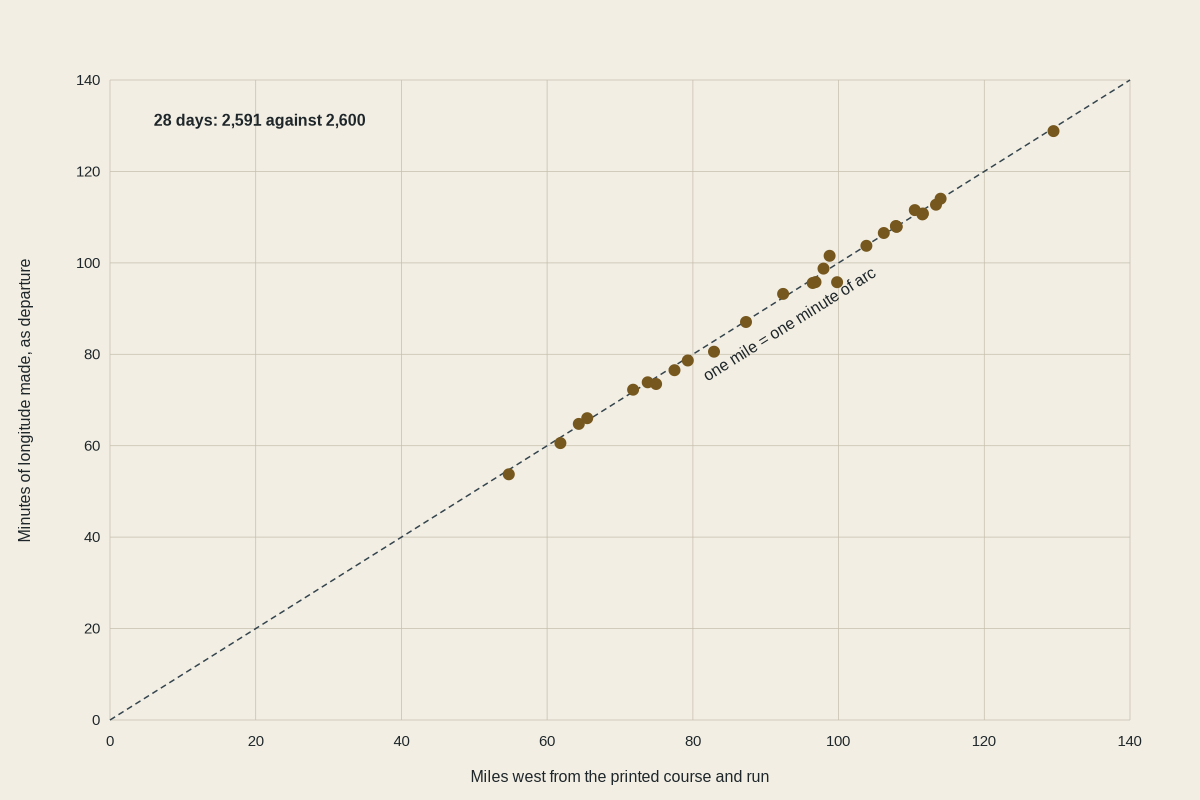
Each dot is one day with a course, a run and a longitude printed. Departure means the longitude made, scaled for latitude to the distance actually run west. Across 28 days it comes to 2,591 minutes of arc, against 2,600 miles west from the courses and runs. The table further down gives each day's pair.
Keel, Rail & Spoke, CC BY 4.0
Data: William Bligh, A Narrative of the Mutiny on Board His Majesty's Ship Bounty (1790), public domain, https://www.gutenberg.org/ebooks/20337, retrieved 2026-11-08
Reuse this diagram: credit to copy
"Bligh's printed runs against his longitude made" by Keel, Rail & Spoke, https://keelrailandspoke.com/ships/mutiny-on-the-bounty/, licensed under CC BY 4.0 (https://creativecommons.org/licenses/by/4.0/).
Data behind this diagram: mutiny-on-the-bounty-launch-log.csv · Where this data came from
First, his bookkeeping counts one mile as one minute of arc, and a minute of arc on the earth is about 1.85 km. Second, he estimated the trip beforehand at “a distance of full 1200 leagues,” and his 3,618 miles works out to about three miles for each of those leagues, though he never defines the league.
Third, a land mile does not fit the map. At 1.609 km, 3,618 miles is 5,823 km, yet straight lines from Tofua to Restoration Island and Booby Island, then his noon positions onward, already make about 6,490 km. At 1.852 km it is 6,701 km, close to the recalculated 6,689 km.
Those positions carry his own error. At the reef he judged he had outrun his reckoning by 1° 9′, and the straight link from there to Restoration Island takes that up. So the miles behave like nautical miles, but that is this site's inference, not his word.
The printed days do not add up to his total. The runs he prints come to 3,176 miles and leave 442 not itemized. Positions on either side of the missing noons account for about 383 of those: 15 May, the morning of 28 May, the coast inside the reef, and the last night before Timor.
The printed runs, day by day
The table lists every run Bligh prints, and for the 28 days that allow it, the two figures the diagram above compares. He prints no run for 15 May, 28 May, 31 May, 1 June, 3 June or 12 June, and on 30 May the boat lay at Restoration Island.
| Sea date, 1789 | Miles printed | Miles west, by course and run | Departure, from longitude made |
|---|---|---|---|
| 3 May | 86 | n/a | n/a |
| 4 May | 95 | n/a | n/a |
| 5 May | 94 | 83 | 81 |
| 6 May | 84 | 64 | 65 |
| 7 May | 79 | 65 | 66 |
| 8 May | 62 | 55 | 54 |
| 9 May | 64 | 62 | 61 |
| 10 May | 78 | 72 | 72 |
| 11 May | 102 | 96 | 96 |
| 12 May | 89 | 87 | 87 |
| 13 May | 79 | 77 | 77 |
| 14 May | 89 | 79 | 79 |
| 16 May | 101 | n/a | n/a |
| 17 May | 100 | 92 | 93 |
| 18 May | 106 | 98 | 99 |
| 19 May | 100 | 99 | 102 |
| 20 May | 75 | 75 | 74 |
| 21 May | 99 | 97 | 96 |
| 22 May | 130 | 130 | 129 |
| 23 May | 116 | 112 | 111 |
| 24 May | 114 | 113 | 113 |
| 25 May | 108 | 108 | 108 |
| 26 May | 112 | 112 | 111 |
| 27 May | 109 | 108 | 108 |
| 29 May | 18 | n/a | n/a |
| 2 June | 30 | n/a | n/a |
| 4 June | 111 | n/a | n/a |
| 5 June | 108 | 108 | 108 |
| 6 June | 117 | 114 | 114 |
| 7 June | 88 | 74 | 74 |
| 8 June | 106 | 100 | 96 |
| 9 June | 107 | 104 | 104 |
| 10 June | 111 | 110 | 112 |
| 11 June | 109 | 106 | 107 |
What did 18 men eat on the way to Timor?
Bligh had about 150 pounds of bread, 28 gallons of water, 20 pounds of pork, three bottles of wine and five quarts of rum when the boat left Tofoa, and he meant the bread to last eight weeks. On 9 May he made scales from two coconut shells and took a pistol ball as his weight, 25 to the pound, so that one issue was a ball's weight of bread. He gives that ball as 272 grains, or 17.6 grams, though 25 balls to a 16-ounce pound would make it 280 grains, about 18 grams, so his two figures differ by about 3 percent. At 272 grains, three issues a day came to about 53 grams of bread for each man.
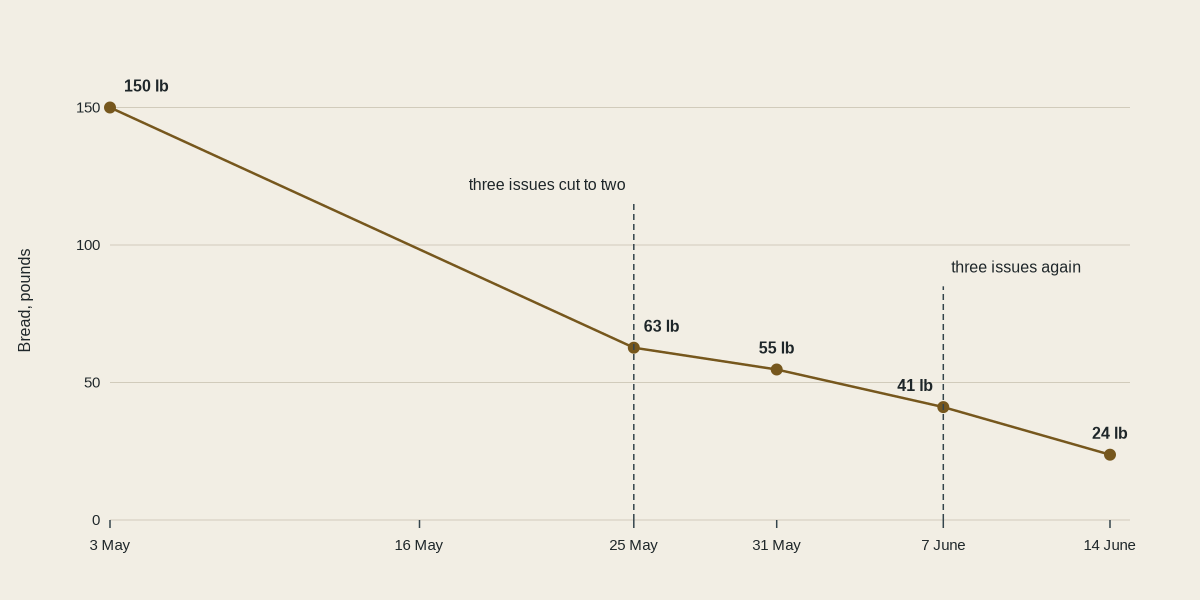
Bread left, worked out from Bligh's own counts of days remaining, at 18 men and one 25th of a pound an issue. His 29-day and 43-day counts of 25 May agree within about 1 percent. The last point assumes three issues a day, since on arrival he gives only days.
Keel, Rail & Spoke, CC BY 4.0
Data: William Bligh, A Narrative of the Mutiny on Board His Majesty's Ship Bounty (1790), public domain, https://www.gutenberg.org/ebooks/20337, retrieved 2026-11-08
Reuse this diagram: credit to copy
"Bread left in the launch, 1789" by Keel, Rail & Spoke, https://keelrailandspoke.com/ships/mutiny-on-the-bounty/, licensed under CC BY 4.0 (https://creativecommons.org/licenses/by/4.0/).
Data behind this diagram: mutiny-on-the-bounty-bread.csv · Where this data came from
The plan's gear changed on 25 May. He found 29 days of bread left and, since he could not be sure of reaching Timor, dropped the evening issue, which stretched it to 43 days. On 7 June, with 19 days left at the old rate and a quick passage in prospect, he brought supper back. Beyond the stores, they had what they could catch: seabirds divided into 18 shares by calling “Who shall have this?”, oysters and clams from the reef islands, and a small dolphin on 9 June.
The last spare here is none exhausted, on Bligh's count, since he says that on arrival there was still bread “sufficient for eleven days, at our scanty allowance.” The pork ran out on 30 May and the dried clams on 7 June, but neither stopped the boat. No other record read here checks his figures.
The Ibry strip: 41 days to Timor, 47 from the mutiny
Bligh's 41 is a count of sea days, from 3 May to 12 June, counting both, and by the hours he gives, from about 8 at night to 3 in the morning, the run took about 40 days 7 hours. The gunner's watch stopped on 2 June. After that, he says, only noon, sunrise and sunset are certain, so the last of those hours is his estimate.
Coupang, now Kupang, is a further stretch that the 3,618 does not cover. A local man whom Bligh does not name piloted the boat there for pay, and she came to a grapnel off the town near daylight on 14 June, 47 days after the mutiny. The governor, William Adrian Van Este, and his second, Timotheus Wanjon, took the men in.
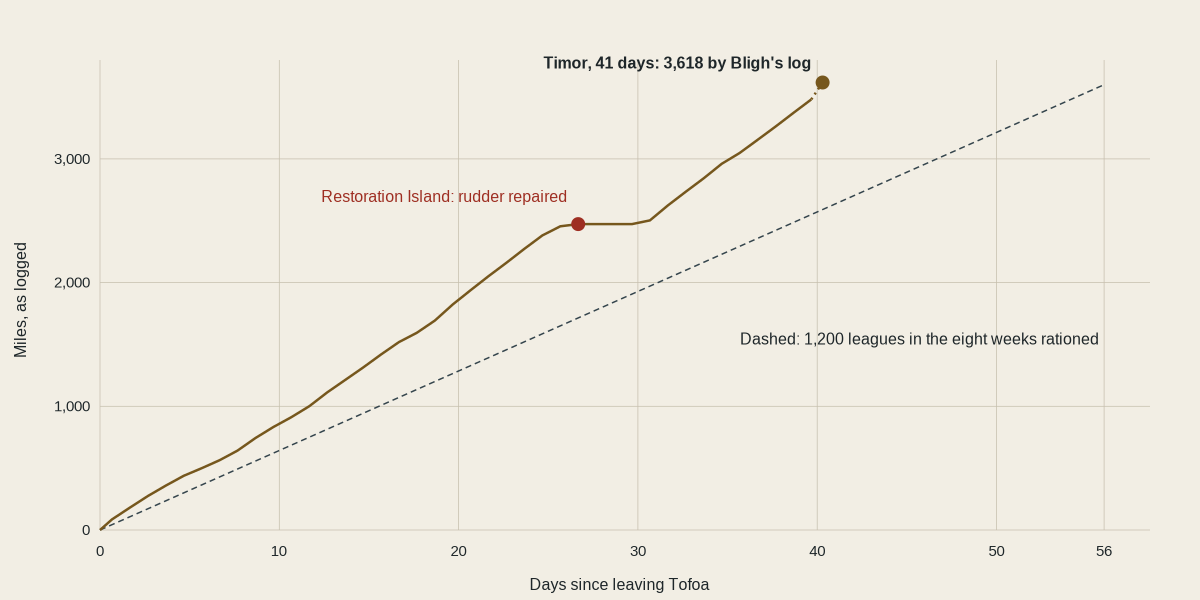
Time runs left to right and distance runs up, so slope is speed. The heavy line adds Bligh's printed runs, estimated from positions where none is printed, and its last step, dotted, closes on his total. The dashed line is 1,200 leagues over his eight weeks, at 3 miles to the league.
Keel, Rail & Spoke, CC BY 4.0
Data: William Bligh, A Narrative of the Mutiny on Board His Majesty's Ship Bounty (1790), public domain, https://www.gutenberg.org/ebooks/20337, retrieved 2026-11-08; Wikidata coordinates (CC0), https://www.wikidata.org/, retrieved 2026-11-08
Reuse this diagram: credit to copy
"The Bounty's launch: time-distance strip, 1789" by Keel, Rail & Spoke, https://keelrailandspoke.com/ships/mutiny-on-the-bounty/, licensed under CC BY 4.0 (https://creativecommons.org/licenses/by/4.0/).
Data behind this diagram: mutiny-on-the-bounty-launch-log.csv · Where this data came from
| Sea date, 1789 | Event | Miles printed |
|---|---|---|
| 3 May | Bears away from Tofoa at about 8 at night | 86 by noon |
| 22 May | Longest printed day, in strong gales | 130 |
| 28 May | Enters the reef through a passage in 12° 51′ S | none printed |
| 29–31 May | Restoration Island; rudder repaired | 18 to reach it |
| 4 June | Back in the open ocean at about 8 in the evening | 111 for that sea day |
| 12 June | Timor sighted at about 3 in the morning, by his estimate | none printed |
| 14 June | Off Coupang near daylight | not in the 3,618 |
The steep parts of the line are the two ocean crossings: Tofoa to the reef works out to about 1.5 times walking pace, and the noon of 4 June, the first printed position after Booby Island, to the noon of 12 June off Timor about 1.6. Together they give a walking multiple of about 1.5 (moving), with the coast inside the reef and the first hours past Booby Island left out. On 28 May the wind came round and held the boat against the reef, and the men had little strength left for the oars; sailing against the wind was more than she could do that morning. If a mile was a minute of arc, the best day, 130 miles, was about 241 km, or 48 hours of walking at 5 km/h.
Data behind these multiples: mutiny-on-the-bounty-moving-legs.csv · Where this data came from
What happened to the mutineers?
Of the 25 left aboard, by Barrow's account, 16 went ashore at Otaheite in September 1789, and nine sailed on with Christian. Two of the 16 were killed on the island, and HMS Pandora took the other 14 in 1791. When she struck the Barrier Reef that year, four of them drowned in irons, and the remaining ten faced a court-martial in September 1792.
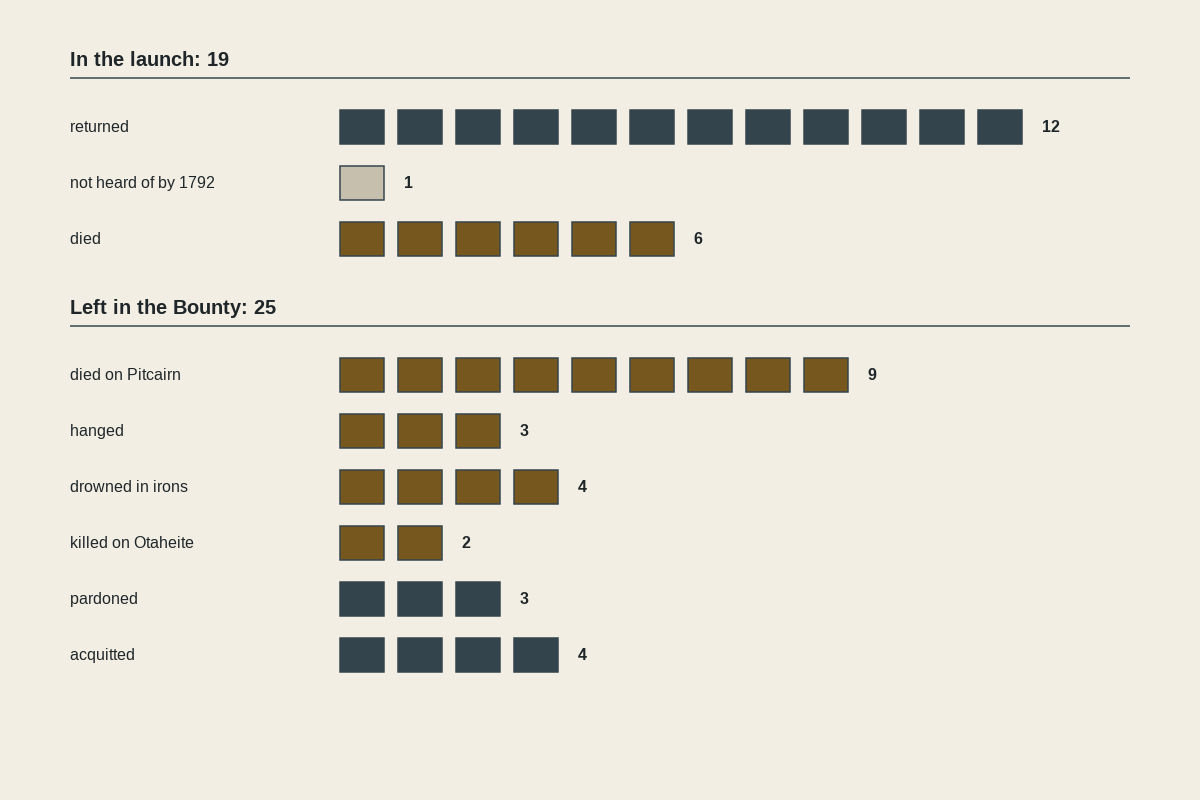
Every man named on Bligh's two lists, sorted by outcome: the launch as Bligh records it, the ship as Barrow records it. Thomas Ledward had not been heard of when Bligh wrote in 1792.
Keel, Rail & Spoke, CC BY 4.0
Data: William Bligh, A Narrative of the Mutiny on Board His Majesty's Ship Bounty (1790), public domain, https://www.gutenberg.org/ebooks/20337, retrieved 2026-11-08; William Bligh, A Voyage to the South Sea (1792), public domain, https://www.gutenberg.org/ebooks/15411, retrieved 2026-11-08; John Barrow, The Eventful History of the Mutiny and Piratical Seizure of H.M.S. Bounty (1831), public domain, https://www.gutenberg.org/ebooks/14424, retrieved 2026-11-08
Reuse this diagram: credit to copy
"The 44 men after the mutiny, by outcome" by Keel, Rail & Spoke, https://keelrailandspoke.com/ships/mutiny-on-the-bounty/, licensed under CC BY 4.0 (https://creativecommons.org/licenses/by/4.0/).
Data behind this diagram: mutiny-on-the-bounty-people.csv · Where this data came from
| Group | Men | Outcome, as recorded |
|---|---|---|
| Launch | 12 | Reached England, by Bligh's count |
| Launch | 6 | Norton at Tofoa; Nelson at Coupang; Hall, Elphinston and Linkletter at Batavia; Lamb on the way home |
| Launch | 1 | Ledward, not yet heard of in 1792 |
| Ship | 3 | Burkitt, Millward and Ellison hanged on HMS Brunswick, 29 October 1792 |
| Ship | 3 | Heywood, Morrison and Muspratt sentenced to death, then pardoned |
| Ship | 4 | Coleman, Norman, McIntosh and Byrne acquitted |
| Ship | 4 | Stewart, Sumner, Skinner and Hillbrant drowned in the wreck of the Pandora |
| Ship | 2 | Churchill and Thompson killed on Otaheite |
| Ship | 9 | Went on to Pitcairn; eight dead by 1808, the last in 1829 |
Barrow's account of the departure has seven Tahitian men and twelve women sailing with the nine. The 1814 letter from Sir Thomas Staines that he prints, and his own list of the settlers, have six men and twelve women, and the list calls them natives of Tabouai and Otaheite. At Pitcairn they ran the ship ashore.
Nobody outside knew until Mayhew Folger of the American ship Topaz landed in 1808 and found Alexander Smith, also called John Adams, “the only person remaining of nine.” Accounts of what happened differ. Smith said the Tahitian men killed the Englishmen and were killed in turn by the women; Folger's mate said Christian threw himself from the rocks; Barrow lists him as killed. The Barrow text read here gives no name for any of the Tahitian men or women and no account of their own.
That leaves the boat: Bligh left Coupang in August 1789 in a schooner he had bought there, with the launch in tow, reaching Batavia on 1 October. The schooner went at auction for 295 rix-dollars. “The launch likewise was sold,” he wrote. “The services she had rendered us made me feel great reluctance at parting with her.”
Sources
- William Bligh, A Narrative of the Mutiny, on Board His Majesty's Ship Bounty (London: George Nicol, 1790). Project Gutenberg eBook 20337. https://www.gutenberg.org/ebooks/20337Read: full text
- William Bligh, A Voyage to the South Sea (London: George Nicol, 1792). Project Gutenberg eBook 15411. https://www.gutenberg.org/ebooks/15411Read: chapters on the mutiny, the launch, Coupang and Batavia; closing paragraph
- [John Barrow], The Eventful History of the Mutiny and Piratical Seizure of H.M.S. Bounty (London: John Murray, 1831). Project Gutenberg eBook 14424. https://www.gutenberg.org/ebooks/14424Read: chapters: the causes in chapter 3, parts of chapters 4 to 8, the closing list
- Wikidata, coordinate location (P625) of Tofua (Q1414448), Restoration Island (Q21905136), Booby Island (Q892945) and Kupang (Q14155). CC0. https://www.wikidata.org/wiki/Q1414448Read: full page of each item, coordinates used
Cite this page
Keel, Rail & Spoke. "Mutiny on the Bounty: 3,618 Miles in 41 Days, by Bligh’s Log." Published 2026-11-08. https://keelrailandspoke.com/ships/mutiny-on-the-bounty/. Accessed on the date you read it.
How facts are checked · Corrections · Contact
Found a mistake on this page? Write to contact@keelrailandspoke.com.
More from Ships & Wrecks
Ships & Wrecks
Vasa Ship, 1628: Stability Test Stopped, Then She Sailed
The Vasa ship sank about 1,300 m into her 1628 maiden voyage. About a month before, her master testified, thirty men rolled her so far the test was stopped.
Picture credit
"Vasa 2" by MLeb — https://commons.wikimedia.org/wiki/File:Vasa_2.jpg — Public domain (released into the public domain worldwide by the photographer)
Ships & Wrecks
Spanish Armada, 1588: One Undated Spanish List Says 65 Lost
One English report of 1588 said the Spanish Armada had lost at least 16 ships; an undated Spanish list printed in 1899 totals 65. Each count, with who gave it.
Picture credit
"The Spanish Armada off the English Coast in 1588" by Cornelis Claesz van Wieringen; Rijksmuseum, SK-A-1629 — https://commons.wikimedia.org/wiki/File:The_Spanish_Armada_off_the_English_Coast_in_1588_(by_Cornelis_Claesz_van_Wieringen)_-_Rijksmuseum,_Amsterdam_(SK-A-1629).jpg — Public domain (US: painted about 1620 to 1625, every term expired; elsewhere: creator died 1633, life+70 term expired; Rijksmuseum marks it public domain)
Ships & Wrecks
USS Indianapolis: Men Spotted by Chance Days Later, Law Says
USS Indianapolis sank in about 12 minutes on 30 July 1945, a 2018 act says. A 1999 House text says shore offices did not report her overdue. Sources for each.
Picture credit
"USS Indianapolis (CA-35) underway at sea on 27 September 1939" by unknown creator; U.S. Navy photo 80-G-425615 — https://commons.wikimedia.org/wiki/File:USS_Indianapolis_(CA-35)_underway_at_sea_on_27_September_1939_(80-G-425615).jpg — Public domain (US: work of the U.S. Navy, no copyright under 17 U.S.C. 105; elsewhere: anonymous work, made 1939, more than 70 years since it was made)


