Ships & Wrecks · Wreck & failure inquiry
USS Indianapolis: Men Spotted by Chance Days Later, Law Says
Congress has written that this cruiser sank in about 12 minutes. The claim that shore offices did not report her overdue rests on thinner paper.
Keel, Rail & Spoke · Published
TL;DR
- USS Indianapolis (CA-35) was torpedoed just after midnight on 30 July 1945 and sank in about 12 minutes, by a text Congress passed in 2018.
- That Navy shore offices did not report her overdue is the claim of a House resolution introduced in 1999. The 2000 law does not repeat it, and the 1945 court record was not read here.
- Survivors were “spotted by chance” on 2 August, by the 2000 law. Most federal texts read here say 316 lived.
Leg card
- Departure
- Guam, 28 July 1945, by H.J.Res.48 and a 2019 talk; a 1999 Senate speech gives both 28 and 26 July. Hour not read
- Arrival
- Did not arrive. Bound for Leyte Gulf; sunk 30 July 1945. A Navy chart marks 12°02′N 134°48′E
- Distance
- About 1,081 km (672 mi; 584 nmi): great circle from Apra Harbor to the charted position. Not a track
- Machine
- USS Indianapolis (CA-35), Portland-class heavy cruiser
- Elapsed
- Roughly 24 to 48 hours from Guam to the torpedoes; hour of leaving not read. About 82 hours more from 0014 (a 1994 text) to the sighting at 10:25 (a 2018 text), if both clocks share a time zone
- Walking multiple
- unknown (overall): hour of leaving not read; about 4.5 to 9 if the leg took roughly 24 to 48 hours
- Repair radius
- n/a
- The last spare
- not applicable
- Key source
- H.J.Res.48 (1999, as introduced), the overdue claim; Public Law 106-398, section 545 (2000); Gold Medal Act text (2018). The 1945 court record was not read
Download this card (CSV) · Where this data came from
Data: H.J.Res.48, 106th Congress, as introduced, 28 April 1999, U.S. government work, https://www.govinfo.gov/content/pkg/BILLS-106hjres48ih/html/BILLS-106hjres48ih.htm, retrieved 2026-11-08; Congressional Record, Senate, 25 May 1999, Senator Smith on S.J.Res.25, U.S. government work, https://www.govinfo.gov/content/pkg/CREC-1999-05-25/pdf/CREC-1999-05-25-pt1-PgS5954-2.pdf, retrieved 2026-11-08; S. 2101, USS Indianapolis Congressional Gold Medal Act, enrolled, 115th Congress, 2018, U.S. government work, https://www.govinfo.gov/content/pkg/BILLS-115s2101enr/pdf/BILLS-115s2101enr.pdf, retrieved 2026-11-08; Public Law 106-398, appendix, section 545, 2000, U.S. government work, https://www.govinfo.gov/content/pkg/GPO-CDOC-106sdoc30/pdf/GPO-CDOC-106sdoc30-1-14-3-1.pdf, retrieved 2026-11-08; Congressional Record, 1995, vol. 141 part 16, U.S.S. Indianapolis Memorial, U.S. government work, https://www.govinfo.gov/content/pkg/GPO-CRECB-1995-pt16/pdf/GPO-CRECB-1995-pt16-1-3.pdf, retrieved 2026-11-08; U.S. Navy chart of the last voyage, photo 80-G-702177, date not read, position read from the image, https://commons.wikimedia.org/wiki/File:USS_Indianapolis-last_voyage_chart.jpg, retrieved 2026-11-08; Blair Atcheson and Richard Hulver, USS Indianapolis Discovered, National Park Service transcript, 2019, U.S. government work, https://www.nps.gov/articles/000/uss-indianapolis-discovered-analysis-of-a-shipwreck-site.htm, retrieved 2026-11-08; Wikidata coordinates (CC0), https://www.wikidata.org/, retrieved 2026-11-08

What the card means: walking multiple, repair radius, last spare.
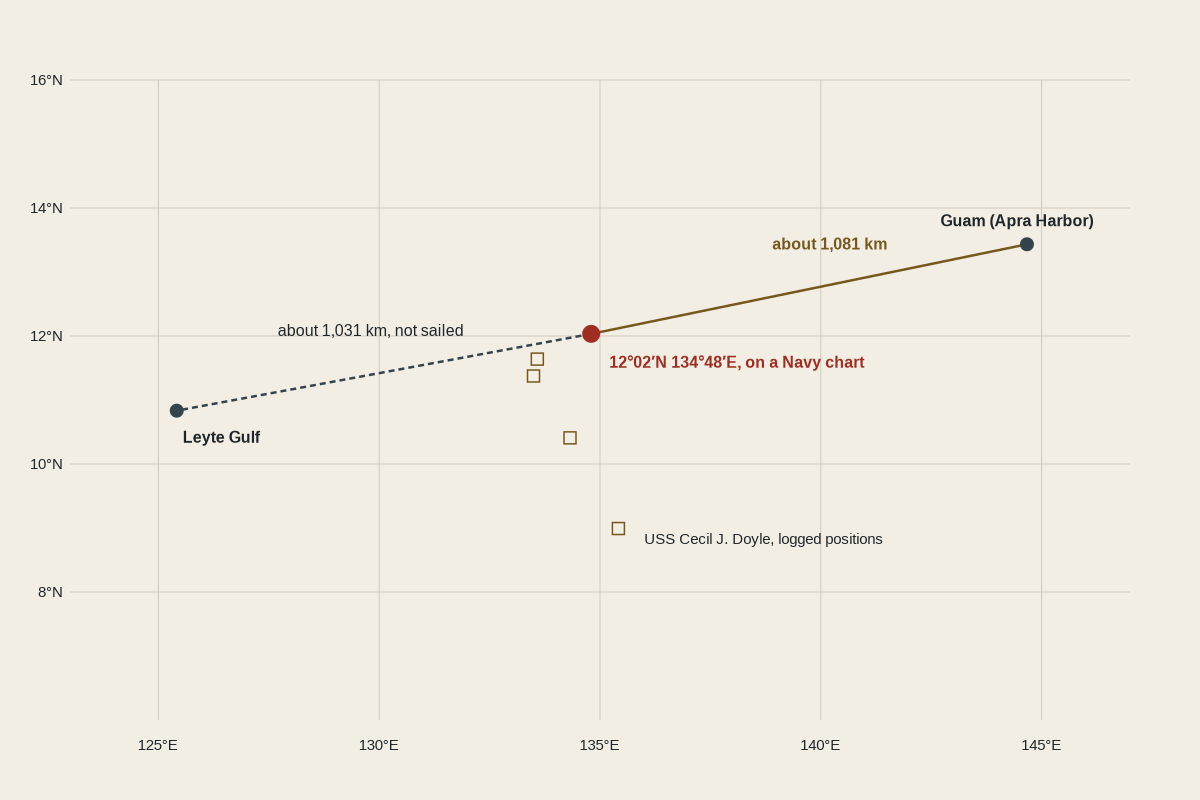
The last leg as straight lines, not a track. The point is the position written on a Navy chart. Small squares are logged positions of the destroyer escort USS Cecil J. Doyle on 2 and 3 August. They are that ship's positions, not those of the men in the water.
Keel, Rail & Spoke, CC BY 4.0
Data: U.S. Navy chart of the last voyage, photo 80-G-702177, date not read, position read from the image, https://commons.wikimedia.org/wiki/File:USS_Indianapolis-last_voyage_chart.jpg, retrieved 2026-11-08; USS Cecil J. Doyle (DE-368), war diary, August 1945, NAID 83573581, U.S. government work, https://commons.wikimedia.org/wiki/File:USS_Cecil_J._Doyle_(DE-368)_war_diary,_1-5_August_1945_(83573581).png, retrieved 2026-11-08; Wikidata coordinates (CC0), https://www.wikidata.org/, retrieved 2026-11-08

Reuse this diagram: credit to copy
"USS Indianapolis: Guam toward Leyte, 1945" by Keel, Rail & Spoke, https://keelrailandspoke.com/ships/uss-indianapolis-1945/, licensed under CC BY 4.0 (https://creativecommons.org/licenses/by/4.0/).
Data behind this diagram: uss-indianapolis-1945-route.csv · Where this data came from
By a Navy chart, USS Indianapolis was about 1,081 km from Guam when torpedoes sank her in about 12 minutes. The 12 minutes is in the USS Indianapolis Congressional Gold Medal Act, passed by Congress in 2018. The position, 12°02′N, 134°48′E, is the one written on a Navy chart of her last voyage, with the rest of the route to Leyte dashed, and the distance runs straight from Guam to that mark. The overdue claim is another matter.
Stops on this page (8)
- What was USS Indianapolis doing on the way to Leyte?
- How fast did USS Indianapolis sink?
- Who failed to report USS Indianapolis overdue?
- How were the survivors of USS Indianapolis found?
- How many men survived, and how many did sharks kill?
- What happened to Captain McVay?
- The Ibry strip: about 1,081 km, then no way made
- Where is the wreck of USS Indianapolis?
What was USS Indianapolis doing on the way to Leyte?
She was a Portland-class heavy cruiser going to training, after a secret delivery. The 2018 text says she took parts of the atomic bomb to Tinian, then went on to Guam, where she received orders to join Task Group 95.7 in Leyte Gulf. On the Tinian delivery the texts disagree by a day: 25 July in the 2000 law, 26 July in both the 1999 resolution and the 2018 text.
The texts also credit that run with a speed record. The 1999 resolution gives a record average of 29 knots, or 53.7 km/h, which is about 10.7 times a 5 km/h walking pace. It does not say over which stretch. The 2018 text puts the record on California to Pearl Harbor.
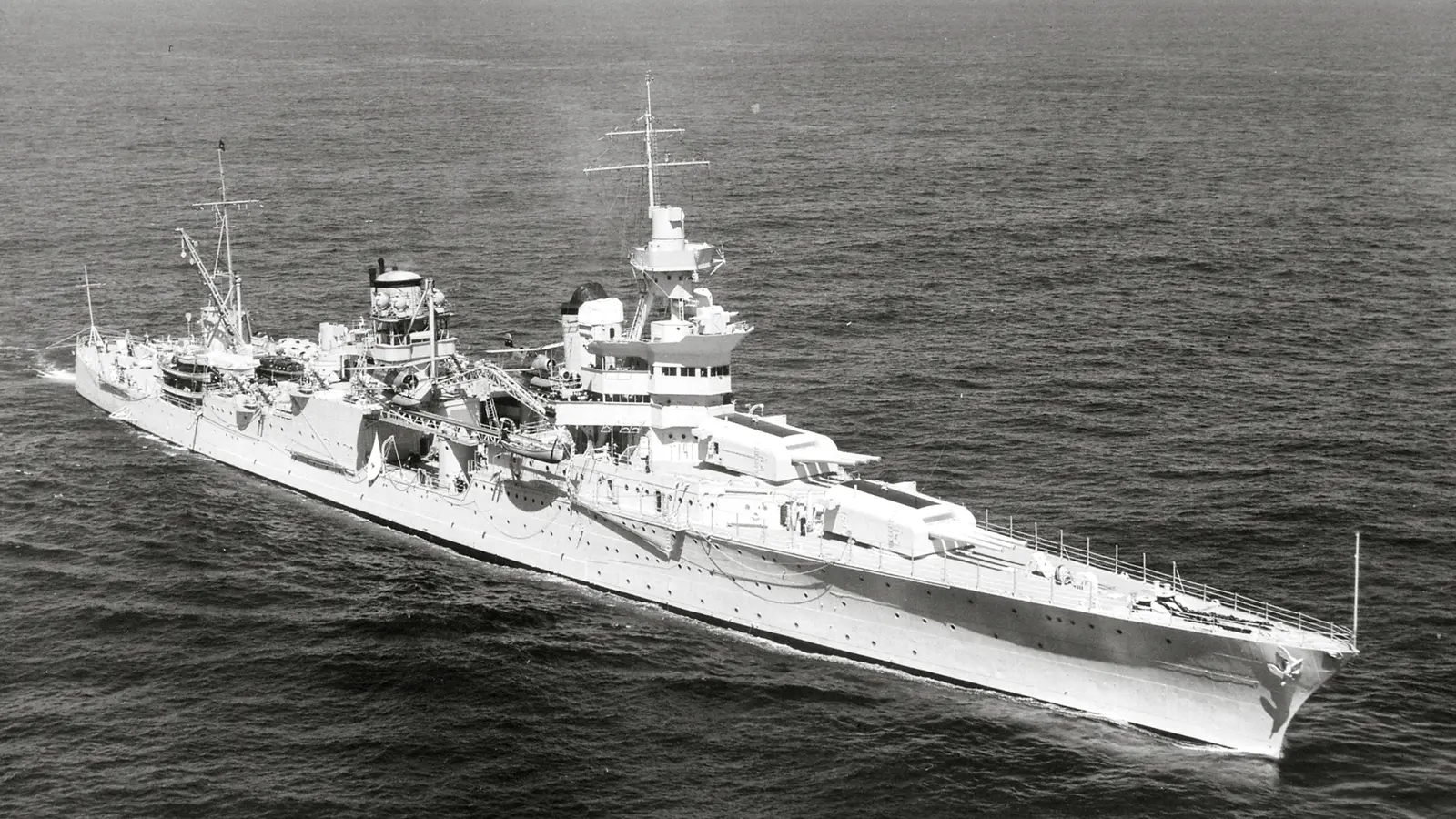
USS Indianapolis under way on 27 September 1939, six years before her last voyage.
USS Indianapolis (CA-35) underway at sea on 27 September 1939 by unknown creator; U.S. Navy photo 80-G-425615, Public domain
Full credit
"USS Indianapolis (CA-35) underway at sea on 27 September 1939" by unknown creator; U.S. Navy photo 80-G-425615 — https://commons.wikimedia.org/wiki/File:USS_Indianapolis_(CA-35)_underway_at_sea_on_27_September_1939_(80-G-425615).jpg — Public domain (US: work of the U.S. Navy, no copyright under 17 U.S.C. 105; elsewhere: anonymous work, made 1939, more than 70 years since it was made)

The last leg has no such figure. Blair Atcheson of the Navy's Underwater Archeology Branch told a National Park Service conference in 2019 that the ship left Guam on 28 July, and the 1999 resolution gives the same date. Neither gives the hour. Senator Smith's 1999 speech says the 28th in one place and the 26th in another.
Counting from 28 July, the time to the torpedoes is roughly 24 to 48 hours. Over about 1,081 km, that makes the walking multiple about 4.5 to 9 (overall). The card says unknown, because a range this wide is not a measurement.
Congress later listed what she sailed without. The 2000 law finds that Navy officials disapproved McVay's request for a destroyer escort as “not necessary,” and that they did not tell him signal intelligence had placed the submarine I-58 in the area of his course. It also finds he was not told that the destroyer escort USS Underhill had been sunk by a submarine within range of that course, four days before he left Guam. These are findings by Congress in 2000, and the 1945 papers behind them were not read here.
How fast did USS Indianapolis sink?
Every text read here that states how long she took to sink gives about 12 minutes, and the clock times do not quite fit it. The 2018 text says “about 12 minutes,” the 1999 resolution says “within 12 minutes,” and a 1998 tribute in the Congressional Record says twelve. The 2019 talk speaks more loosely of her “worst 10 minutes” and “worst 15 minutes.” At a walking pace, 12 minutes is 1 km.
Two clock times are also on paper. Captain Charles B. McVay III, in an oral history quoted by the National Archives in 2020, put the first explosion at “approximately five minutes after midnight,” while a 1994 commendation, as printed in the Congressional Record in 1995, says she was sunk at 0014. Read as the moment she went under, 0014 gives 9 minutes from the first explosion, not 12. Counting 12 minutes back from 0014 gives 00:02. The 1994 line does not say whether 0014 marks the hits or the end.
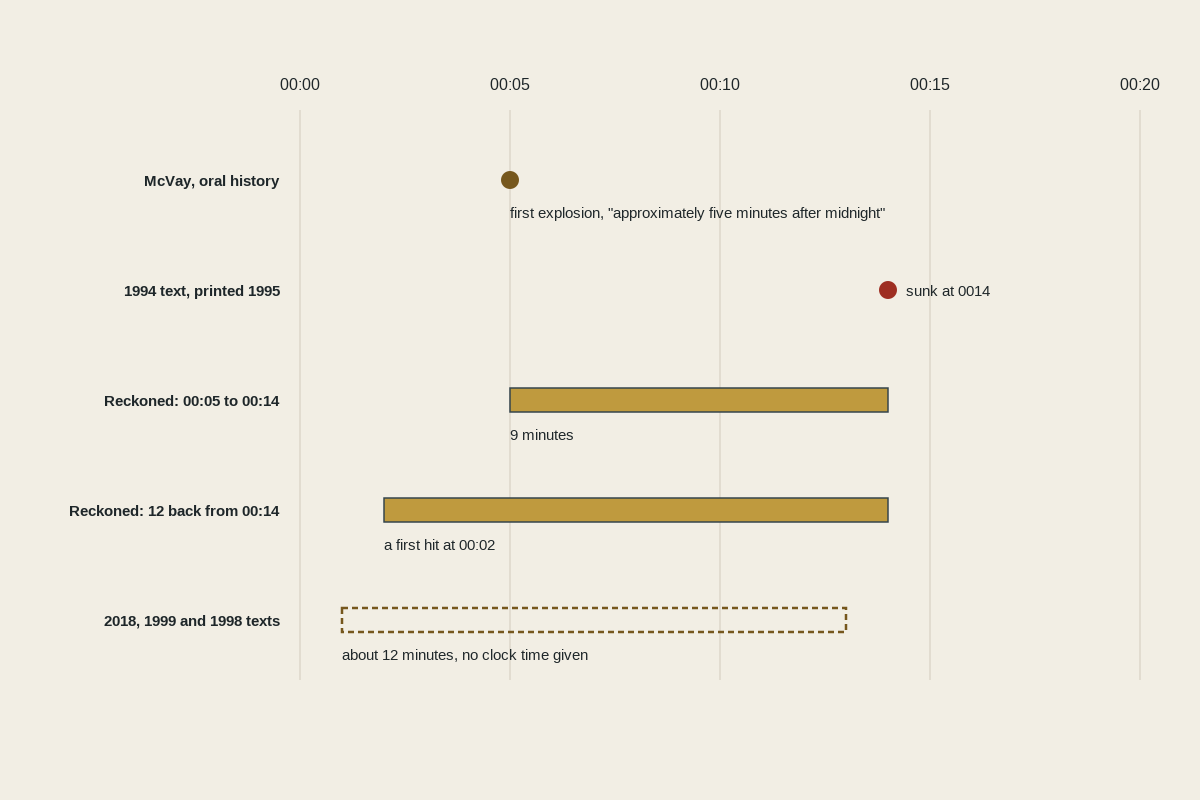
Two clock times and one length of time, from three different texts. They cannot all be exact, and nothing read here settles which to drop.
Keel, Rail & Spoke, CC BY 4.0
Data: Congressional Record, Senate, 25 May 1999, Senator Smith on S.J.Res.25, U.S. government work, https://www.govinfo.gov/content/pkg/CREC-1999-05-25/pdf/CREC-1999-05-25-pt1-PgS5954-2.pdf, retrieved 2026-11-08; H.J.Res.48, 106th Congress, as introduced, 28 April 1999, U.S. government work, https://www.govinfo.gov/content/pkg/BILLS-106hjres48ih/html/BILLS-106hjres48ih.htm, retrieved 2026-11-08; S. 2101, USS Indianapolis Congressional Gold Medal Act, enrolled, 115th Congress, 2018, U.S. government work, https://www.govinfo.gov/content/pkg/BILLS-115s2101enr/pdf/BILLS-115s2101enr.pdf, retrieved 2026-11-08; Congressional Record, 1995, vol. 141 part 16, U.S.S. Indianapolis Memorial, U.S. government work, https://www.govinfo.gov/content/pkg/GPO-CRECB-1995-pt16/pdf/GPO-CRECB-1995-pt16-1-3.pdf, retrieved 2026-11-08; Congressional Record, 4 June 1998, E1035, U.S. government work, https://www.govinfo.gov/content/pkg/CREC-1998-06-04/pdf/CREC-1998-06-04-pt1-PgE1035-2.pdf, retrieved 2026-11-08; Michael J. Hancock, The Sinking of the USS Indianapolis, National Archives, Pieces of History, 30 July 2020, U.S. government work, https://prologue.blogs.archives.gov/2020/07/30/the-sinking-of-the-uss-indianapolis/, retrieved 2026-11-08
Reuse this diagram: credit to copy
"USS Indianapolis: clock times against 12 minutes" by Keel, Rail & Spoke, https://keelrailandspoke.com/ships/uss-indianapolis-1945/, licensed under CC BY 4.0 (https://creativecommons.org/licenses/by/4.0/).
Data behind this diagram: uss-indianapolis-1945-timeline.csv · Where this data came fromData: H.J.Res.48, 106th Congress, as introduced, 28 April 1999, U.S. government work, https://www.govinfo.gov/content/pkg/BILLS-106hjres48ih/html/BILLS-106hjres48ih.htm, retrieved 2026-11-08; S. 2101, USS Indianapolis Congressional Gold Medal Act, enrolled, 115th Congress, 2018, U.S. government work, https://www.govinfo.gov/content/pkg/BILLS-115s2101enr/pdf/BILLS-115s2101enr.pdf, retrieved 2026-11-08; Congressional Record, 1995, vol. 141 part 16, U.S.S. Indianapolis Memorial, U.S. government work, https://www.govinfo.gov/content/pkg/GPO-CRECB-1995-pt16/pdf/GPO-CRECB-1995-pt16-1-3.pdf, retrieved 2026-11-08; Congressional Record, 4 June 1998, E1035, U.S. government work, https://www.govinfo.gov/content/pkg/CREC-1998-06-04/pdf/CREC-1998-06-04-pt1-PgE1035-2.pdf, retrieved 2026-11-08; Congressional Record, Senate, 25 May 1999, Senator Smith on S.J.Res.25, U.S. government work, https://www.govinfo.gov/content/pkg/CREC-1999-05-25/pdf/CREC-1999-05-25-pt1-PgS5954-2.pdf, retrieved 2026-11-08; Michael J. Hancock, The Sinking of the USS Indianapolis, National Archives, Pieces of History, 30 July 2020, U.S. government work, https://prologue.blogs.archives.gov/2020/07/30/the-sinking-of-the-uss-indianapolis/, retrieved 2026-11-08; USS Cecil J. Doyle (DE-368), war diary, August 1945, NAID 83573581, U.S. government work, https://commons.wikimedia.org/wiki/File:USS_Cecil_J._Doyle_(DE-368)_war_diary,_1-5_August_1945_(83573581).png, retrieved 2026-11-08; Blair Atcheson and Richard Hulver, USS Indianapolis Discovered, National Park Service transcript, 2019, U.S. government work, https://www.nps.gov/articles/000/uss-indianapolis-discovered-analysis-of-a-shipwreck-site.htm, retrieved 2026-11-08; Congressional Record, 2001, vol. 147 part 10, p. 14817, U.S. government work, https://www.govinfo.gov/content/pkg/CRECB-2001-pt10/html/CRECB-2001-pt10-Pg14817.htm, retrieved 2026-11-08
Atcheson's talk describes the machine failing, in what the talk calls preliminary results. The submarine's commander reported four hits, the talk says, but the wreck data fit the survivors' two. The wreck shows those hits on the starboard side, the first taking off the bow forward of frame 10 and the second, near frame 46, cutting communications to the bridge and the engine room.
By that account, the engine room kept the one working engine going in order to escape, not knowing it was pushing water into the open bow. The ship went down by the head, listed to starboard, and circled to port until she nearly capsized.
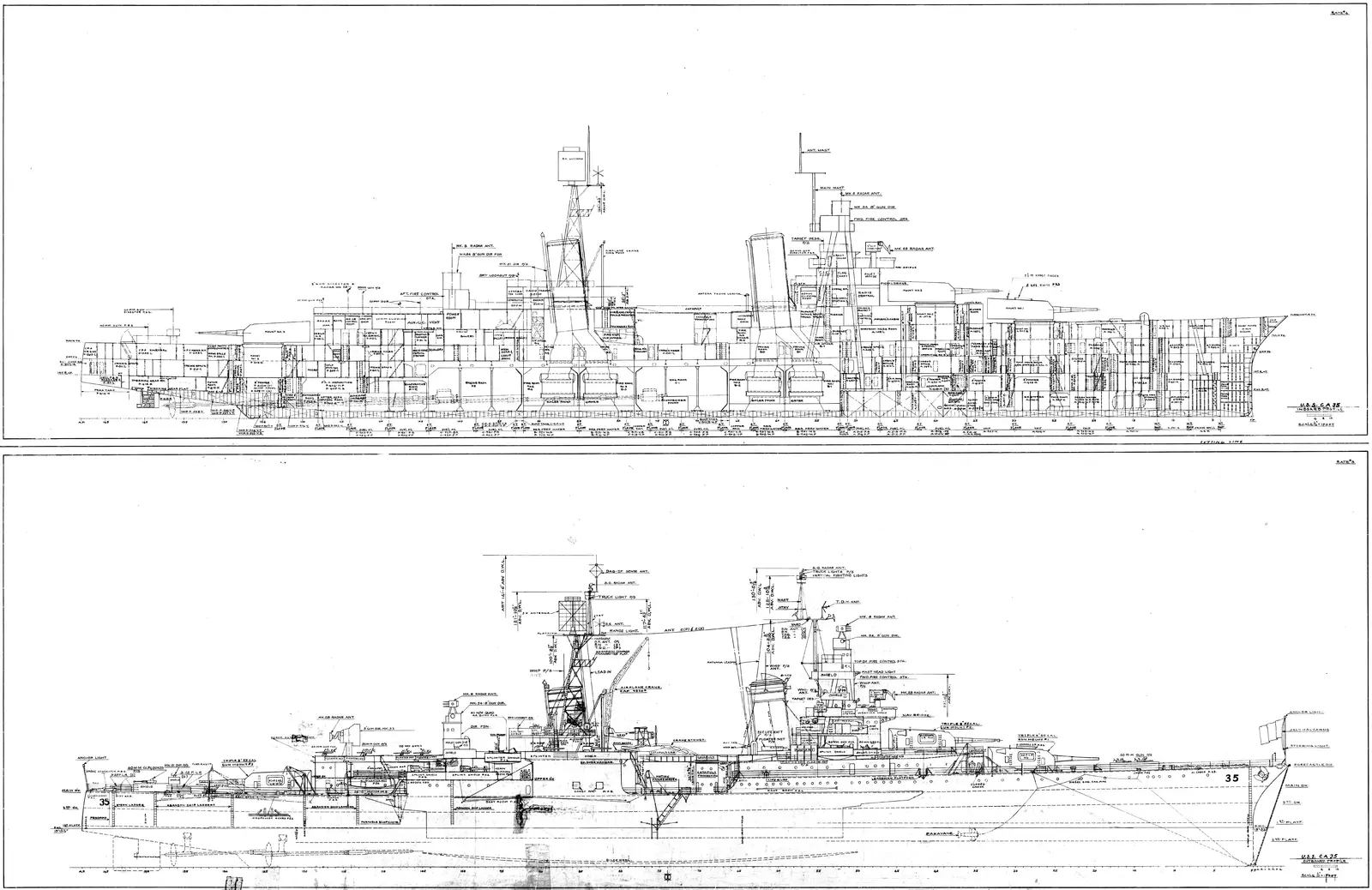
Navy profile drawings of the ship after her 1944 refit, about a year before the sinking. The 2019 talk calls the part forward of frame 10 a small portion of the bow structure.
USS Indianapolis (CA-35) inboard and outboard profiles by U.S. Navy Bureau of Ships; National Archives, NAID 6919451, Public domain
Full credit
"USS Indianapolis (CA-35) inboard and outboard profiles" by U.S. Navy Bureau of Ships; National Archives, NAID 6919451 — https://commons.wikimedia.org/wiki/File:USS_Indianapolis_(CA-35)_inboard_and_outboard_profiles_c1944.png — Public domain (US: work of the U.S. Navy, no copyright under 17 U.S.C. 105; elsewhere: institutional work, about 1944, 70 years passed)

Who failed to report USS Indianapolis overdue?
No text read here names an office. The words come from H.J.Res.48, introduced in the House on 28 April 1999: “various Navy shore offices compounded the previous errors” by “failing to report the ship's overdue arrival.” A joint resolution at that stage is a statement by its sponsors, and its stated subject is the captain's conviction. It is not a finding of fact.
Senator Smith of New Hampshire, introducing the Senate version on 25 May 1999, put it differently: “The Navy failed to notice when the ship did not show up in port in the Philippines.” He also said she sent three distress calls, that one was received at the naval base in the Philippines, and that a message from the submarine I-58 reporting the sinking was intercepted and ignored. These are statements in a speech. The records behind them were not read here.
An older text gives a different reason. The 1994 commendation, as printed in 1995, says the loss stayed unknown “as a result of the ship's communication ability having been destroyed in the attack.” McVay's account, as quoted in 2020, has the officer of the deck telling him, “I have lost all communications.”
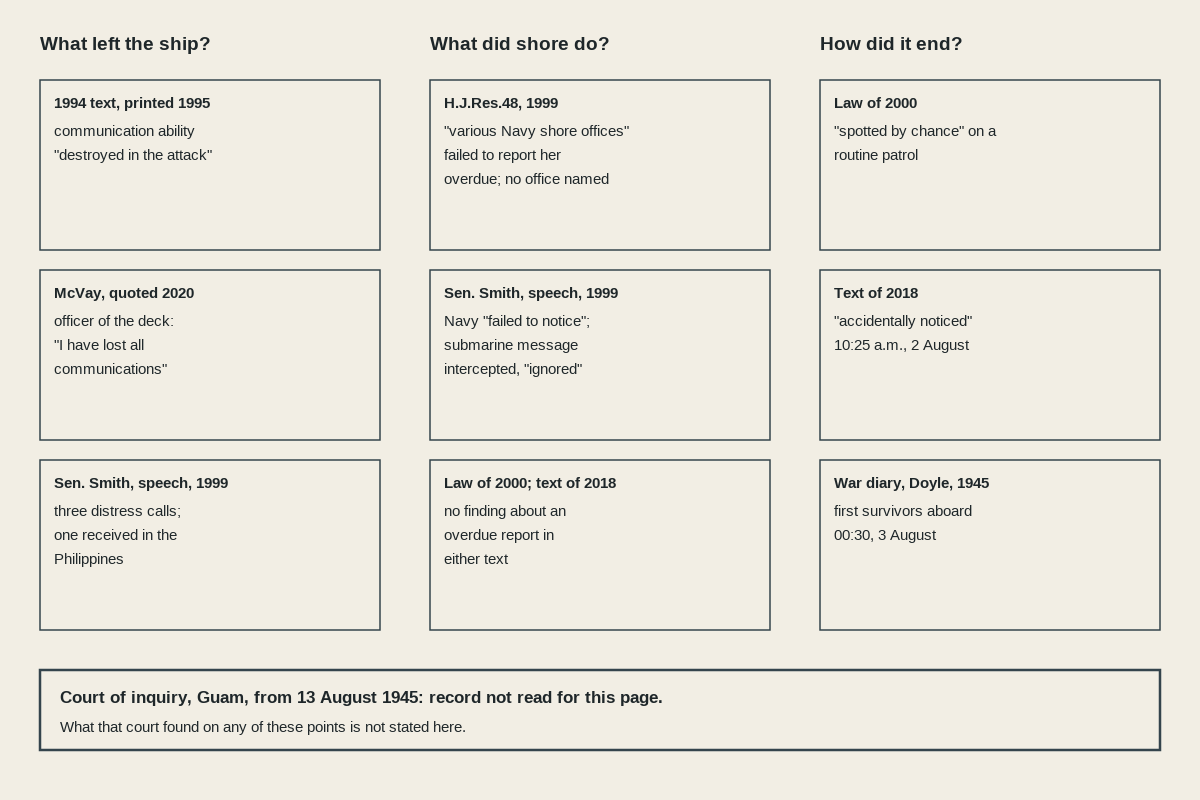
Each box is one text's claim, not an established step. Where two boxes in a column disagree, both are kept.
Keel, Rail & Spoke, CC BY 4.0
Data: H.J.Res.48, 106th Congress, as introduced, 28 April 1999, U.S. government work, https://www.govinfo.gov/content/pkg/BILLS-106hjres48ih/html/BILLS-106hjres48ih.htm, retrieved 2026-11-08; Congressional Record, Senate, 25 May 1999, Senator Smith on S.J.Res.25, U.S. government work, https://www.govinfo.gov/content/pkg/CREC-1999-05-25/pdf/CREC-1999-05-25-pt1-PgS5954-2.pdf, retrieved 2026-11-08; Congressional Record, 1995, vol. 141 part 16, U.S.S. Indianapolis Memorial, U.S. government work, https://www.govinfo.gov/content/pkg/GPO-CRECB-1995-pt16/pdf/GPO-CRECB-1995-pt16-1-3.pdf, retrieved 2026-11-08; Michael J. Hancock, The Sinking of the USS Indianapolis, National Archives, Pieces of History, 30 July 2020, U.S. government work, https://prologue.blogs.archives.gov/2020/07/30/the-sinking-of-the-uss-indianapolis/, retrieved 2026-11-08; Public Law 106-398, appendix, section 545, 2000, U.S. government work, https://www.govinfo.gov/content/pkg/GPO-CDOC-106sdoc30/pdf/GPO-CDOC-106sdoc30-1-14-3-1.pdf, retrieved 2026-11-08; S. 2101, USS Indianapolis Congressional Gold Medal Act, enrolled, 115th Congress, 2018, U.S. government work, https://www.govinfo.gov/content/pkg/BILLS-115s2101enr/pdf/BILLS-115s2101enr.pdf, retrieved 2026-11-08; USS Cecil J. Doyle (DE-368), war diary, August 1945, NAID 83573581, U.S. government work, https://commons.wikimedia.org/wiki/File:USS_Cecil_J._Doyle_(DE-368)_war_diary,_1-5_August_1945_(83573581).png, retrieved 2026-11-08
Reuse this diagram: credit to copy
"USS Indianapolis: who says what about the missing ship" by Keel, Rail & Spoke, https://keelrailandspoke.com/ships/uss-indianapolis-1945/, licensed under CC BY 4.0 (https://creativecommons.org/licenses/by/4.0/).
Congress then passed something narrower. Section 545 of Public Law 106-398, in 2000, lists a dozen findings on the case and says nothing about an overdue report, and the 2018 text does not mention one either. The court of inquiry that met at Guam from 13 August 1945 would be the place to look, but its record was not read for this page, so the page cannot say what that court found on the point. The overdue claim stands as the sponsors' claim, no stronger.
How were the survivors of USS Indianapolis found?
They were found by a patrol that was not looking for them. The 2000 law says they were “spotted by chance” by Lieutenant Wilbur C. Gwinn on a routine patrol. The 2018 text says he “accidentally noticed” men in the water at 10:25 a.m. on 2 August. Smith and the National Archives say shortly after 11 a.m.
From 0014 on 30 July to 10:25 on 2 August is about 82 hours, or 3 days and 10 hours, if those clocks share a time zone. The texts say “4 days” or “the fourth day,” which fits the calendar.
By both Smith and the National Archives, Lieutenant Adrian Marks then landed a PBY flying boat on the open sea to pick up men, against orders not to land at sea. From this point the one 1945 record readable here takes over: the war diary of the destroyer escort USS Cecil J. Doyle.
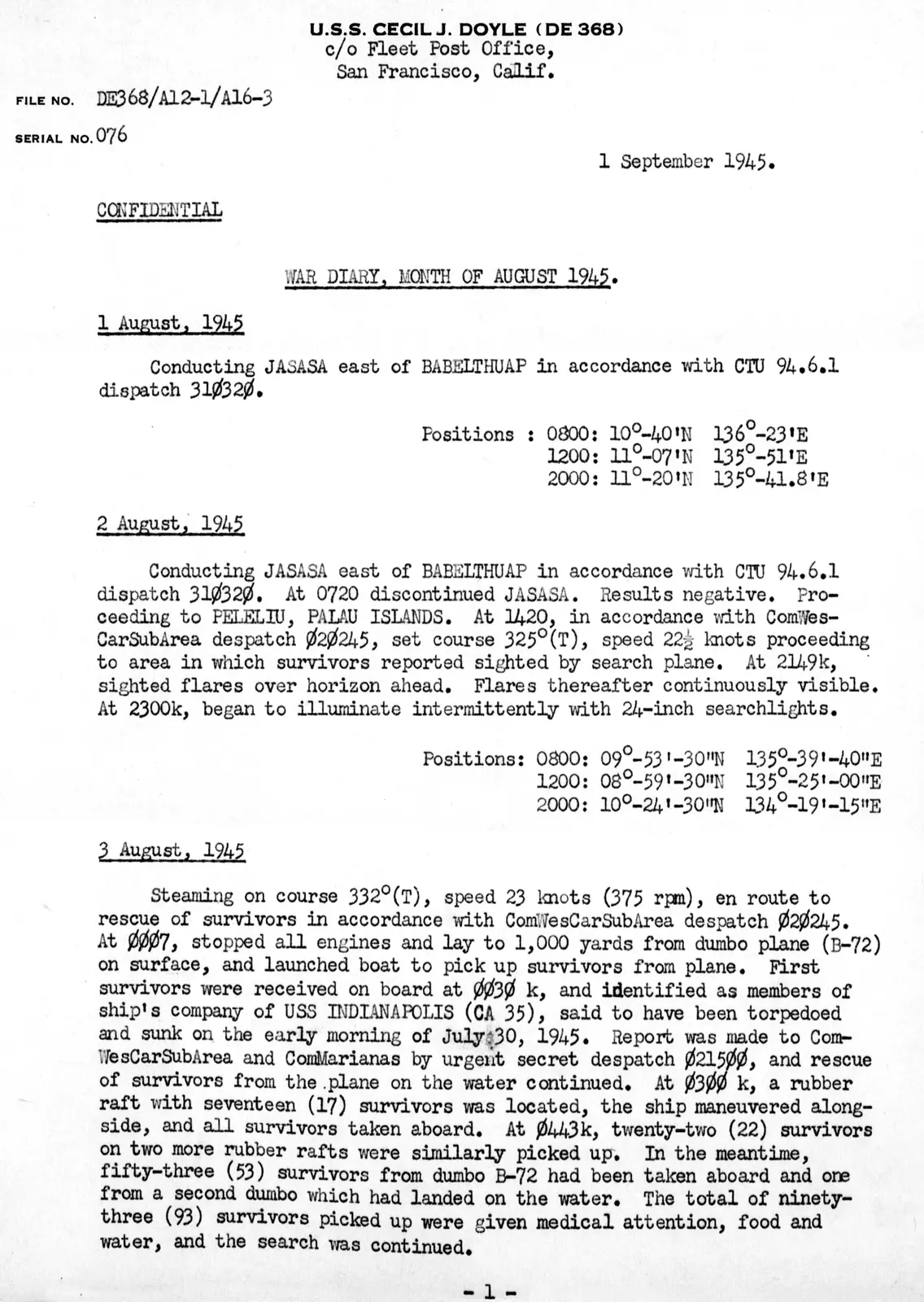
Page 1 of the USS Cecil J. Doyle war diary for August 1945, dated 1 September 1945, cropped from a two-page scan. The 3 August entry records the first survivors aboard.
USS Cecil J. Doyle (DE-368) war diary, August 1945, page 1 by U.S. Navy; National Archives, NAID 83573581, Public domain
Full credit
"USS Cecil J. Doyle (DE-368) war diary, August 1945, page 1" by U.S. Navy; National Archives, NAID 83573581 — https://commons.wikimedia.org/wiki/File:USS_Cecil_J._Doyle_(DE-368)_war_diary,_1-5_August_1945_(83573581).png — Public domain (US: work of the U.S. Navy, no copyright under 17 U.S.C. 105; elsewhere: institutional work, 1945, 70 years passed); modified: cropped: page 1 of the two-page scan, converted to JPEG
At 14:20 on 2 August she set course for “area in which survivors reported sighted by search plane,” at 22½ knots, about 8.3 times a walking pace. She sighted flares at 21:49. At 23:00 she began using her searchlights, a step the 2018 text calls a considerable risk. At 00:07 on 3 August she stopped 1,000 yards from the flying boat, and at 00:30 the first survivors came aboard and were “identified as members of ship's company of USS INDIANAPOLIS (CA 35), said to have been torpedoed and sunk on the early morning of July 30, 1945.”
“Said to have been” is the diary's own hedge, and the page does not say what the ship had been told before then. The diary counts 93 taken aboard: 53 from that plane, 1 from a second, and 39 from three rafts. Smith and the National Archives credit Marks's crew with 56, so the two numbers differ by 3. The National Archives post says seven Navy ships in all converged on the site, and the 1998 tribute says eight rescued survivors.
How many men survived, and how many did sharks kill?
Most texts say 316 survived. No text read here gives a shark count. The crew figure runs from 1,195 to 1,199, and the survivors from 316 to 319. In every pairing, about 26 percent lived.
| Text | Aboard | Survived | Share |
|---|---|---|---|
| Gold Medal Act text, 2018 | 1,195 | 316 | 26.4% |
| H.J.Res.48, 1999; Public Law 106-398, 2000 | 1,196 | 316 | 26.4% |
| Senator Smith, 1999 | 1,196 | 317 | 26.5% |
| 1994 commendation, as printed 1995 | 1,198 | 319 | 26.6% |
| Congressional Record, 1998 | 1,199 | 316 | 26.4% |
| National Archives blog, 2020 | 1,199 | 317 | 26.4% |
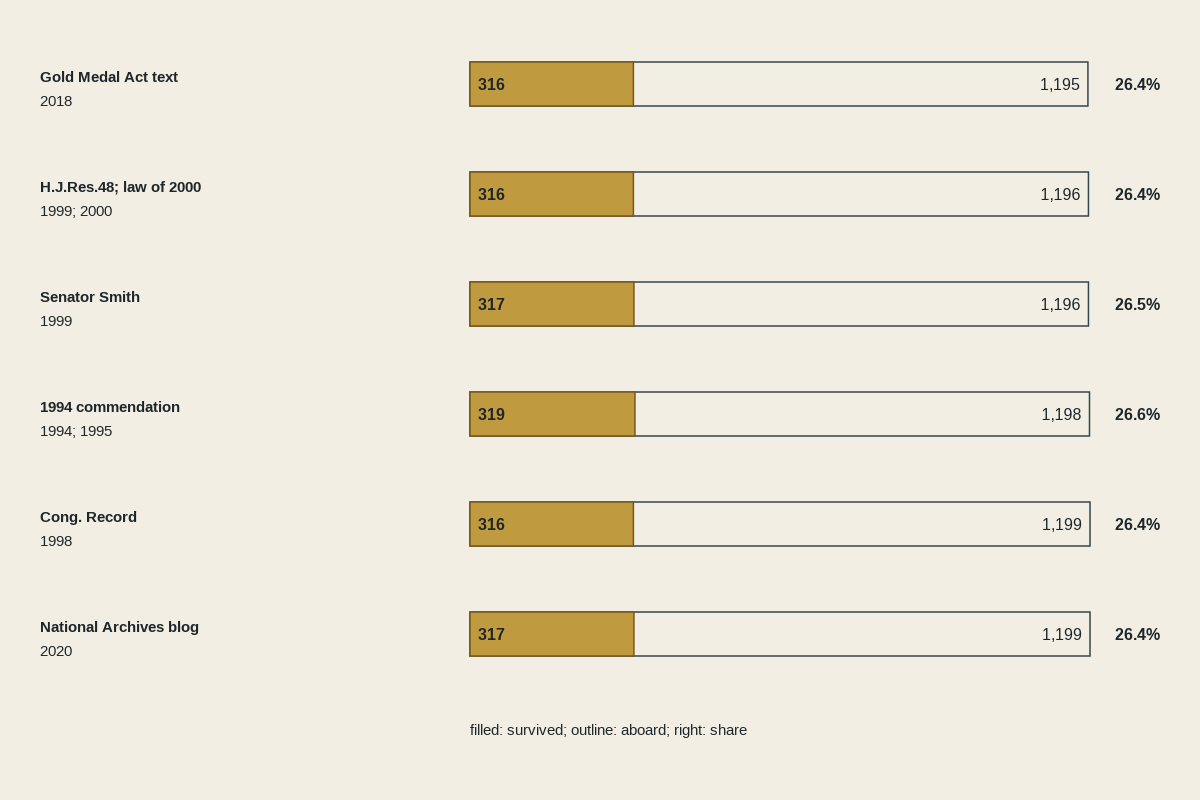
Six pairings of crew and survivor counts, each from one text. The share barely moves, whichever pair is used.
Keel, Rail & Spoke, CC BY 4.0
Data: S. 2101, USS Indianapolis Congressional Gold Medal Act, enrolled, 115th Congress, 2018, U.S. government work, https://www.govinfo.gov/content/pkg/BILLS-115s2101enr/pdf/BILLS-115s2101enr.pdf, retrieved 2026-11-08; H.J.Res.48, 106th Congress, as introduced, 28 April 1999, U.S. government work, https://www.govinfo.gov/content/pkg/BILLS-106hjres48ih/html/BILLS-106hjres48ih.htm, retrieved 2026-11-08; Public Law 106-398, appendix, section 545, 2000, U.S. government work, https://www.govinfo.gov/content/pkg/GPO-CDOC-106sdoc30/pdf/GPO-CDOC-106sdoc30-1-14-3-1.pdf, retrieved 2026-11-08; Congressional Record, Senate, 25 May 1999, Senator Smith on S.J.Res.25, U.S. government work, https://www.govinfo.gov/content/pkg/CREC-1999-05-25/pdf/CREC-1999-05-25-pt1-PgS5954-2.pdf, retrieved 2026-11-08; Congressional Record, 1995, vol. 141 part 16, U.S.S. Indianapolis Memorial, U.S. government work, https://www.govinfo.gov/content/pkg/GPO-CRECB-1995-pt16/pdf/GPO-CRECB-1995-pt16-1-3.pdf, retrieved 2026-11-08; Congressional Record, 4 June 1998, E1035, U.S. government work, https://www.govinfo.gov/content/pkg/CREC-1998-06-04/pdf/CREC-1998-06-04-pt1-PgE1035-2.pdf, retrieved 2026-11-08; Michael J. Hancock, The Sinking of the USS Indianapolis, National Archives, Pieces of History, 30 July 2020, U.S. government work, https://prologue.blogs.archives.gov/2020/07/30/the-sinking-of-the-uss-indianapolis/, retrieved 2026-11-08
Reuse this diagram: credit to copy
"USS Indianapolis: six pairings of crew and survivors" by Keel, Rail & Spoke, https://keelrailandspoke.com/ships/uss-indianapolis-1945/, licensed under CC BY 4.0 (https://creativecommons.org/licenses/by/4.0/).
Data behind this diagram: uss-indianapolis-1945-counts.csv · Where this data came from
Most texts put about 900 men in the water after the sinking. H.J.Res.48 alone says approximately 950. Deaths are 880 in that resolution and 870 in Smith's speech. As with the Spanish Armada, each count needs its speaker beside it.
The 2000 law lists the causes of death as battle wounds, drowning, “predatory shark attacks,” exposure, and lack of food and water. It gives no number for any of them. This page gives none either, because no source read here does. The last spare is not applicable: the leg ended in an attack, not in running out of anything.
What happened to Captain McVay?
A court-martial convicted him, and Congress said in 2000 that his record should reflect that he was exonerated. H.J.Res.48 dates the conviction to 23 February 1946, on a charge of “suffering a vessel to be hazarded through negligence,” which the 2000 law ties to his not zigzagging, a maneuver meant to help evade submarines. The 1999 text says his sentence was remitted, that he retired in 1949 as a rear admiral, and that he died on 6 November 1968. Representative Carson of Indiana, in 2001, put it differently: he was “convicted 56 years ago,” which, counted back from 2001, gives 1945.
The 2000 law, in a section headed as the sense of Congress, says the American people “should now recognize Captain McVay's lack of culpability.” It adds that his record “should now reflect that he is exonerated.” In the same 2001 remarks, Carson told the House that his record had been modified. The trial record itself was not read, so this page does not describe the trial, its witnesses or its reasoning.
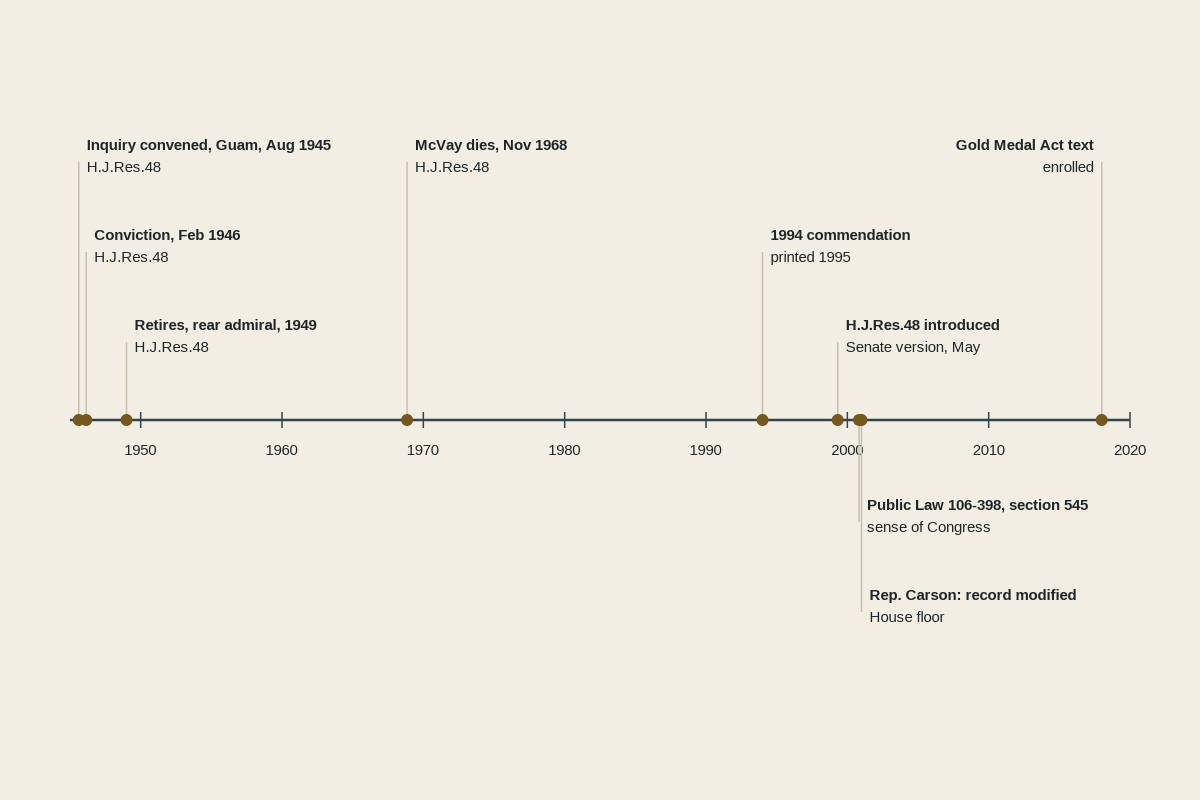
The paper trail, by year. Most of this page comes from the texts on the right-hand side, written decades after the event.
Keel, Rail & Spoke, CC BY 4.0
Data: H.J.Res.48, 106th Congress, as introduced, 28 April 1999, U.S. government work, https://www.govinfo.gov/content/pkg/BILLS-106hjres48ih/html/BILLS-106hjres48ih.htm, retrieved 2026-11-08; Congressional Record, 1995, vol. 141 part 16, U.S.S. Indianapolis Memorial, U.S. government work, https://www.govinfo.gov/content/pkg/GPO-CRECB-1995-pt16/pdf/GPO-CRECB-1995-pt16-1-3.pdf, retrieved 2026-11-08; Public Law 106-398, appendix, section 545, 2000, U.S. government work, https://www.govinfo.gov/content/pkg/GPO-CDOC-106sdoc30/pdf/GPO-CDOC-106sdoc30-1-14-3-1.pdf, retrieved 2026-11-08; Congressional Record, 2001, vol. 147 part 10, p. 14817, U.S. government work, https://www.govinfo.gov/content/pkg/CRECB-2001-pt10/html/CRECB-2001-pt10-Pg14817.htm, retrieved 2026-11-08; S. 2101, USS Indianapolis Congressional Gold Medal Act, enrolled, 115th Congress, 2018, U.S. government work, https://www.govinfo.gov/content/pkg/BILLS-115s2101enr/pdf/BILLS-115s2101enr.pdf, retrieved 2026-11-08
Reuse this diagram: credit to copy
"USS Indianapolis: the official texts by year" by Keel, Rail & Spoke, https://keelrailandspoke.com/ships/uss-indianapolis-1945/, licensed under CC BY 4.0 (https://creativecommons.org/licenses/by/4.0/).
The Ibry strip: about 1,081 km, then no way made
Time runs across and distance from Guam runs up. Two lines climb from 28 July because the hour of leaving was not read. At the torpedoes the line goes flat, and the machine's part of the journey is over. The lines are dotted because no position between these points was read here.
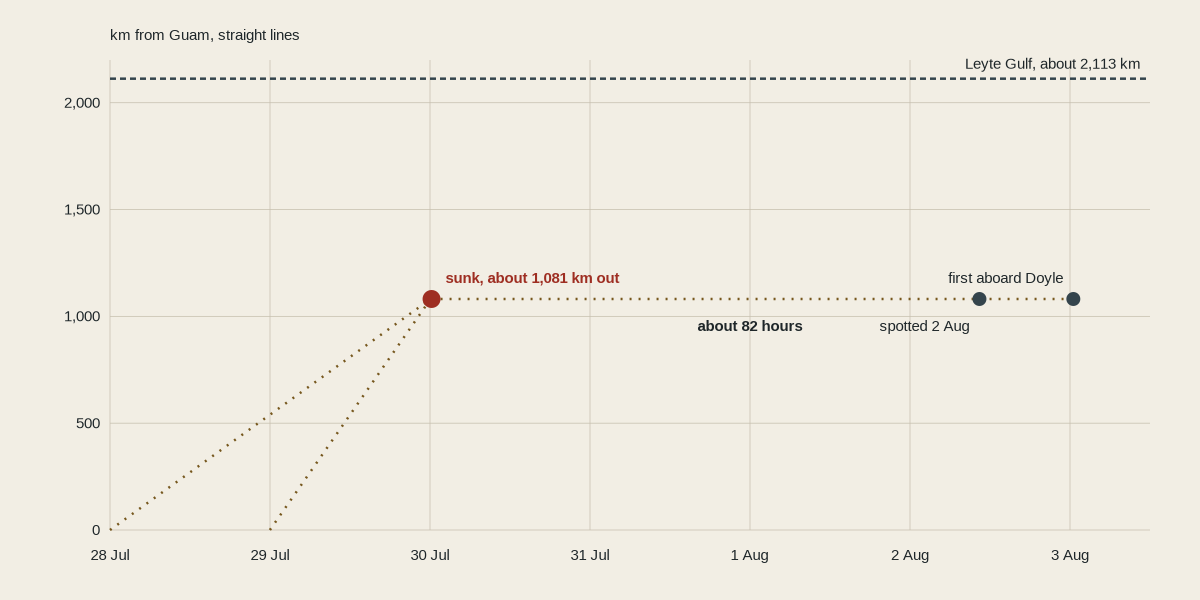
USS Indianapolis: distance from Guam against time, 28 July to 3 August 1945. The dotted lines are not position fixes. The men in the water drifted, and no drift figure was read here.
Keel, Rail & Spoke, CC BY 4.0
Data: H.J.Res.48, 106th Congress, as introduced, 28 April 1999, U.S. government work, https://www.govinfo.gov/content/pkg/BILLS-106hjres48ih/html/BILLS-106hjres48ih.htm, retrieved 2026-11-08; S. 2101, USS Indianapolis Congressional Gold Medal Act, enrolled, 115th Congress, 2018, U.S. government work, https://www.govinfo.gov/content/pkg/BILLS-115s2101enr/pdf/BILLS-115s2101enr.pdf, retrieved 2026-11-08; Congressional Record, 1995, vol. 141 part 16, U.S.S. Indianapolis Memorial, U.S. government work, https://www.govinfo.gov/content/pkg/GPO-CRECB-1995-pt16/pdf/GPO-CRECB-1995-pt16-1-3.pdf, retrieved 2026-11-08; Michael J. Hancock, The Sinking of the USS Indianapolis, National Archives, Pieces of History, 30 July 2020, U.S. government work, https://prologue.blogs.archives.gov/2020/07/30/the-sinking-of-the-uss-indianapolis/, retrieved 2026-11-08; USS Cecil J. Doyle (DE-368), war diary, August 1945, NAID 83573581, U.S. government work, https://commons.wikimedia.org/wiki/File:USS_Cecil_J._Doyle_(DE-368)_war_diary,_1-5_August_1945_(83573581).png, retrieved 2026-11-08; U.S. Navy chart of the last voyage, photo 80-G-702177, date not read, position read from the image, https://commons.wikimedia.org/wiki/File:USS_Indianapolis-last_voyage_chart.jpg, retrieved 2026-11-08; Blair Atcheson and Richard Hulver, USS Indianapolis Discovered, National Park Service transcript, 2019, U.S. government work, https://www.nps.gov/articles/000/uss-indianapolis-discovered-analysis-of-a-shipwreck-site.htm, retrieved 2026-11-08; Wikidata coordinates (CC0), https://www.wikidata.org/, retrieved 2026-11-08
Reuse this diagram: credit to copy
"USS Indianapolis: time-distance strip, 1945" by Keel, Rail & Spoke, https://keelrailandspoke.com/ships/uss-indianapolis-1945/, licensed under CC BY 4.0 (https://creativecommons.org/licenses/by/4.0/).
Compare Mutiny on the Bounty, where an open boat logged 3,618 miles as it went. No record read here gives the men's position on this flat stretch.
Where is the wreck of USS Indianapolis?
The wreck lies about three miles down in the Philippine Sea. Atcheson's 2019 talk says a team funded by Paul Allen, working independently of the Navy's historians, found it on 19 August 2017, and calls it the Navy's deepest confirmed shipwreck.
The Navy's historians had proposed a search box about 35 nautical miles southeast of the 1945 sinking position, and the wreck was 6 nautical miles outside it. A point 35 nautical miles southeast of the chart's mark is about 1,045 km from Guam, so the 1,081 km is a distance to that mark, not to the wreck. Part of the clue was a landing ship that McVay mentioned passing about 11 hours before the attack.
Atcheson also said the Navy's Bureau of Ships interviewed the survivors and filed its official report on 2 October 1945, with no wreckage to examine. Atcheson called it more an informed estimate than a definitive conclusion, and said the wreck showed the investigation to be remarkably accurate. That report was not read here.
The ship is under Navy jurisdiction and, in Atcheson's words of 2019, a final resting place for nearly 300 sailors, which sets her apart from Vasa, a hull that visitors can walk around in a museum.
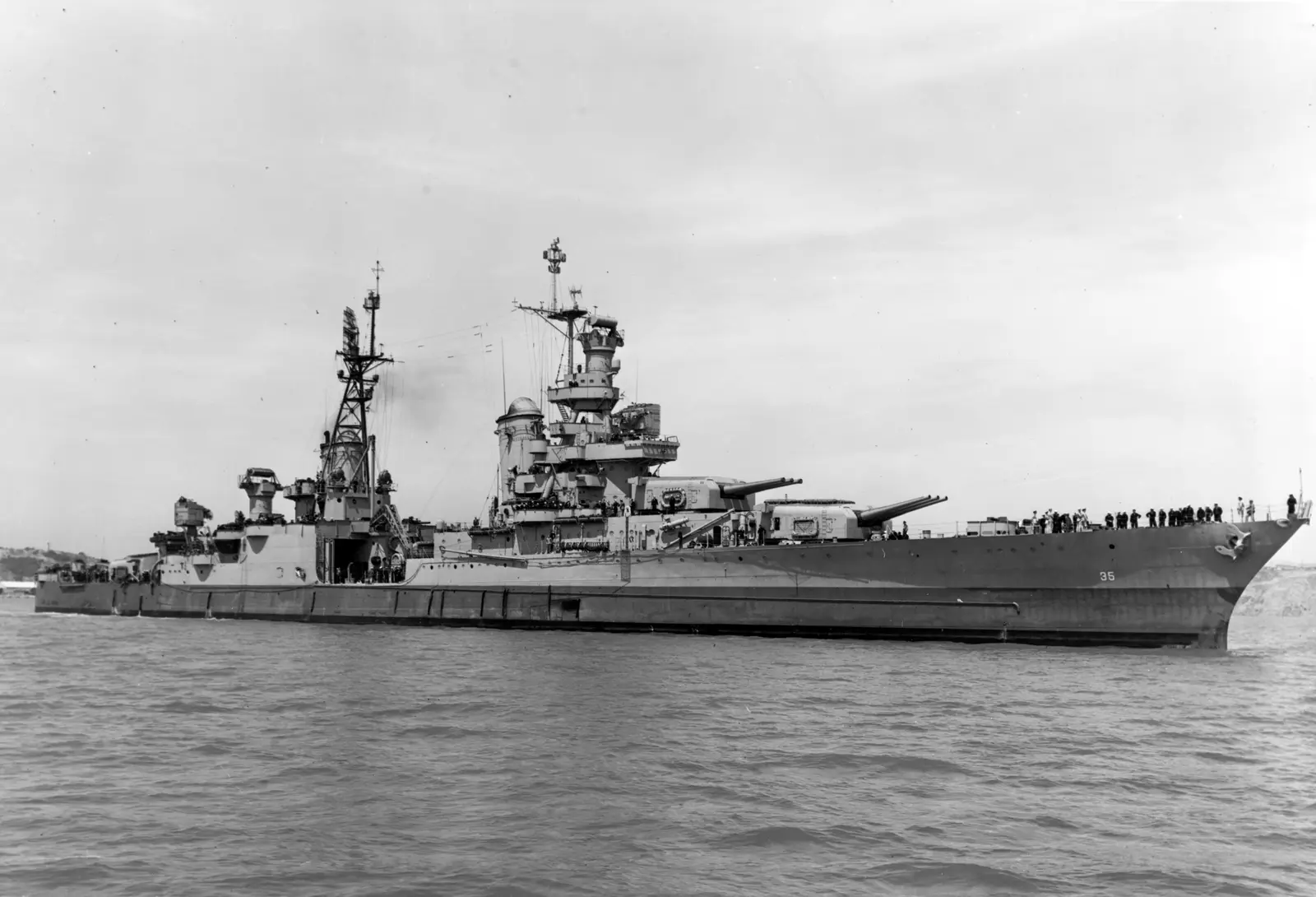
USS Indianapolis off Mare Island Naval Shipyard, California, on 10 July 1945, twenty days before she was sunk. The number 35 is on the bow.
USS Indianapolis (CA-35) off the Mare Island Naval Shipyard on 10 July 1945 by unknown creator; U.S. Navy photo 19-N-86911, Public domain
Full credit
"USS Indianapolis (CA-35) off the Mare Island Naval Shipyard on 10 July 1945" by unknown creator; U.S. Navy photo 19-N-86911 — https://commons.wikimedia.org/wiki/File:USS_Indianapolis_(CA-35)_off_the_Mare_Island_Naval_Shipyard_on_10_July_1945_(19-N-86911).jpg — Public domain (US: work of the U.S. Navy, no copyright under 17 U.S.C. 105; elsewhere: anonymous work, made 1945, more than 70 years since it was made)

The bow now lies apart from the hull, on its starboard side and half buried in sediment. By Atcheson's account, the first thing the team found was that number, 35, on its port side.
Sources
- H.J.Res.48, 106th Congress, 1st session, as introduced in the House, 28 April 1999. https://www.govinfo.gov/content/pkg/BILLS-106hjres48ih/html/BILLS-106hjres48ih.htmRead: full text
- S. 2101, USS Indianapolis Congressional Gold Medal Act, enrolled bill, 115th Congress, 2nd session, 2018. https://www.govinfo.gov/content/pkg/BILLS-115s2101enr/pdf/BILLS-115s2101enr.pdfRead: full text
- Public Law 106-398, Floyd D. Spence National Defense Authorization Act for Fiscal Year 2001, appendix, section 545 (30 October 2000). https://www.govinfo.gov/content/pkg/GPO-CDOC-106sdoc30/pdf/GPO-CDOC-106sdoc30-1-14-3-1.pdfRead: section 545 in full
- Congressional Record, Senate, 25 May 1999, statement of Senator Smith of New Hampshire on S.J.Res.25, pp. S5964 to S5967. https://www.govinfo.gov/content/pkg/CREC-1999-05-25/pdf/CREC-1999-05-25-pt1-PgS5954-2.pdfRead: chapter-length part: the statement, to the point used
- Congressional Record, 1995, vol. 141, part 16, Extensions of Remarks, U.S.S. Indianapolis Memorial. https://www.govinfo.gov/content/pkg/GPO-CRECB-1995-pt16/pdf/GPO-CRECB-1995-pt16-1-3.pdfRead: chapter-length part: the commendation text as printed
- Congressional Record, 4 June 1998, Extensions of Remarks, p. E1035. https://www.govinfo.gov/content/pkg/CREC-1998-06-04/pdf/CREC-1998-06-04-pt1-PgE1035-2.pdfRead: full page: the tribute
- Congressional Record, 2001, vol. 147, part 10, p. 14817, Exoneration of Captain Charles B. McVay III. https://www.govinfo.gov/content/pkg/CRECB-2001-pt10/html/CRECB-2001-pt10-Pg14817.htmRead: full page
- USS Cecil J. Doyle (DE-368), War Diary, Month of August 1945, dated 1 September 1945, National Archives Identifier 83573581. https://commons.wikimedia.org/wiki/File:USS_Cecil_J._Doyle_(DE-368)_war_diary,_1-5_August_1945_(83573581).pngRead: pages 1 and 2 of the excerpt
- U.S. Navy chart of the last voyage of USS Indianapolis, photo 80-G-702177, date not read. https://commons.wikimedia.org/wiki/File:USS_Indianapolis-last_voyage_chart.jpgRead: full page: the chart as an image
- Michael J. Hancock, “The Sinking of the USS Indianapolis,” Pieces of History, U.S. National Archives, 30 July 2020. https://prologue.blogs.archives.gov/2020/07/30/the-sinking-of-the-uss-indianapolis/Read: full post
- Blair Atcheson and Richard Hulver, “USS Indianapolis Discovered: Analysis of a Shipwreck Site,” transcript of a presentation, Preserving U.S. Military Heritage, June 2019, National Park Service. https://www.nps.gov/articles/000/uss-indianapolis-discovered-analysis-of-a-shipwreck-site.htmRead: full page
- Wikidata, coordinate location (P625) of Apra Harbor (Q621760) and Leyte Gulf (Q240753). CC0. https://www.wikidata.org/wiki/Q621760Read: full page: the coordinate statements
Cite this page
Keel, Rail & Spoke. "USS Indianapolis: Men Spotted by Chance Days Later, Law Says." Published 2026-11-08. https://keelrailandspoke.com/ships/uss-indianapolis-1945/. Accessed on the date you read it.
How facts are checked · Corrections · Contact
Found a mistake on this page? Write to contact@keelrailandspoke.com.
More from Ships & Wrecks
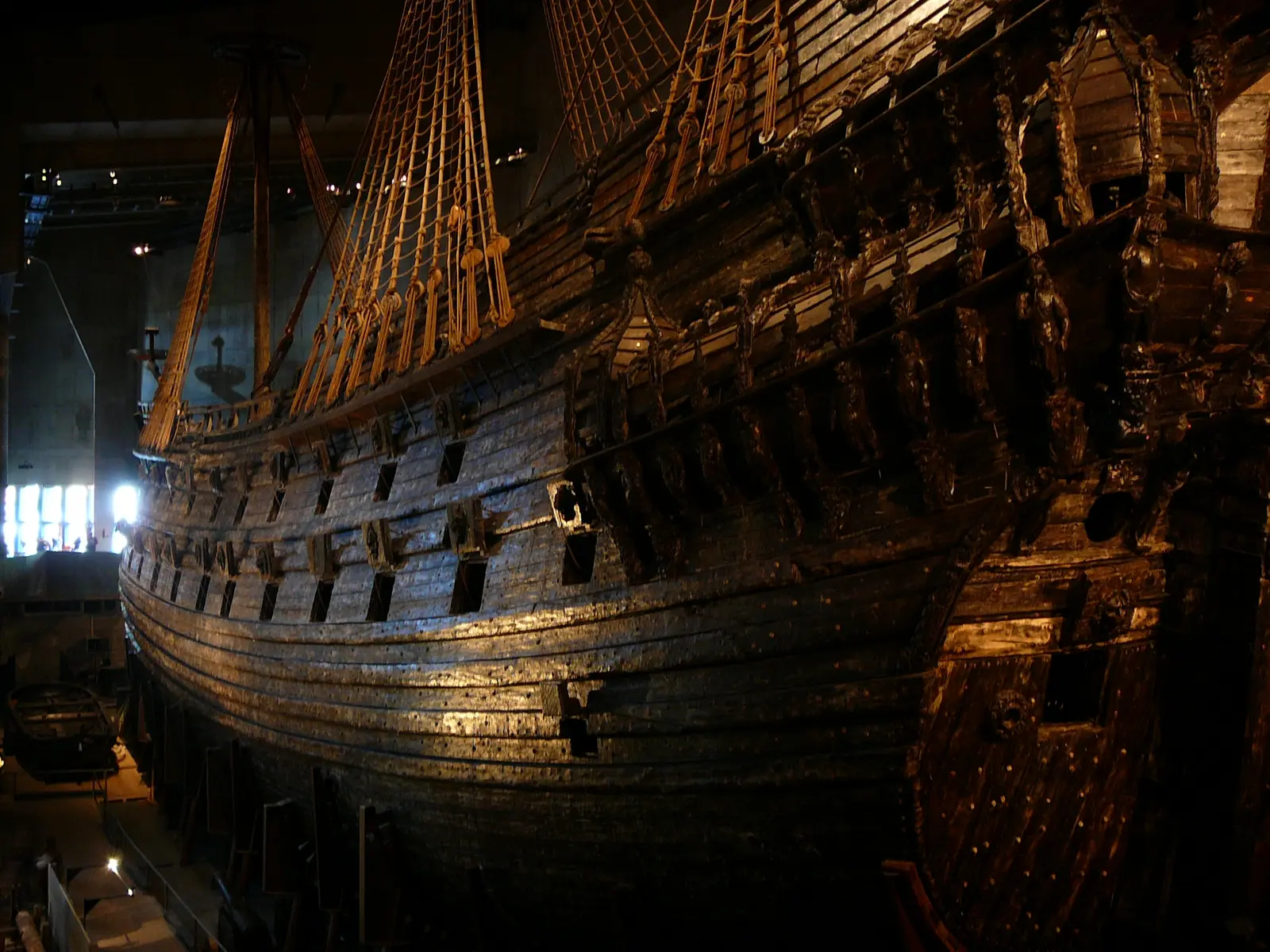
Ships & Wrecks
Vasa Ship, 1628: Stability Test Stopped, Then She Sailed
The Vasa ship sank about 1,300 m into her 1628 maiden voyage. About a month before, her master testified, thirty men rolled her so far the test was stopped.
Picture credit
"Vasa 2" by MLeb — https://commons.wikimedia.org/wiki/File:Vasa_2.jpg — Public domain (released into the public domain worldwide by the photographer)
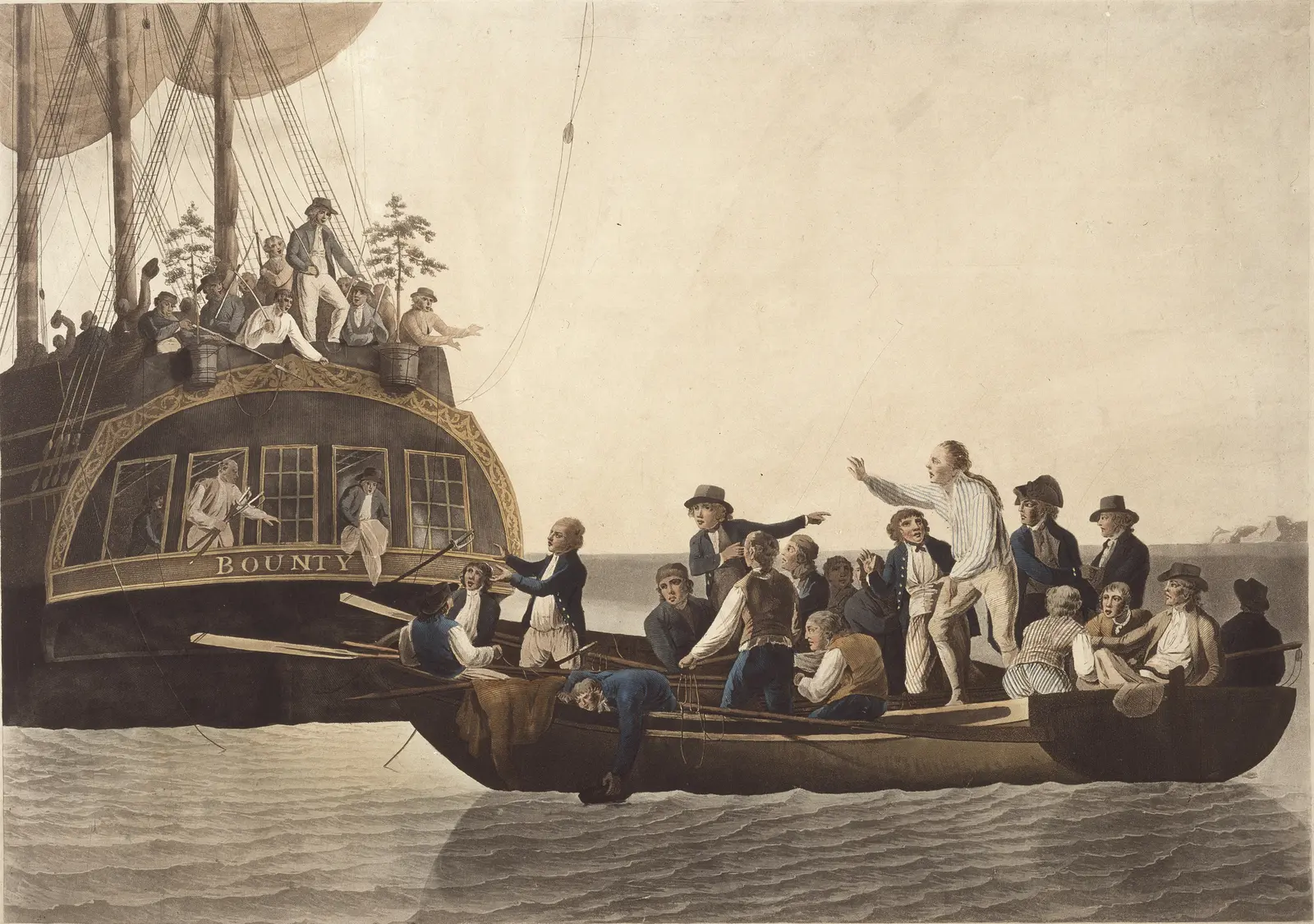
Ships & Wrecks
Mutiny on the Bounty: 3,618 Miles in 41 Days, by Bligh’s Log
After the 1789 mutiny on the Bounty, William Bligh logged 3,618 miles to Timor in 41 days in an open launch. His noon positions rechecked, and 44 men's fates.
Picture credit
"The Mutineers turning Lt Bligh and part of the Officers and Crew adrift from His Majesty's Ship the Bounty" by Robert Dodd; State Library of New South Wales, DL Pf 137 — https://commons.wikimedia.org/wiki/File:Mutiny_HMS_Bounty.jpg — Public domain (US: published 1790, before 1931; elsewhere: creator died 1815, life+70 term expired); modified: cropped: paper margin and printed text below the image removed; reduced to 2,400 px wide
Ships & Wrecks
Spanish Armada, 1588: One Undated Spanish List Says 65 Lost
One English report of 1588 said the Spanish Armada had lost at least 16 ships; an undated Spanish list printed in 1899 totals 65. Each count, with who gave it.
Picture credit
"The Spanish Armada off the English Coast in 1588" by Cornelis Claesz van Wieringen; Rijksmuseum, SK-A-1629 — https://commons.wikimedia.org/wiki/File:The_Spanish_Armada_off_the_English_Coast_in_1588_(by_Cornelis_Claesz_van_Wieringen)_-_Rijksmuseum,_Amsterdam_(SK-A-1629).jpg — Public domain (US: painted about 1620 to 1625, every term expired; elsewhere: creator died 1633, life+70 term expired; Rijksmuseum marks it public domain)


