Ships & Wrecks · Wreck & failure inquiry
Vasa Ship, 1628: Stability Test Stopped, Then She Sailed
Thirty men running across the Vasa ship made her roll so far, her master testified, that the demonstration was stopped; the museum dates it about a month before she sailed.
Keel, Rail & Spoke · Published
TL;DR
- Vasa sank on 10 August 1628 about 1,300 meters into her first voyage, the Vasa Museum says, in Stockholm harbor; roughly 30 people died.
- About a month earlier by the museum's dating, a demonstration at the quay was stopped, her master testified, because thirty men running across her deck made her lean over so far.
- The inquest of 5 September 1628 punished no one; its transcript has her master saying she was narrow in the bottom, with no belly.
Leg card
- Departure
- Quay below the royal palace, Stockholm; 10 August 1628 (Julian calendar), cast off between 15:00 and 16:00 (Council letter, 1628) or 16:00 and 17:00 (Vasa Museum)
- Arrival
- Did not arrive. Sank off Beckholmen, Stockholm harbor, the same day; depth 32 m
- Distance
- About 1.3 km (0.81 mi; 0.70 nmi), the Vasa Museum's figure. Planned destination Älvsnabben: at least 38.3 km (23.8 mi; 20.7 nmi) in a straight line
- Machine
- Vasa, Swedish warship with two gundecks; 64 guns aboard; 4 of 10 sails set
- Elapsed
- About 15 to 20 minutes under sail (museum pages differ); time spent warping out not given in the sources read
- Walking multiple
- unknown (overall): the start point of the 1.3 km and the warping time are not recorded in the sources read
- Repair radius
- About 0.45 km at the July demonstration. Fault: stability (a crank hull). Repair site: the navy yard on Blasieholmen, whose contractors were to repair and maintain the navy's ships. Straight line between Wikidata reference points
- The last spare
- Not applicable: the voyage ended by capsize, which the sources read do not tie to any supply running out
- Key source
- Transcript of the inquest of 5 September 1628 (surviving part); Vasa Museum, "The Inquest"
Download this card (CSV) · Where this data came from
Data: Vasa Museum (SMMTF) history pages, https://www.vasamuseet.se/en/explore/vasa-history, retrieved 2026-11-08; Council of State letter of 12 August 1628, Vasa Museum transcript, https://www.vasamuseet.se/skola/i-klassrummet/originaldokument-om-vasa, retrieved 2026-11-08; Transcript of the Vasa inquest of 5 September 1628, Vasa Museum education unit after the original in Riksarkivet, https://www.vasamuseet.se/skola/i-klassrummet/originaldokument-om-vasa, retrieved 2026-11-08; Wikidata coordinates (CC0), https://www.wikidata.org/, retrieved 2026-11-08
What the card means: walking multiple, repair radius, last spare.
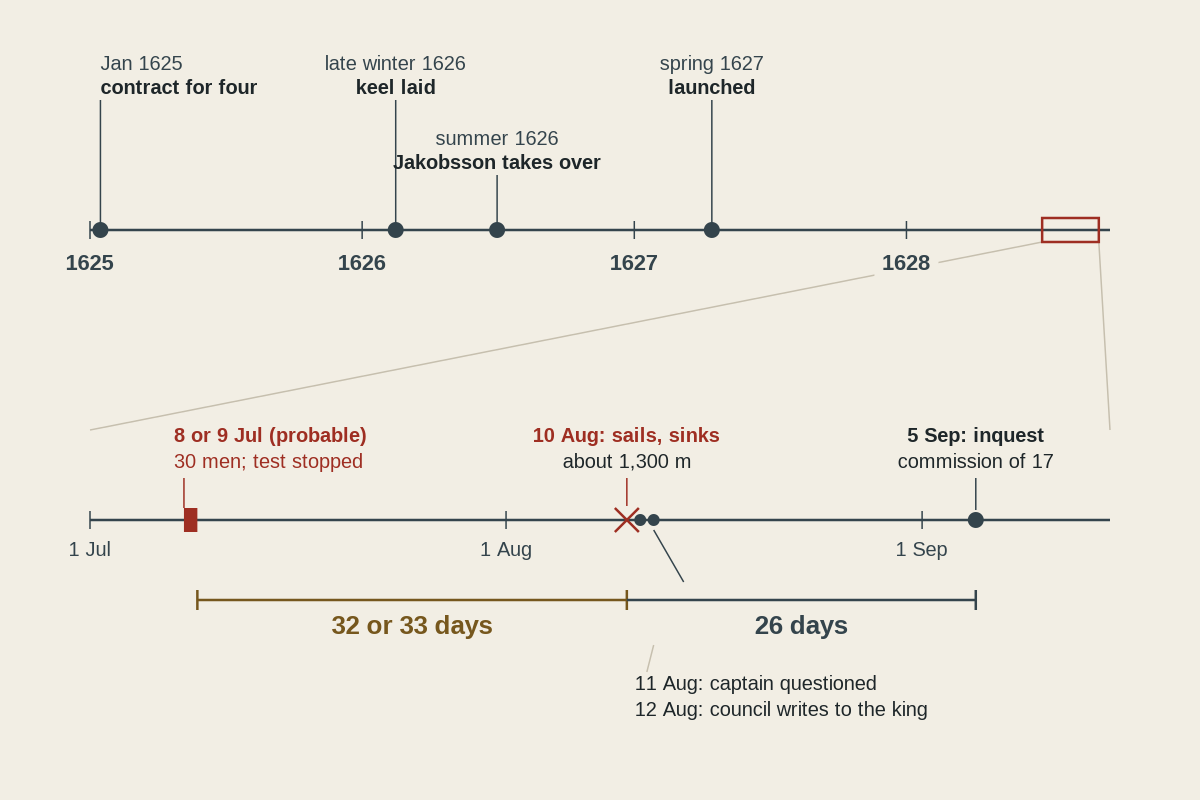
The Vasa record, 1625–1628. The enlarged strip shows 32 or 33 days from the demonstration at the quay, on the museum's probable date, to the sailing, and 26 days from the sinking to the inquest. Season-level dates are plotted mid-season. Dates up to 1627 and the probable July date come from the museum and are not in the data file.
Keel, Rail & Spoke, CC BY 4.0
Data: Vasa Museum (SMMTF) history pages, https://www.vasamuseet.se/en/explore/vasa-history, retrieved 2026-11-08; Transcript of the Vasa inquest of 5 September 1628, Vasa Museum education unit after the original in Riksarkivet, https://www.vasamuseet.se/skola/i-klassrummet/originaldokument-om-vasa, retrieved 2026-11-08
Reuse this diagram: credit to copy
"The Vasa record, 1625-1628" by Keel, Rail & Spoke, https://keelrailandspoke.com/ships/vasa-1628/, licensed under CC BY 4.0 (https://creativecommons.org/licenses/by/4.0/).
Data behind this diagram: vasa-1628-timeline.csv · Where this data came from
The Swedish warship Vasa sank on 10 August 1628, about 1,300 meters into her first voyage. That figure comes from the Vasa Museum in Stockholm, where her raised hull now stands. The transcript of the inquest held that September adds a harder fact: her master testified that a demonstration at the quay, meant to make her heel (lean to one side), had been stopped because she rolled so far, and the museum dates it to about a month before she sailed. She sailed anyway.
Why she sank has a short answer: her hull had too little volume below the waterline for the heavy decks, guns and rig above it. Her lower gunports were also open when a gust pushed her over, so the water came straight in.
Stops on this page (7)
How far did the Vasa sail?
Vasa cast off from the quay below the royal palace in the afternoon: between three and four by the Council's letter of 12 August 1628, between four and five on the museum's page. With the wind from the south she could not simply sail away. Her crew warped her along the waterfront, hauling her forward on anchors and lines, to Tranbodarna, the place now called Slussen. There she set four of her ten sails and fired a salute, with her gunports open.
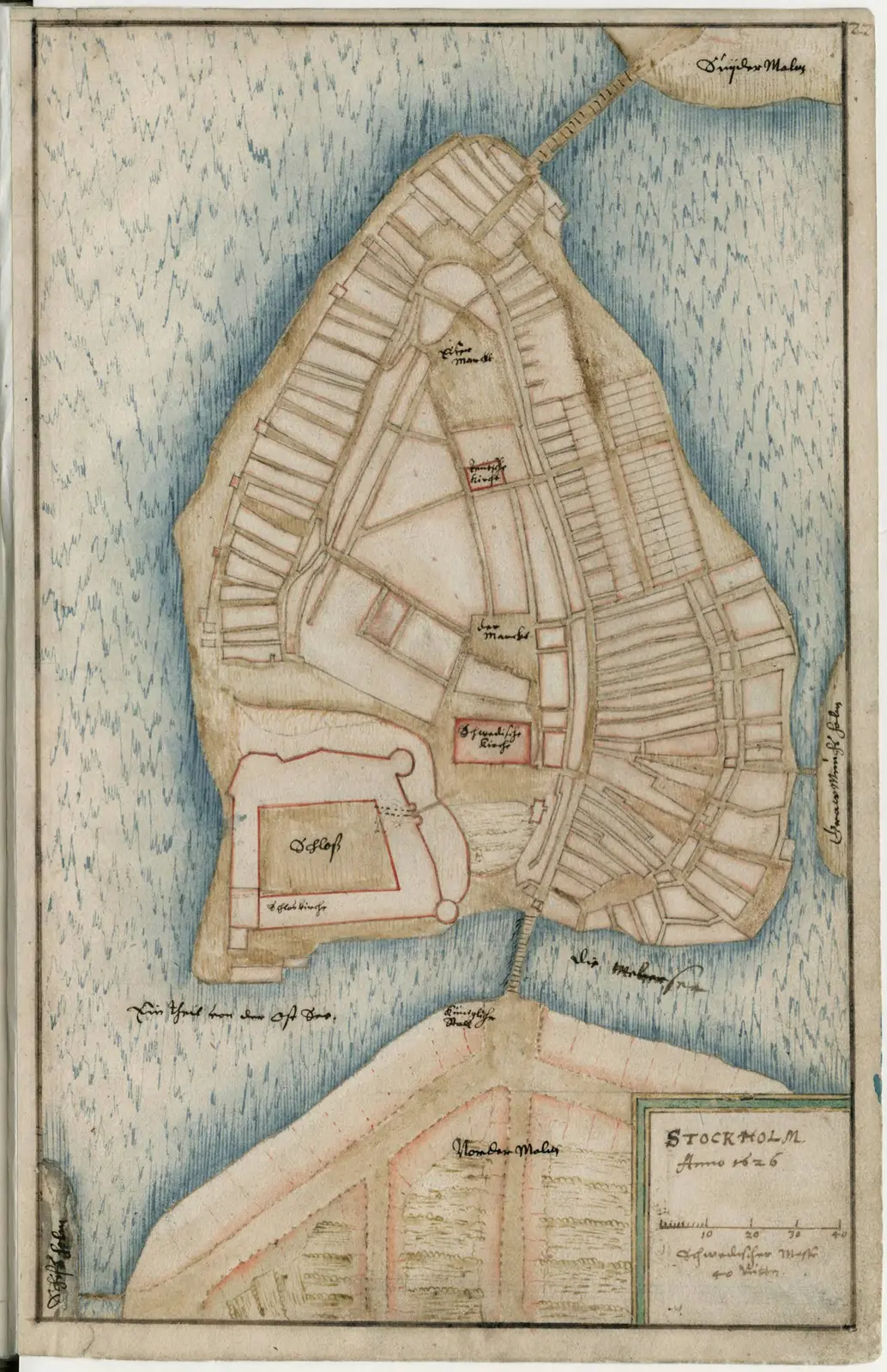
Stockholm's city island in 1626, two years before the sailing, on a hand-drawn map from the atlas of Heinrich Thomé. North is at the bottom, so the palace is at the lower left and the far end of the island, toward what is now Slussen, is at the top.
Atlas of Heinrich Thomé, No 17: Stockholm Anno 1626 by Heinrich Thomé, Public domain
Full credit
"Atlas of Heinrich Thomé, No 17: Stockholm Anno 1626" by Heinrich Thomé — https://commons.wikimedia.org/wiki/File:Atlas_of_Heinrich_Thom%C3%A9_-_No_17._Stockholm_Anno_1626.jpg — Public domain (US: map dated 1626, older than every US copyright term, published or unpublished; elsewhere: life-plus-70 tag and Public Domain Mark on the file page, supplied by the National Archives of Sweden)

The museum's English FAQ says she sailed for about 20 minutes before water came in. Its Swedish page says about fifteen. The distance on its timeline, 1,300 meters, would take about 16 minutes to walk at 5 km/h; its inquest pages round the same voyage to about a kilometer.
That walk is a tempting comparison, but it does not become a speed here. The walking multiple divides a speed by a 5 km/h walk, so it needs a distance and a time that belong together. The pages read for this account do not say whether the 1,300 meters is counted from the palace or from Slussen, and they give no time for the warping, so the Leg card says unknown.
The 38-kilometer plan
The plan was far longer. Crew families were aboard for the opening leg and were to go ashore at the fortress of Vaxholm, and the ship would then go on to Älvsnabben, the fleet's summer base in the archipelago. Only there would two companies of soldiers, 300 in all, board.
Wikidata coordinates and the haversine formula, the standard way to measure distance over the curve of the Earth, put the straight line from the palace to Älvsnabben at 38.3 km, or about 7.7 hours at walking pace. Any route through the archipelago would be longer. Vasa covered about 3 percent of even that straight line.
What happened when the Vasa sank?
Under the Södermalm bluffs there was so little wind that, according to the museum, it could not even pull the sheets taut (the sheets are the lines that hold the lower corners of the sails). The ship drifted on the current without answering her helm until a small gust heeled her to port, her left-hand side. She came back upright slowly. How square sails like hers turn wind into push is the subject of Tacking: How a Square-Rigged Ship Sailed Against the Wind.
The Council's letter of 12 August says more wind came into the sails in the bay at Tegelviken and she began to heel hard to leeward. She righted a little once or twice, the letter goes on, and off what it calls Bleekholmen she fell right over and the water came in at the gunports. The museum puts the stronger gust at the gap in the bluffs and the flooding at the open ports of the lower gundeck.
Its account has the captain order the sheets let go and the gunports shut, while Erik Jönsson went below to check that the guns had not broken loose. The museum calls him Vice Admiral. At the inquest the Admiral of the Realm said he had been appointed as one, and Jönsson answered that he was neither captain nor vice admiral, only a master of ordnance (Tygmestare). Within minutes she lay on the bottom, 32 meters down and about 120 meters from the shore of Beckholmen.
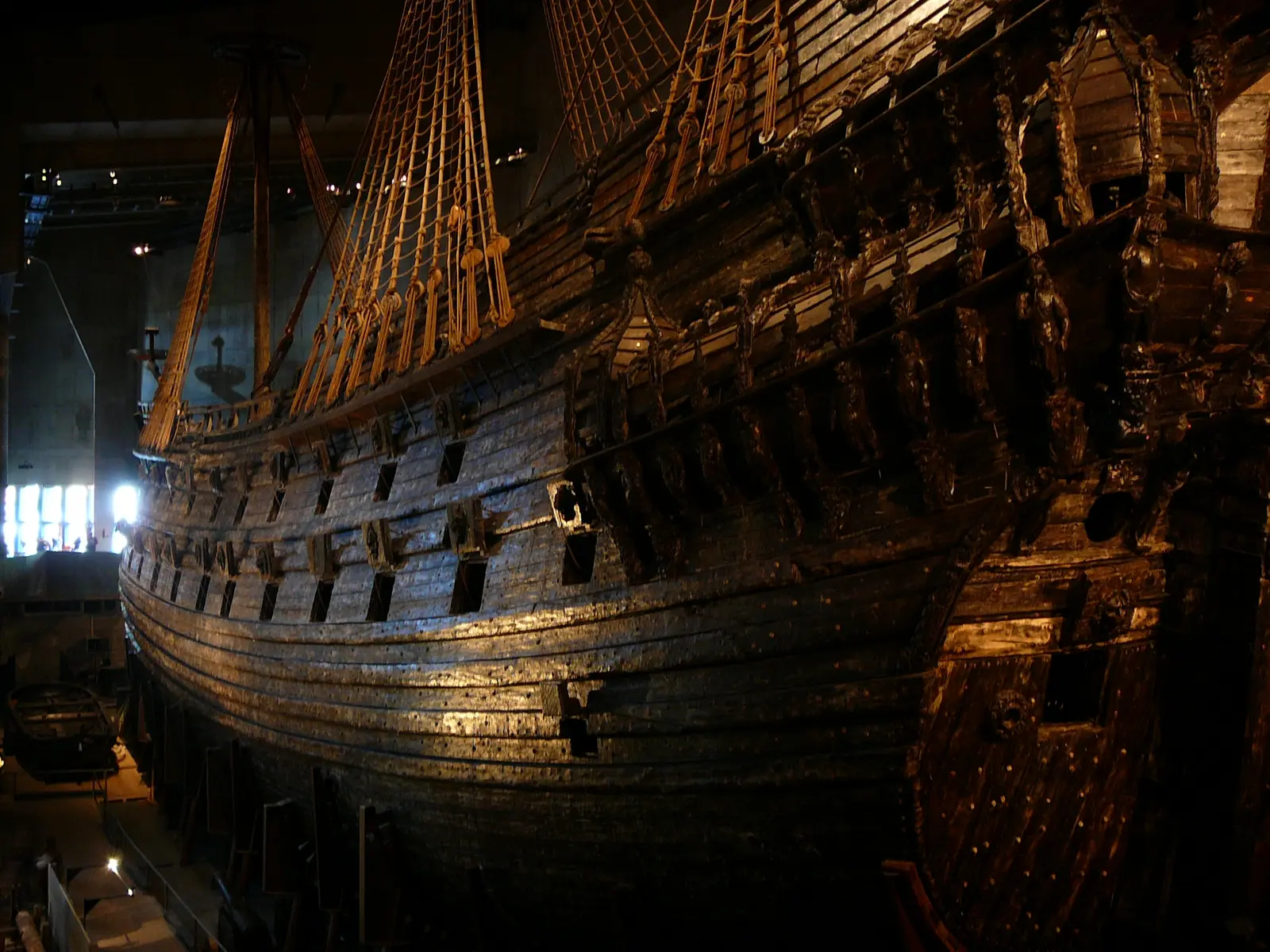
Vasa's hull in the Vasa Museum, photographed in 2007, with her two tiers of gunports. The water came in through the lower tier.
"Vasa 2" by MLeb — https://commons.wikimedia.org/wiki/File:Vasa_2.jpg — Public domain (released into the public domain worldwide by the photographer)

Her masts still stood above the water and many aboard held on to them, while others swam to Beckholmen or were picked up by small boats that had followed her. The museum puts the dead at roughly thirty, most of them trapped inside the ship. Only one is named in the historical sources: Captain Hans Jonsson, Vasa's original captain, who had stayed aboard as a second experienced officer for the maiden cruise. Söfring Hansson, the captain in command, was pulled down with her and only just came up.
Did anyone know the Vasa was unstable?
Yes. The warning came at the quay about a month before the voyage, and the record of it comes from the ship's master, Jöran Matsson, who described it to the inquest on 5 September 1628.
The thirty men on the upper deck
Söfring Hansson, the captain who supervised the ship's construction, had asked Vice Admiral Klas Fleming to watch thirty men run from side to side across the upper deck to set the ship rolling. The surviving transcript keeps Matsson's own count: Förste gången gaf det sigh een Planck öfwer, annan gången twå Plankor och 3 gången tree Plankor: one plank, two planks, three planks (translated by Keel, Rail & Spoke). Then, he said, Fleming told them to stop.
Matsson added that if they had run more times she would have gone over: hadhe de Lupet flere ressor, så hadhe det gådt omkull (translated by Keel, Rail & Spoke). The museum's modern account says a few crossings were enough to raise a real fear of capsizing where she lay moored below the palace. The museum's Swedish page calls it a stability demonstration (stabilitetsdemonstration).
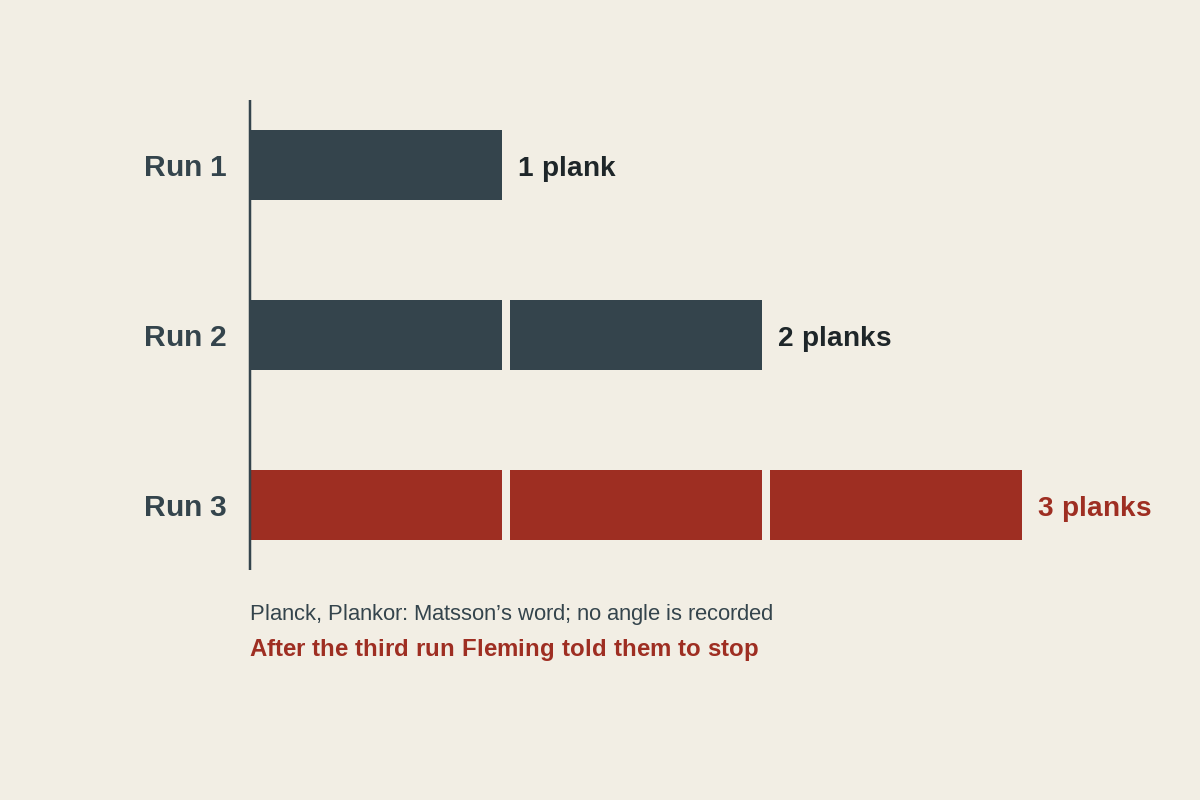
Matsson's count of the three runs, from the transcript of 5 September 1628: one plank, then two, then three. The planks are his word; no angle is recorded.
Keel, Rail & Spoke, CC BY 4.0
Data: Transcript of the Vasa inquest of 5 September 1628, Vasa Museum education unit after the original in Riksarkivet, https://www.vasamuseet.se/skola/i-klassrummet/originaldokument-om-vasa, retrieved 2026-11-08
Reuse this diagram: credit to copy
"Matsson's count of the three runs, 1628" by Keel, Rail & Spoke, https://keelrailandspoke.com/ships/vasa-1628/, licensed under CC BY 4.0 (https://creativecommons.org/licenses/by/4.0/).
Data behind this diagram and the two below: vasa-1628-inquest-record.csv · Where this data came from
The museum's English page dates this to probably 8 or 9 July, while its Swedish page says only that it was the month before departure, its timeline loosely says the voyage came months later, and the surviving transcript gives no date. These 1628 dates run on the old Julian calendar: the Council's letter and the museum both call 10 August a Sunday, true only on that calendar, where the day is 20 August by today's reckoning.
Matsson also reported what was said when it happened, in the transcript's spelling H.K.Mtt ändå wore hema: if only His Royal Majesty were at home (translated by Keel, Rail & Spoke). The transcript says only “he”; the museum's pages take the speaker to be Fleming.
Fleming did not tell the king, the museum says. Gustav II Adolf was away with the army and had written to Fleming several times urging him to get Vasa to sea, and the museum's Swedish page names the cost of the other choice: a larger rebuild to make the ship stable would have meant long delays. The museum's timeline says Fleming told Hansson to sail anyway, while its inquest page says all he did was name Hansson captain. In the gear terms this site uses for journeys, the missed gear came here on the quay, and the museum's account names the decision: a vice admiral watched the ship roll, did not report it, and the sailing went ahead.
A repair radius of about half a kilometer
The repair radius is this site's measure of how far a machine was from help when it failed: the distance from the fault to the nearest place on record that could fix it. In July 1628 that place was Skeppsgården, the navy yard where Vasa had been built, which stood on what is now the Blasieholmen peninsula; the museum's page on the yard says its contractors were to repair and maintain the navy's ships as well as build them. The straight line between the Wikidata points for the palace and Blasieholmen is 0.45 km, about five minutes on foot.
Shipwrights of the time called a ship that heeled too easily tender or crank. They knew what to do with one. The museum lists the accepted fixes: change the armament, add planking at the waterline, or cut the ship down by removing a deck. Vasa, the museum says, was too crank to last that long.
Why did the Vasa sink?
The people at the inquest named the cause in 1628. Matsson said she was narrow in the bottom with no buek, no belly, and the same word was put to the builder when he was called. In an appendix to the record, the museum reports, a group of captains and shipwrights gave their opinions, and one of them said she lacked the “belly” to bear her high, heavy upperworks, the hull and decks above the waterline.
The transcript's own copy of that appendix does not use that word. Its word is holskip, the depth of the hold (translated by Keel, Rail & Spoke), and six of the eight opinions say it was too small. The experts had no calculus or naval-architecture theory to lean on, since the mathematics now used to predict stability came, the museum notes, more than a century later.
Too little belly
The part of the hull under water was too small for the part above it. The museum's Swedish page says where the weight sat: both gundecks were built with thick, heavy beams to stop cannonballs and carry the ship's own guns, and the rig, her masts and rigging, was heavy as well. Its English page says that put the center of gravity, the point where the ship's whole weight acts, so far above the water that a light wind could tip her alarmingly.
The museum gives her length as 69 meters and her height from keel to the top of the mainmast as more than 50 meters, and she carried 64 guns when she sailed, with eight gunports still empty because the foundry had not cast enough guns.
Two systems of measurement
The museum's page on the navy yard says more than 400 people worked there in the warm months. About half were year-round workers recruited in Sweden, and the rest were seasonal workers, mostly from the Netherlands and Germany, so the yard mixed two languages, two shipbuilding traditions and two systems of measurement. The museum's comment is dry: “It is hardly a surprise that the ship turned out to be asymmetrical.” The page stops there and does not say the asymmetry sank her.
Could more ballast have saved her?
Ballast is weight stowed low in the hull to steady it. Vasa carried 120 tonnes of stone. Jöran Matsson, who was in charge of loading it, told the inquest by the museum's English account that he had ballasted her as deeply as she should go. The transcript's words are stronger: så mycken barlast der kunde ingå, as much ballast as could go in (translated by Keel, Rail & Spoke).
The builder argued that more ballast would have removed the danger. Hansson answered that the scuppers would then have come under water, and that the guns could not then have been used; the transcript's words on the ports, Portarne igen, drefne, can be read as driven shut or driven under (translated by Keel, Rail & Spoke). The witnesses' figures show how little room there was: Erik Jönsson said the gunports lay no more than 3½ feet from the water, and Petter Gierdsson estimated 4 or 4½ sko.
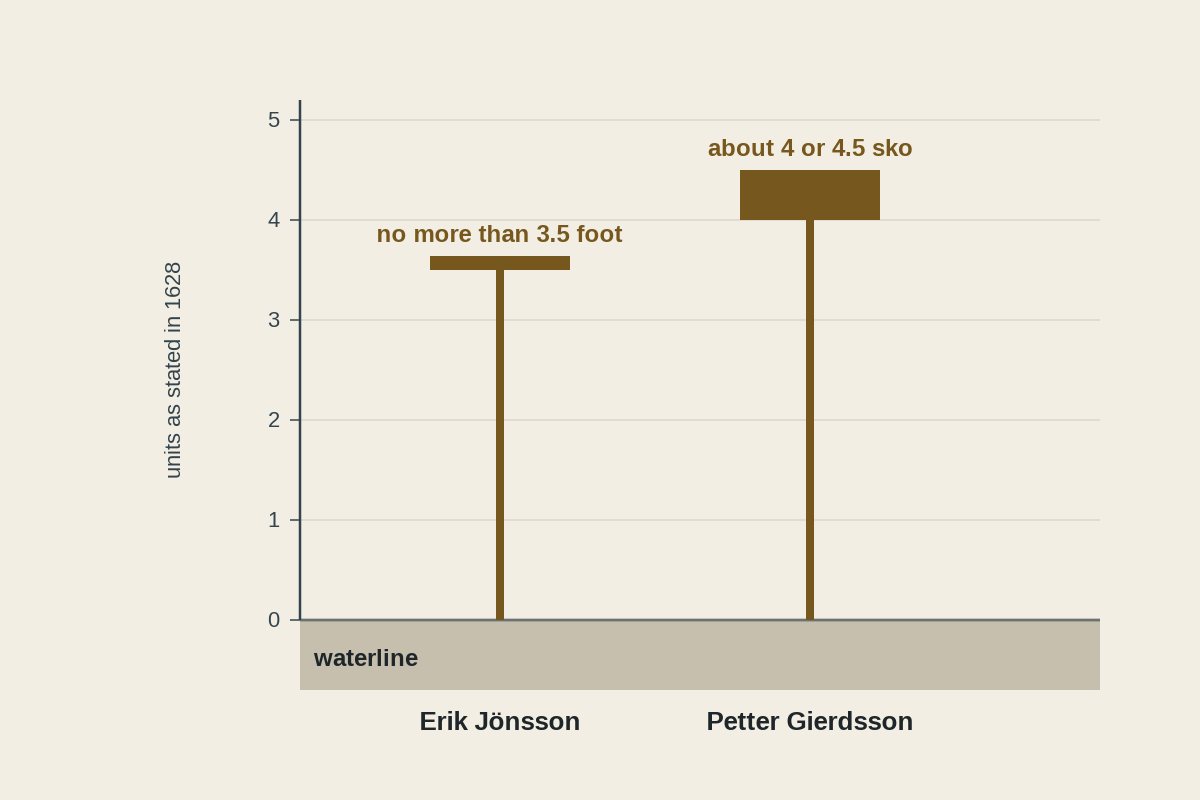
How high the gunports stood above the water, in the witnesses' own figures. Jönsson said foot and Gierdsson said sko; neither unit is converted here.
Keel, Rail & Spoke, CC BY 4.0
Data: Transcript of the Vasa inquest of 5 September 1628, Vasa Museum education unit after the original in Riksarkivet, https://www.vasamuseet.se/skola/i-klassrummet/originaldokument-om-vasa, retrieved 2026-11-08
Reuse this diagram: credit to copy
"Gunport height stated to the inquest, 1628" by Keel, Rail & Spoke, https://keelrailandspoke.com/ships/vasa-1628/, licensed under CC BY 4.0 (https://creativecommons.org/licenses/by/4.0/).
The open gunports turned a heel into a sinking. The museum calls leaving them open a fateful decision. Closed, the museum says, they would have kept the water out, and the ship might have stayed up until she could be rebuilt steadier. The Swedish page adds a caution, though: either way, Vasa was plainly not seaworthy.
This site files wrecks by how they failed before it files them by fame. Vasa goes under stability. Her famous name adds nothing to that diagnosis, which the inquest reached in 1628. The same question, what the record names as the failure, runs through USS Indianapolis and the Spanish Armada.
Who was blamed for the Vasa sinking?
Officially, no one. Söfring Hansson was jailed right after the sinking, and on 11 August the Council of State questioned him. He swore the crew were sober and every gun fast, and the record of that day has him say the fault was nothing but crankness: she was so crank she could not carry her masts.
The Council's first report went to the king on 12 August. The museum's English page says his fury can still be read in his reply, which demanded that the guilty be punished, while its Swedish page is more careful and says only that it is easy to assume he was furious. Accounts differ, even inside one museum.
The inquest at Tre Kronor, 5 September 1628
A commission of 17 councilors and senior officers met at Tre Kronor, the royal palace of the time, under the Admiral of the Realm, Karl Karlsson Gyllenhielm, the king's older half-brother. Parts of the transcript are lost. Each surviving officer was asked whether he had known the ship was unsteady, and the museum says all claimed ignorance until Matsson told the story of the thirty men.
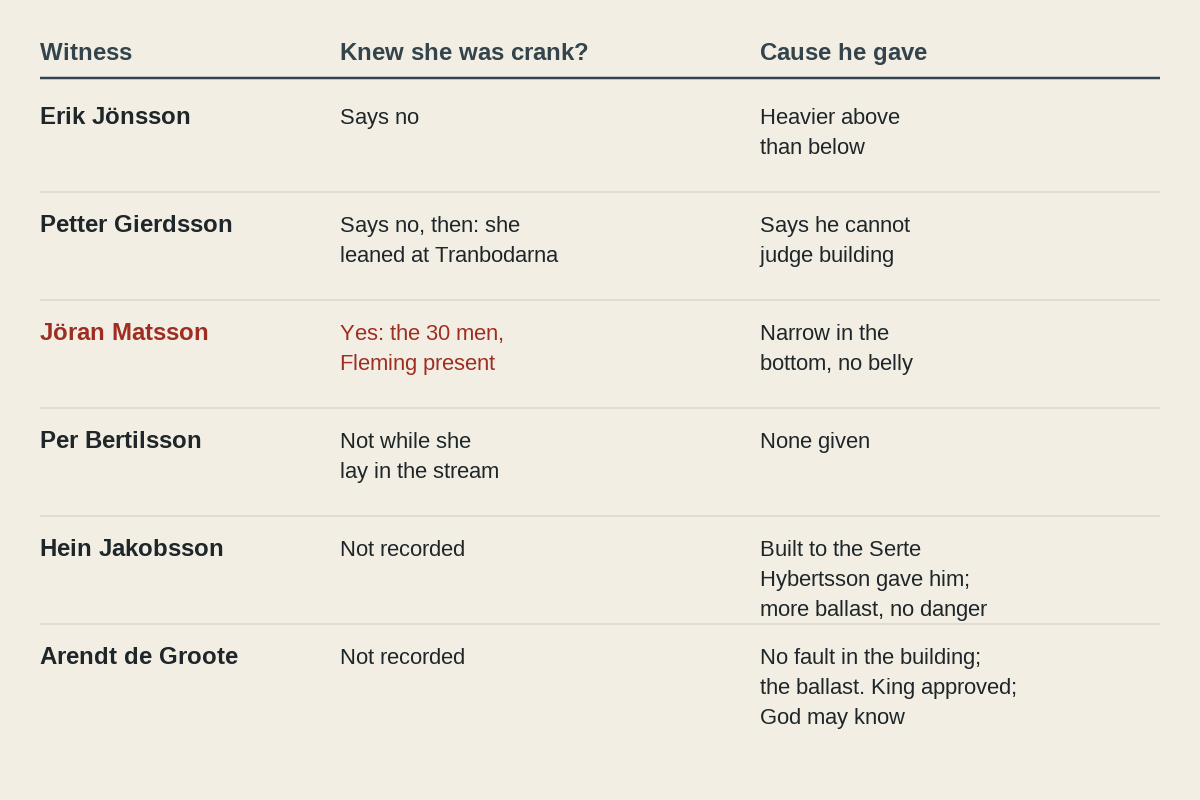
Six of the men questioned in the surviving part of the transcript. The same answers follow as a table.
Keel, Rail & Spoke, CC BY 4.0
Data: Transcript of the Vasa inquest of 5 September 1628, Vasa Museum education unit after the original in Riksarkivet, https://www.vasamuseet.se/skola/i-klassrummet/originaldokument-om-vasa, retrieved 2026-11-08
Reuse this diagram: credit to copy
"Six of the witnesses at the inquest of 5 September 1628" by Keel, Rail & Spoke, https://keelrailandspoke.com/ships/vasa-1628/, licensed under CC BY 4.0 (https://creativecommons.org/licenses/by/4.0/).
| Witness | Knew she was crank? | Cause he gave |
|---|---|---|
| Erik Jönsson | Says no | Heavier above than below |
| Petter Gierdsson | Says no, then says she leaned at Tranbodarna when people walked to one side | Says he cannot judge shipbuilding |
| Jöran Matsson | Yes: the 30 men, with Fleming present | Narrow in the bottom, no belly |
| Per Bertilsson | Not while she lay in the stream | None given |
| Hein Jakobsson | Not recorded in the surviving part | Built to the Serte Hybertsson gave him (the museum's Swedish page: specification); more ballast, he says, would have kept her safe |
| Arendt de Groote | Not recorded in the surviving part | No fault in the building, he says, only the ballast; the king approved; God may know |
The builders were next. Hein Jakobsson said he had built the ship to Master Henrik Hybertsson's design, one the king had approved, though he added that he had widened her slightly: by about 40 cm on the museum's English page, or about 42 cm on its Swedish one. The transcript itself says een foot och 5 tumar, a foot and five inches (translated by Keel, Rail & Spoke). By the museum's account Arendt de Groote, Hybertsson's business partner, said he had once put an image of a comparable ship before the king to work from.
Promotions instead of punishment
Convicting the builders risked blackening the name of the king who had approved the design, the museum's Swedish page notes, and its English page calls the proceedings, to a certain degree, “a piece of political theatre.” No one was punished. The English page says everyone questioned was eventually promoted.
Jakobsson built ships for the navy until he retired in 1638, Matsson became a captain, and Hansson rose to run the navy yard as its supervising officer. Fleming was abroad and was never questioned. Most of the blame fell, indirectly, on Hybertsson, who had died in 1627 and could not answer.
Where is the Vasa now?
She stands in the Vasa Museum in Stockholm, which opened on 15 June 1990, and the museum says more than 98 percent of her original structure survives. Almost all of her guns came up between 1663 and 1665, when divers led by Albrecht von Treileben and Andreas Peckell worked from a diving bell, but the hull stayed in the mud. The museum's FAQ gives the main reason she lasted: she went down in one piece, in brackish water, which has no shipworm to eat the wood.
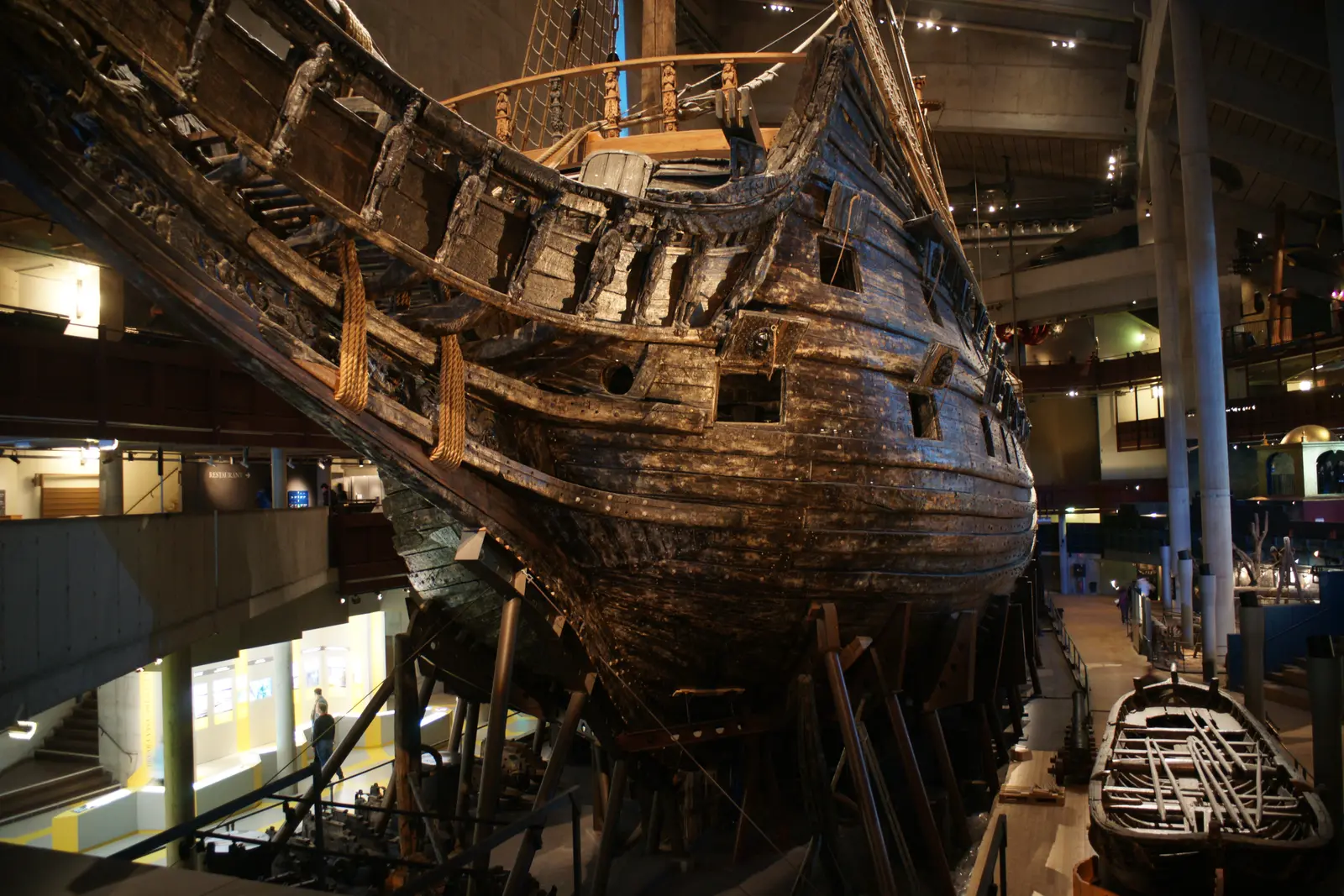
The hull in the Vasa Museum, seen from the bow, photographed in 2009.
"The Vasa from the Bow" by JavierKohen — https://commons.wikimedia.org/wiki/File:The_Vasa_from_the_Bow.jpg — CC BY-SA 3.0 (https://creativecommons.org/licenses/by-sa/3.0)

On 25 August 1956 Anders Franzén, a fuels engineer, pulled up a core of black, sodden oak off Beckholmen. From 20 August 1959 salvors lifted the wreck in 18 stages into the lee of Kastellholmen, 17 meters down, and divers then spent more than 18 months making the hull ready.
The shores of Kastellholmsviken, the bay by Kastellholmen, filled with thousands of people on Monday 24 April 1961, much as a crowd had lined the shore in 1628. At 09:03 the worn tops of a few frames showed above the water.
The Ibry strip: a month at the quay, then 1.3 km
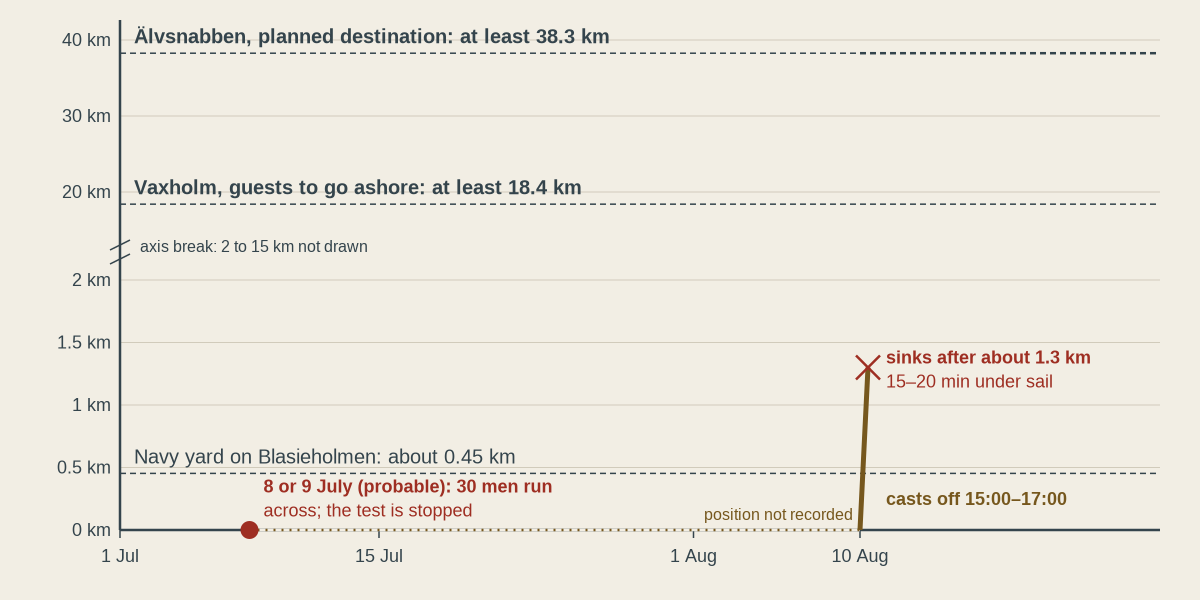
Time runs left to right and distance runs up, so the slope of a line is a speed. The dotted stretch is the month between the demonstration and the sailing, when her position is not recorded in the pages read, and dashed lines mark the planned stops and the navy yard.
Keel, Rail & Spoke, CC BY 4.0
Data: Vasa Museum (SMMTF) history pages, https://www.vasamuseet.se/en/explore/vasa-history, retrieved 2026-11-08; Council of State letter of 12 August 1628, Vasa Museum transcript, https://www.vasamuseet.se/skola/i-klassrummet/originaldokument-om-vasa, retrieved 2026-11-08; Wikidata coordinates (CC0), https://www.wikidata.org/, retrieved 2026-11-08
Reuse this diagram: credit to copy
"Vasa, 1628: a month at the quay, then 1.3 km" by Keel, Rail & Spoke, https://keelrailandspoke.com/ships/vasa-1628/, licensed under CC BY 4.0 (https://creativecommons.org/licenses/by/4.0/).
Reference distances and coordinates behind this diagram: vasa-1628-ibry-strip.csv · Where this data came fromData: Wikidata coordinates (CC0), https://www.wikidata.org/, retrieved 2026-11-08
The planned stops are straight-line minimums between Wikidata points: Vaxholm at least 18.4 km, Älvsnabben at least 38.3 km, with the navy yard at 0.45 km. Dates sit at the start of each day, so the 10 August leg, which began between 15:00 and 17:00 by the two accounts, draws as a near-vertical line whose slope is not a measured speed. The 1.3 km is drawn from the quay only because the pages read do not give its start, and the 15 to 20 minutes are sailing time alone. The dated points come from the museum and the Council's letter and are not in the data file.
The last spare on this voyage is not applicable: she capsized, and the sources read do not tie that to any supply running out.
Sources
- Protocol of the inquest held at Stockholm Palace on 5 September 1628 (surviving part). Transcribed by the education unit of the Vasa Museum, June 2015, after the original in Riksarkivet and Hafström, En bok om skeppet Wasa. https://www.vasamuseet.se/globalassets/vasamuseet/dokument/skola/t_forhorsprotokoll-5-sep-1628-renskrift.pdfRead: full transcript, in the original Swedish
- Interrogation of Captain Söfring Hansson, 11 August 1628. Transcribed by the education unit of the Vasa Museum, June 2015, after the original in Riksarkivet. https://www.vasamuseet.se/globalassets/vasamuseet/dokument/skola/t_forhor-med-sofring-hansson-renskrift.pdfRead: full transcript, in the original Swedish
- Council of State to the king, 12 August 1628. Transcribed by the education unit of the Vasa Museum after the original in Riksarkivet. https://www.vasamuseet.se/globalassets/vasamuseet/dokument/skola/t_radets-brev-till-kungen-renskrift.pdfRead: full transcript, in the original Swedish
- Vasa Museum (SMMTF). "The Inquest." https://www.vasamuseet.se/en/explore/vasa-history/inquestRead: full page, in English
- Vasamuseet (SMMTF). "Utredningen" (Swedish: "The Inquest"). https://www.vasamuseet.se/utforska/vasas-historia/utredningenRead: full page, in Swedish
- Vasa Museum (SMMTF). "The Disaster." https://www.vasamuseet.se/en/explore/vasa-history/disasterRead: full page, in English
- Vasamuseet (SMMTF). "Olyckan" (Swedish: "The Disaster"). https://www.vasamuseet.se/utforska/vasas-historia/olyckanRead: full page, in Swedish
- Vasa Museum (SMMTF). "Timeline." https://www.vasamuseet.se/en/explore/vasa-history/timelineRead: full page, in English
- Vasa Museum (SMMTF). "Facts about Vasa." https://www.vasamuseet.se/en/explore/vasa-history/facts-about-vasaRead: full page, in English
- Vasa Museum (SMMTF). "The Ship Yard." https://www.vasamuseet.se/en/explore/vasa-history/ship-yardRead: full page, in English
- Vasa Museum (SMMTF). "Vasa – the machine of war." https://www.vasamuseet.se/en/explore/vasa-history/machine-of-warRead: full page, in English
- Vasa Museum (SMMTF). "Skeletons from Vasa." https://www.vasamuseet.se/en/explore/research/skeletonsRead: full page, in English
- Vasa Museum (SMMTF). "The Salvage." https://www.vasamuseet.se/en/explore/vasa-history/salvageRead: full page, in English
- Vasa Museum (SMMTF). "Why was Vasa so well preserved when the ship was salvaged?" Museum FAQ. https://faq.vasamuseet.se/category/45/article/4494?lang=enRead: full answer, in English
- Wikidata. Coordinate statements (P625) for Stockholm Palace (Q750444), Blasieholmen (Q1888208), Slussen (Q371929), Gustav V dry dock (Q10511160), Vaxholm Fortress (Q2627611) and Älvsnabben (Q932957). https://www.wikidata.org/wiki/Special:EntityData/Q750444.jsonRead: entity data, coordinates only
- Wikidata. "Wikidata:Copyright" (structured data released under CC0). https://www.wikidata.org/wiki/Wikidata:CopyrightRead: full page
Cite this page
Keel, Rail & Spoke. "Vasa Ship, 1628: Stability Test Stopped, Then She Sailed." Published 2026-11-08. https://keelrailandspoke.com/ships/vasa-1628/. Accessed on the date you read it.
How facts are checked · Corrections · Contact
Found a mistake on this page? Write to contact@keelrailandspoke.com.
More from Ships & Wrecks
Ships & Wrecks
Mutiny on the Bounty: 3,618 Miles in 41 Days, by Bligh’s Log
After the 1789 mutiny on the Bounty, William Bligh logged 3,618 miles to Timor in 41 days in an open launch. His noon positions rechecked, and 44 men's fates.
Picture credit
"The Mutineers turning Lt Bligh and part of the Officers and Crew adrift from His Majesty's Ship the Bounty" by Robert Dodd; State Library of New South Wales, DL Pf 137 — https://commons.wikimedia.org/wiki/File:Mutiny_HMS_Bounty.jpg — Public domain (US: published 1790, before 1931; elsewhere: creator died 1815, life+70 term expired); modified: cropped: paper margin and printed text below the image removed; reduced to 2,400 px wide
Ships & Wrecks
Spanish Armada, 1588: One Undated Spanish List Says 65 Lost
One English report of 1588 said the Spanish Armada had lost at least 16 ships; an undated Spanish list printed in 1899 totals 65. Each count, with who gave it.
Picture credit
"The Spanish Armada off the English Coast in 1588" by Cornelis Claesz van Wieringen; Rijksmuseum, SK-A-1629 — https://commons.wikimedia.org/wiki/File:The_Spanish_Armada_off_the_English_Coast_in_1588_(by_Cornelis_Claesz_van_Wieringen)_-_Rijksmuseum,_Amsterdam_(SK-A-1629).jpg — Public domain (US: painted about 1620 to 1625, every term expired; elsewhere: creator died 1633, life+70 term expired; Rijksmuseum marks it public domain)
Ships & Wrecks
USS Indianapolis: Men Spotted by Chance Days Later, Law Says
USS Indianapolis sank in about 12 minutes on 30 July 1945, a 2018 act says. A 1999 House text says shore offices did not report her overdue. Sources for each.
Picture credit
"USS Indianapolis (CA-35) underway at sea on 27 September 1939" by unknown creator; U.S. Navy photo 80-G-425615 — https://commons.wikimedia.org/wiki/File:USS_Indianapolis_(CA-35)_underway_at_sea_on_27_September_1939_(80-G-425615).jpg — Public domain (US: work of the U.S. Navy, no copyright under 17 U.S.C. 105; elsewhere: anonymous work, made 1939, more than 70 years since it was made)


