Ships & Wrecks · Wreck & failure inquiry
Spanish Armada, 1588: One Undated Spanish List Says 65 Lost
Every count of the Armada's lost ships comes from someone with a reason to give it, so this page sets each number beside who gave it and when.
Keel, Rail & Spoke · Published
TL;DR
- The Spanish Armada of 1588 mustered 131 ships at Corunna, by its own statement, fought the English in the Channel, then sailed home around Scotland and Ireland.
- An English report of 7 August 1588, Old Style, said the Spanish had “lost at the least 16 of their best ships.” It was written before the voyage home was over.
- A Spanish list printed by Martin Hume in 1899 totals 65 vessels lost. Hume had it at second hand, and he warned that it understates Ireland.
Leg card
- Departure
- Lisbon, put to sea 30 May 1588 (NS), 20 May (OS). One relation says 29 May
- Arrival
- Santander: the Duke of Medina Sidonia wrote from there on 23 September 1588 (NS). Other ships reached other ports or none
- Distance
- About 4,879 km (3,032 mi; 2,635 nmi) as a rough floor: straight links, Lisbon to Santander, through places the fleet reached and headlands outside which its course ran. Not a track. The purser Calderon gave 750 leagues for the way home alone
- Machine
- About 130 ships in the Lisbon plan, 131 at the Corunna muster, 151 vessels by the purser Calderon: galleons, hulks, pataches, 4 galleasses, 4 galleys
- Elapsed
- 116 days to the Duke's letter from Santander, including 33 days at Corunna
- Walking multiple
- about 0.35 (overall): about 4,879 km, a rough floor, in 116 days to the Duke's letter, at 5 km/h
- Repair radius
- unknown. Fault: shot damage and leaks after 8 August. No record read here names a place able to repair the fleet
- The last spare
- multiple constraints: shot by 8 August (the Duke's journal); water and bread by September (the Duke's letter of 23 September). Causes other than supply are also in the record
- Key source
- Laughton, State Papers Relating to the Defeat of the Spanish Armada (1894); Hume, Calendar of State Papers, Simancas, vol. 4 (1899)
Download this card (CSV) · Where this data came from
Data: Martin A. S. Hume, ed., Calendar of Letters and State Papers, Simancas, vol. 4 (1899), public domain, https://archive.org/details/adw2692.0004.001.umich.edu, retrieved 2026-11-08; J. K. Laughton, ed., State Papers Relating to the Defeat of the Spanish Armada, vol. 2 (1894), public domain, https://archive.org/details/statepapersrelat02navyuoft, retrieved 2026-11-08; Wikidata coordinates (CC0), https://www.wikidata.org/, retrieved 2026-11-08
What the card means: walking multiple, repair radius, last spare.
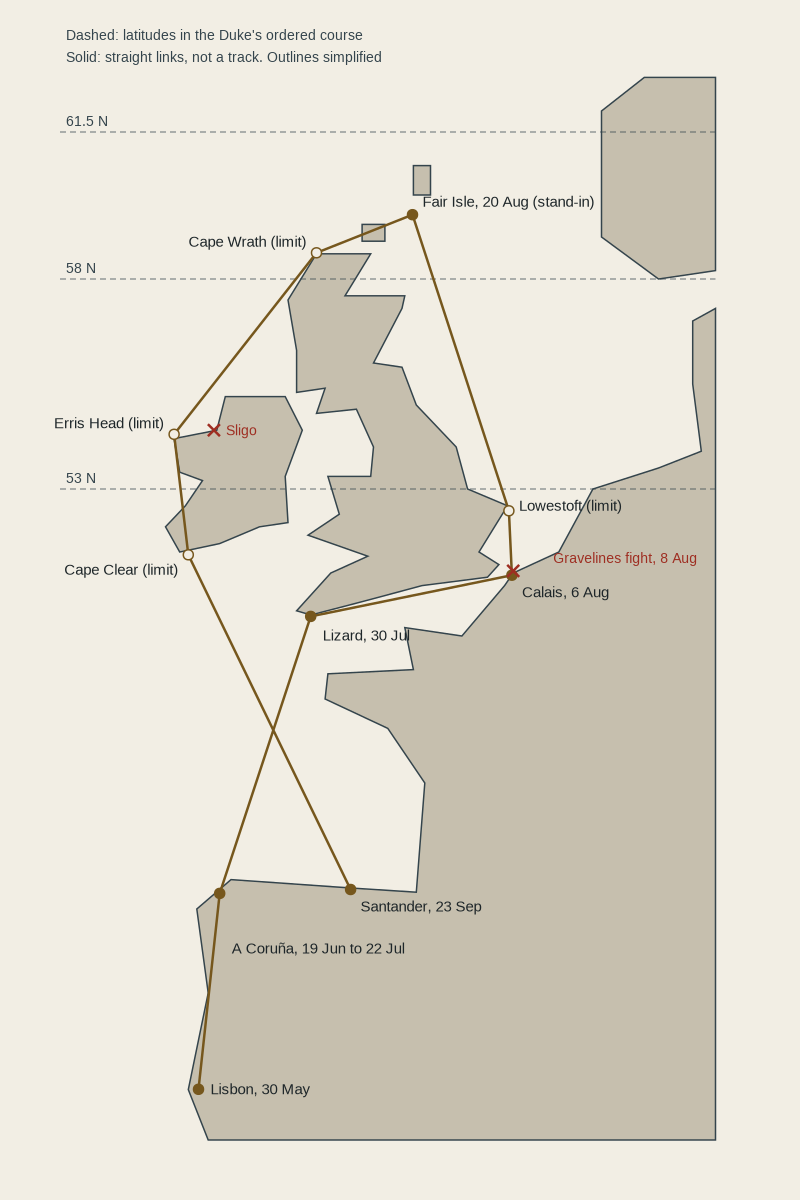
The Armada's way, 30 May to 23 September 1588, dated as Spain dated it. Straight lines run between places, and some cross land the fleet had to sail around, so the total is a rough floor and not a track. Hollow points are headlands outside which the course ran, not recorded stops.
Keel, Rail & Spoke, CC BY 4.0
Data: Martin A. S. Hume, ed., Calendar of Letters and State Papers, Simancas, vol. 4 (1899), public domain, https://archive.org/details/adw2692.0004.001.umich.edu, retrieved 2026-11-08; J. K. Laughton, ed., State Papers Relating to the Defeat of the Spanish Armada, vol. 2 (1894), public domain, https://archive.org/details/statepapersrelat02navyuoft, retrieved 2026-11-08; Hugh Allingham and Robert Crawford, Captain Cuellar's Adventures in Connacht and Ulster (1897), public domain, https://www.gutenberg.org/ebooks/52472, retrieved 2026-11-08; Wikidata coordinates (CC0), https://www.wikidata.org/, retrieved 2026-11-08
Reuse this diagram: credit to copy
"The Spanish Armada: Lisbon to Santander, 1588" by Keel, Rail & Spoke, https://keelrailandspoke.com/ships/spanish-armada-1588/, licensed under CC BY 4.0 (https://creativecommons.org/licenses/by/4.0/).
Data behind this diagram: spanish-armada-1588-route.csv · Where this data came from
An English report counted at least 16 Armada ships lost by Gravelines, before a way home of about 3,073 km. The report is “A Brief Abstract of Accidents,” sent with Lord Howard of Effingham's letter of 7 August 1588; John Knox Laughton printed it in 1894. A list traced to the Spanish archive at Simancas, printed by Martin Hume in 1899, gives a total of 65. The two numbers do not count the same thing.
The whole voyage, Lisbon to Santander, comes to about 4,879 km in straight links, 3,073 km of them from Calais, and 116 days counted to the Duke's letter from Santander on 23 September. The links cut corners the ships had to sail around, so that total is a rough floor. It gives a walking multiple of about 0.35 (overall), with 33 days in port at Corunna included. At 5 km/h, a walker who never stopped would cover the same distance in about 41 days.
Stops on this page (6)
- How many ships sailed with the Spanish Armada?
- What did the English report say about Spanish losses?
- Which ships do Spanish accounts say were lost in the fighting?
- How many ships did the Spanish list as lost?
- The Ibry strip: why did the Armada go home around Scotland?
- What happened to the Armada on the Irish coast?
How many ships sailed with the Spanish Armada?
The record says 130, 131, 145 or 151, depending on who is counting and when. A summary drawn up at Lisbon on 9 May says “There will go in the Armada 130 ships,” with 10 caravels and 10 faluas counted apart. The muster at Corunna on 13 July has a printed total of 131, and its rows reach that figure only if seven felucas are left out.
Don Diego Pimentel, a Spanish officer taken prisoner, told his questioners the fleet left the river of Lisbon with 145 sail. Laughton warns that the translations of those depositions, “the English especially, are very inaccurate,” so that figure carries less weight than the two Spanish papers. Pedro Coco Calderon, the fleet's chief purser, lists 151 vessels leaving Corunna on 22 July, in nine classes that include 11 caravels and 10 pinnaces.
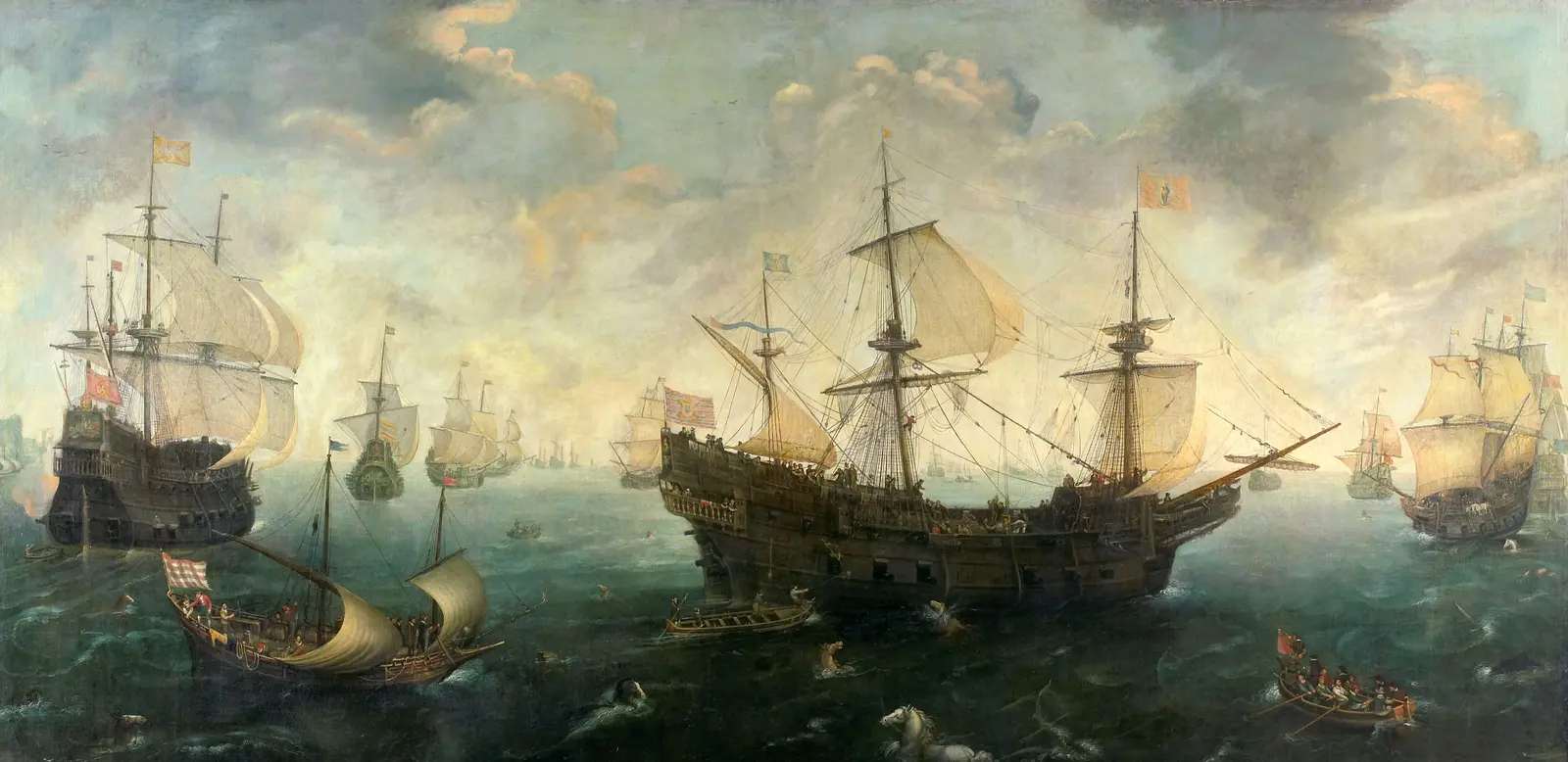
Cornelis Claesz van Wieringen painted this view around 1620 to 1625, more than 30 years after the event. It is a painter's picture of the fleet, not a record of it.
The Spanish Armada off the English Coast in 1588 by Cornelis Claesz van Wieringen; Rijksmuseum, SK-A-1629, Public domain
Full credit
"The Spanish Armada off the English Coast in 1588" by Cornelis Claesz van Wieringen; Rijksmuseum, SK-A-1629 — https://commons.wikimedia.org/wiki/File:The_Spanish_Armada_off_the_English_Coast_in_1588_(by_Cornelis_Claesz_van_Wieringen)_-_Rijksmuseum,_Amsterdam_(SK-A-1629).jpg — Public domain (US: painted about 1620 to 1625, every term expired; elsewhere: creator died 1633, life+70 term expired; Rijksmuseum marks it public domain)

The dates need one warning. Spain had moved to the New Style calendar and England had not, so 8 August in a Spanish paper is 29 July in an English one. Dates here are New Style unless marked OS. Howard's letter, dated 7 August OS, was written on 17 August by the Spanish count.
By the Spanish calendar, the fleet put to sea from Lisbon on 30 May. The Duke entered Corunna after a gale on 19 June, and the fleet left on 22 July, was off the Lizard on 30 July, and anchored off Calais on 6 August.
What did the English report say about Spanish losses?
Howard's own letter makes the smaller claim, seven ships in one fight. Of the last fight, before Gravelines, he wrote: “we sank three of their ships, and made four to go room with the shore so leak as they were not able to live at sea.”
The abstract sent with the letter covers the whole Channel fight and goes further. After reporting three sunk and four or five driven ashore, it says, “at that time it was assured that they had lost at the least 16 of their best ships.” It does not list the 16. Another English paper, a copy of a letter to Prince Maurice that Laughton gives with a query to Lord Henry Seymour, says “about eight great ships.”
Other counts run lower or sit in between. A relation in Hume's volume, which he thought a Genoese spy in London had probably translated from an English account, says the enemy had “lost 11 or 12 of his best ships,” adding “that we know of.” Pimentel, who strayed from the fleet on 8 August, said “they had lost but three ships.” This page works like the USS Indianapolis page: every claim stays attached to the person who made it.
| Who | When | Figure | Covers |
|---|---|---|---|
| Don Diego Pimentel, prisoner | 12 August 1588 | 3 | The fleet up to 8 August |
| Spanish narratives, counted on this page | August and September 1588 | 6 named | The fighting, to 8 August |
| Howard to Walsyngham | 7 August 1588 OS | 7 | The Gravelines fight only |
| Letter to Prince Maurice | August 1588 OS, date queried | about 8 | Great ships |
| Relation, Hume no. 424 | 7 September 1588 OS, date queried | 11 or 12 | Best ships |
| Abstract of Accidents | 7 August 1588 OS | at least 16 | Best ships, whole Channel fight |
| Irish state paper, via Allingham | 1588 | 15 or 16 | Connaught coast and just off it |
| Advices from London, sent to Spain | 21 November 1588 | 16 or more, a rumor | Ireland |
| Carew Papers list, via Hume | not dated by Hume | 17 | Ireland |
| Captain Francisco de Cuellar | 4 October 1589 | more than 20 | Ireland, Scotland and Shetland; largest ships |
| Simancas relation, via Hume | undated | 65 | All vessels, whole campaign |
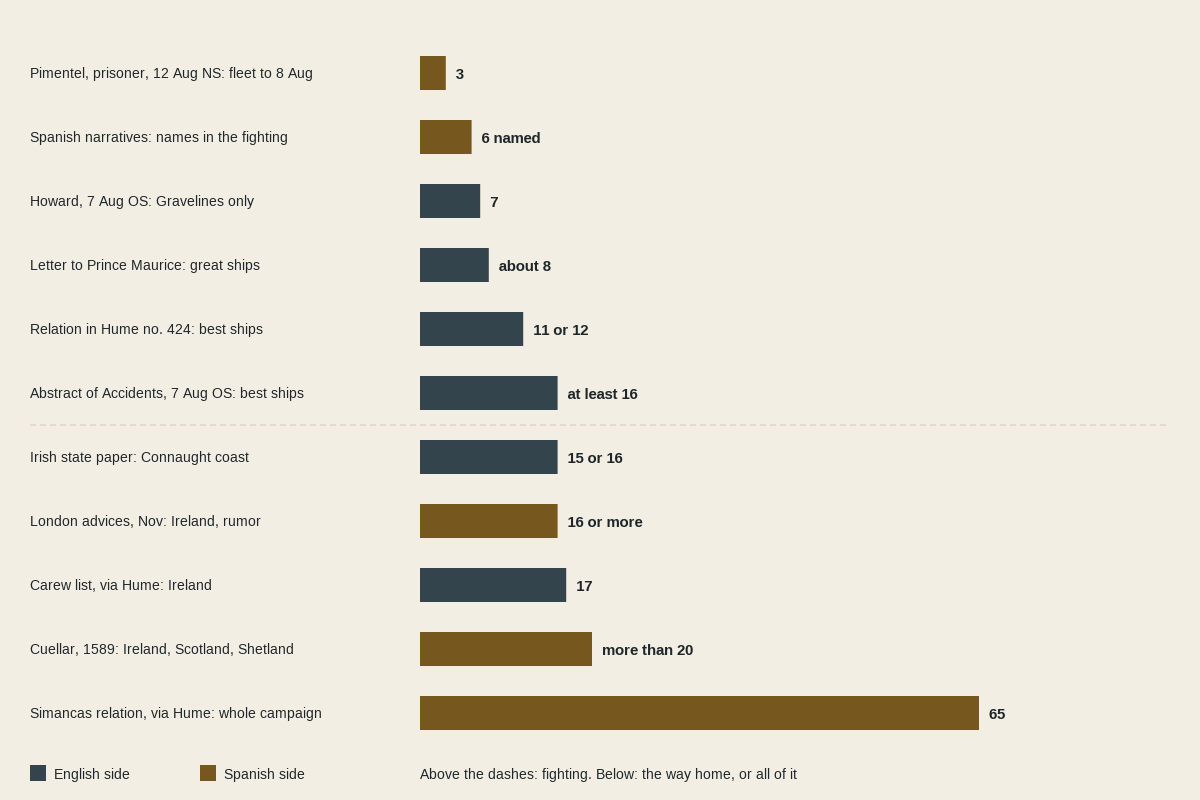
Eleven counts, each with its speaker and its scope. The bars above the dashed line cover the fighting. Those below cover Ireland, or the whole campaign. They are not one series, and they should not be added.
Keel, Rail & Spoke, CC BY 4.0
Data: J. K. Laughton, ed., State Papers Relating to the Defeat of the Spanish Armada, vol. 2 (1894), public domain, https://archive.org/details/statepapersrelat02navyuoft, retrieved 2026-11-08; Martin A. S. Hume, ed., Calendar of Letters and State Papers, Simancas, vol. 4 (1899), public domain, https://archive.org/details/adw2692.0004.001.umich.edu, retrieved 2026-11-08; Hugh Allingham and Robert Crawford, Captain Cuellar's Adventures in Connacht and Ulster (1897), public domain, https://www.gutenberg.org/ebooks/52472, retrieved 2026-11-08
Reuse this diagram: credit to copy
"Eleven counts of the Armada's losses" by Keel, Rail & Spoke, https://keelrailandspoke.com/ships/spanish-armada-1588/, licensed under CC BY 4.0 (https://creativecommons.org/licenses/by/4.0/).
Data behind this diagram: spanish-armada-1588-losses.csv · Where this data came from
Which ships do Spanish accounts say were lost in the fighting?
The Spanish narratives read here name six ships, by this page's count. Five are in the journal the Duke of Medina Sidonia sent to the king, and the sixth is in Calderon's statement. Their ends were not all the same.
On 31 July, Don Pedro de Valdes's Rosario ran foul of another ship, lost her bowsprit, and then broke her foremast. She fell behind in the dark and the English took her. At 4 that afternoon, on Oquendo's vice-admiral, the San Salvador, “some of the powder barrels caught fire, and her two decks and her poop were blown up.”
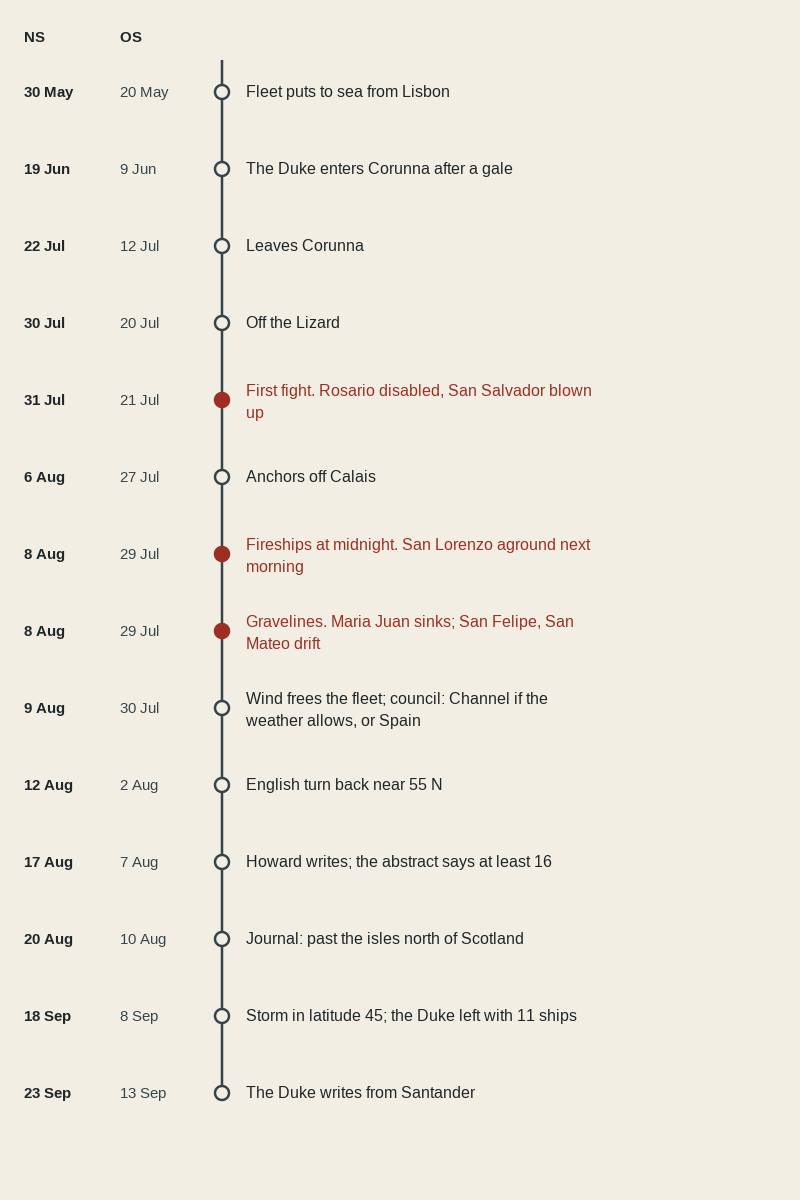
The voyage in both calendars. Red marks the days when the Spanish narratives name a ship lost.
Keel, Rail & Spoke, CC BY 4.0
Data: J. K. Laughton, ed., State Papers Relating to the Defeat of the Spanish Armada, vol. 2 (1894), public domain, https://archive.org/details/statepapersrelat02navyuoft, retrieved 2026-11-08; Martin A. S. Hume, ed., Calendar of Letters and State Papers, Simancas, vol. 4 (1899), public domain, https://archive.org/details/adw2692.0004.001.umich.edu, retrieved 2026-11-08
Reuse this diagram: credit to copy
"The Armada in both calendars, 1588" by Keel, Rail & Spoke, https://keelrailandspoke.com/ships/spanish-armada-1588/, licensed under CC BY 4.0 (https://creativecommons.org/licenses/by/4.0/).
Eight fireships came down on the anchored fleet off Calais around midnight on 7 August. In the confusion the flag galleass San Lorenzo tangled with the San Juan de Sicilia, damaged herself, and ran aground at the entrance to Calais harbor the next morning.
The fight at Gravelines came on 8 August, against an English fleet the journal puts at 136 ships. There the San Felipe and the San Mateo were so badly hit that their people were being taken off, and both drifted toward Zeeland. Calderon adds the Maria Juan, whose crew “had taken to the spars and rigging” before she sank. She is the only one of the six these accounts describe as sinking.
Howard said three. The two sides disagree on this point, and nothing read here settles it.
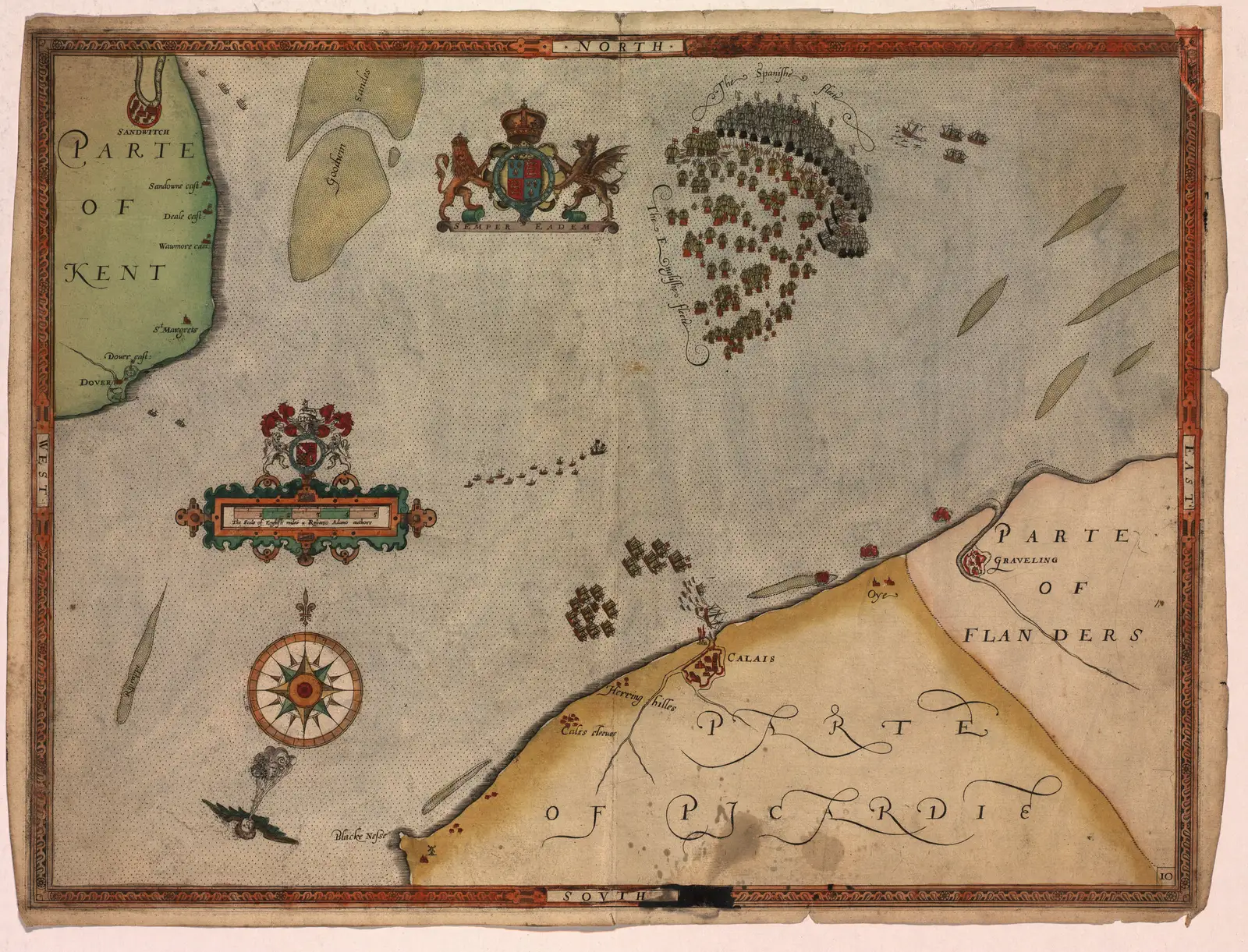
Robert Adams and Augustine Ryther's chart of the strait, engraved to go with Petruccio Ubaldini's discourse on the campaign and dated 1589 on its file page. It gives the English view. Reduced in size.
Expeditionis Hispanorum in Angliam vera descriptio, Map 7 by Robert Adams and Augustine Ryther; Library of Congress, Hans P. and Hanni Kraus Sir Francis Drake Collection, Public domain
Full credit
"Expeditionis Hispanorum in Angliam vera descriptio, Map 7" by Robert Adams and Augustine Ryther; Library of Congress, Hans P. and Hanni Kraus Sir Francis Drake Collection — https://commons.wikimedia.org/wiki/File:Expeditionis_Hispanorum_in_Angliam_vera_descriptio._Anno_Do-_M_D_LXXXVIII._LOC_2004629175-8.jpg — Public domain (US: published about 1589 to 1590, before 1931; elsewhere: published more than 400 years ago, every term expired); modified: reduced to 2,400 px wide

How many ships did the Spanish list as lost?
The list totals 65: 41 ships, 20 pataches (small dispatch boats), 3 galleasses and 1 galley. Hume prints it at pages 343 and 344 of his calendar, under the title “A Statement of all the Vessels of the Armada which were lost.” He is plain about where it came from: “It is extracted by Captain Fernandez Duro from the transcript of a ‘relation’ at Simancas, the original of which I have not been able to find.”
That gives the figure three limits. It is one undated list, not a set of Spanish counts. The text of two separate scans of the volume yields the same 63 names against the stated 65, so the gap looks like the printed page's own, and it has not been reconciled.
Hume also says that “The above list understates the number of ships lost on the Irish coast,” and he names the San Marcos, which does not appear among the 63. Neither does the San Mateo.
Only 13 of the 63 names carry a note on where the ship was lost. Six are noted as lost in or off Ireland, and three in or just after the fighting. Four went at a port in France or Spain, and one of those, the galley Diana, went at Bayonne before the fleet reached England. The other 50 have no place or cause.
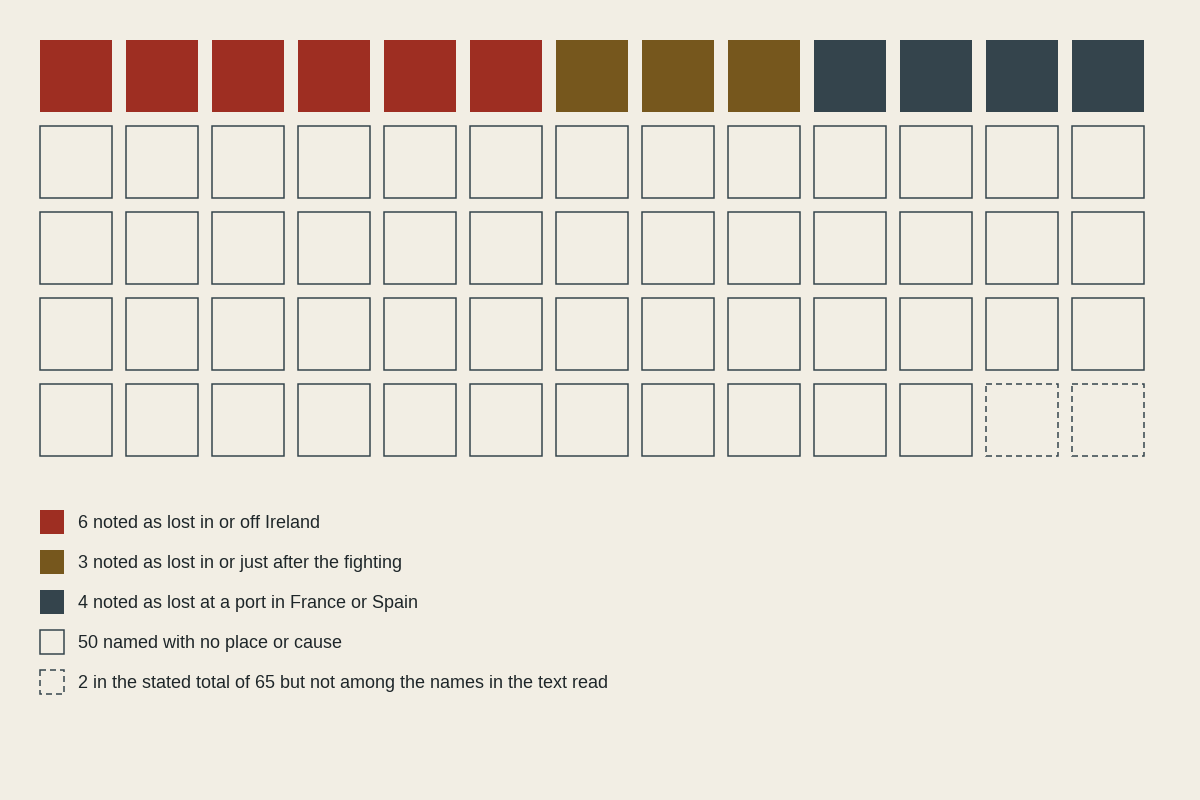
What the list itself says about each vessel. The notes are the list's own, sorted into groups for this page.
Keel, Rail & Spoke, CC BY 4.0
Data: Martin A. S. Hume, ed., Calendar of Letters and State Papers, Simancas, vol. 4 (1899), public domain, https://archive.org/details/adw2692.0004.001.umich.edu, retrieved 2026-11-08
Reuse this diagram: credit to copy
"What a Spanish list says about each lost vessel" by Keel, Rail & Spoke, https://keelrailandspoke.com/ships/spanish-armada-1588/, licensed under CC BY 4.0 (https://creativecommons.org/licenses/by/4.0/).
Data behind this diagram: spanish-armada-1588-list.csv · Where this data came from
So at least 59 of the 65 are not among the six named in the fighting, or 60 if the San Mateo is not one of the two missing names. That is arithmetic and not a finding, because the list does not say when most of them were lost. It does not prove that weather or wreck took them all.
The Ibry strip: why did the Armada go home around Scotland?
By the Duke's journal, wind and shoals left no way back, with battle damage, lack of shot and short provisions behind the choice. After Gravelines, the journal says, his pilots told him a return was impossible, “nearly all the best ships being spoiled and unable to resist longer, as well from the damage they had received as from not having shot for their ordnance.” On 9 August a change of wind took the fleet off the banks of Zeeland, and that evening, by the journal, the council chose the Channel if the weather allowed and the North Sea to Spain if not. Calderon says only that it was resolved to set course for Spain.
The English followed until 12 August, near 55° North, and then turned back. The junction the voyage was meant to make never came: word from Dunkirk on 7 August had been that the Duke of Parma's munitions were still unshipped, and that he could hardly be ready in under a fortnight. Whether to call that an English win or a Spanish failure is a judgment. No Spanish army crossed.
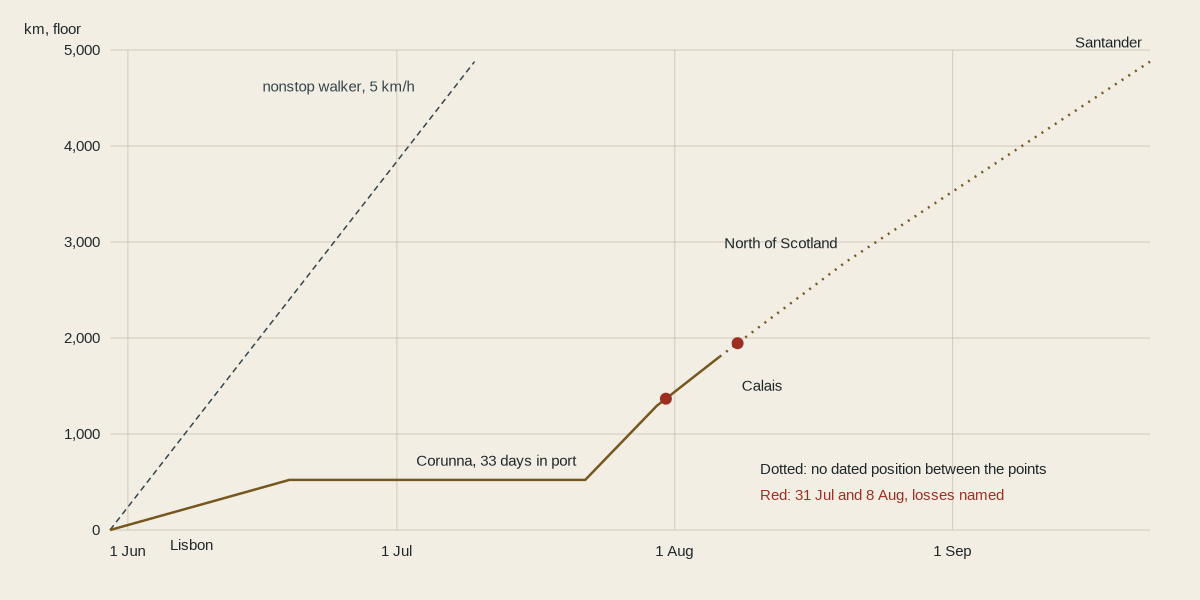
Time against distance, as rough straight-line floors. The flat stretch is Corunna. The dashed line is a walker at 5 km/h who never stops. North of Scotland stands in for a position the journal does not give exactly, and the dotted stretches have no dated position between the points.
Keel, Rail & Spoke, CC BY 4.0
Data: Martin A. S. Hume, ed., Calendar of Letters and State Papers, Simancas, vol. 4 (1899), public domain, https://archive.org/details/adw2692.0004.001.umich.edu, retrieved 2026-11-08; J. K. Laughton, ed., State Papers Relating to the Defeat of the Spanish Armada, vol. 2 (1894), public domain, https://archive.org/details/statepapersrelat02navyuoft, retrieved 2026-11-08; Wikidata coordinates (CC0), https://www.wikidata.org/, retrieved 2026-11-08
Reuse this diagram: credit to copy
"The Spanish Armada: time-distance strip, 1588" by Keel, Rail & Spoke, https://keelrailandspoke.com/ships/spanish-armada-1588/, licensed under CC BY 4.0 (https://creativecommons.org/licenses/by/4.0/).
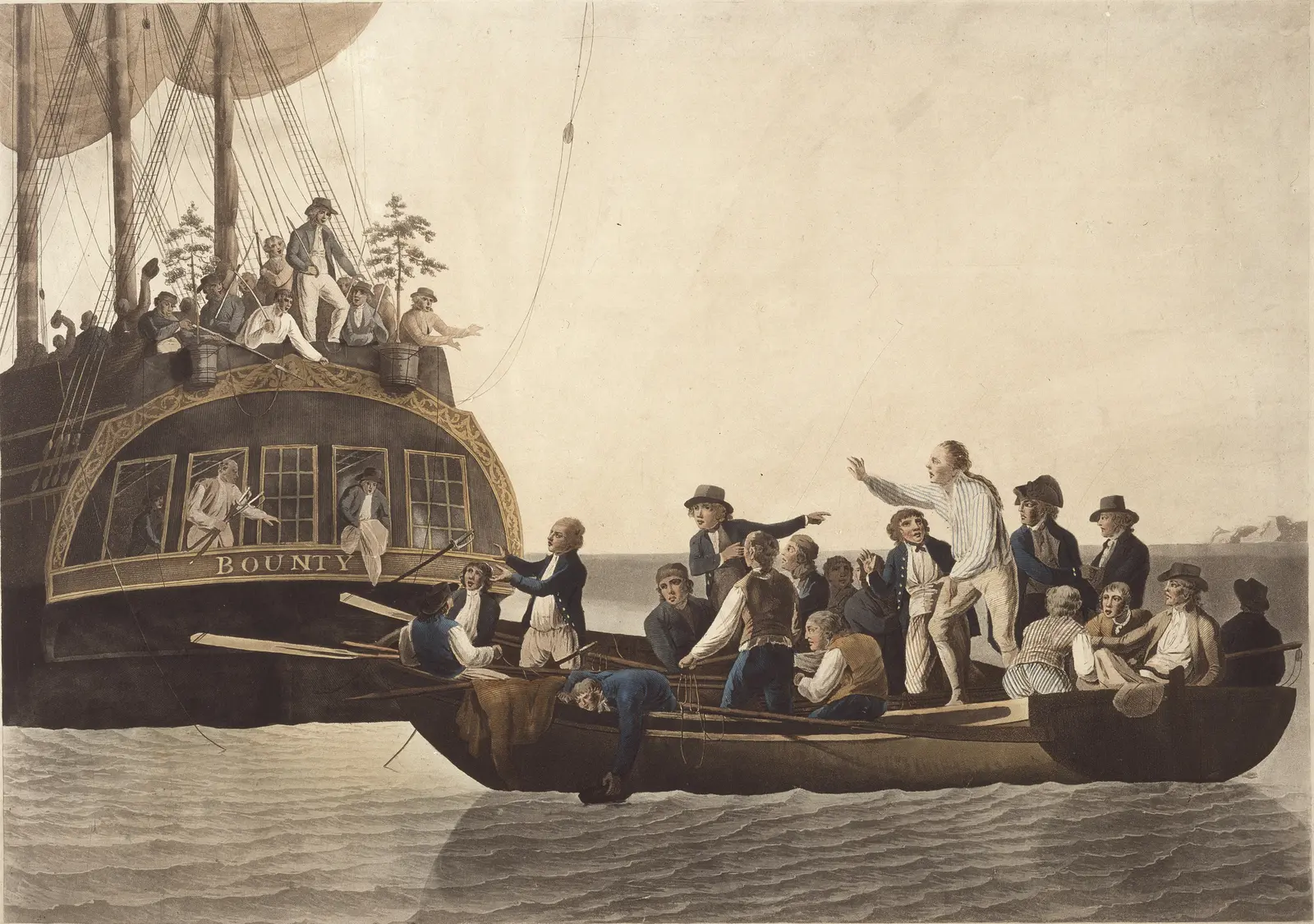
Calderon told two captains the way home would be “750 leagues, through stormy seas almost unknown to us.” A copy of the Duke's orders, kept among the Irish state papers, shows the course: north to 61½ degrees, then down to 58 and 53 and on to Cape Finisterre, taking “great heed lest you fall upon the island of Ireland.” From the Calais anchorage to the Duke's letter from Santander is 48 days, a walking multiple of about 0.53 (overall) on the floor distance. The launch in the Mutiny on the Bounty, a single open boat, came to about 1.4 (overall) on its own long way home.
Supply is the last spare question, and the answer is multiple constraints. Calderon records a cut on 13 August, to eight ounces of bread, half a pint of wine and a pint of water for each soldier. By the Duke's letter of 23 September, some ships had gone a fortnight with “not one drop of water to drink,” and the biscuit and wine left would be gone in a week. Nothing in these papers shows any one shortage ending the voyage.
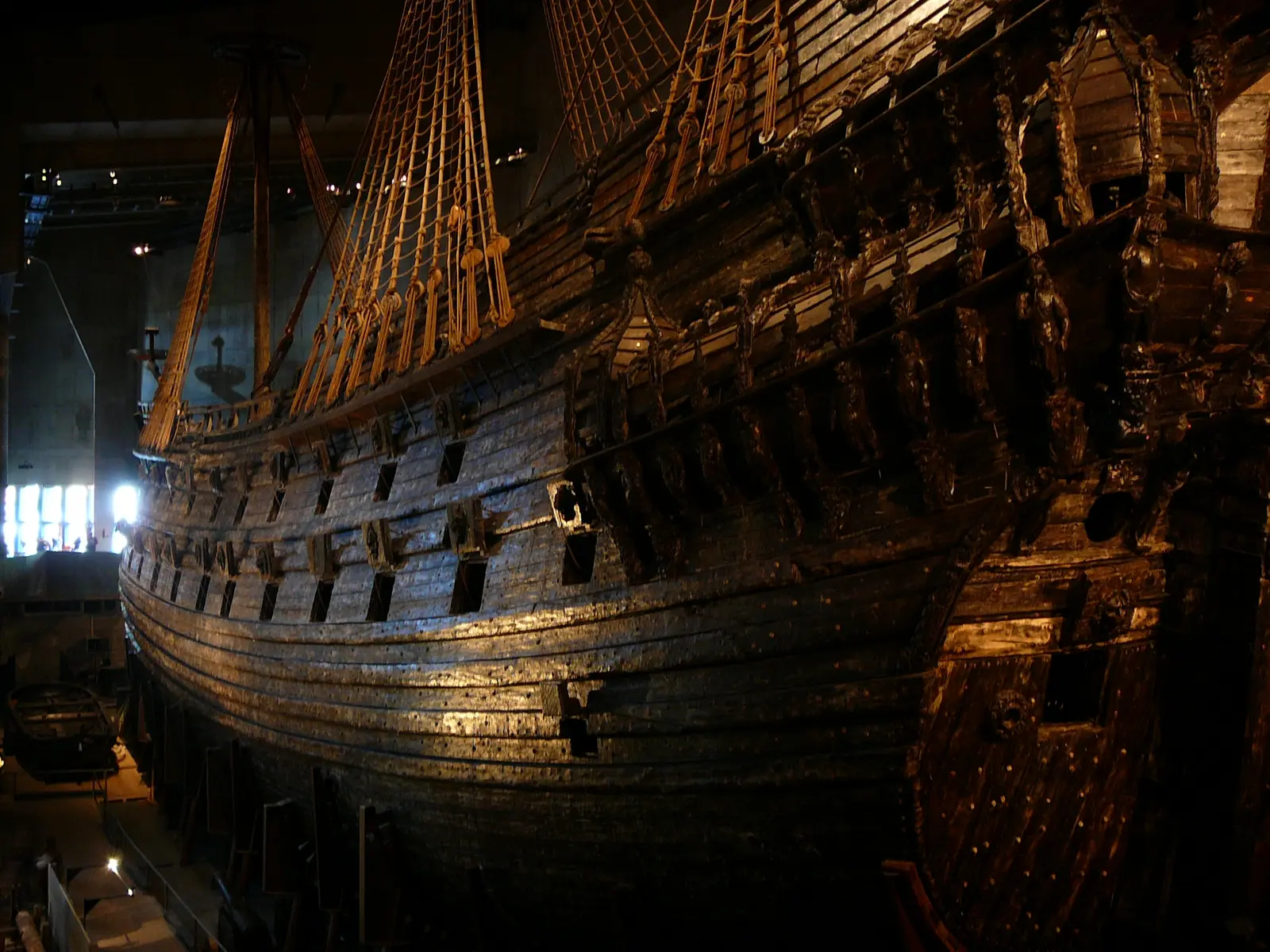
The repair radius is unknown, since no record read here names a place that could have repaired the fleet. That was a different kind of failure from the Vasa, whose fault showed in July 1628 about 0.45 km from a yard that could deal with it.
Why did the Spanish Armada fail?
The papers read here give several answers, each with an author. Hume's preface quotes the Duke complaining, as the fleet was leaving Lisbon, that the victuals were “spoiling and rotting fast.” The Duke's journal stresses the lack of shot, the wind and the shoals. A note by Hume to Calderon's statement says that Oquendo and the old mariners blamed the advice of Diego Flores de Valdes, who “was the only scapegoat” and went to prison on his return.
Those witnesses all had stakes in the answer. Hume calls Calderon “evidently a creature of the Duke,” and the journal was the Duke's own report to his king. Calderon also records urging a wide berth around Ireland, over the objection of Diego Flores, and his story gives him the better of that argument. An answer that names one cause goes further than these sources do.
How many ships and men came home?
That is also unsettled, because no muster of the returning fleet was read. The Duke's own group shrank as it went: 60 ships stayed with him until a storm in latitude 45 on 18 September left him with 11. His letter then counts 21 great ships at Laredo, eight at Santander, five or six on the Biscay coast, and six or seven more reported offshore.
A London report of 21 November claimed “only 42” had reached Spain. Subtracting the list from the Corunna muster gives 66, and that is only subtraction. On the men, a prisoner from Recalde's San Juan thought “half the number of people do not return,” which was one man's guess. On the flagship alone, the Duke wrote, 180 men had died of sickness, along with three of the four pilots.
What happened to the Armada on the Irish coast?
Four counts of Irish losses appear in the sources read here, and they are close without agreeing. An Irish state paper quoted by Hugh Allingham in 1897 has twelve ships on the shore of Connaught and “some three or four besides” sunk offshore.
Hume cites a list in the Carew Papers of 17 ships and 5,394 men off Ireland. A London report says “16 or more,” though its writer had believed little of such news until a list reached him. Captain Francisco de Cuellar, who was there, says in one passage that “more than twenty” were lost in Ireland, and in another that more than twenty of the largest were lost across Ireland, Scotland and Shetland.
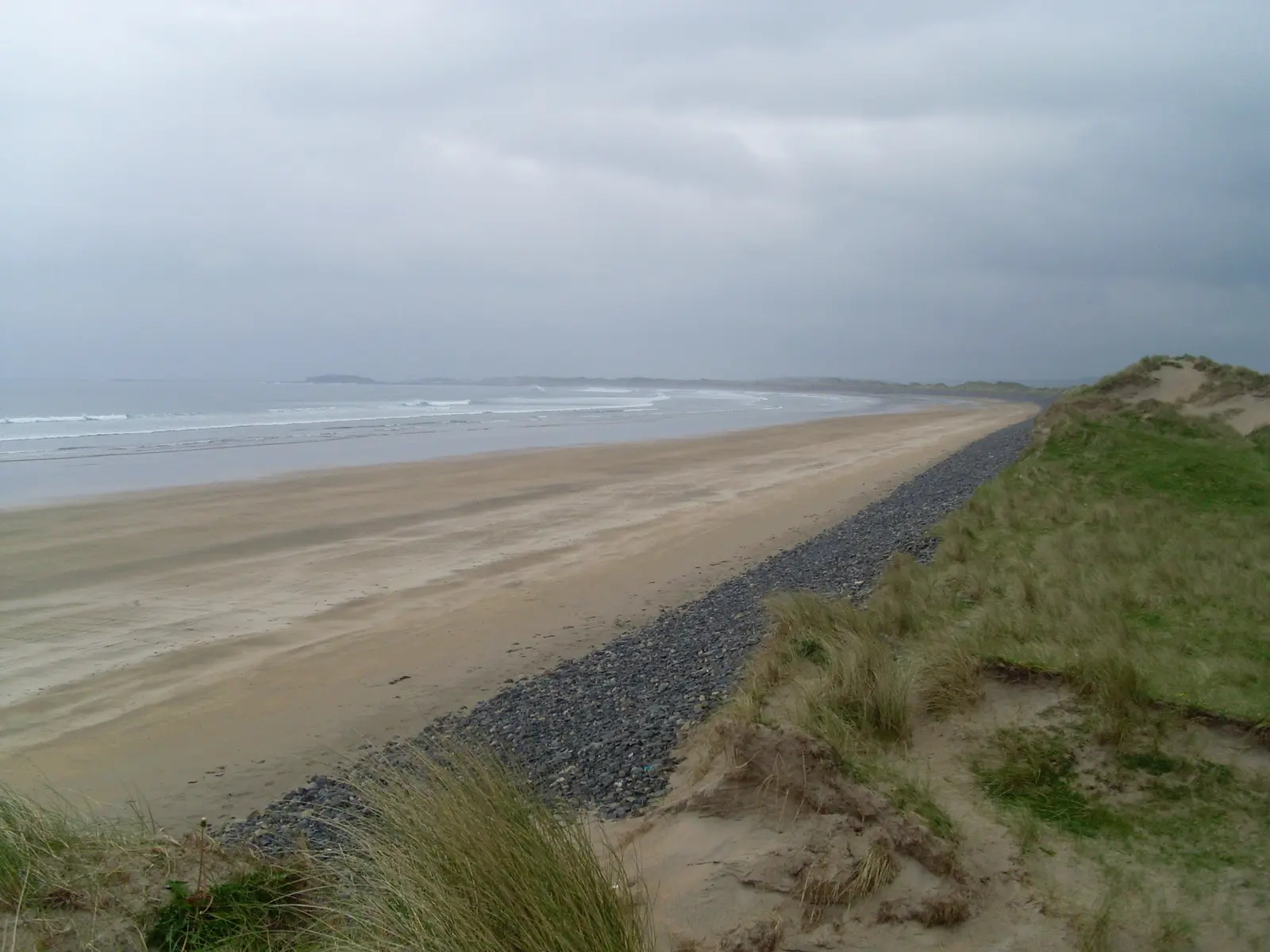
Streedagh Strand in County Sligo in 2007, identified by Allingham as the beach where Cuellar's three ships came ashore.
"Streedagh Beach" by Brianbowler — https://commons.wikimedia.org/wiki/File:Streedagh_Beach.jpg — CC BY-SA 3.0 (https://creativecommons.org/licenses/by-sa/3.0)

Cuellar's ship was one of three that could not clear the coast and anchored off it for four days, and a storm on the fifth day drove them ashore. “Such a thing was never seen: for within the space of an hour all three ships were broken in pieces,” he wrote, “so that there did not escape three hundred men, and more than one thousand were drowned.” His editor notes that he wrote from memory.
Those who reached land met very different receptions. The state paper says some 1,000 men who got ashore in Connaught were killed. Cuellar himself was sheltered by the Irish lord he calls Señor de Ruerque, O'Rourke in Allingham's reading, and later made his way to Dunluce. Allingham says that Sir James MacDonnell of Dunluce helped him cross to Scotland with seventeen Spanish sailors.
From Scotland he took ship for Flanders. He dated his letter from Antwerp on 4 October 1589, more than a year after the wreck, and said he had not been able to write until then.
Sources
- John Knox Laughton, ed., State Papers Relating to the Defeat of the Spanish Armada, Anno 1588, vol. 2 (London: Navy Records Society, 1894). https://archive.org/details/statepapersrelat02navyuoftRead: pages 53 to 58, 75 to 76, 115, 226 to 227, 240, and Appendix E, the Duke's journal, pages 354 to 370
- Martin A. S. Hume, ed., Calendar of Letters and State Papers Relating to English Affairs, Preserved Principally in the Archives of Simancas, vol. 4, Elizabeth, 1587-1603 (London: HMSO, 1899). https://archive.org/details/adw2692.0004.001.umich.eduRead: chapter-length parts: nos. 288, 306, 344, 424 with its note, 425 on the sighting between Orkney and Shetland, 433, 439 and 476, part of the preface; searched, not read through
- Hugh Allingham, Captain Cuellar's Adventures in Connacht and Ulster, A.D. 1588, with a translation of Cuellar's narrative by Robert Crawford (London: Elliot Stock, 1897). Project Gutenberg eBook 52472. https://www.gutenberg.org/ebooks/52472Read: chapter-length parts: Allingham's introduction in part; the letter's opening, the wreck and its date
- Wikidata, coordinate location (P625) of Lisbon (Q597), A Coruña (Q8757), Lizard Point (Q1808092), Calais (Q6454), Lowestoft (Q986007), Fair Isle (Q762752), Cape Wrath (Q1034522), Erris Head (Q2703868), Cape Clear Island (Q1034392) and Santander (Q23992498). CC0. https://www.wikidata.org/wiki/Q597Read: full page of each item, coordinates used
Cite this page
Keel, Rail & Spoke. "Spanish Armada, 1588: One Undated Spanish List Says 65 Lost." Published 2026-11-08. https://keelrailandspoke.com/ships/spanish-armada-1588/. Accessed on the date you read it.
How facts are checked · Corrections · Contact
Found a mistake on this page? Write to contact@keelrailandspoke.com.
More from Ships & Wrecks
Ships & Wrecks
Vasa Ship, 1628: Stability Test Stopped, Then She Sailed
The Vasa ship sank about 1,300 m into her 1628 maiden voyage. About a month before, her master testified, thirty men rolled her so far the test was stopped.
Picture credit
"Vasa 2" by MLeb — https://commons.wikimedia.org/wiki/File:Vasa_2.jpg — Public domain (released into the public domain worldwide by the photographer)
Ships & Wrecks
Mutiny on the Bounty: 3,618 Miles in 41 Days, by Bligh’s Log
After the 1789 mutiny on the Bounty, William Bligh logged 3,618 miles to Timor in 41 days in an open launch. His noon positions rechecked, and 44 men's fates.
Picture credit
"The Mutineers turning Lt Bligh and part of the Officers and Crew adrift from His Majesty's Ship the Bounty" by Robert Dodd; State Library of New South Wales, DL Pf 137 — https://commons.wikimedia.org/wiki/File:Mutiny_HMS_Bounty.jpg — Public domain (US: published 1790, before 1931; elsewhere: creator died 1815, life+70 term expired); modified: cropped: paper margin and printed text below the image removed; reduced to 2,400 px wide
Ships & Wrecks
USS Indianapolis: Men Spotted by Chance Days Later, Law Says
USS Indianapolis sank in about 12 minutes on 30 July 1945, a 2018 act says. A 1999 House text says shore offices did not report her overdue. Sources for each.
Picture credit
"USS Indianapolis (CA-35) underway at sea on 27 September 1939" by unknown creator; U.S. Navy photo 80-G-425615 — https://commons.wikimedia.org/wiki/File:USS_Indianapolis_(CA-35)_underway_at_sea_on_27_September_1939_(80-G-425615).jpg — Public domain (US: work of the U.S. Navy, no copyright under 17 U.S.C. 105; elsewhere: anonymous work, made 1939, more than 70 years since it was made)


