Journeys & Expeditions · Journey file
Ferdinand Magellan: His Ship’s Calendar Lost a Day
Ferdinand Magellan died in the Philippines in 1521, and the men who finished his voyage learned at Cape Verde that their count of days was one short.
Keel, Rail & Spoke · Published
TL;DR
- Ferdinand Magellan, a Portuguese captain sailing for Spain, left Sanlúcar with five ships on 20 September 1519 by Pigafetta's date and was killed on Mactan on 27 April 1521, so he did not finish the voyage.
- Juan Sebastián Elcano brought the Victoria home to Sanlúcar on 6 September 1522 by the ship's count, with 18 men by Antonio Pigafetta's figure.
- At Cape Verde in July 1522 the crew's Wednesday was the shore's Thursday, as Pigafetta and the pilot Francisco Albo both recorded, because they had sailed west around the world.
Leg card
- Departure
- Sanlucar de Barrameda, Spain: 20 September 1519, five ships (Pigafetta; the Genoese pilot says 21 September)
- Arrival
- Sanlucar de Barrameda, Spain: the Victoria alone, Saturday 6 September 1522 by the ship's count; the 7th ashore by Ramusio, who names the port of Seville
- Distance
- At least about 53,725 km (33,383 mi) as straight lines between 19 points; Pigafetta reckoned more than 14,460 leagues
- Machine
- Five ships, Trinidad, San Antonio, Concepcion, Victoria, Santiago; only the Victoria, 85 tons by one list, finished
- Elapsed
- 1,082 days by the ship's count; 1,083 ashore if Ramusio's 7 September is right
- Walking multiple
- about 0.41 (overall), straight lines only, so a floor
- Repair radius
- unknown for the Victoria, foremast sprung near the Cape, May 1522. Trinidad, leak, December 1521: repaired where it failed, found at anchor off Tidore and refitted there; its king offered 225 carpenters (Pigafetta) and the Genoese pilot records the refit
- The last spare
- multiple constraints: food, down to rice and water on the way home (Pigafetta); hands to work the pumps (Maximilian Transylvanus)
- Key source
- Antonio Pigafetta and the log of Francisco Albo, translated by Lord Stanley of Alderley (1874)
Download this card (CSV) · Where this data came from
Data: Antonio Pigafetta and others, The First Voyage Round the World, by Magellan, translated by Lord Stanley of Alderley (Hakluyt Society, 1874), https://www.gutenberg.org/ebooks/74723; Pigafetta, translated by James Alexander Robertson, in The Philippine Islands, 1493-1898, Vol. XXXIII (1906), https://www.gutenberg.org/ebooks/42884; Wikidata P625 coordinates (CC0), https://www.wikidata.org/wiki/Special:EntityData/Q210887.json and the items named row by row in the data file
What the card means: walking multiple, repair radius, last spare.
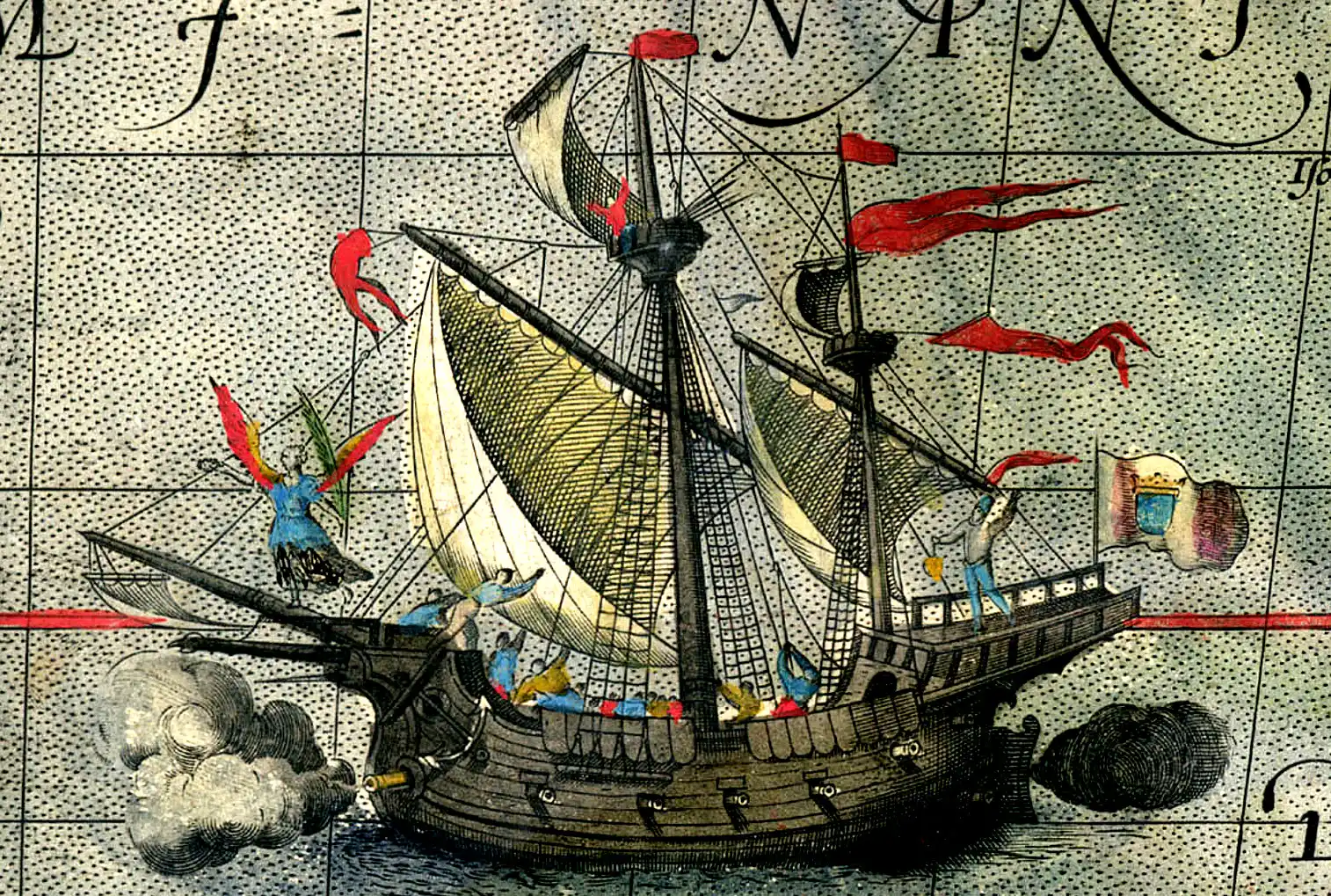
The Victoria on a printed map by Abraham Ortelius, dated 1589 or 1590, cropped to the ship. This is a 16th-century imagined picture, made decades after the voyage, and not a record of her real shape.
Detail from a map of Ortelius: Magellan's ship Victoria by Abraham Ortelius, Public domain
Full credit
"Detail from a map of Ortelius: Magellan's ship Victoria" by Abraham Ortelius — https://commons.wikimedia.org/wiki/File:Detail_from_a_map_of_Ortelius_-_Magellan's_ship_Victoria.png — Public domain (US: published about 1589 to 1590, before 1931; elsewhere: Abraham Ortelius died 1598, life plus 70 expired); modified: cropped: to the ship; coast, verse and most map lettering removed

The Victoria anchored at Cape Verde after about 50,600 km in straight lines, with one day missing from her calendar. Her pilot, Francisco Albo, logged the date as 9 July 1522: “this day was Wednesday, and they reckoned this day as Thursday, and so I believe that we had made a mistake of a day.” Antonio Pigafetta, who says he had written down every day without a break, was more surprised than anyone. The gap needs no miscount to explain it.
Counted as straight lines between 19 points, the whole voyage comes to about 53,700 km in 1,082 days, or 49.7 km a day. That is about ten hours of walking at 5 km/h, every day for three years: a walking multiple of about 0.41, counted overall, stops included. The ships went farther than straight lines, so this is a floor.
Stops on this page (8)
Why was the crew a day behind at Cape Verde?
Pigafetta tells it as a test. The men going ashore at Santiago for rice were told to ask what day of the week it was, and the Portuguese said Thursday. “We could not persuade ourselves that we were mistaken,” he wrote. He was told later that there was no error, “since as we had always sailed towards the west, following the course of the sun, and had returned to the same place, we must have gained twenty-four hours.”
The sum is short. The Sun crosses 360 degrees of longitude in 24 hours, so each 15 degrees west puts a ship one hour behind the place she left. Stand on her deck and keep a tally of noons, as Pigafetta did, and on a westward run each noon arrives a little late; the eastward run from Brunei to Tidore took some of that back, and over the whole voyage the net comes to about 80 seconds a day. After a full circle the tally holds 1,082 days where the port she left has counted 1,083, if Ramusio is right that the 6th aboard was the 7th ashore.
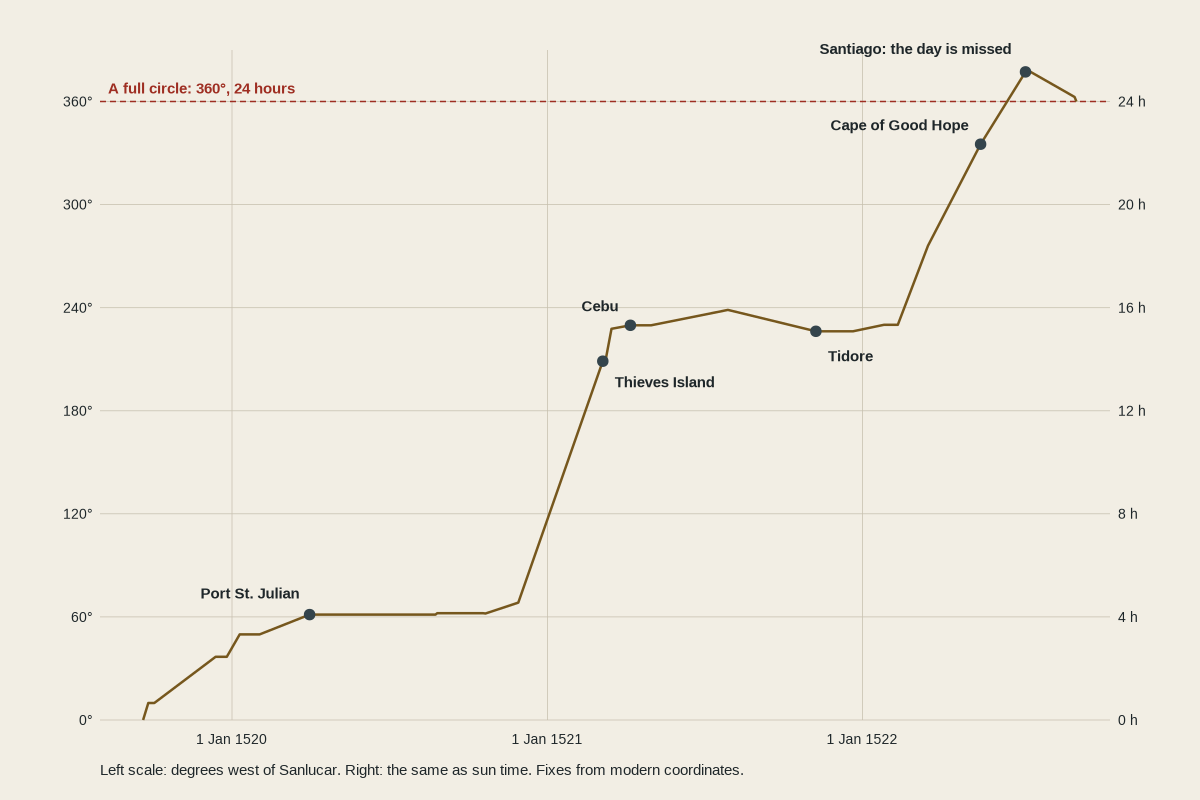
How far west of Sanlúcar the ships had come, in degrees and in hours of sun time. The line dips at Tidore because the fleet doubled back east from Brunei.
Keel, Rail & Spoke, CC BY 4.0
Data: Antonio Pigafetta and others, The First Voyage Round the World, by Magellan, translated by Lord Stanley of Alderley (Hakluyt Society, 1874), https://www.gutenberg.org/ebooks/74723; Wikidata P625 coordinates (CC0), https://www.wikidata.org/wiki/Special:EntityData/Q210887.json and the items named row by row in the data file
Reuse this diagram: credit to copy
"Degrees and sun hours west of Sanlucar by date" by Keel, Rail & Spoke, https://keelrailandspoke.com/journeys/ferdinand-magellan-voyage/, licensed under CC BY 4.0 (https://creativecommons.org/licenses/by/4.0/).
| Stop | Ship's date | Degrees west of Sanlúcar | Sun hours behind |
|---|---|---|---|
| Port St. Julian | 31 Mar 1520 | 61.4 | 4.09 |
| Thieves Island (Guam) | 6 Mar 1521 | 208.8 | 13.92 |
| Cebu | 7 Apr 1521 | 229.7 | 15.32 |
| Tidore | 8 Nov 1521 | 226.2 | 15.08 |
| Cape of Good Hope | 18–19 May 1522, Albo as Stanley reads it; Pigafetta 6 May | 335.2 | 22.34 |
| Santiago, Cape Verde | 9 Jul 1522 | 377.3 | 25.15 |
| Sanlúcar | 6 Sep 1522 | 360.0 | 24.00 |
Data behind this diagram: ferdinand-magellan-voyage-legs.csv · Where this data came from
Santiago lies past the full circle, about 17.3 degrees west of Sanlúcar, so its own sun runs about 1.15 hours behind Spain. Take that away from 25.15 and the gap between the ship and the shore is 24 hours exactly.
The count itself held up, too: 14 weekday and date pairs sampled from the journals, from Tuesday 20 September 1519 to Monday 8 September 1522, all fit the Julian calendar then in use. Stanley notes one slip from before the ships left Spain, a Monday given for 10 August, and says the other dates agree. Wednesday goes with the 9th of July that year, and Thursday with the 10th.
The two words for it still differ. Pigafetta says they gained 24 hours, and the editor Ramusio, quoted by Stanley, says they “found they had lost one day.” He adds that when they reached Seville it was the 7th of September, and by their account the 6th.
He says the Venetian ambassador Gasparo Contarini explained it to the chronicler Peter Martyr, who had examined the survivors, and that Martyr's own book was lost in the sack of Rome. On average each ship's day ran longer, and there was one fewer of them.
Who was Ferdinand Magellan?
Ferdinand Magellan was a Portuguese soldier and navigator who served in India and Morocco before turning to Spain. A charter dated at Valladolid on 22 March 1518 calls him “a knight, native of the Kingdom of Portugal.” By the accounts printed by Stanley, King Manuel refused him a small raise in his palace stipend, and he reached Seville on 20 October 1517. Stanley's chronology prints that year as 1518, but his text and the charter's date both point to 1517.
The idea came partly from letters. Pigafetta says that while Magellan was at Malacca, his relative and friend Francisco Serrano wrote to him from the spice islands of Maluco, the Moluccas in eastern Indonesia, and that Magellan then proposed to the king of Spain to come there “by way of the west.” The charter speaks of limits “within the bounds of our demarcation,” the line dividing Spanish from Portuguese claims, so the voyage began as a search for a route. It was not ordered as a lap of the world.
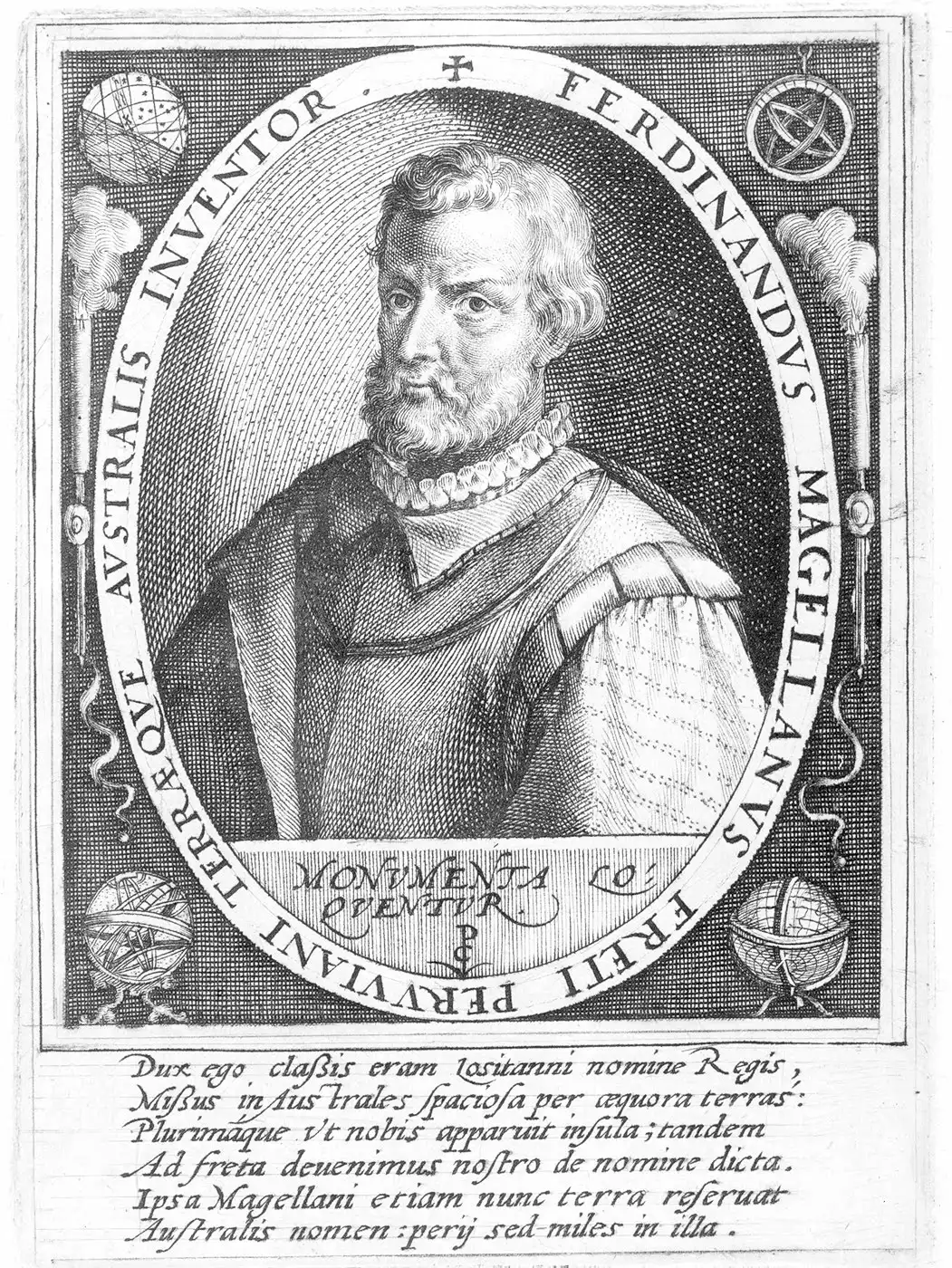
Magellan as engraved by Crispijn van de Passe in 1598, 77 years after his death. The verse below has him sailing in the name of the Portuguese king, and the record says he sailed for Spain.
Ferdinand Magellan by Crispijn van de Passe the Elder, Public domain
Full credit
"Ferdinand Magellan" by Crispijn van de Passe the Elder — https://commons.wikimedia.org/wiki/File:Ferdinand_Magellan_by_Crispijn_van_de_Passe_1598.jpg — Public domain (US: published 1598, before 1931; elsewhere: engraved 1598 by a printmaker whose file page carries a life plus 100 tag, every term expired)

Five ships left Seville on 10 August 1519 and sailed from Sanlúcar on 20 September, although the Genoese pilot says the 21st. The charter asked for ships of 130, 90 and 60 tons. One register, as James Robertson gives it in 1906, lists these:
| Ship | Tons in that register | What became of her |
|---|---|---|
| Trinidad, the flagship | 110 | Leaked at Tidore, later taken and wrecked |
| San Antonio | 120 | Left the fleet in the strait, home 6 May 1521 |
| Concepción | 90 | Burned off Bohol, May 1521 |
| Victoria | 85 | Finished the voyage |
| Santiago | 75 | Lost scouting in 1520, crew recovered |
How did the fleet find the strait?
The fleet crossed to Brazil and worked south down the coast, looking for a way through. The extract of Albo's log, which starts on 29 November 1519, records the first hope and its end: a great river of fresh water at about 35° S, which the Genoese pilot says they entered “thinking they would find a passage.” They left it on 2 February 1520.
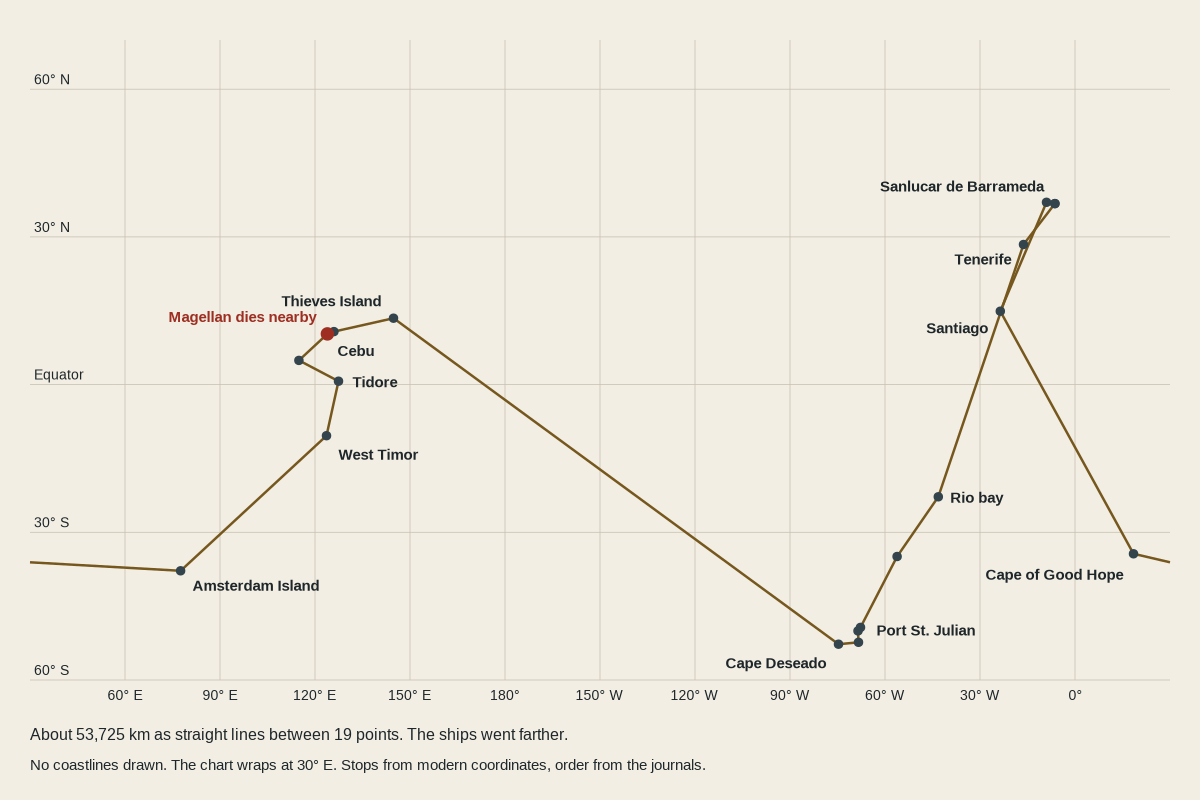
The route as straight lines between stops, about 53,700 km. Coordinates are modern, and some are stand-ins for the place in the journals, as the data file says row by row.
Keel, Rail & Spoke, CC BY 4.0
Data: Antonio Pigafetta and others, The First Voyage Round the World, by Magellan, translated by Lord Stanley of Alderley (Hakluyt Society, 1874), https://www.gutenberg.org/ebooks/74723; Wikidata P625 coordinates (CC0), https://www.wikidata.org/wiki/Special:EntityData/Q210887.json and the items named row by row in the data file
Reuse this diagram: credit to copy
"Route of the fleet as straight lines between stops" by Keel, Rail & Spoke, https://keelrailandspoke.com/journeys/ferdinand-magellan-voyage/, licensed under CC BY 4.0 (https://creativecommons.org/licenses/by/4.0/).
On 31 March the ships entered Port St. Julian, at 49⅔° S by Albo, and stayed 146 days. Three ships rose against Magellan there, and the pilot records that a captain, Luis de Mendoza, was stabbed by the fleet's chief constable on Magellan's order and that Gaspar de Quesada was beheaded days later. Albo says many local people came to the port, dressed in skins, and were swift runners. The pilot says that the fleet took three or four of them aboard and that all but one died.
The Santiago was lost while scouting, with her crew recovered. On 21 October 1520 the four remaining ships reached the Cape of the Virgins, and within it a strait that the pilot puts at 100 leagues and Pigafetta at 110. The San Antonio turned back there without leave and reached Seville on 6 May 1521. The others came out on 28 November by Pigafetta, on the 26th by the pilot.
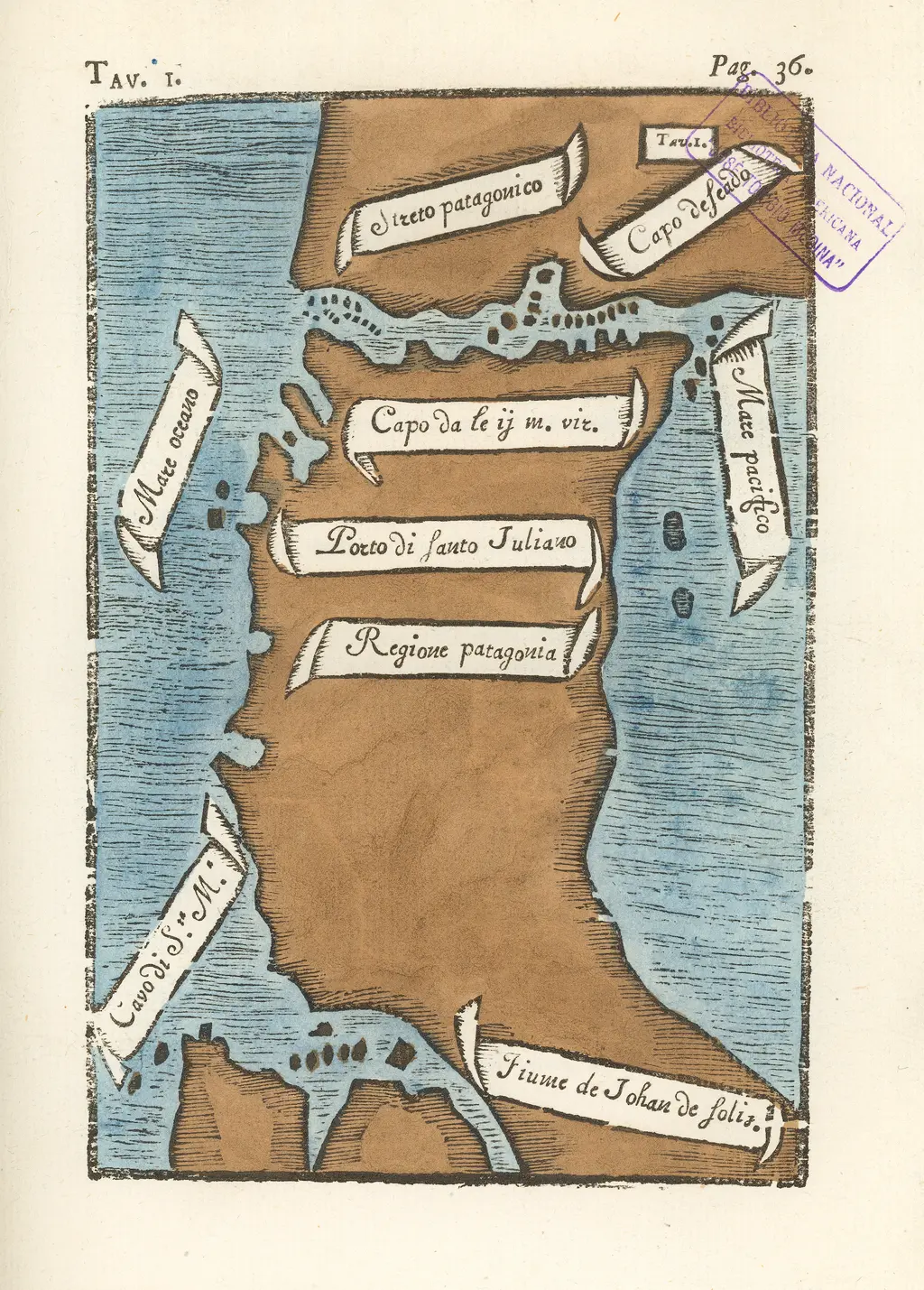
Pigafetta's map of the strait as printed in Carlo Amoretti's edition of 1800, with south at the top and a library stamp at upper right. Port St. Julian and the River of Solís are labeled.
The First Map of the Strait of Magellan, 1520 by Carlo Amoretti, Public domain
Full credit
"The First Map of the Strait of Magellan, 1520" by Carlo Amoretti — https://commons.wikimedia.org/wiki/File:The_First_Map_of_the_Strait_of_Magellan,_1520_WDL3972.png — Public domain (US: published 1800, before 1931; elsewhere: Carlo Amoretti died 1816, life plus 70 expired)

How long did the Pacific crossing take?
By the dates, the crossing from Cape Deseado to the first inhabited island took 98 days, about 14,400 km in a straight line, or a walking multiple of at least about 1.23 on the same overall count. Albo's log shows the line was not straight, since the fleet first ran north along the coast. His latitudes go from 48° S on 1 December to 25½° S on 31 December, and he is north of the Equator by 13 February 1521.
Albo gives latitude from the Sun's altitude and declination, the noon sum behind How a Sextant Works, but only a few scattered longitudes. Fridtjof Nansen's printed fixes can be chained into a drift, and Clark's mileage can be added up on the Lewis and Clark Expedition. Albo's cannot, which is why the distance here runs between stops.
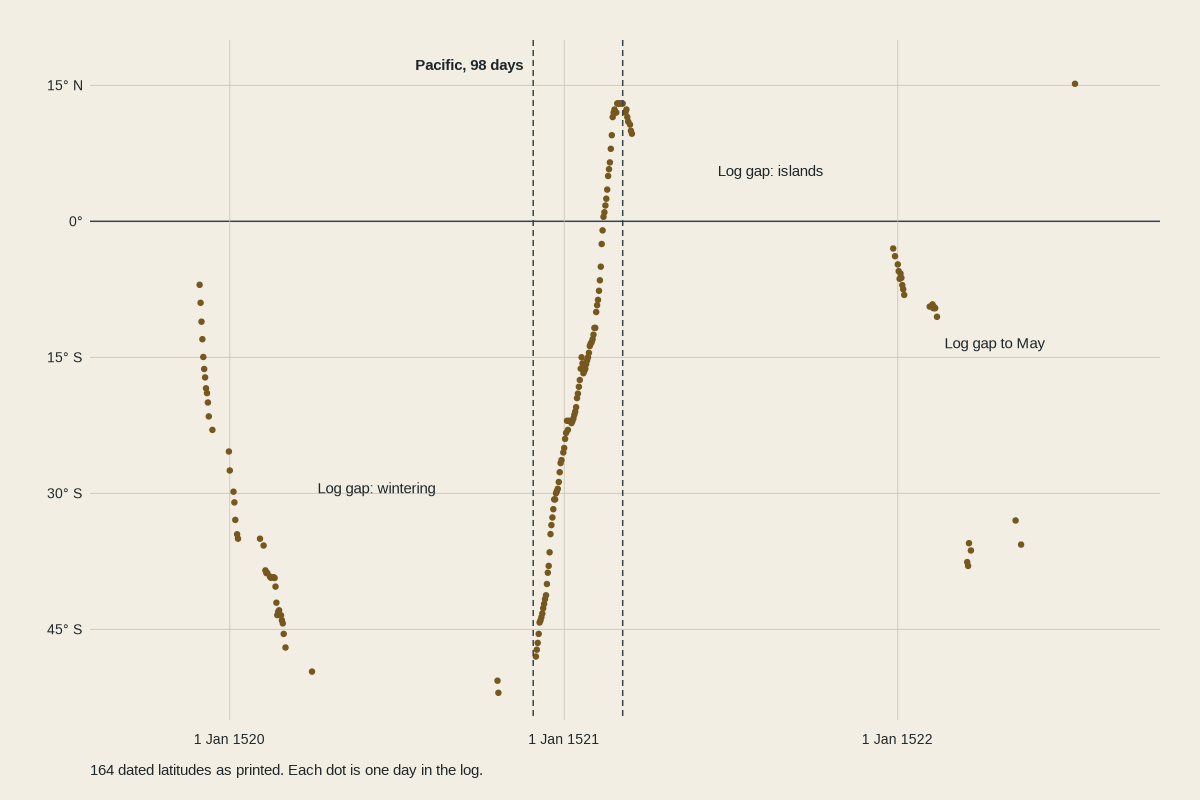
Every dated latitude in Albo's log as Stanley prints it. Near the Philippines, the log goes on naming places and leaves the dates out.
Keel, Rail & Spoke, CC BY 4.0
Data: Antonio Pigafetta and others, The First Voyage Round the World, by Magellan, translated by Lord Stanley of Alderley (Hakluyt Society, 1874), https://www.gutenberg.org/ebooks/74723
Reuse this diagram: credit to copy
"Dated latitudes in the log of Francisco Albo" by Keel, Rail & Spoke, https://keelrailandspoke.com/journeys/ferdinand-magellan-voyage/, licensed under CC BY 4.0 (https://creativecommons.org/licenses/by/4.0/).
Data behind this diagram: ferdinand-magellan-voyage-latitudes.csv · Where this data came from
Pigafetta, who wrote the account of hunger on this leg, puts it at three months and twenty days, longer than the dates to Guam, without saying where he stopped counting. The men ate biscuit gone to powder, ox hides softened in the sea, sawdust and rats. Nineteen died of a sickness that swelled the gums, along with the second of the Patagonian men he calls giants and an Indian from Brazil, both brought aboard. He says they ran “fully four thousand leagues,” and at his own 17.5 leagues to a degree, that is about 25,400 km.
Land came on Wednesday 6 March 1521, at the island that Robertson's notes identify as Guam. People came aboard and took the flagship's skiff. Magellan went ashore with armed men, and by Pigafetta's count burned 40 or 50 houses and killed seven people; the pilot says the fleet burned the whole village and killed seven or eight, men and women. The fleet's name for the place, Thieves' Island, comes from this side of the story, and no account by the islanders is in these sources.
How did Magellan die?
Magellan died on the shallows of Mactan, an island off Cebu, on Saturday 27 April 1521. The fleet had reached Cebu on 7 April, and its king, named Raja Humabon in the Milan edition, had accepted baptism and an alliance with Spain. Mactan had two chiefs: Zula, who sent word that his rival was keeping him from obeying, and Cilapulapu, who would not obey. Zula asked for a boatload of men against his rival, and Magellan decided to go himself.
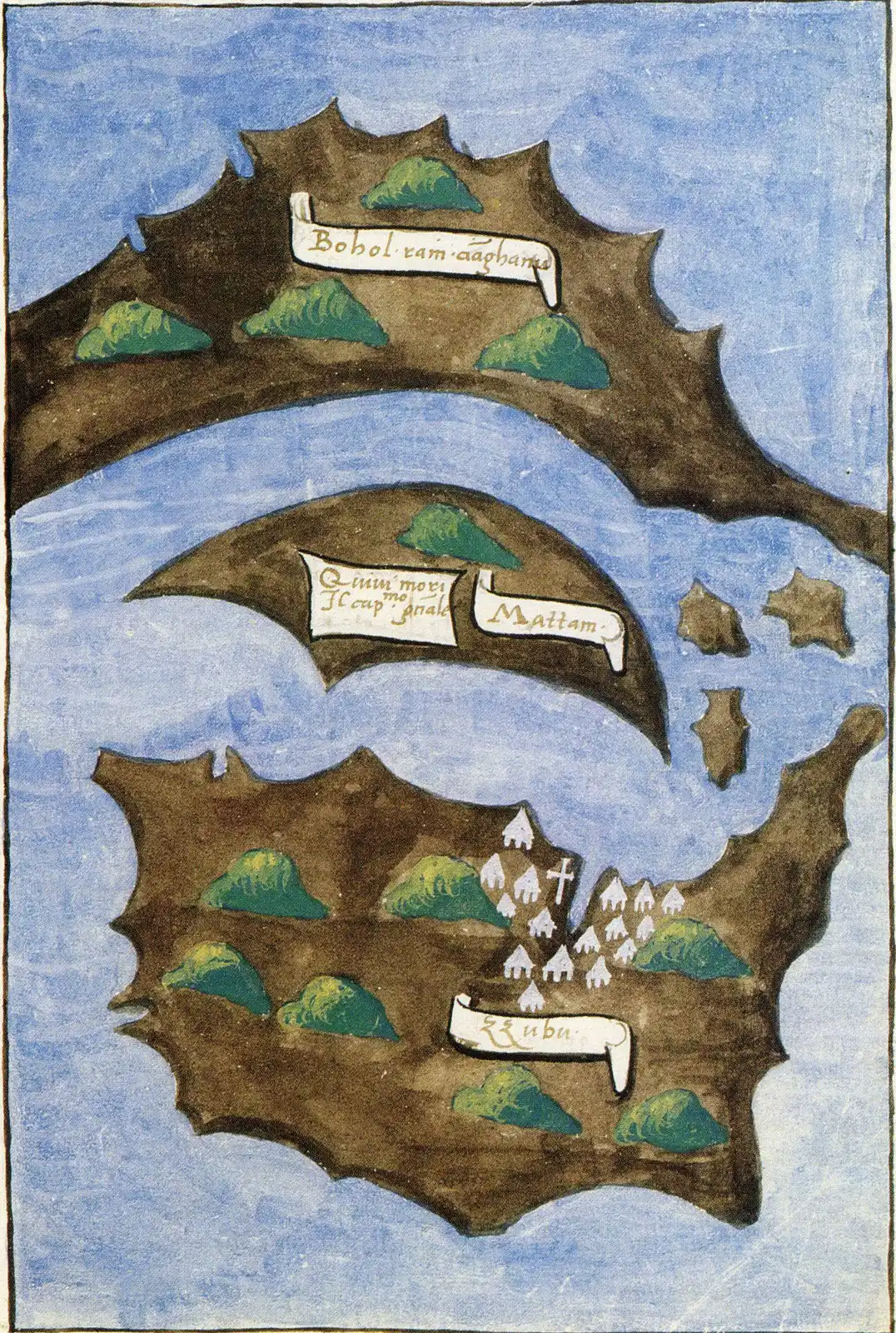
Bohol, Mactan and Cebu in a manuscript of Pigafetta's account, about 1530.
Cebu map attached to Pigafetta's report by unknown creator, Public domain
Full credit
"Cebu map attached to Pigafetta's report" by unknown creator — https://commons.wikimedia.org/wiki/File:Cebu_map_attached_to_the_Pigafetta's_report.jpg — Public domain (US: manuscript of about 1530; the map set was published in Amoretti's edition of 1800, before 1931, and if this drawing was not, the term for an unknown author's unpublished work has expired; elsewhere: creator unknown, about 1530, every term expired)

Every number that follows comes from the fleet's side. Pigafetta says that 49 men waded ashore through water too shallow for the boats' guns to help, and met 1,500 islanders, while the pilot says 3,000 or 4,000.
Cilapulapu's men answered a demand for tribute by saying that they too had lances, and they aimed at the legs of the armored men. Pigafetta counts eight of the fleet and four allied islanders dead, and 15 of the enemy. The pilot says six, and dates it the 28th, although a note in Stanley points out that the Saturday was the 27th.
The fleet offered goods for the bodies. The people of Mactan refused, Pigafetta says, and meant to keep Magellan “as a monument of their triumph.”
On 1 May the king of Cebu invited the new commanders ashore, and Pigafetta says his men killed Duarte Barbosa and the others at the feast. Juan Serrano was brought to the beach wounded and bound, saying that all had been slain except the interpreter, and begged to be ransomed, but the ships sailed without him. Pigafetta blames Magellan's enslaved interpreter, Henry, who had been threatened with flogging, but Pigafetta stayed aboard that day with a wound and gives no source for the plot. Too few were left to work three ships, so the Concepción was burned off Bohol.
Did Magellan sail around the world?
No. He crossed from Spain to the Philippines by the west and died there, and Pigafetta himself writes that the circuit was one “which he had almost completed.” The ship that closed the circle was the Victoria, which Stanley calls “the first ship which went round the world,” and the men who stayed with her from Sanlúcar back to Sanlúcar are the first on record to have gone round. Elcano, listed as master of the Concepción in the register, commanded her on the way home and received a pension and a coat of arms showing a globe with the motto “Primus me circumdedisti,” “you went around me first” (translated by Keel, Rail & Spoke), the globe speaking to him.
Why did the ships split at Tidore?
The two remaining ships reached Tidore on Friday 8 November 1521, by way of Brunei, with pilots taken by force on the way, as the Genoese pilot records. Sultan Manzor, its king, agreed a price in cloves. In December both were loaded, and the Trinidad's hold was found to be filling “as through a pipe.” The sultan sent divers, five and then three by Pigafetta, 25 by the pilot, and they could not find the leak.
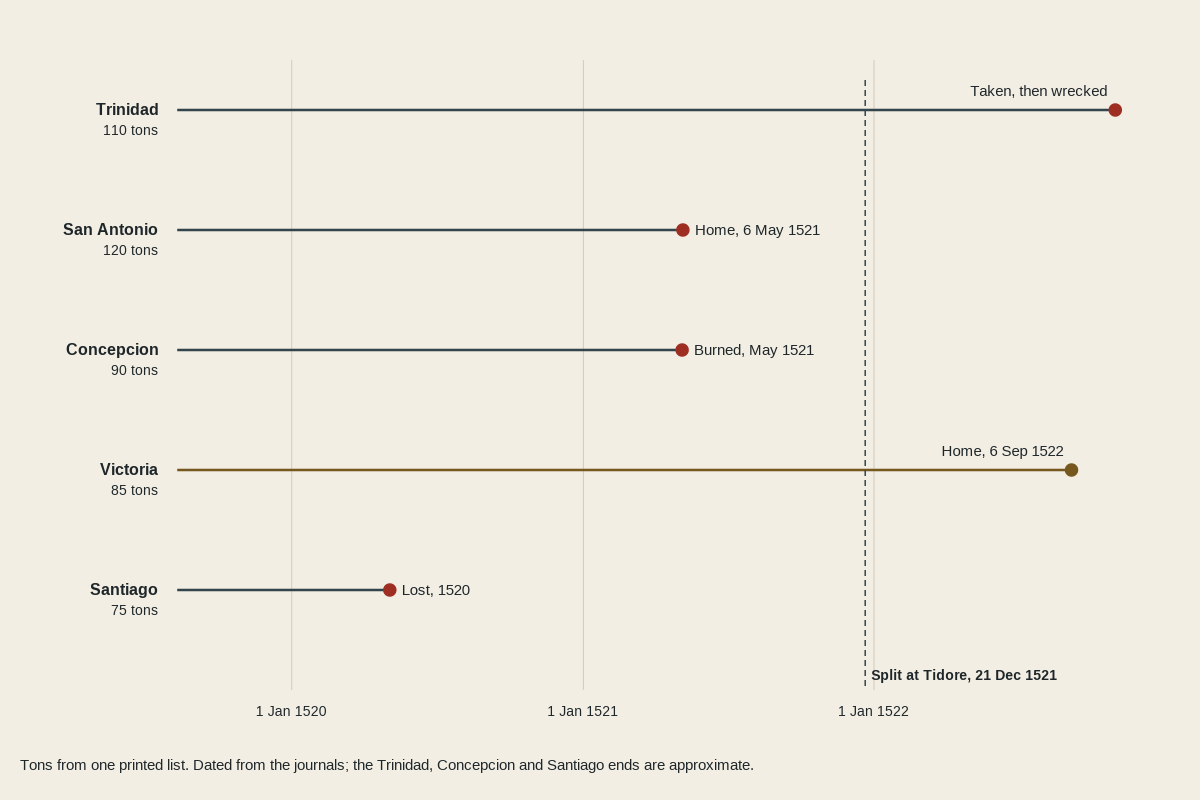
What became of the five ships. The tons come from one printed register. The Santiago, Concepción and Trinidad ends are approximate, as the data file says.
Keel, Rail & Spoke, CC BY 4.0
Data: Antonio Pigafetta and others, The First Voyage Round the World, by Magellan, translated by Lord Stanley of Alderley (Hakluyt Society, 1874), https://www.gutenberg.org/ebooks/74723; Pigafetta, translated by James Alexander Robertson, in The Philippine Islands, 1493-1898, Vol. XXXIII (1906), https://www.gutenberg.org/ebooks/42884
Reuse this diagram: credit to copy
"Five ships from Seville to the end of each" by Keel, Rail & Spoke, https://keelrailandspoke.com/journeys/ferdinand-magellan-voyage/, licensed under CC BY 4.0 (https://creativecommons.org/licenses/by/4.0/).
Data behind this diagram: ferdinand-magellan-voyage-fleet.csv · Where this data came from
In this site's gear language, Tidore was the shift point, the supply stop where the voyage changed gear. The evidence is the decision itself: the Victoria would go west at once on the east winds, and the Trinidad would refit and go east for Darien, on the Panama side, when the west winds came. In the sources read, the Victoria's course home was settled here, over a leak.
The repair radius, this site's measure of the distance from a fault to the nearest place that could fix it, takes the value repaired where it failed: the leak was found at anchor off Tidore and mended there. The sultan offered 225 carpenters to work under the ship's men, and the pilot says the refit and reloading took four months and 16 days. The dates do not fit that figure: from the leak, found on the Wednesday before 21 December, to sailing on 6 April is 109 days. The Trinidad sailed on 6 April 1522 with 50 on the muster-roll, reached 42° N, and turned back with her crew dying.
The Portuguese took her at Maluco, and the Genoese pilot says a squall cast her ashore. The account of her crew says three of her men reached Spain, besides a priest.
How many men came home on the Victoria?
The Victoria left Tidore on 21 December 1521 with 47 Europeans and 13 men Pigafetta calls Indians. Some deserted at Timor. She stayed clear of the Portuguese route, went as far as 42° S, and spent nine weeks off the Cape of Good Hope with her sails struck. Stanley reads Albo's log as passing it on 18 to 19 May, Pigafetta writes 6 May, and on 16 May Albo records the foremast and fore-yard sprung.
The last spare, this site's name for the supply whose loss ends a journey, reads multiple constraints, because the sources give two. Pigafetta says that the meat had rotted for want of salt, that they had only rice and water, and that 21 men died in two months. The imperial secretary Maximilian Transylvanus says the ship was leaking and the sailors left could no longer clear the water, so they landed to buy slaves for the pumps. Pigafetta's version of the landing has them telling the Portuguese a false story about the fleet, and it held until one of the men gave it away.
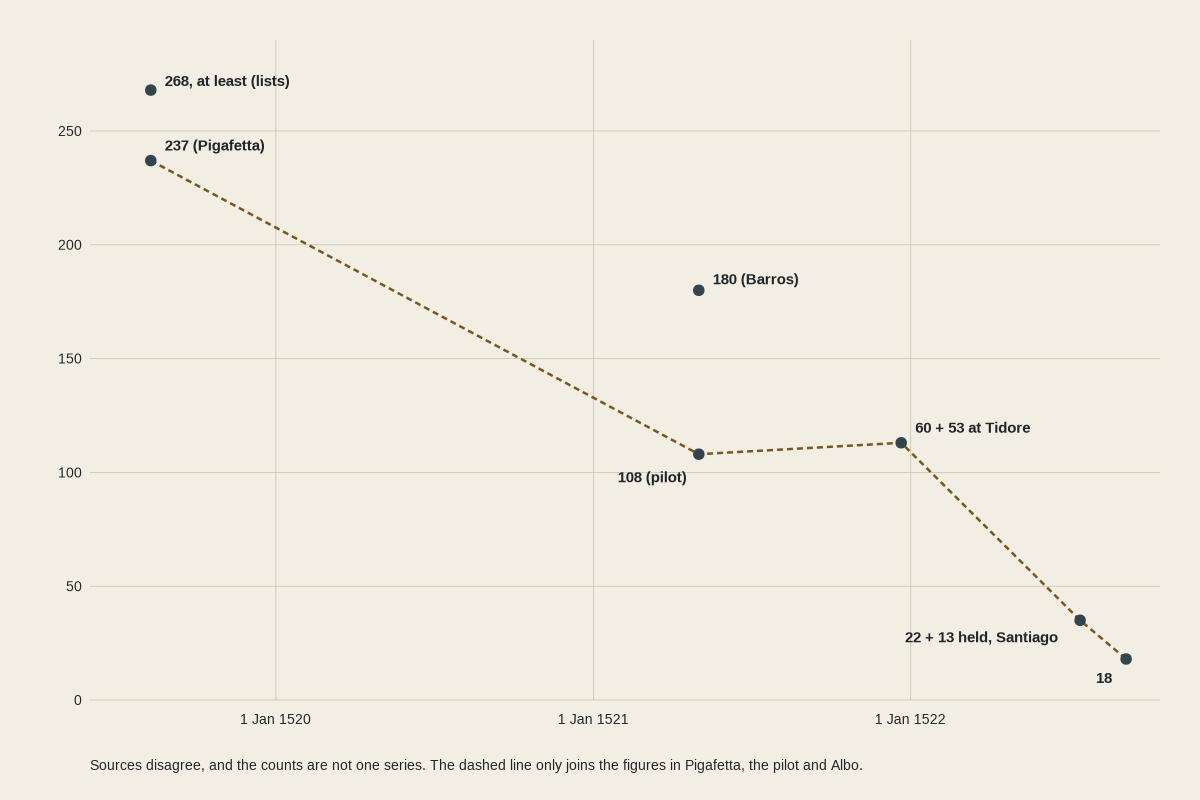
Counts of the men by date. These figures come from different writers and do not form one series, and the dashed line only joins some of them to show the direction.
Keel, Rail & Spoke, CC BY 4.0
Data: Antonio Pigafetta and others, The First Voyage Round the World, by Magellan, translated by Lord Stanley of Alderley (Hakluyt Society, 1874), https://www.gutenberg.org/ebooks/74723; Pigafetta, translated by James Alexander Robertson, in The Philippine Islands, 1493-1898, Vol. XXXIII (1906), https://www.gutenberg.org/ebooks/42884
Reuse this diagram: credit to copy
"Counts of men by date, from different sources" by Keel, Rail & Spoke, https://keelrailandspoke.com/journeys/ferdinand-magellan-voyage/, licensed under CC BY 4.0 (https://creativecommons.org/licenses/by/4.0/).
Data behind this diagram: ferdinand-magellan-voyage-crew.csv · Where this data came from
The count of who left is unsettled too, and the Spanish Armada has the same trouble: its counts of ships come from papers that do not count the same thing. Pigafetta has 237 at Seville, and notes in Robertson give 265 from lists and at least 268. Two figures come from before the start: the charter of 1518 planned for 234, and a Portuguese official in Seville reported 230 in July 1519. After Cebu the printed pilot has 108, while Barros and a Madrid manuscript have 180.
On 15 July, with 13 men and the boat held at Santiago, Albo sailed “with twenty-two men, sick and sound.” Pigafetta counts 18 at Sanlúcar, and Maximilian has 18 left at Santiago after the 13 were seized. Stanley notes that Herrera's list of 31 names equals Pigafetta's 13 plus 18, and that some Molucca men also arrived, so the 18 may not count everyone aboard. Correa's 13, in a chronicle written in India that also gets the year wrong, can be set aside.
The Ibry strip: 1,082 days by the ship's count
Read this chart as a graph of speed: time runs left to right, distance runs up, and a steeper line is a faster one. The flat stretches are stops, and the longest is the 146 days at Port St. Julian. The steep run across the Pacific is 14,400 km in 98 days. No dashed plan line is drawn, because no dated plan was found in the documents read.
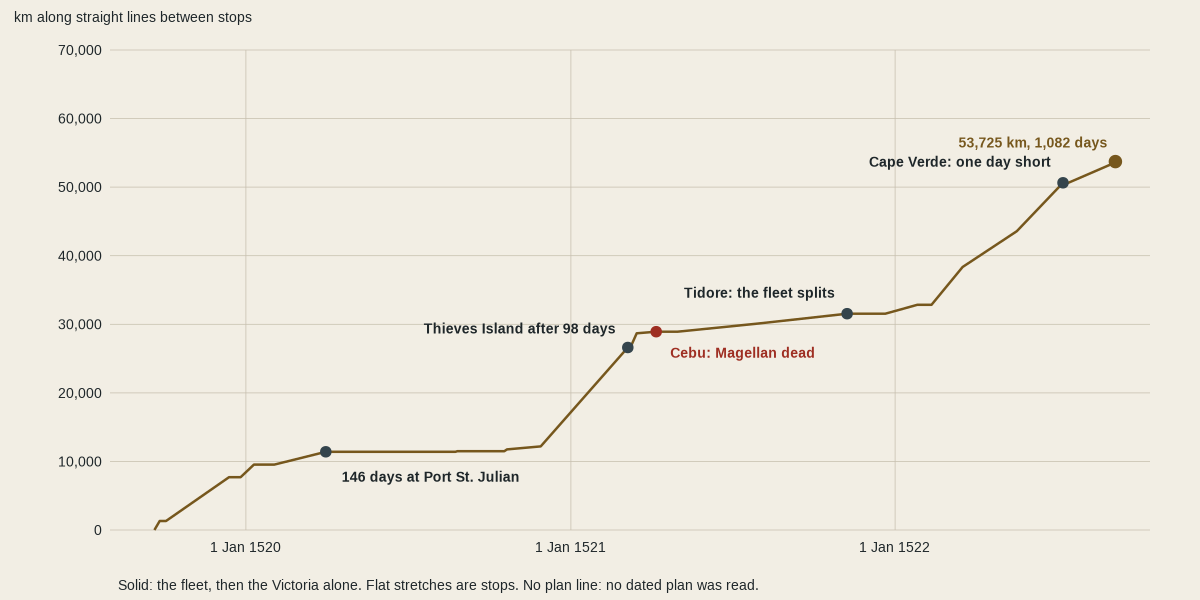
Distance as straight lines between stops, by the ship's dates. The fleet is the line until Tidore, and after that it is the Victoria.
Keel, Rail & Spoke, CC BY 4.0
Data: Antonio Pigafetta and others, The First Voyage Round the World, by Magellan, translated by Lord Stanley of Alderley (Hakluyt Society, 1874), https://www.gutenberg.org/ebooks/74723; Wikidata P625 coordinates (CC0), https://www.wikidata.org/wiki/Special:EntityData/Q210887.json and the items named row by row in the data file
Reuse this diagram: credit to copy
"Time-distance strip of the fleet, 1519 to 1522" by Keel, Rail & Spoke, https://keelrailandspoke.com/journeys/ferdinand-magellan-voyage/, licensed under CC BY 4.0 (https://creativecommons.org/licenses/by/4.0/).
Pigafetta's own total is much larger. He reckoned “more than fourteen thousand four hundred and sixty leagues,” and his treatise on navigation puts 17.5 leagues in a degree and 6,300 round the Earth. By his own figures those 14,460 leagues are 2.3 times round, or about 91,900 km against the straight-line 53,700 km. The real track was longer than the straight lines, but none of the logs read here lets anyone check his figure.
On Saturday 6 September 1522, by the ship's count, the Victoria entered the bay of Sanlúcar, and on Monday the 8th she anchored at the mole of Seville and fired all her guns. The next day the men walked in their shirts, barefoot, each with a taper, to the shrine of St. Maria of Victory. Pigafetta writes that day down as Tuesday.
Sources
- Antonio Pigafetta, the Genoese pilot, Francisco Albo, Maximilian Transylvanus and others, The First Voyage Round the World, by Magellan, translated with notes by Lord Stanley of Alderley (London: Hakluyt Society, 1874). The Maximilian letter is translated by James Baynes. https://www.gutenberg.org/ebooks/74723Read: chapters: introduction on the sources, chronology, the Genoese pilot in full, Pigafetta on the main events and the treatise on navigation, Herrera's names, Albo's log in full, the account of the Trinity, the cost account
- Antonio Pigafetta, First Voyage Around the World, translated by James Alexander Robertson, in Emma Helen Blair and James Alexander Robertson, eds., The Philippine Islands, 1493-1898, Vol. XXXIII (Cleveland: Arthur H. Clark, 1906). https://www.gutenberg.org/ebooks/42884Read: chapter on the Pacific passage, to compare with Stanley; notes on crew numbers, the register of ships, Elcano and Guam
- Wikidata. Coordinate statements (P625) for the 18 places in the stops file, Q210887 (Sanlucar de Barrameda) to Q4103 (Cape St. Vincent). https://www.wikidata.org/wiki/Special:EntityData/Q210887.jsonRead: entity data, coordinates only
Cite this page
Keel, Rail & Spoke. "Ferdinand Magellan: His Ship’s Calendar Lost a Day." Published 2026-11-08. https://keelrailandspoke.com/journeys/ferdinand-magellan-voyage/. Accessed on the date you read it.
How facts are checked · Corrections · Contact
Found a mistake on this page? Write to contact@keelrailandspoke.com.
More from Journeys & Expeditions
Journeys & Expeditions
Lewis and Clark Expedition: Lewis’s Iron Boat Leaked, 1805
The Lewis and Clark Expedition took 862 days. Clark put the way out at 4,134 miles, and Lewis's iron-framed boat leaked at the Great Falls in July 1805.
Picture credit
"Captain Clark and his men shooting bears" by unknown creator — https://commons.wikimedia.org/wiki/File:Captain_Clark_and_his_men_shooting_bears_LCCN2001699664.jpg — Public domain (US: published 1810, before 1931; elsewhere: creator unknown, published more than 200 years ago, every term expired); modified: cropped: printed title and page number removed
Journeys & Expeditions
Robert Falcon Scott: The Motors Gave Out Before the Ponies
Scott's two motor sledges stopped by 1 November 1911, about 50 miles out and near 78° S by reckoning. His ponies, dogs and men went on. The records, dated.
Picture credit
"The Motor Party" by Herbert Ponting — https://commons.wikimedia.org/wiki/File:The_great_white_South_BHL46249112.jpg — Public domain (US: published no later than 1923, the date on the file page, before 1931; elsewhere: Herbert Ponting died 1935, life plus 70 expired); modified: cropped: plate only, book page margins, caption and two other photographs removed
Journeys & Expeditions
Fridtjof Nansen: Had the Fram Built to Freeze In, Then Left
Nansen had the Fram built to freeze into the pack. By her printed fixes she drifted about 3.20 km a day; he left in March 1895 and turned back near 86° 14′ N.
Picture credit
"Fram i isen" by Fridtjof Nansen — https://commons.wikimedia.org/wiki/File:Fram_i_isen,_1895_(4594586561).jpg — Public domain (US: photographer died 1930; if first printed in Farthest North 1897, published before 1931; if not printed then, unpublished-work term expired; elsewhere: Fridtjof Nansen died 1930, life plus 70 expired)


