Journeys & Expeditions · Journey file
Robert Falcon Scott: The Motors Gave Out Before the Ponies
Scott took four kinds of traction south in 1911. The newest stopped first, about 50 miles from the hut and far short of where its crew hoped to meet him.
Keel, Rail & Spoke · Published
TL;DR
- Robert Falcon Scott's expedition took motors, ponies, dogs and men hauling sledges toward the South Pole in 1911. By William Lashly's diary the last motor stopped on 1 November, about a mile past Corner Camp.
- That is near 78° S by reckoning, about 273 km short of the 80° 30′ meeting point.
- All five men who reached the Pole died on the return; Scott's last camp was within 11 miles of One Ton Depot.
Leg card
- Departure
- Cape Evans, Ross Island: motor sledges 24 October 1911; Scott with the ponies 1 November 1911
- Arrival
- Did not arrive: last camp within 11 miles of One Ton Depot, reached 19 March 1912; last journal entry 29 March 1912
- Distance
- About 2,560 km (1,591 mi) out to the Pole and back to the last camp: 130 geographical miles to One Ton, then latitude difference only; the track was longer
- Machine
- Motor sledges, ponies, dog teams and men hauling sledges, in that order of stopping
- Elapsed
- 149 days, 1 November 1911 to 29 March 1912, including the last days in camp
- Walking multiple
- about 0.14 (overall), a low figure because the distance counts latitude only south of One Ton
- Repair radius
- unknown: later big-end failures, no spare left: Day's motor on 29 October, about 58 km out, and Lashly's on 1 November, about 80 km out (reckoned route). The nearest workshop on record was at Cape Evans, with no record it could replace a big end. The first big-end failure was mended on board with a spare
- The last spare
- Multiple constraints: fuel short at the depots, food down to two days by 20 March, and pulling strength after two men fell ill
- Key source
- Scott's Last Expedition, Vol. I (1913), with Lashly's diary as printed in Cherry-Garrard, The Worst Journey in the World (1922)
Download this card (CSV) · Where this data came from
Data: Robert Falcon Scott, Scott's Last Expedition, Vol. I (1913), https://www.gutenberg.org/ebooks/11579; Apsley Cherry-Garrard, The Worst Journey in the World (1922), https://www.gutenberg.org/ebooks/14363
What the card means: walking multiple, repair radius, last spare.
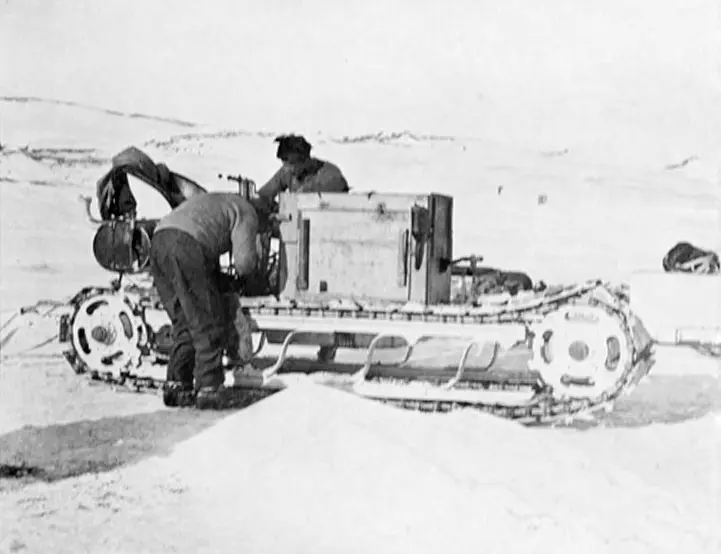
One of the motor sledges on the ice, 1911, as captioned in Scott's book.
"One of the Motor Sledges" by Herbert Ponting — https://commons.wikimedia.org/wiki/File:One_of_the_Motor_Sledges.jpg — Public domain (US: published 1913, before 1931; elsewhere: Herbert Ponting died 1935, life plus 70 expired)

Two motor sledges left Cape Evans on 24 October 1911, and the farther one made about 50 statute miles. Robert Falcon Scott, the Royal Navy captain leading the Terra Nova expedition, wrote down the wreckage as he reached it, and William Lashly, one of the two drivers, kept a diary of each day. Bernard Day, the other driver, had left a note on the trail: “Hope to meet in 80° 30' (Lat.).” Scott copied it out and added, “Poor chap, within 2 miles he must have had to sing a different tale.”
Stops on this page (8)
- Where did Scott's motor sledges stop?
- How fast were the motor sledges?
- What did Scott expect from the motors?
- Why did the motor sledges break down?
- What happened to Scott's ponies and dogs?
- Why did Scott and his men die?
- How far was Scott from One Ton Depot?
- The Ibry strip: four kinds of traction on one chart
Where did Scott's motor sledges stop?
Day's motor stopped first, on 29 October by Lashly's diary. Scott walked past it on 4 November: a tin on the track read “Big end Day's motor No. 2 cylinder broken,” and half a mile on stood the machine with its sledges. A big end is the bearing that joins a connecting rod to the crankshaft, so a broken one stops that cylinder.
Lashly's motor kept going for three more days, and he wrote that it gave out on 1 November, “about a mile past Corner Camp.” Stand at Corner Camp on 5 November, as Scott did, and his entry has you looking south at “three black dots.” The next day he reached them, and a note from Lieutenant Edward Evans reported that the big end of No. 1 cylinder had cracked.
Lashly and Scott are a day apart here, and this page keeps both dates. Lashly writes that they reached Corner Camp on 1 November and left a note for Scott, and only then did the engine give out. Scott says Evans's note at Corner Camp was written on the morning of the 2nd.
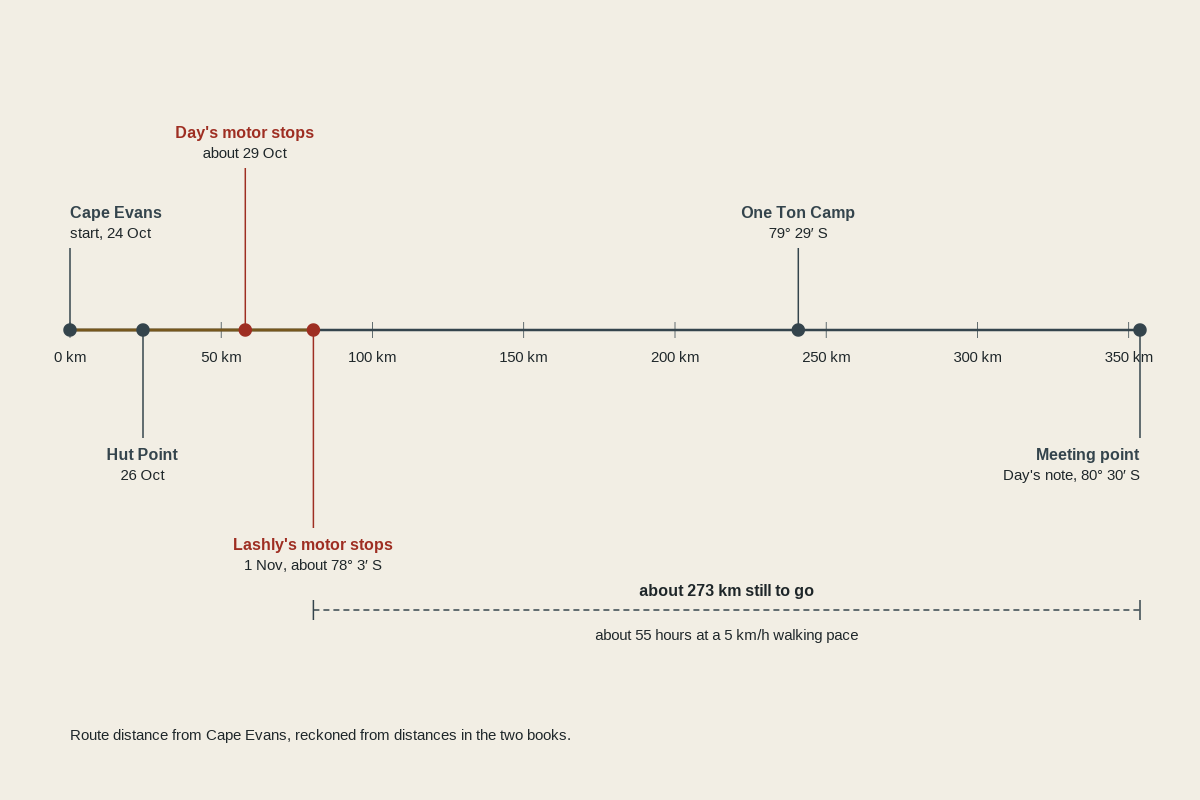
Where each motor stopped on the route south of Cape Evans. The meeting point in Day's note lay about 273 km beyond the last one.
Keel, Rail & Spoke, CC BY 4.0
Data: Robert Falcon Scott, Scott's Last Expedition, Vol. I (1913), https://www.gutenberg.org/ebooks/11579; Apsley Cherry-Garrard, The Worst Journey in the World (1922), https://www.gutenberg.org/ebooks/14363
Reuse this diagram: credit to copy
"Where the motor sledges stopped, October and November 1911" by Keel, Rail & Spoke, https://keelrailandspoke.com/journeys/robert-falcon-scott-terra-nova/, licensed under CC BY 4.0 (https://creativecommons.org/licenses/by/4.0/).
Data behind this diagram: robert-falcon-scott-terra-nova-depots.csv · Where this data came from
Neither book prints a latitude for the spot, so near 78° S is a reckoning.
Scott's summary of the 1911 Depot Journey lists the runs from Corner Camp to his 79° 29′ depot, all due south, and they add up to about 87 geographical miles. A geographical mile is about one minute of latitude, which puts Corner Camp near 78° 2′. A second route agrees: Scott gives 78° 13′ for the next camp south, about 10 miles on, which gives 78° 3′. One row of that table carries a question mark in print.
So the 80° figure belongs to the plan and not to the machines. Cherry-Garrard says the party was to wait at 80° 30′ and haul loads on by hand if the motors broke down, and on 21 November Scott found them waiting on foot at 80° 32′, having walked the difference. The gap from the last motor to the meeting point comes to about 273 km, or about 55 hours at a 5 km/h walking pace.
How fast were the motor sledges?
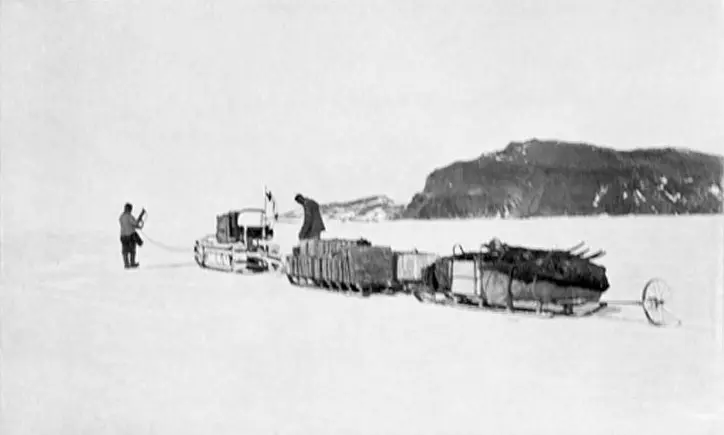
Day's motor under way, 1911, as captioned in Scott's book.
"Day's Motor Under Way" by Herbert Ponting — https://commons.wikimedia.org/wiki/File:Day%27s_Motor_Under_Way.jpg — Public domain (US: published 1913, before 1931; elsewhere: Herbert Ponting died 1935, life plus 70 expired)

The machines allowed about walking pace when they ran. On 27 October Scott gave the speed of Lashly's motor in second gear as “2 1/2 to 3 miles an hour,” which is 4.0 to 4.8 km/h if he meant statute miles, and called it “a nice easy walking speed.” The day before, he had watched Day's machine go off “faster than one could walk.”
The trouble was how little of each day they spent running. Lashly wrote that after three-quarters of a mile to a mile the engine needed at least half an hour to cool. Scott describes the same trade: the rear cylinders ran too hot while the air on the carburetor kept it too cold.
A note from Evans put the best at about 7 miles a day, and the result was about 10 km a day across the eight days from 24 October to 1 November. That is a walking multiple of about 0.08, counted overall, stops included. On 27 October Scott himself walked 26 1/2 statute miles, about 43 km, and went back to the hut.
What did Scott expect from the motors?
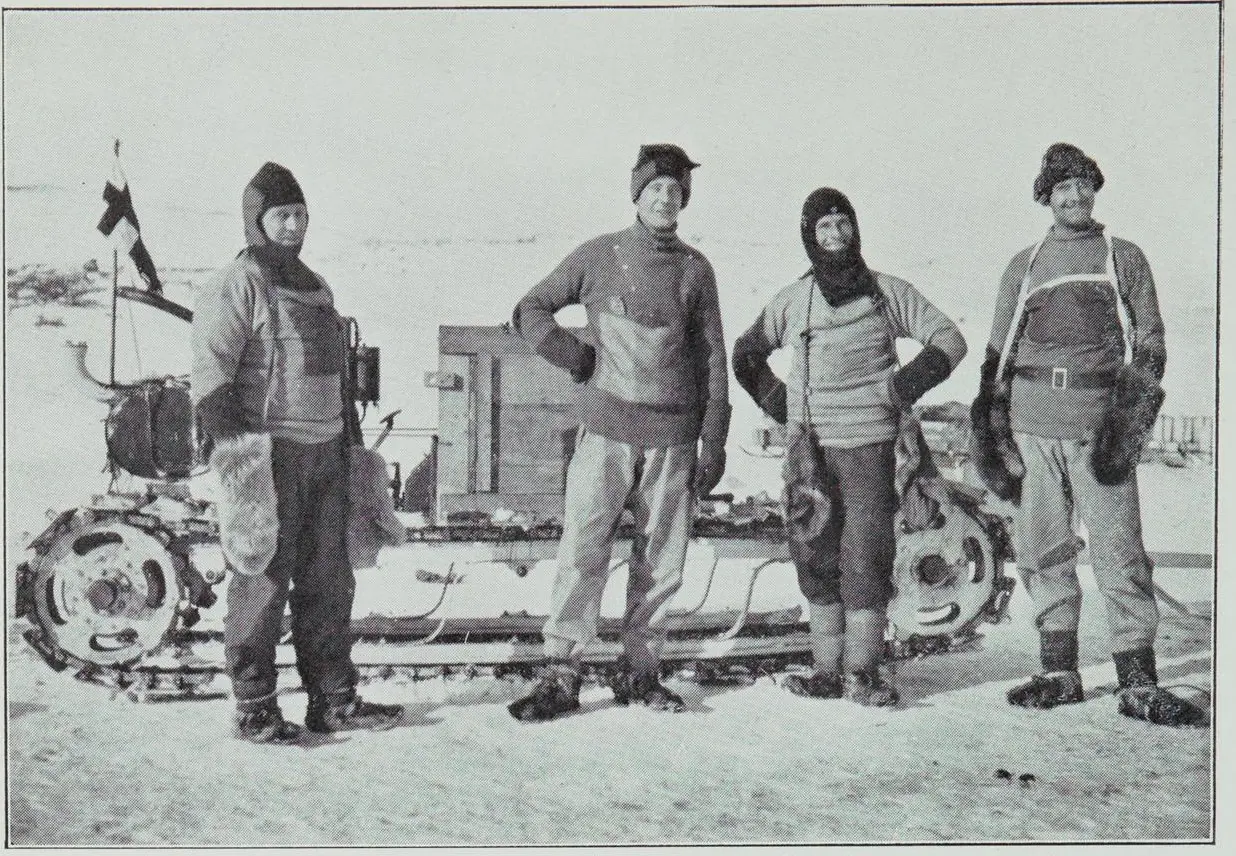
The motor party, named in the book's caption as Lashly, Day, Lieutenant Evans and Hooper; cropped from a copy of Ponting's The Great White South dated 1923.
The Motor Party by Herbert Ponting, Public domain
Full credit
"The Motor Party" by Herbert Ponting — https://commons.wikimedia.org/wiki/File:The_great_white_South_BHL46249112.jpg — Public domain (US: published no later than 1923, the date on the file page, before 1931; elsewhere: Herbert Ponting died 1935, life plus 70 expired); modified: cropped: plate only, book page margins, caption and two other photographs removed

Scott had warned himself. “I do not count on the motors,” he wrote on 10 September 1911, adding that if they worked well, the first stage to the glacier would be made quite easy. On 1 September he had judged that the plan would carry the party through without them, “though in that case nothing else must fail.”
The sledges had some history: a footnote in his book lists tests at Lauteret in the Alps in 1908 and in Norway in 1909 and 1910. A third machine never got that far: on 8 January 1911 it went through the sea ice while being landed.
The last weeks in camp went no better. On 17 October the best motor overrode its chain, Day slipped and jammed the throttle full on, and the aluminum axle casing split, though Day had it mended within days.
“It all goes to show that we want more experience and workshops,” Scott wrote that night, and a week later he thought the loads looked a good deal heavier than planned. He was blunt about the cost of that haste: “the trifling mechanical defects and lack of experience show the risk of cutting out trials.”
The stop changed the ponies' work before anything else. The motors had been carrying forage for them, and Evans's party moved on with what it could haul. So on 6 November Scott set out “arranging so that full loads should be carried” if the dots ahead proved to be the second machine. On that march the ponies took their full loads, and by his entry they “did splendidly.”
Why did the motor sledges break down?
Three faults run through the record. The chains slipped on thin snow over hard ice, the rollers split, and the engines ran hot, while the big ends failed three times. By Scott's entry, Evans traced the first of those to a faulty casting. Lashly also doubted the design itself, writing on 26 October that the sledges were “not powerful enough for the work.”
In this site's gear language the chain fault is slippage, and here the word is literal. Scott looked at the ice after Day's chains slipped on 24 October and found that the studs “had grooved the ice.”
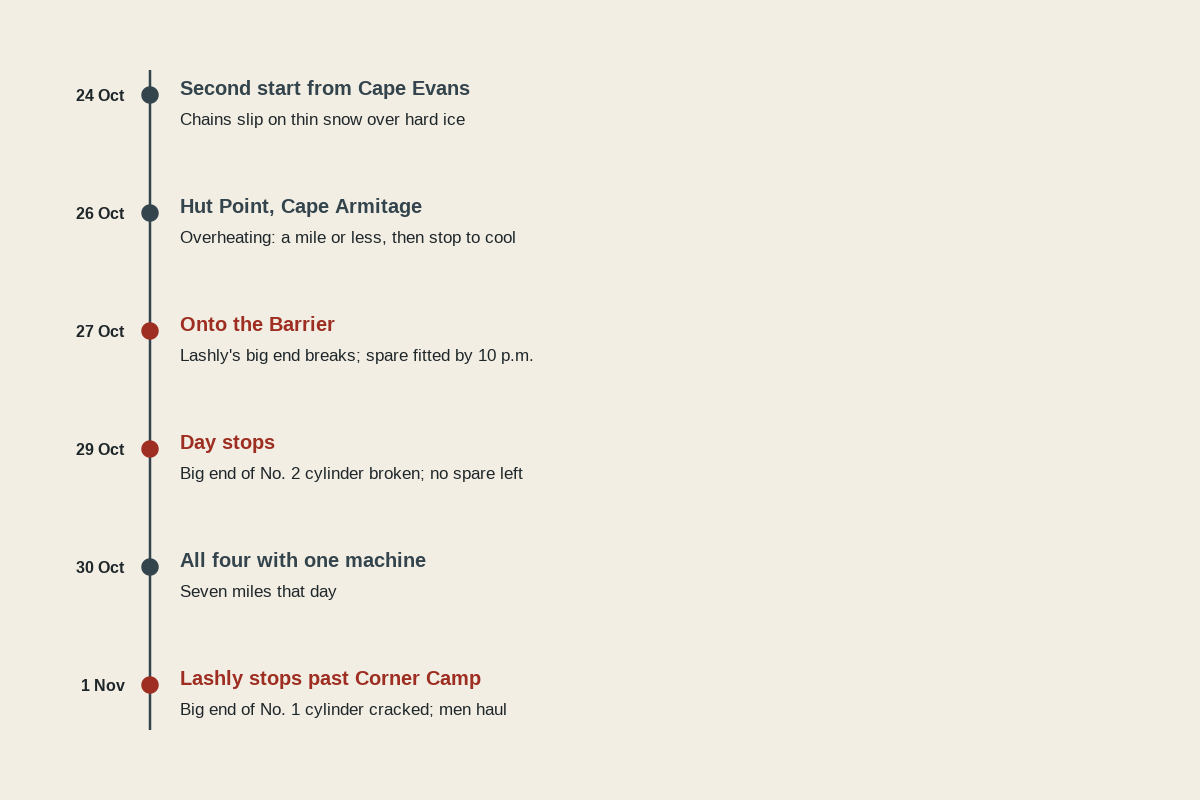
Eight days of the motors, from Lashly's diary and Scott's journal. Red marks the three big-end failures.
Keel, Rail & Spoke, CC BY 4.0
Data: Robert Falcon Scott, Scott's Last Expedition, Vol. I (1913), https://www.gutenberg.org/ebooks/11579; Apsley Cherry-Garrard, The Worst Journey in the World (1922), https://www.gutenberg.org/ebooks/14363
Reuse this diagram: credit to copy
"Eight days of the motor sledges, 24 October to 1 November 1911" by Keel, Rail & Spoke, https://keelrailandspoke.com/journeys/robert-falcon-scott-terra-nova/, licensed under CC BY 4.0 (https://creativecommons.org/licenses/by/4.0/).
The repair radius, this site's measure of the distance from a fault to the nearest place on record that could fix it, changes across those eight days. The first big-end failure, on 27 October, was mended on the spot.
Lashly says the crank brasses “broke into little pieces,” and he and Day fitted the spares by 10 p.m. in a temperature Scott puts at -25° F. At that moment the radius was on board.
Then the spares ran out. “The only spare had been used for Lashly's machine,” Scott wrote when he reached Day's motor. For the last failure the Leg card has to say unknown.
The nearest workshop on record was the hut at Cape Evans, about 80 km back, where Day had mended a split axle casing that same month and turned new rollers using a small motor as a lathe. Nothing read says that bench could have replaced a cracked big end.
Scott did not write the machines off. He noted on 6 November that “the system of propulsion is altogether satisfactory,” and he blamed the engines for not being fitted to the climate. Cherry-Garrard later judged that fifty statute miles was still an advance, since no motor had run on the Barrier before.
What happened to Scott's ponies and dogs?
The ponies outlasted the motors by five weeks. Ten of them left in November, by Cherry-Garrard's count, and Scott's entries show them hauling well past Corner Camp; his own pony, Snippets, had over 700 lbs with the sledge on 6 November.
They were shot as they weakened and the forage ran down. From One Ton the plan was 13 geographical miles a day, and on 1 December Scott wrote that the ponies were outlasting the forage. Jehu went on 24 November, Chinaman on 28 November, Christopher on 1 December, Victor on 2 December and Michael on 4 December.
The last five were shot on 9 December at Camp 31, which took the name Shambles Camp, after a four-day blizzard that Scott calls devastating. “It is hard to have to kill them so early,” he wrote.
The position has no latitude in the entries read. It is about 83° 22′ S as an estimate, from Scott's 83° on 2 December plus three later runs in his table.
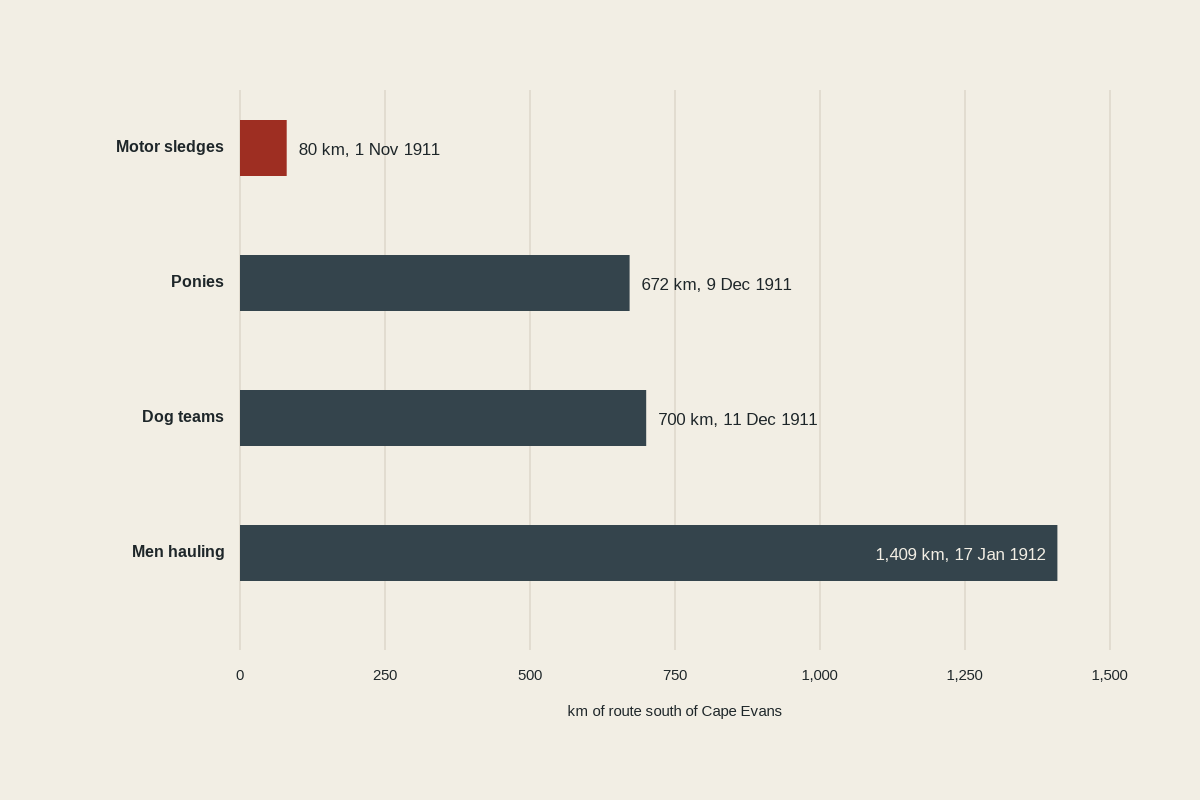
How far south of Cape Evans each kind of traction got. The dog figure is interpolated and the pony figure estimated; south of One Ton the distance counts latitude only.
Keel, Rail & Spoke, CC BY 4.0
Data: Robert Falcon Scott, Scott's Last Expedition, Vol. I (1913), https://www.gutenberg.org/ebooks/11579; Apsley Cherry-Garrard, The Worst Journey in the World (1922), https://www.gutenberg.org/ebooks/14363
Reuse this diagram: credit to copy
"How far south of Cape Evans each kind of traction reached" by Keel, Rail & Spoke, https://keelrailandspoke.com/journeys/robert-falcon-scott-terra-nova/, licensed under CC BY 4.0 (https://creativecommons.org/licenses/by/4.0/).
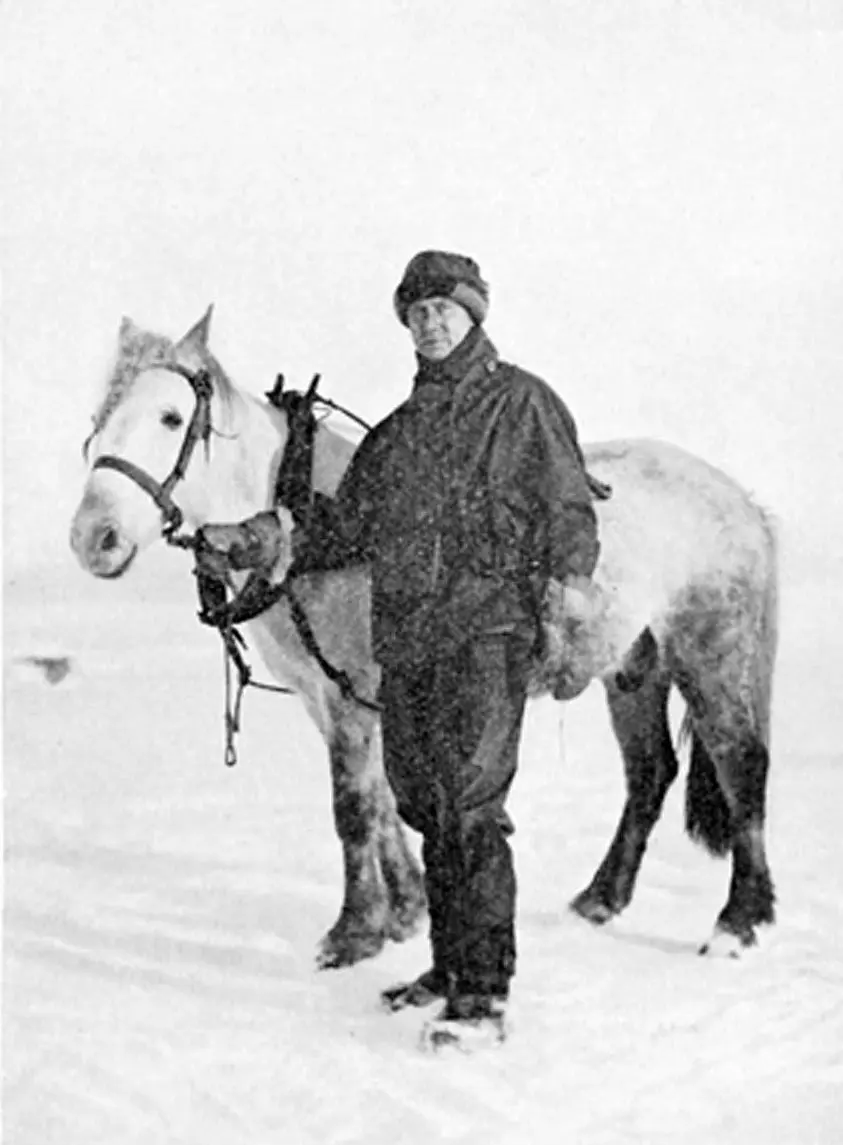
Dr. Wilson and the pony Nobby, 1911, as captioned in Scott's book.
"Dr. Wilson and Pony 'Nobby'" by Herbert Ponting — https://commons.wikimedia.org/wiki/File:Dr._Wilson_and_Pony_%27Nobby%27.jpg — Public domain (US: published 1913, before 1931; elsewhere: Herbert Ponting died 1935, life plus 70 expired)

The dog teams went a little farther. On 10 December they were still carrying 600 lbs of the load, and on 11 December they turned back with Cecil Meares and Demetri Gerof, above the Lower Glacier Depot by a note in Scott's book.
From there on, men pulled everything; Day and Hooper had already turned home on 24 November. Four more men left at the top of the glacier on 22 December, and on 3 January, at about 87° 32′, Scott told off the last three to go back, among them Lashly and Lieutenant Evans.
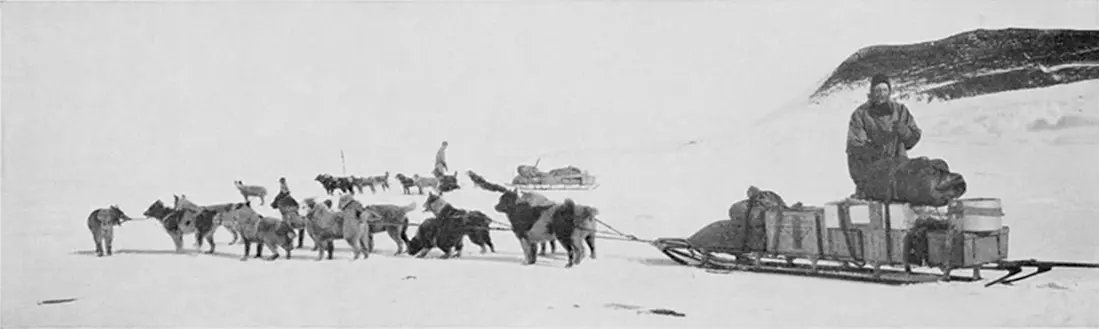
Meares and Demetri with their dog teams leaving Hut Point, 1911, as captioned in Scott's book.
Meares and Demetri with their Dog-teams leaving Hut Point by Herbert Ponting, Public domain
Full credit
"Meares and Demetri with their Dog-teams leaving Hut Point" by Herbert Ponting — https://commons.wikimedia.org/wiki/File:Meares_and_Demetri_with_their_Dog-teams_leaving_Hut_Point.jpg — Public domain (US: published 1913, before 1931; elsewhere: Herbert Ponting died 1935, life plus 70 expired)

Lashly had hauled on foot since 1 November. Cherry-Garrard reckons that he and Evans man-hauled four hundred statute miles farther than the rest.
| Traction | Dates | Distance | Walking multiple (overall) |
|---|---|---|---|
| Motor sledges | 24 Oct to 1 Nov 1911 | about 80 km | about 0.08 |
| Ponies, to Shambles Camp | 1 Nov to 9 Dec 1911 | about 672 km, estimated, latitude only south of One Ton | about 0.15 |
| Men hauling, Camp 37 to the Pole | 15 Dec 1911 to 17 Jan 1912 | about 652 km, latitude only | about 0.16 |
| Men hauling, the Pole to the last camp | 17 Jan to 19 Mar 1912 | about 1,151 km, latitude only | about 0.15 |
Only these overall figures compare with each other, and the last three run low because south of One Ton they count latitude and not the track. Measured that way, men on foot held the same pace as the ponies, and both held nearly twice the pace of the motors.
Why did Scott and his men die?
Five men reached the Pole, Scott, Edward Wilson, Henry Bowers, Lawrence Oates and Edgar Evans, under a journal entry headed “The Pole” on 17 January 1912, and none of the five came back. Edgar Evans died on the night of 17 February at the foot of the glacier, Oates walked out of the tent around 16 or 17 March, and Scott's last entry is dated 29 March.
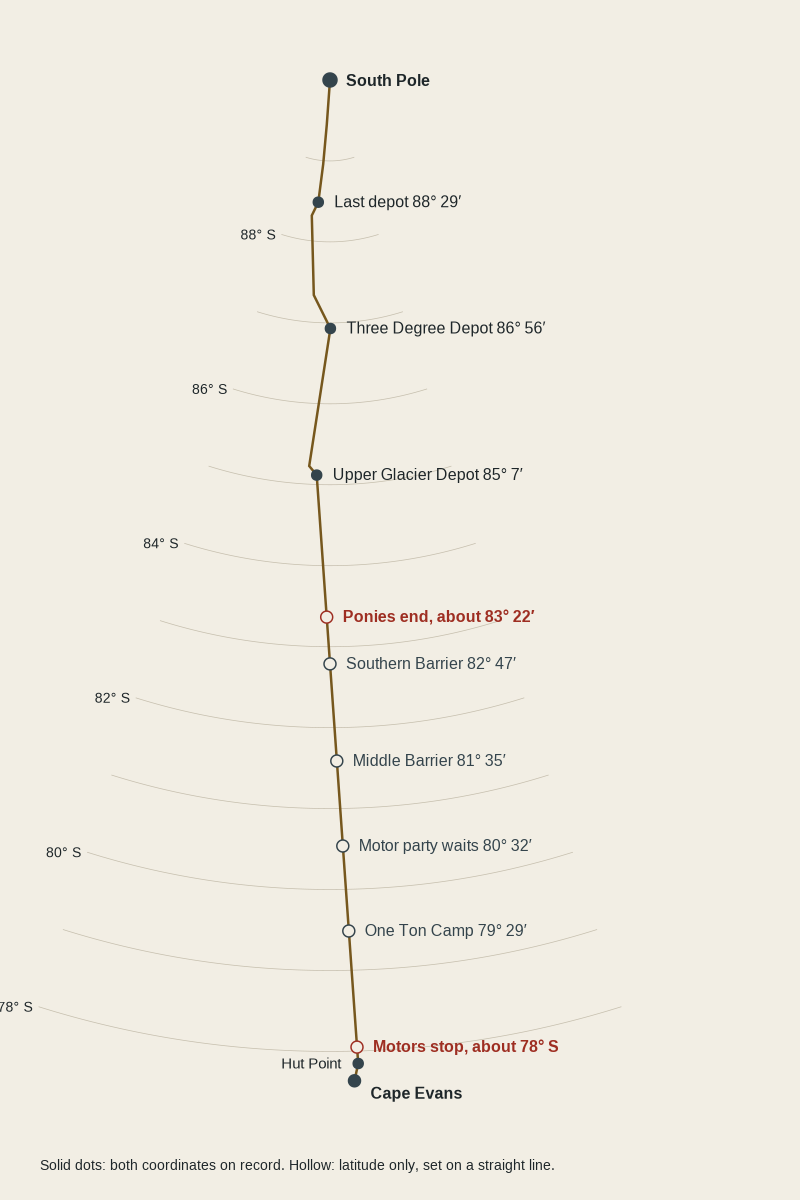
Scott's route south. Solid points have both coordinates on record; hollow ones have latitude only and sit on a straight line.
Keel, Rail & Spoke, CC BY 4.0
Data: Robert Falcon Scott, Scott's Last Expedition, Vol. I (1913), https://www.gutenberg.org/ebooks/11579; Apsley Cherry-Garrard, The Worst Journey in the World (1922), https://www.gutenberg.org/ebooks/14363; Wikidata coordinates (CC0), https://www.wikidata.org/wiki/Q1634141, retrieved 2026-11-08
Reuse this diagram: credit to copy
"Scott's route from Cape Evans to the South Pole" by Keel, Rail & Spoke, https://keelrailandspoke.com/journeys/robert-falcon-scott-terra-nova/, licensed under CC BY 4.0 (https://creativecommons.org/licenses/by/4.0/).
The record gives no single cause. Scott's Message to the Public names several, starting with the loss of ponies in March 1911, which delayed the start, then the weather on the way out, then soft snow on the lower glacier. It goes on to Edgar Evans's collapse, a sudden cold on the Barrier that he puts at -30° F by day and -47° F at night, Oates's illness and “a shortage of fuel in our depôts for which I cannot account.” Of that cold he writes, “our wreck is certainly due to this sudden advent of severe weather.”
The motors are not on that list. Scott had planned for their failure, and on 5 November he wrote, “It is a disappointment,” adding that he had hoped for better on the Barrier surface. Whether their loss helped decide the end is a question the sources read for this page do not settle.
The Leg card's last spare entry therefore says multiple constraints. Three things ran short together, each with its own source.
Fuel was short at the Southern Barrier Depot on 24 February and at the next depots too, and a note in Scott's book blames leakage past perished leather washers on the tins. Food was down to two days on 20 March. Pulling strength fell as two of the five failed. His entry of 29 March counts what was left on the 20th: “fuel to make two cups of tea apiece.”
How far was Scott from One Ton Depot?
Scott's last camp was within 11 miles of One Ton Depot, by his own Message and journal. Which mile he meant takes a second look, because the table of marches printed in his book counts in statute miles, while Cherry-Garrard, who was with the search party, writes 11 geographical miles.
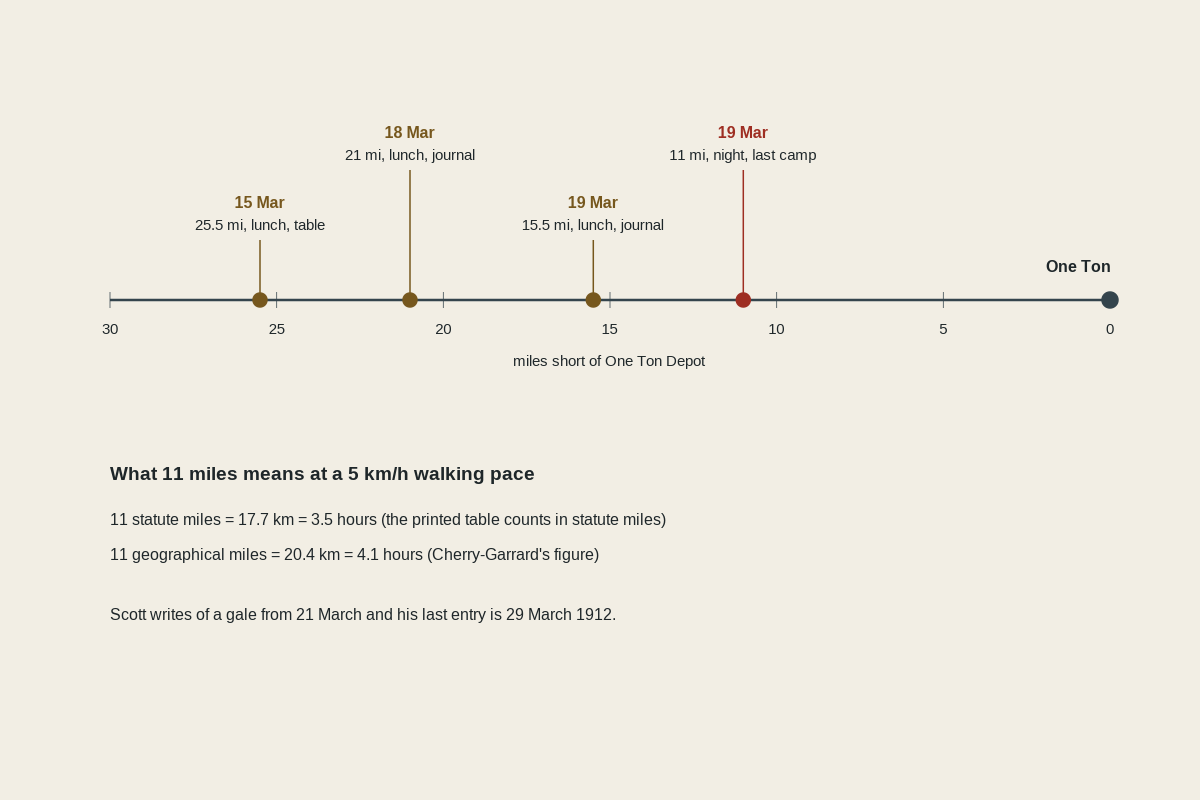
The last entries that give a distance to One Ton Depot, with the walking time for each reading of 11 miles.
Keel, Rail & Spoke, CC BY 4.0
Data: Robert Falcon Scott, Scott's Last Expedition, Vol. I (1913), https://www.gutenberg.org/ebooks/11579; Apsley Cherry-Garrard, The Worst Journey in the World (1922), https://www.gutenberg.org/ebooks/14363
Reuse this diagram: credit to copy
"The last recorded distances to One Ton Depot, March 1912" by Keel, Rail & Spoke, https://keelrailandspoke.com/journeys/robert-falcon-scott-terra-nova/, licensed under CC BY 4.0 (https://creativecommons.org/licenses/by/4.0/).
The two readings give 17.7 km or 20.4 km. At a 5 km/h walking pace that is about 3.5 or 4.1 hours for a rested walker, and the three men in that tent were not rested. The gale Scott describes started on 21 March and, by his entry, had not stopped by the 29th.
Dogs had been at that depot earlier in the month. A note in Scott's book says Cherry-Garrard and Demetri waited six days at One Ton with the teams, then went home when little more than enough dog food to get the teams back was left.
The Ibry strip: four kinds of traction on one chart
Read this chart as a graph of speed: time runs left to right, distance runs up, and a steeper line is a faster one. The motor line is the short one at the bottom left. The other lines follow it out for a few days and then keep climbing, one traction handing over to the next.
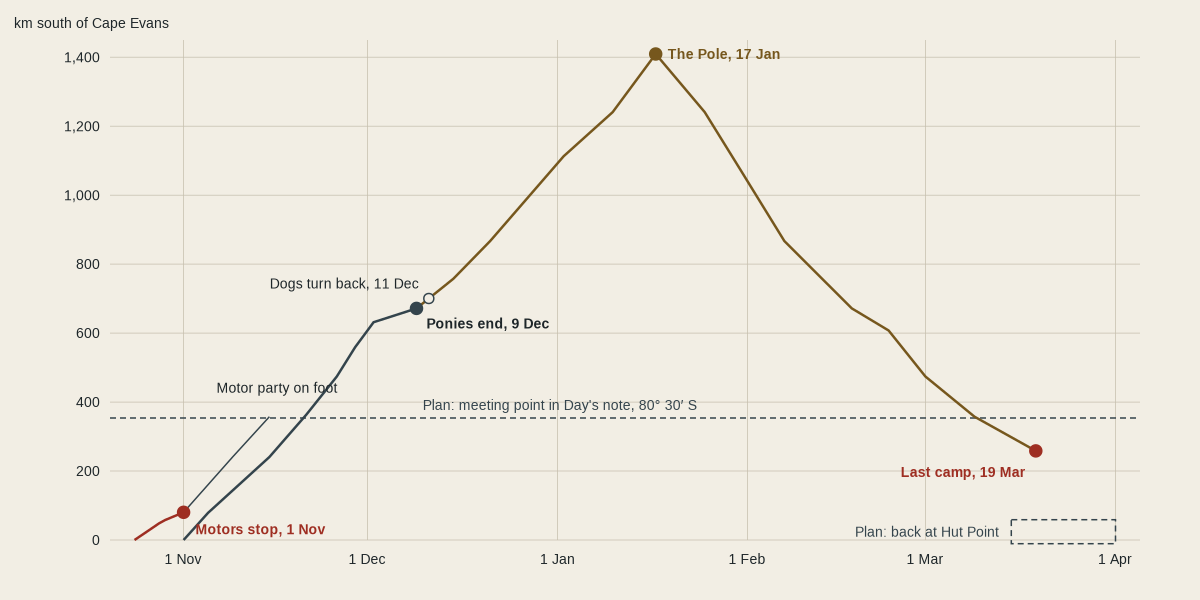
Traction by date and distance south of Cape Evans. Dashed lines mark the plan: the meeting point in Day's note and Scott's forecast return to Hut Point. South of One Ton the distance counts latitude only.
Keel, Rail & Spoke, CC BY 4.0
Data: Robert Falcon Scott, Scott's Last Expedition, Vol. I (1913), https://www.gutenberg.org/ebooks/11579; Apsley Cherry-Garrard, The Worst Journey in the World (1922), https://www.gutenberg.org/ebooks/14363
Reuse this diagram: credit to copy
"Terra Nova time-distance strip, October 1911 to March 1912" by Keel, Rail & Spoke, https://keelrailandspoke.com/journeys/robert-falcon-scott-terra-nova/, licensed under CC BY 4.0 (https://creativecommons.org/licenses/by/4.0/).
Data behind this diagram: robert-falcon-scott-terra-nova-transport.csv · Where this data came from
Leg figures behind the table: robert-falcon-scott-terra-nova-legs.csv · Where this data came from
Other journeys on this site weigh the same question of machine against distance. The iron boat in Lewis and Clark Expedition leaked far from any shipyard, Fridtjof Nansen had Fram built to be frozen in, and Thomas Stevens wheeled a bicycle across continents.
The motor stayed where it stopped. On 14 March 1912 Cherry-Garrard was driving the dog teams home from One Ton, off his course and among crevasses, when he sighted the derelict machine, then Corner Camp, two or three miles to the east of him. It had been standing on the Barrier for 134 days.
Sources
- Robert Falcon Scott, Scott's Last Expedition, Vol. I, arranged by Leonard Huxley (London: Smith, Elder, 1913). Public domain; Scott died in 1912 and Huxley in 1933. https://www.gutenberg.org/ebooks/11579Read: chapters: journal entries for September 1911 to March 1912, part of January and February 1911, the Message to the Public, the appendix notes and the table of marches
- Apsley Cherry-Garrard, The Worst Journey in the World (London: Constable, 1922), including William Lashly's diary. Cherry-Garrard died in 1959; short quotation only. https://www.gutenberg.org/ebooks/14363Read: chapter passages in the introduction and chapters IV, V, VIII, IX and XIII
- Wikidata. Coordinate statements (P625) for Cape Evans (Q1634141) and Discovery Hut (Q15214127). https://www.wikidata.org/wiki/Q1634141Read: full page of structured data, coordinate statements only
Cite this page
Keel, Rail & Spoke. "Robert Falcon Scott: The Motors Gave Out Before the Ponies." Published 2026-11-08. https://keelrailandspoke.com/journeys/robert-falcon-scott-terra-nova/. Accessed on the date you read it.
How facts are checked · Corrections · Contact
Found a mistake on this page? Write to contact@keelrailandspoke.com.
More from Journeys & Expeditions
Journeys & Expeditions
Lewis and Clark Expedition: Lewis’s Iron Boat Leaked, 1805
The Lewis and Clark Expedition took 862 days. Clark put the way out at 4,134 miles, and Lewis's iron-framed boat leaked at the Great Falls in July 1805.
Picture credit
"Captain Clark and his men shooting bears" by unknown creator — https://commons.wikimedia.org/wiki/File:Captain_Clark_and_his_men_shooting_bears_LCCN2001699664.jpg — Public domain (US: published 1810, before 1931; elsewhere: creator unknown, published more than 200 years ago, every term expired); modified: cropped: printed title and page number removed
Journeys & Expeditions
Fridtjof Nansen: Had the Fram Built to Freeze In, Then Left
Nansen had the Fram built to freeze into the pack. By her printed fixes she drifted about 3.20 km a day; he left in March 1895 and turned back near 86° 14′ N.
Picture credit
"Fram i isen" by Fridtjof Nansen — https://commons.wikimedia.org/wiki/File:Fram_i_isen,_1895_(4594586561).jpg — Public domain (US: photographer died 1930; if first printed in Farthest North 1897, published before 1931; if not printed then, unpublished-work term expired; elsewhere: Fridtjof Nansen died 1930, life plus 70 expired)
Journeys & Expeditions
Ferdinand Magellan: His Ship’s Calendar Lost a Day
Ferdinand Magellan died at Mactan in 1521. In July 1522 the Victoria, his one ship to finish, reached Cape Verde on a Wednesday the shore called Thursday.
Picture credit
"Detail from a map of Ortelius: Magellan's ship Victoria" by Abraham Ortelius — https://commons.wikimedia.org/wiki/File:Detail_from_a_map_of_Ortelius_-_Magellan's_ship_Victoria.png — Public domain (US: published about 1589 to 1590, before 1931; elsewhere: Abraham Ortelius died 1598, life plus 70 expired); modified: cropped: to the ship; coast, verse and most map lettering removed


