Journeys & Expeditions · Journey file
Fridtjof Nansen: Had the Fram Built to Freeze In, Then Left
Fridtjof Nansen had a ship built to be trapped in the Arctic ice and carried by it, then left her after eighteen months and headed for the North Pole.
Keel, Rail & Spoke · Published
TL;DR
- Fridtjof Nansen, the Norwegian polar explorer and scientist, had the Fram built to freeze into the Arctic pack and drift with it; by straight lines between her printed positions she drifted about 3.20 km a day.
- On 14 March 1895 he left her at 84° 4′ N with Hjalmar Johansen and turned back at 86° 13.6′ N by his own figure, about 419 km short of the Pole.
- The Fram drifted on to 85° 55.5′ N under Otto Sverdrup and cleared the ice on 13 August 1896.
Leg card
- Departure
- Christiania (now Oslo), Norway: 24 June 1893
- Arrival
- Fram: Skjervoy, Norway, 20 August 1896. Nansen and Johansen: Vardo, Norway, 13 August 1896, by the ship Windward
- Distance
- Drift about 2,945 km (1,590 nmi) as straight lines between 51 fixes, 7 Nov 1893 to 16 May 1896; about 1,830 mi. The whole voyage was not summed
- Machine
- Fram, three-masted schooner with a 220 hp engine, built by Colin Archer
- Elapsed
- 1,153 days, 24 June 1893 to 20 August 1896; frozen in or held by ice about 1,056 of them. The drift figure spans 921 days
- Walking multiple
- about 0.0266 (overall), the drift span only, about 3.20 km a day
- Repair radius
- on board. Fault: windmill shaft broken, 1895, welded at the forge by Pettersen, back in use 9 May. The ship carried a smithy and a mechanical workshop. Sverdrup, 1895, found no hull damage so far as he could see, though she leaked
- The last spare
- none exhausted, for the ship: Sverdrup says at Danes Island that coal was the only thing to top up. The sledge party killed its dogs along the way and went on by kayak
- Key source
- Fridtjof Nansen, Farthest North (1897), with the report of Otto Sverdrup
Download this card (CSV) · Where this data came from
Data: Fridtjof Nansen, Farthest North, Vol. I (1897), https://www.gutenberg.org/ebooks/30197; Fridtjof Nansen, with Otto Sverdrup, Farthest North, Vol. II (1897), https://www.gutenberg.org/ebooks/34120
What the card means: walking multiple, repair radius, last spare.
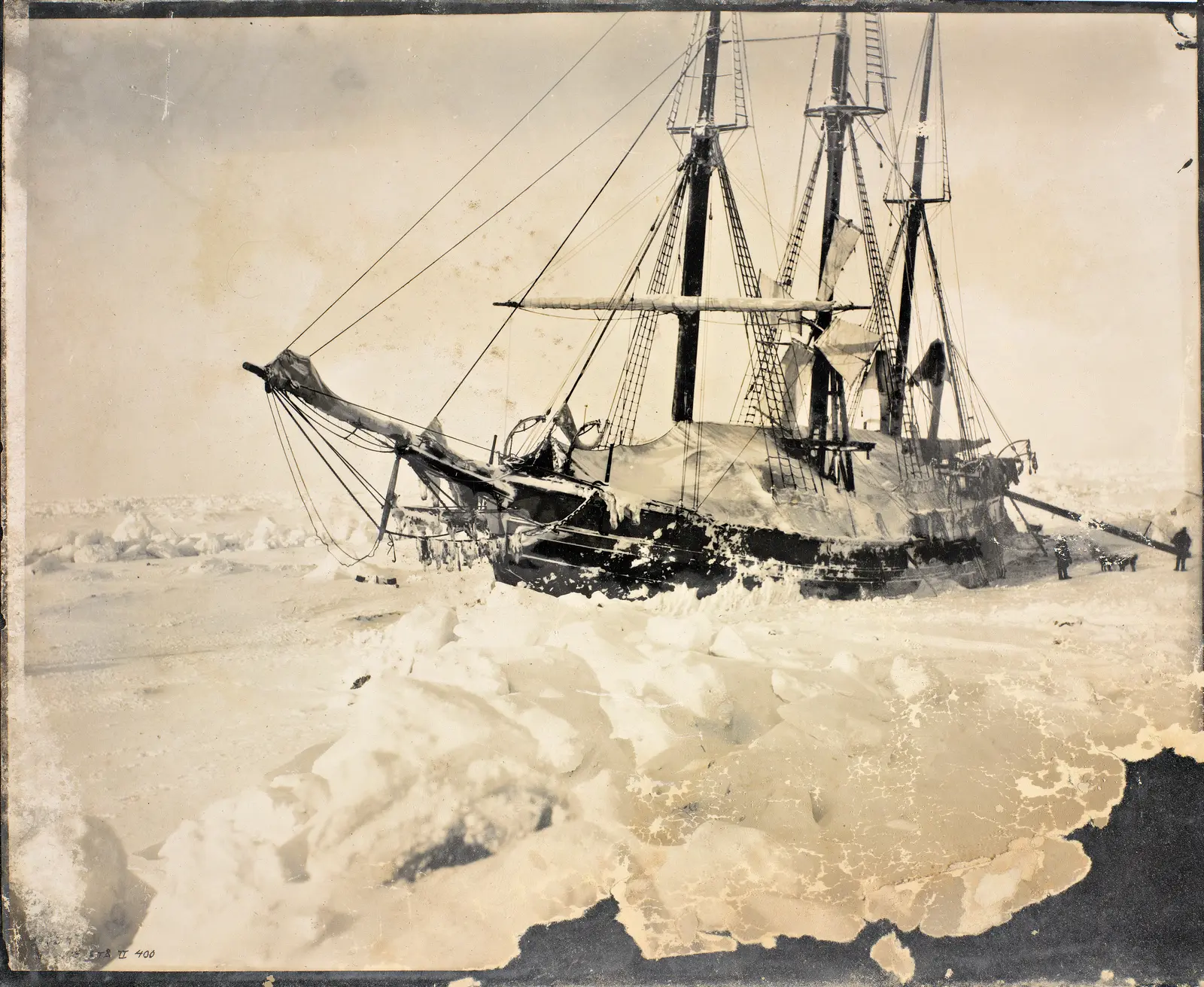
The Fram in the ice, March 1895, the month Nansen left her. The damage at the edges is in the scan.
Fram i isen by Fridtjof Nansen, Public domain
Full credit
"Fram i isen" by Fridtjof Nansen — https://commons.wikimedia.org/wiki/File:Fram_i_isen,_1895_(4594586561).jpg — Public domain (US: photographer died 1930; if first printed in Farthest North 1897, published before 1931; if not printed then, unpublished-work term expired; elsewhere: Fridtjof Nansen died 1930, life plus 70 expired)

The Fram, Fridtjof Nansen's polar ship, drifted about 2,945 km in 921 days, roughly 3.20 km a day. That figure is recalculated as straight lines between the positions printed in Farthest North, Nansen's account of 1897, and in the report by her captain, Otto Sverdrup. At a 5 km/h walking pace, 3.20 km takes about 38.4 minutes, which makes a walking multiple of about 0.0266, counted overall and including every stop. The ship was doing exactly what she had been built to do, and in March 1895 Nansen got off.
Stops on this page (8)
What was Nansen's plan for the Fram?
The plan started with a list of provisions. The Jeannette, an American exploring ship, stuck fast in the ice in 1879 and was crushed north of the New Siberian Islands on 12 June 1881. By her commander's journal she went down at 4 a.m. the next day, although Nansen's book dates the foundering to the 12th. Three years later, Inuit on the southwest coast of Greenland found articles frozen into the drift ice near Julianehaab, and Lytzen, the colonial manager there, collected them: a provisions list signed by De Long, her commander, a list of her boats, and a pair of oilskin breeches marked with a crewman's name.
Nansen read of the finds in the autumn of 1884, in an article by Professor Mohn, who suggested that they had crossed the Polar Sea on a floe. His own crossing of the Greenland ice came later, in 1888. He kept collecting evidence afterward. The mud on the drift ice off Greenland held diatoms, the tiny algae that build glassy shells, which Professor Cleve matched to a sample from a floe near Bering Strait and to none of the many thousands of others he had seen.
If a floe could cross the unknown sea, Nansen reasoned, then a ship could ride one. He put the idea to the Christiania Geographical Society in February 1890, proposing to moor between floes and stop steering altogether. “Henceforth the current will be our motive power, while our ship, no longer a means of transport, will become a barrack,” he said, and he guessed at about two miles a day from the speed of the Jeannette relics.
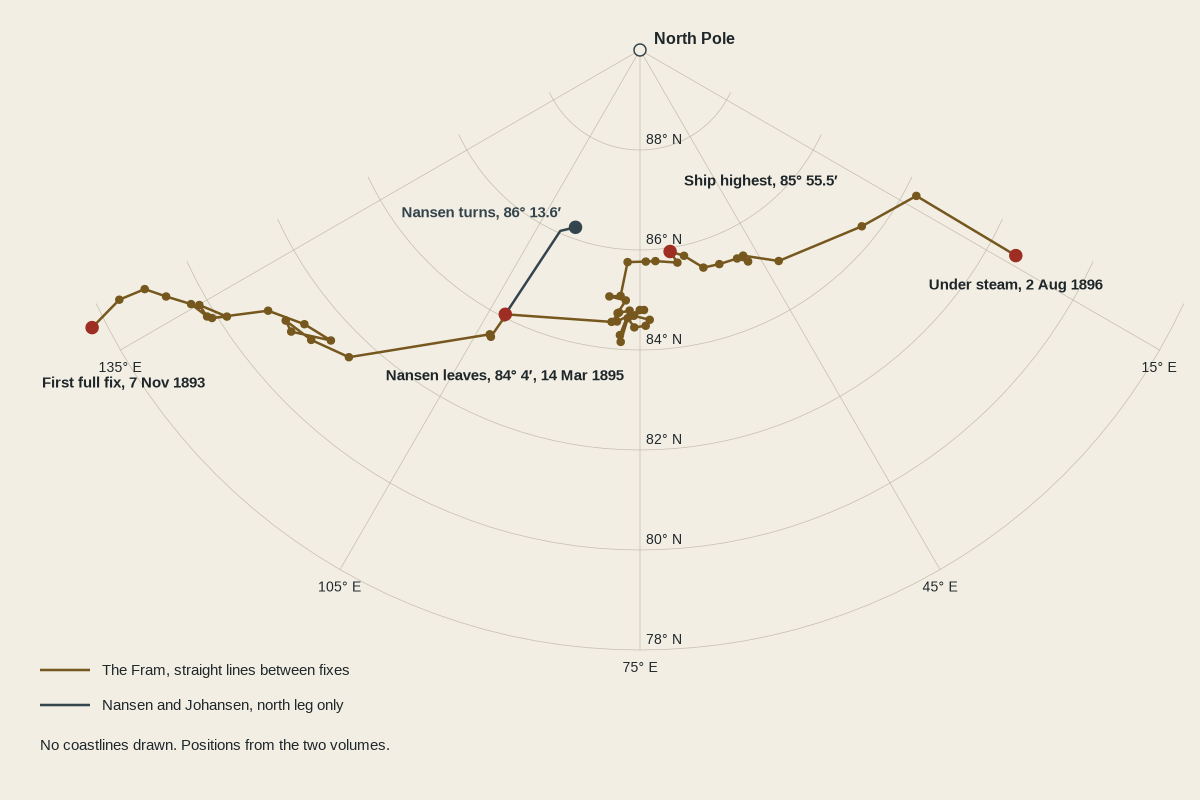
The track as straight lines between fixes that give both latitude and longitude. The real track between fixes was longer, and after 16 May 1896 the line includes steaming.
Keel, Rail & Spoke, CC BY 4.0
Data: Fridtjof Nansen, Farthest North, Vol. I (1897), https://www.gutenberg.org/ebooks/30197; Fridtjof Nansen, with Otto Sverdrup, Farthest North, Vol. II (1897), https://www.gutenberg.org/ebooks/34120
Reuse this diagram: credit to copy
"The Fram's track on a polar grid" by Keel, Rail & Spoke, https://keelrailandspoke.com/journeys/fridtjof-nansen-fram/, licensed under CC BY 4.0 (https://creativecommons.org/licenses/by/4.0/).
Data behind this diagram: fridtjof-nansen-fram-drift.csv · Where this data came from
In London in November 1892 the plan met the men who knew the ice best. Admiral Sir Leopold M'Clintock called it “the most adventurous programme ever brought under the notice of the Royal Geographical Society.” Admiral Sir George Nares objected that the accepted rule was to keep close to a coast and hold a safe line of retreat, and that this plan deliberately broke both parts of the rule.
Why was the Fram not crushed by the ice?
Nares had a sharper point about the hull. A ship frozen into the pack, he argued, becomes part of the block around her, so “the form of the vessel goes for nothing.” Nansen's answer was a hull, designed by the shipbuilder Colin Archer around a single idea: the ice should find nothing to grip.
Bow, stern and keel were all rounded. Barely three inches of keel showed below the planking. Nansen says a section amidships recalled half a coconut, and the sloping sides were meant to make pressing ice slide under her and lift her. She came out considerably larger than he originally asked for: 402 tons gross, 128 feet on deck, 36 feet across, her breadth about a third of her length.
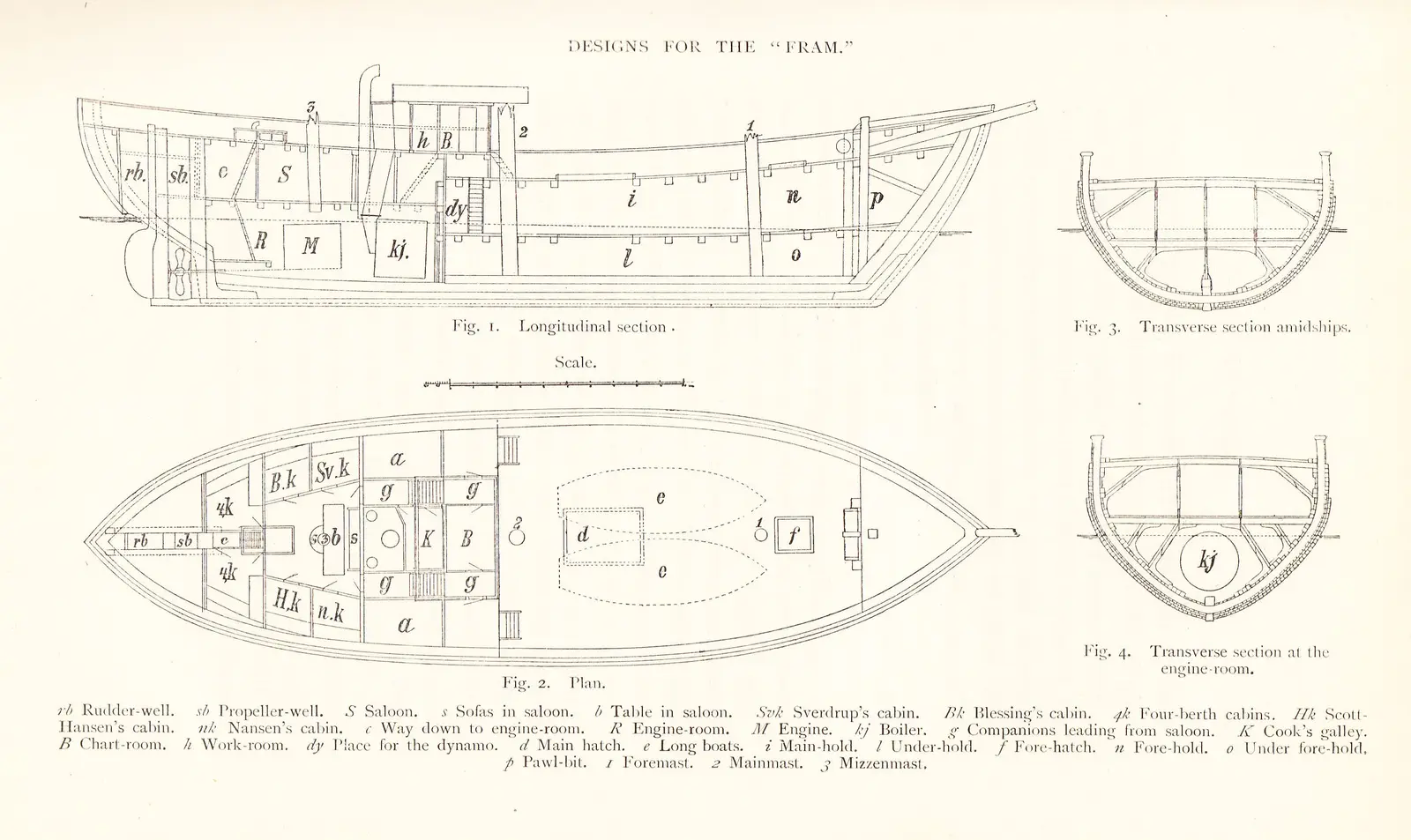
Designs for the Fram, as printed in Farthest North, Vol. I, in 1897. The two cross-sections at right show the rounded hull.
"Designs for the Fram" by unknown creator — https://commons.wikimedia.org/wiki/File:Fram_Drawings.jpg — Public domain (US: published 1897, before 1931; elsewhere: printed with no draftsman named, published 1897, anonymous term expired)

The walls did the rest of the work. Nansen lists the layers one by one, and they add up to his stated 24 to 28 inches of wood, while inside the hold every cross beam was stayed, until the space looked to him like a cobweb.
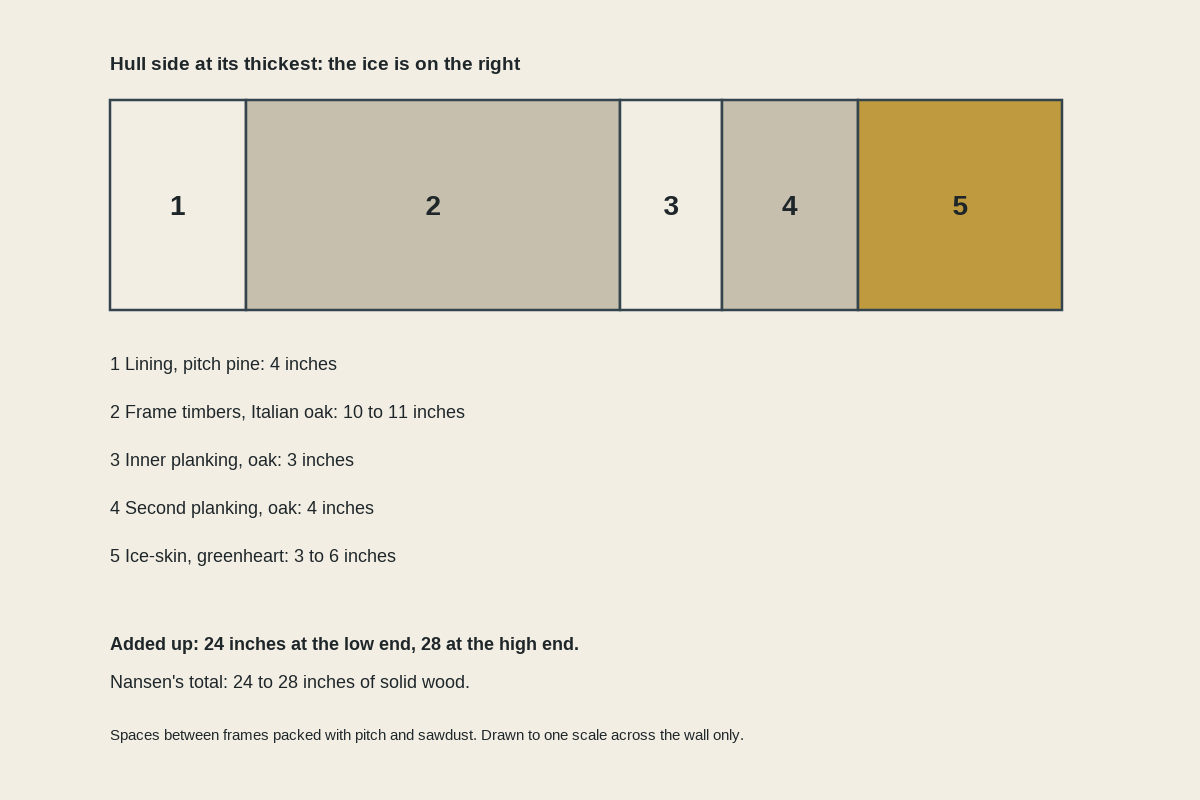
One wall of the hull, layer by layer. The lining also came in 8-inch planks, which this sum leaves out.
Keel, Rail & Spoke, CC BY 4.0
Data: Fridtjof Nansen, Farthest North, Vol. I (1897), https://www.gutenberg.org/ebooks/30197
Reuse this diagram: credit to copy
"Layers of the Fram hull wall" by Keel, Rail & Spoke, https://keelrailandspoke.com/journeys/fridtjof-nansen-fram/, licensed under CC BY 4.0 (https://creativecommons.org/licenses/by/4.0/).
| Layer of the hull wall | Inches |
|---|---|
| Lining, pitch pine | 4 (also 8) |
| Frame timbers, Italian oak | 10 to 11 |
| Inner planking, oak | 3 |
| Second planking, oak | 4 |
| Ice-skin, greenheart | 3 to 6 |
Data behind this diagram: fridtjof-nansen-fram-hull.csv · Where this data came from
The first test came on 9 October 1893. According to the diary the whole ship shook, the crew ran on deck, and the ice went down under her while she rose, at times by several feet. “The Fram behaved beautifully, as I had expected she would.”
Later entries give Nares some of his due. By March 1895, Sverdrup reports, she lay in about 25 feet of ice with a layer of it under her keel, so the block that Nares predicted had formed around her. On 9 August 1895 a 7-pound gunpowder mine burst the floe and she plunged out of it into the water, after which Sverdrup looked her over and found that, as far as he could see, her hull had “suffered no damage whatever.”
She was not watertight. In 1895 Sverdrup reports baling about 130 gallons a day from the engine room, and he thought ice forming in the layers of the skin was forcing the planks apart. Nansen says the pumps sat idle from December 1893 to July 1895, with only a few buckets of ice to clear each month.
How fast did the Fram drift?
The Fram froze in on or about 22 September 1893 near 78° 43′ N, north of the island of Kotelnoi. She then stopped being a machine that moved itself, because the rudder was hauled up and the engine was taken apart, oiled and stored, part by part. Her chief engineer went on tending it through the winters anyway.
The record says that she began by going the wrong way. On 7 November 1893 she stood at 77° 43′, farther south than where she had frozen in. No earlier position after the freeze-in gives both coordinates, so the count of 2,945 km starts there, runs through 51 dated fixes, and ends at the last one before she was worked free, 83° 45′ N on 16 May 1896.
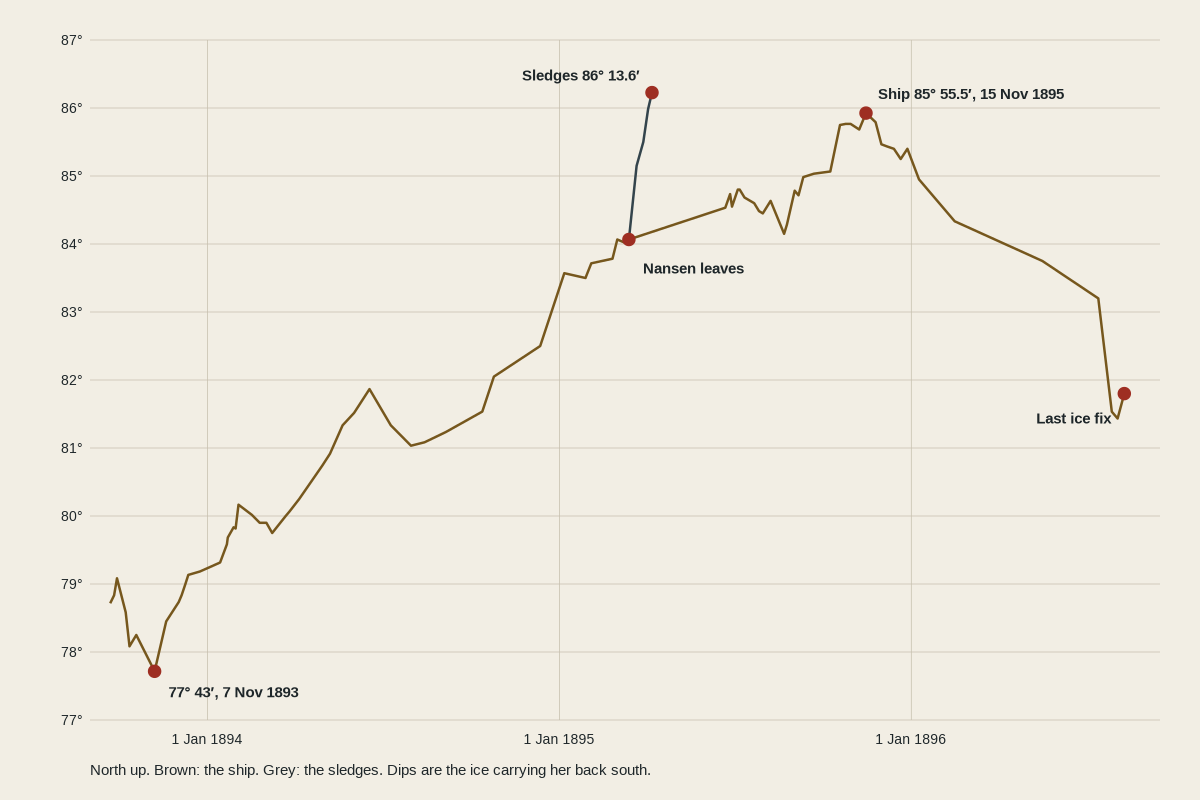
Latitude from the printed positions. The dips are the ice carrying her back south, as in the summer of 1894.
Keel, Rail & Spoke, CC BY 4.0
Data: Fridtjof Nansen, Farthest North, Vol. I (1897), https://www.gutenberg.org/ebooks/30197; Fridtjof Nansen, with Otto Sverdrup, Farthest North, Vol. II (1897), https://www.gutenberg.org/ebooks/34120
Reuse this diagram: credit to copy
"Latitude of the Fram by date, 1893 to 1896" by Keel, Rail & Spoke, https://keelrailandspoke.com/journeys/fridtjof-nansen-fram/, licensed under CC BY 4.0 (https://creativecommons.org/licenses/by/4.0/).
Between those two fixes the straight-line gain was about 1,855 km, and the rest went on zigzags, which is why a chart of her latitude looks like a saw. On 18 June 1894 she reached 81° 52′, and by 31 July she was back at 81° 2′. The average of 3.20 km a day comes to 1.99 statute miles, close to the two miles that Nansen guessed in 1890. His address does not say which mile he meant.
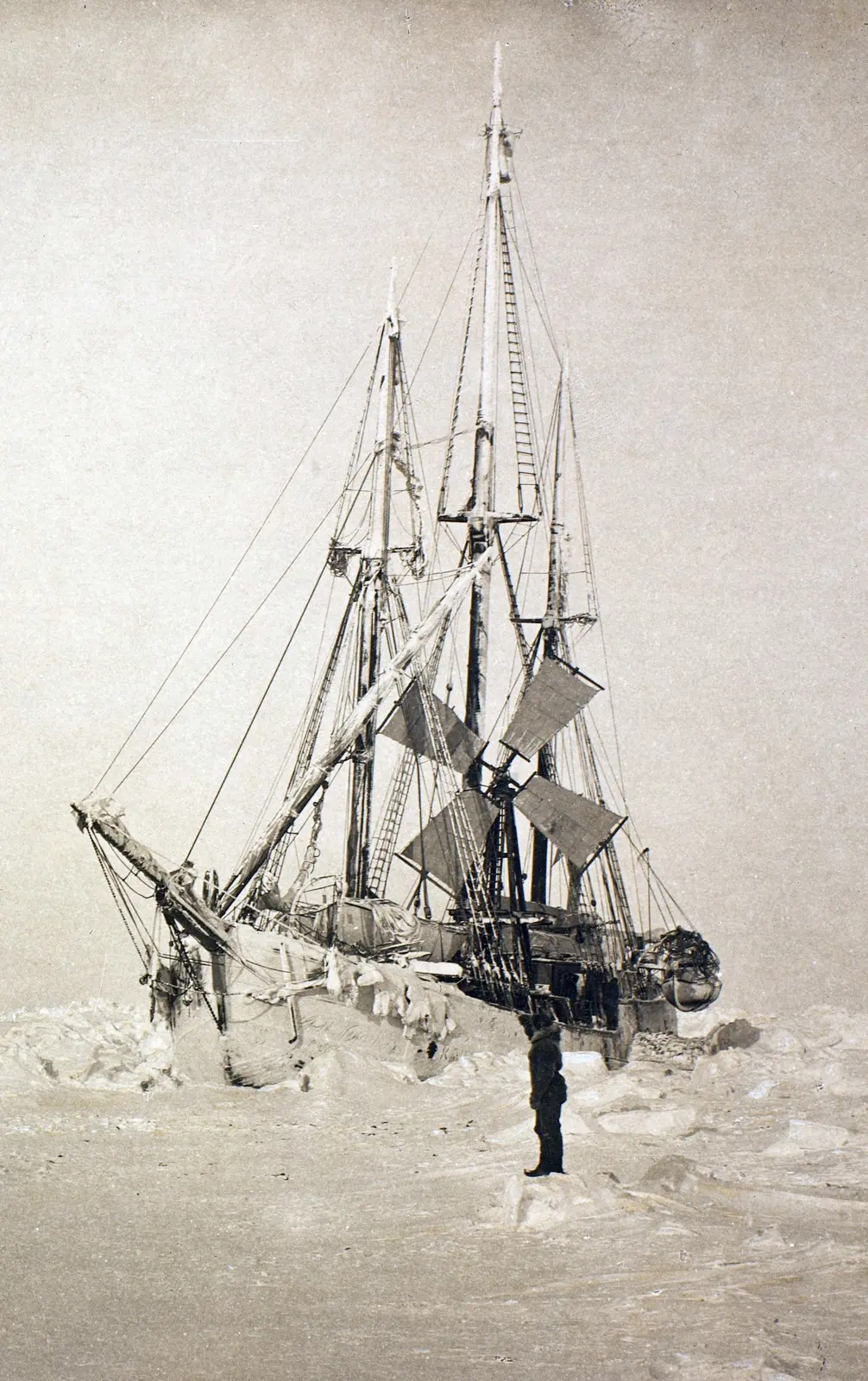
The Fram in March 1894, from a photograph printed in Farthest North. The sails amidships belong to the windmill that drove her dynamo.
"Fram, March 1894" by unknown creator — https://commons.wikimedia.org/wiki/File:Fram_March_1894.jpg — Public domain (US: published 1897, before 1931; elsewhere: printed with no photographer named, published 1897, anonymous term expired)

Nansen did the sum himself on 18 February 1894: one degree in five months. It depressed him. “At best, if things go on as they are doing now, we shall be home in eight years.” By September 1894 his numbers looked better, and he forecast the remaining drift at 827 miles, at 305 miles a year, or 2.7 years.
The repair radius, this site's measure of the distance from a fault to the nearest place that could fix it, reads on board here. The ship carried a smithy and a mechanical workshop. When the windmill shaft broke in 1895, Lars Pettersen welded it at the forge. Nansen wrote that almost anything, from delicate instruments to wooden shoes, could be made on board, unlike the iron boat in the Lewis and Clark Expedition, which leaked with no pitch to seal it.
January 1895: packed to leave the ship
The worst pressure came in the first week of 1895. A ridge formed about thirty paces off the port side on 3 January and kept coming, so the crew moved provisions onto the ice and made the sledges and kayaks ready, and by the 5th everyone was sleeping fully dressed.
The hummock reached her at about 5:30 that morning. At about 8 in the evening, masses of snow and ice came over the rail amidships, the half-deck beams creaked overhead, and all hands ran their bags out across the floe; when it stopped the port side was buried. They dug the next day, and that afternoon Sigurd Scott-Hansen's meridian sight gave 83° 34′, which Nansen called the most northern latitude yet reached. “Last night we were running with the bags for our lives; to-night we are drinking punch and feasting,” he wrote.
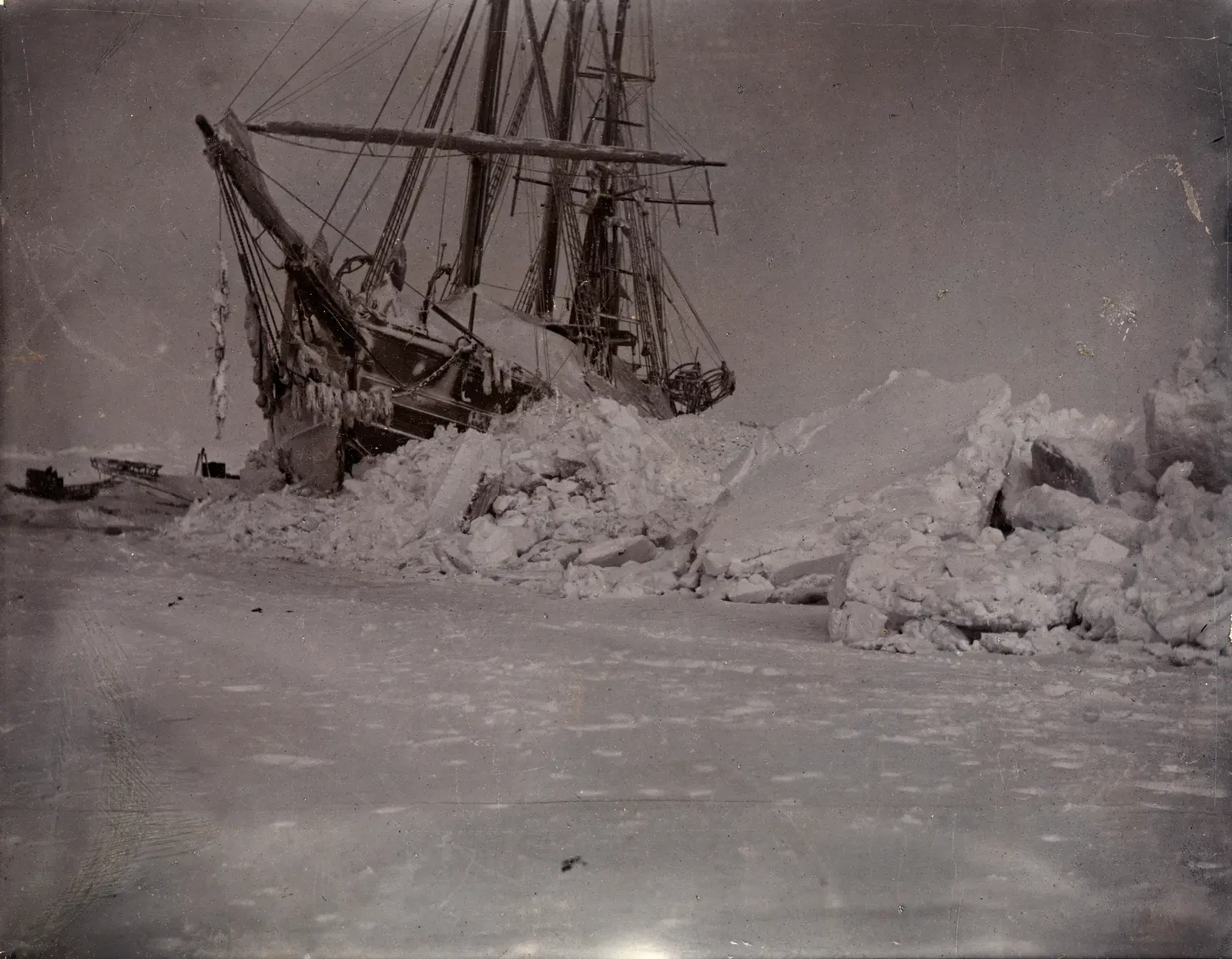
The Fram in the pressure ice, dated 10 January 1895, days after the worst of it.
Fram i skruisen i maneskinn by Fridtjof Nansen, Public domain
Full credit
"Fram i skruisen i maneskinn" by Fridtjof Nansen — https://commons.wikimedia.org/wiki/File:Fram_i_skruisen_i_m%C3%A5neskinn,_1895_(4594423119).jpg — Public domain (US: photographer died 1930; if first printed in Farthest North 1897, published before 1931; if not printed then, unpublished-work term expired; elsewhere: Fridtjof Nansen died 1930, life plus 70 expired)

The ship came through with her stores still out on the floe. “Who shall say after this that a vessel's shape is of little consequence?” Nansen wrote on 7 January. Robert Falcon Scott's motor sledges would later stop about 50 miles out on the ice, whereas the Fram carried her workshop with her.
Why did Nansen leave the Fram?
The ship was going to miss the Pole. By the autumn of 1894 the line of the drift ran well short of it, and Nansen scarcely expected her to pass 85°. On 16 November 1894 he talked it through with Sverdrup, out on skis, which the English text calls snow-shoes, and then in the cabin, and decided not to wait for a better start: two men with dogs and sledges would go north in the spring.
The real goal, he wrote, was the unknown sea and not the exact mathematical point. “If we cannot actually reach the Pole, why, we must turn back before reaching it.” He drew up the load at 28 dogs, 2,100 pounds and 50 days to the Pole, with Lieutenant Hjalmar Johansen as his one companion. His line of retreat, he admitted, was a barren coast.
In this site's gear language, 14 March 1895 was the shift point, the place where one kind of traction hands over to another. For eighteen months the ice had moved the men with no help from them, and that day two of them began to move themselves, averaging about 10.4 km a day in a straight line over the march.
It took three tries to get away. The start on 26 February broke a sledge. The next, on 28 February, showed that the loads were too heavy, although on Nansen's return to the ship Scott-Hansen's sight gave 84° 4′. At about midday on 14 March the two men left with three sledges, to a salute from the ship, and Sverdrup, now in command, walked out a little way and then turned back for dinner at one o'clock.
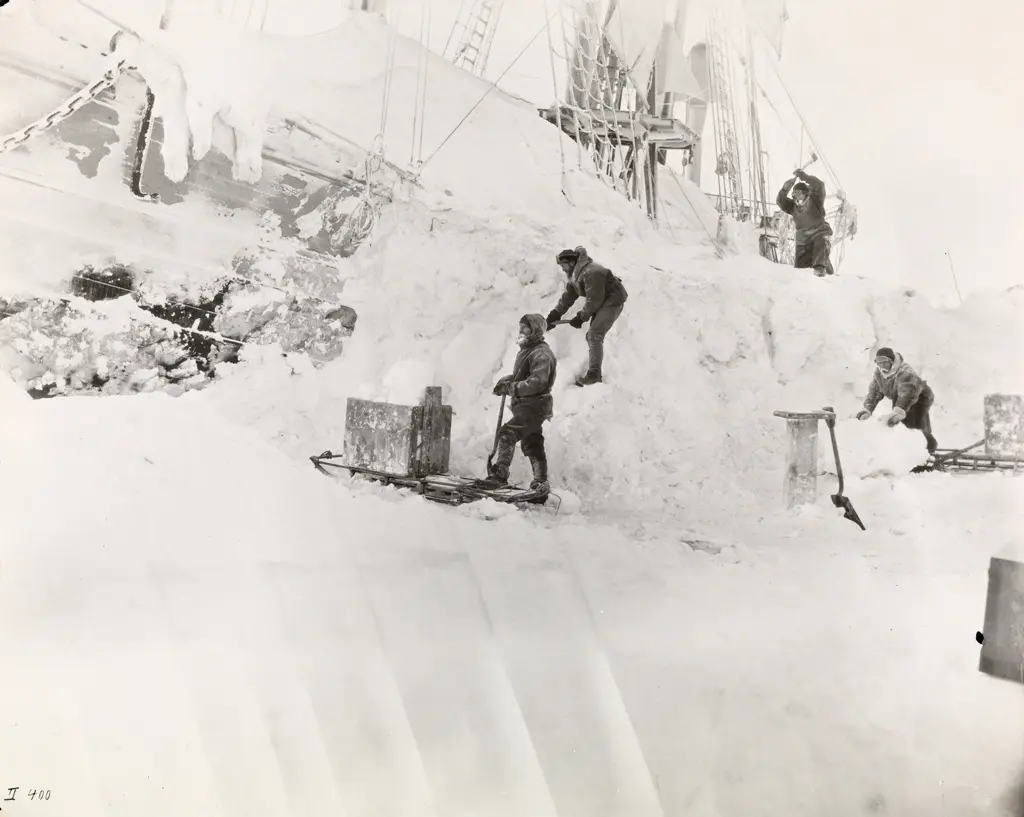
Digging out the Fram, March 1895, the month the sledges left.
Fram graves ut av isen by unknown creator, Public domain
Full credit
"Fram graves ut av isen" by unknown creator — https://commons.wikimedia.org/wiki/File:Fram_graves_ut_av_isen,_1895_(4594549453).jpg — Public domain (US: published 1897 if this is the plate in Vol. II, before 1931; if not printed then, unpublished-work term expired; elsewhere: if the library caption naming Fridtjof Nansen is right, died 1930, life plus 70 expired; if another expedition member took it after Nansen left, printed with no photographer named in 1897, anonymous term expired)

Did Nansen reach the North Pole?
No. The ice to the north grew steadily worse, and on 3 April, when a midday sight gave only 85° 59′, Nansen began to doubt the march. On 8 April, after going ahead alone on skis, he wrote of “a veritable chaos of ice-blocks” stretching to the horizon. He turned for Franz Josef Land.
His figures for the farthest point disagree a little, and all of them are his own.
| Where it is written | Latitude | Date |
|---|---|---|
| Diary, rough estimate | 86° 10′ | sight on the day before 8 April |
| Footnote, later calculation | 86° 13.6′ | same sight |
| Picture caption | 86° 13.6′ | 8 April |
| Note left in the hut, May 1896 | 86° 14′ | 6 April |
| Telegram from Vardö, August 1896 | 86° 14′ | no date |
| Spoken to Frederick Jackson, June 1896 | 86° 15′ | no date |
At 86° 13.6′ he was about 419 km from the Pole. The march had taken about 24 days and covered about 249 km in a straight line, a walking multiple of about 0.086, counted overall, which is more than three times the ship's, although the ship's figure adds up many short legs and this one is a single line.
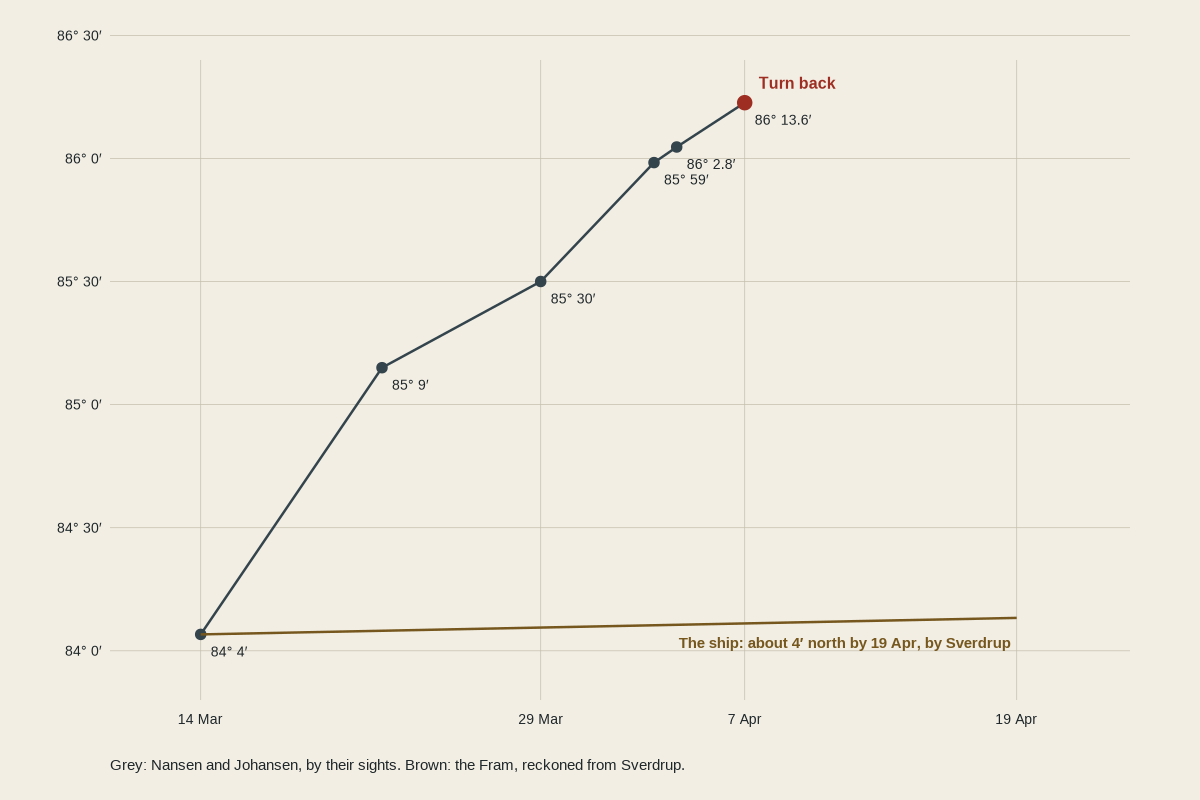
Sledges against ship through the spring of 1895. Nansen doubted his 29 March sight when he took it. The ship's line is reckoned from Sverdrup's 4 minutes by 19 April.
Keel, Rail & Spoke, CC BY 4.0
Data: Fridtjof Nansen, with Otto Sverdrup, Farthest North, Vol. II (1897), https://www.gutenberg.org/ebooks/34120
Reuse this diagram: credit to copy
"Sledges against ship, March and April 1895" by Keel, Rail & Spoke, https://keelrailandspoke.com/journeys/fridtjof-nansen-fram/, licensed under CC BY 4.0 (https://creativecommons.org/licenses/by/4.0/).
Data behind this diagram: fridtjof-nansen-fram-sledge.csv · Where this data came from
The way home took sixteen months. The two men wintered in a hut on the Franz Josef Land coast and lived on bear, having killed their dogs along the way and shot the last two on about 6 August 1895, when they took to the kayaks. On 17 June 1896 Nansen heard dogs and then met a man on the ice, Frederick Jackson of the British expedition at Cape Flora, and the expedition's ship, the Windward, landed the two Norwegians at Vardö on 13 August 1896.
What happened to the Fram after Nansen left?
She kept going and came close to his latitude. Sverdrup's table has her at 85° 55.5′ N and 66° 31′ E on 15 November 1895, the highest latitude in it, so the ship had gained about 112 minutes of latitude in 246 days, against 130 in 24 days for the men on skis. She ended 18 minutes of latitude short of Nansen's mark, about 33.5 km counting latitude alone and on a different meridian.
The drift then carried her south and west. Sverdrup got steam up on 19 May 1896, for the first time since she froze in, and mines of gunpowder and gun-cotton broke her loose on 3 June, although she was not making real way until 19 and 20 July. She steamed out of the ice at 3:45 a.m. on 13 August 1896, and he wrote simply, “We were free!”
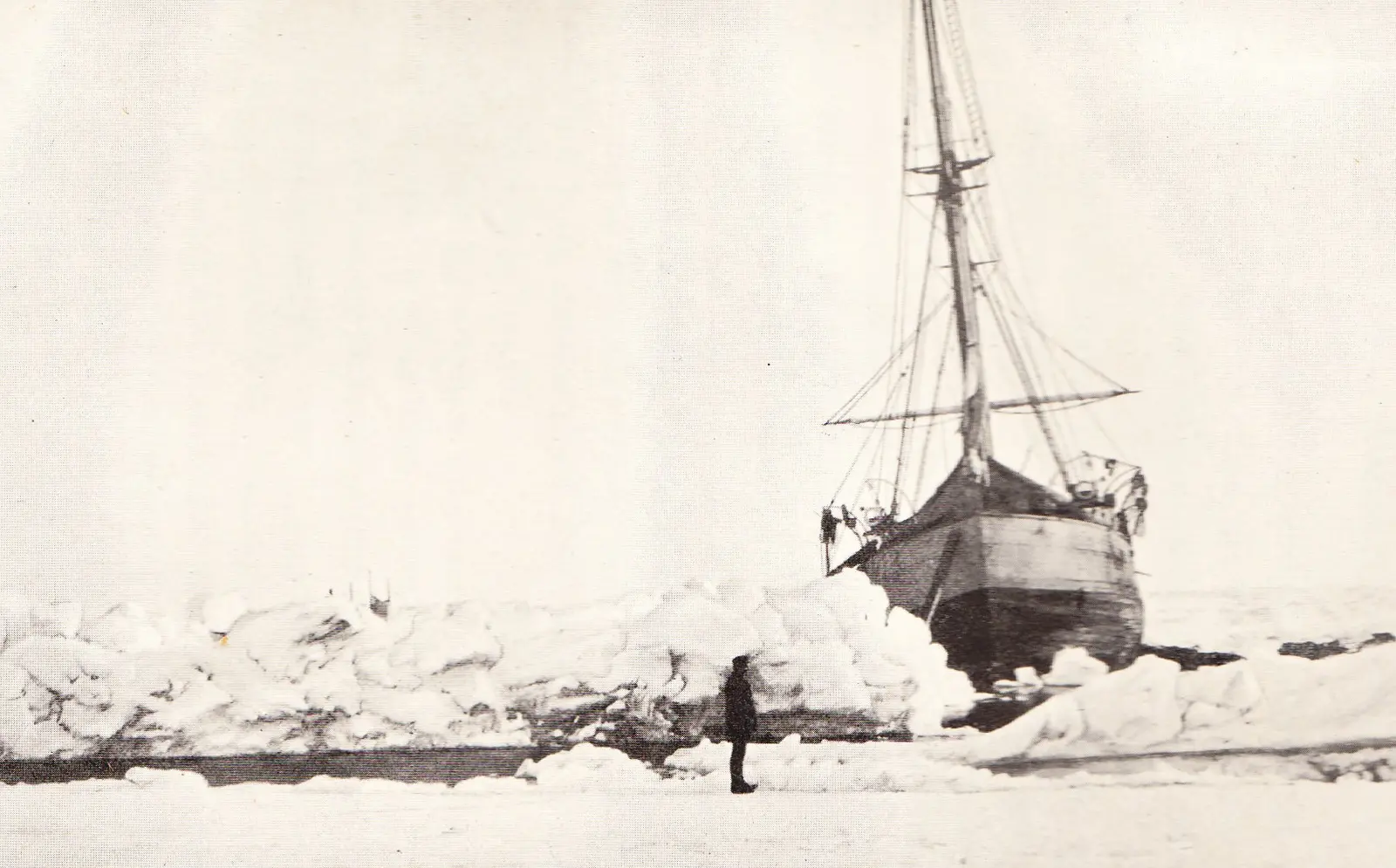
The Fram behind a ridge of piled ice, from Farthest North, Vol. II. The file record dates the print to 1896, near the end of the drift.
Fram in ice 1896 by unknown creator, Public domain
Full credit
"Fram in ice 1896" by unknown creator — https://commons.wikimedia.org/wiki/File:Fram_in_ice_1896.jpg — Public domain (US: published 1897, before 1931; elsewhere: printed with no photographer named, published 1897, anonymous term expired; not traced back)

The drift also answered the question it was built to ask. Nansen's telegram reported no land north of 82°, and Sverdrup's soundings reached bottom at 3,400 meters in July 1896, about 83° 2′ N, in a sea where Sir Allen Young had warned of land in nearly every direction.
The ship did not need rescue. At Danes Island in Spitsbergen on 14 August, Sverdrup planned to reach Tromsö, fill up with coal and sail for Franz Josef Land to look for Nansen, adding that “we were not in want of anything else.” So the last spare, this site's name for the supply whose loss ends a journey, reads none exhausted for the ship, on Sverdrup's word.
Where is the Fram now?
As of November 2026 the Fram Museum says she is housed and shown in its building at Bygdøynes, Oslo, after two more expeditions. The museum adds that she was restored to her state on the second of the three, so the ship on show is not quite the one Nansen left. Nansen himself went on to work as a statesman and in relief work, and the museum records his Nobel Peace Prize of 1922.
The Ibry strip: 921 days of drift, 24 days on foot
Read this chart as a graph of speed: time runs left to right, distance runs up, and a steeper line is a faster one. The ship's long line is nearly flat for a machine, and the short steep line is the sledge party. The dashed line is Nansen's forecast of September 1894, drawn from about where the ship then stood; it is a straight course while the ship's line counts zigzags, so the two are not fully alike.
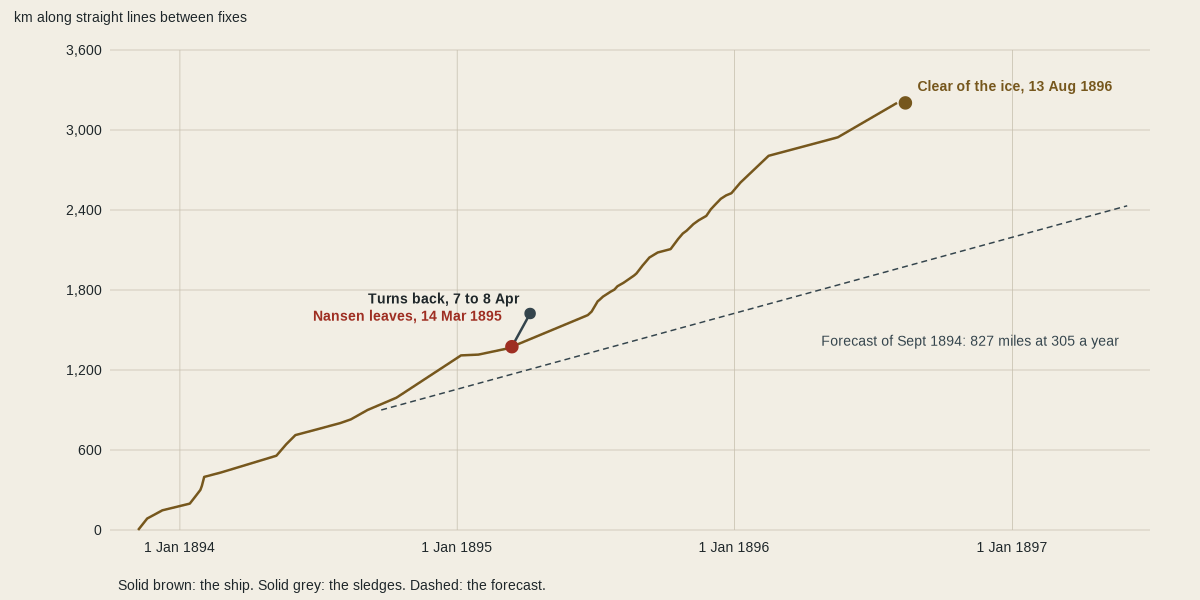
Distance from the first full fix by date, with the sledge leg branching off on 14 March 1895. The line runs 999 days to 2 August 1896: 921 of drift to 16 May, then steaming as well. The forecast's miles are taken as minutes of latitude, as Nansen's own sum in that entry implies.
Keel, Rail & Spoke, CC BY 4.0
Data: Fridtjof Nansen, Farthest North, Vol. I (1897), https://www.gutenberg.org/ebooks/30197; Fridtjof Nansen, with Otto Sverdrup, Farthest North, Vol. II (1897), https://www.gutenberg.org/ebooks/34120
Reuse this diagram: credit to copy
"Fram time-distance strip, November 1893 to August 1896" by Keel, Rail & Spoke, https://keelrailandspoke.com/journeys/fridtjof-nansen-fram/, licensed under CC BY 4.0 (https://creativecommons.org/licenses/by/4.0/).
Dated logs like these are the reason a voyage can be checked at all. Mutiny on the Bounty rests on a boat's noon entries, and the Victoria, the one ship of Ferdinand Magellan's fleet to finish, reached Cape Verde with its count of days one short.
The Fram anchored at Skjervøy, then spelled Skjærvö, at 2 a.m. on 20 August 1896. Sverdrup went ashore in the small boat and hammered on the telegraph station's door until the manager put his head out of an upper window and asked who was making the noise. “I come from the Fram,” Sverdrup said. The manager told him that Nansen had landed at Vardö on the 13th, the same day the ship had cleared the ice.
Sources
- Fridtjof Nansen, Farthest North, Vol. I (New York and London: Harper & Brothers, 1897). The English translator is not named in this edition's front matter. Short quotation only. https://www.gutenberg.org/ebooks/30197Read: chapters: I and II on the plan, the debate and the ship; journal entries of chapters VI to VIII for the dated positions
- Fridtjof Nansen, Farthest North, Vol. II, with the report of Otto Sverdrup (New York and London: Harper & Brothers, 1897). The English translator is not named in this edition's front matter. Short quotation only. https://www.gutenberg.org/ebooks/34120Read: chapters: I to V in part on January to April 1895, the hut note, the meeting with Jackson and the telegrams; Sverdrup's report, position tables and closing chapter
- George W. De Long, journal entries of 12 and 13 June 1881, from The Voyage of the Jeannette, ed. Emma De Long (1884), Vol. II, pp. 572 ff. and 578, as transcribed in the USS Jeannette log books, Naval History Homepage. https://naval-history.net/OW-US/Jeannette/USS_Jeannette-1880-1881.htmRead: transcript: entries of 12 and 13 June 1881 and the editor's notes
- The Fram Museum, "The Polar Ship Fram". https://frammuseum.no/en/polar-history/vessels/the-polar-ship-fram/Read: full page
- The Fram Museum, "Fridtjof Nansen". https://frammuseum.no/en/polar-history/explorers/fridtjof-nansen-1861-1930-en/Read: part of a long page: the opening, the birth date, the 1888 crossing and the passage on 1922
Cite this page
Keel, Rail & Spoke. "Fridtjof Nansen: Had the Fram Built to Freeze In, Then Left." Published 2026-11-08. https://keelrailandspoke.com/journeys/fridtjof-nansen-fram/. Accessed on the date you read it.
How facts are checked · Corrections · Contact
Found a mistake on this page? Write to contact@keelrailandspoke.com.
More from Journeys & Expeditions
Journeys & Expeditions
Lewis and Clark Expedition: Lewis’s Iron Boat Leaked, 1805
The Lewis and Clark Expedition took 862 days. Clark put the way out at 4,134 miles, and Lewis's iron-framed boat leaked at the Great Falls in July 1805.
Picture credit
"Captain Clark and his men shooting bears" by unknown creator — https://commons.wikimedia.org/wiki/File:Captain_Clark_and_his_men_shooting_bears_LCCN2001699664.jpg — Public domain (US: published 1810, before 1931; elsewhere: creator unknown, published more than 200 years ago, every term expired); modified: cropped: printed title and page number removed
Journeys & Expeditions
Robert Falcon Scott: The Motors Gave Out Before the Ponies
Scott's two motor sledges stopped by 1 November 1911, about 50 miles out and near 78° S by reckoning. His ponies, dogs and men went on. The records, dated.
Picture credit
"The Motor Party" by Herbert Ponting — https://commons.wikimedia.org/wiki/File:The_great_white_South_BHL46249112.jpg — Public domain (US: published no later than 1923, the date on the file page, before 1931; elsewhere: Herbert Ponting died 1935, life plus 70 expired); modified: cropped: plate only, book page margins, caption and two other photographs removed
Journeys & Expeditions
Ferdinand Magellan: His Ship’s Calendar Lost a Day
Ferdinand Magellan died at Mactan in 1521. In July 1522 the Victoria, his one ship to finish, reached Cape Verde on a Wednesday the shore called Thursday.
Picture credit
"Detail from a map of Ortelius: Magellan's ship Victoria" by Abraham Ortelius — https://commons.wikimedia.org/wiki/File:Detail_from_a_map_of_Ortelius_-_Magellan's_ship_Victoria.png — Public domain (US: published about 1589 to 1590, before 1931; elsewhere: Abraham Ortelius died 1598, life plus 70 expired); modified: cropped: to the ship; coast, verse and most map lettering removed


