Bicycles · Journey file
Bicycle Around the World: Stevens Counted About 13,500 Miles
Thomas Stevens printed his distance as the last line of his book. His own table of stops shows how much of the trip that figure leaves out.
Keel, Rail & Spoke · Published
TL;DR
- Thomas Stevens left San Francisco on a fifty-inch Columbia on 22 April 1884 and stopped at Yokohama on 17 December 1886, 969 days later.
- His book ends: “DISTANCE ACTUALLY WHEELED, ABOUT 13,500 MILES.” About 6,200 of those miles are his own estimates, made before he had a cyclometer.
- Steamers and trains carried him across the oceans and much of Asia, about half the distance in straight lines, and by his own account Afghan officers arrested him at Furrah in April 1886 and took him back to Persia.
Leg card
- Departure
- San Francisco, 22 April 1884 by his text; his end table prints 23 April
- Arrival
- Yokohama, 17 December 1886
- Distance
- about 13,500 miles wheeled (about 21,726 km), Stevens's own figure; ships and trains not counted
- Machine
- Columbia bicycle, "my fifty-inch machine", a high wheel
- Elapsed
- 969 days, counting the wait for spring in New York and the winter in Teheran
- Walking multiple
- about 0.19 (overall): about 21,726 km wheeled over 969 days at 5 km/h
- Repair radius
- about 222 km as a stand-in, the straight line Furrah to Herat: the camp where the wheel broke, past Subzowar, is not located, so the real distance is unknown. Fault: eleven broken spokes and a twisted rim. Repair: gunsmiths at Herat, with six spare spokes and a spoke-vice from on board
- The last spare
- not applicable: the bicycle part was completed. His six spare spokes were used up at Herat and three spokes stayed missing, but the ride went on
- Key source
- Thomas Stevens, Around the World on a Bicycle, two volumes
Download this card (CSV) · Where this data came from
Data: Thomas Stevens, Around the World on a Bicycle, vol. 1 (1887), public domain, https://www.gutenberg.org/ebooks/5136, retrieved 2026-11-08; Thomas Stevens, Around the World on a Bicycle, vol. 2, public domain, https://www.gutenberg.org/ebooks/13749, retrieved 2026-11-08; Wikidata coordinates (CC0), https://www.wikidata.org/, retrieved 2026-11-08
What the card means: walking multiple, repair radius, last spare.
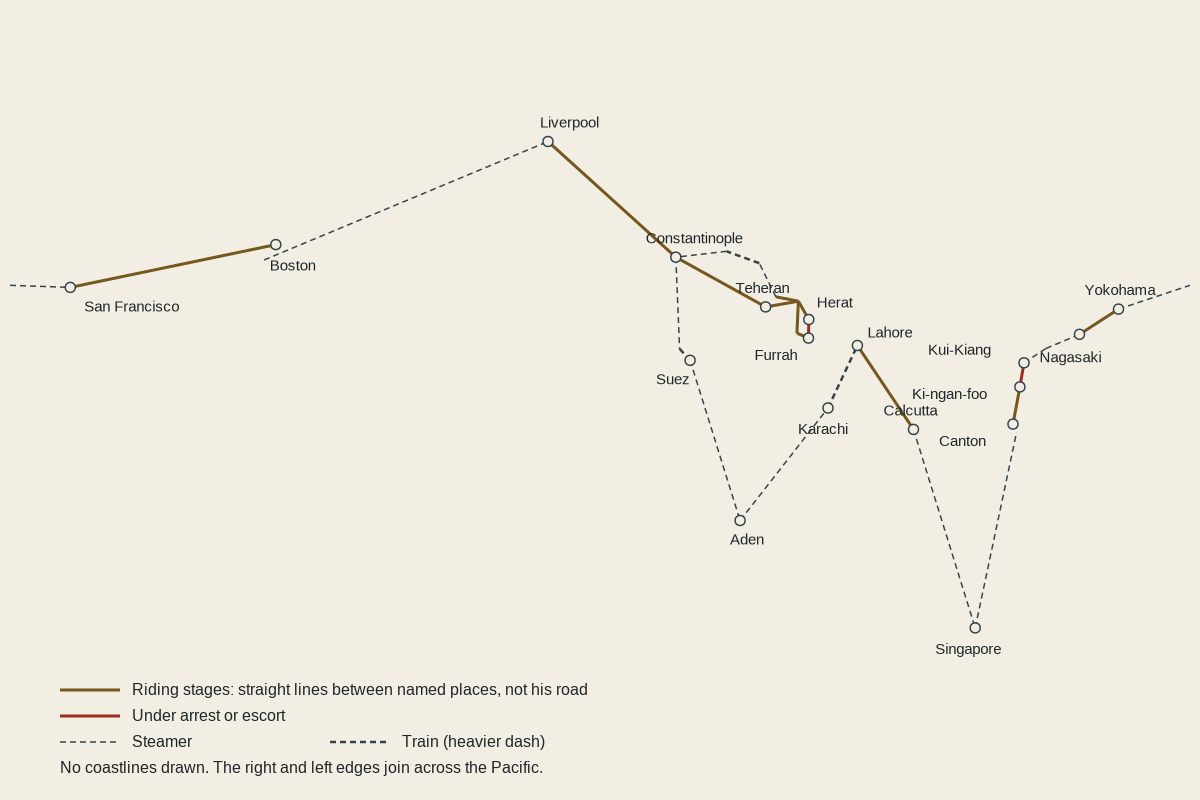
The route as straight lines between places named in his itinerary, so the real road ran longer than any line here. The red stretches are the two times he traveled under arrest or escort.
Keel, Rail & Spoke, CC BY 4.0
Data: Thomas Stevens, Around the World on a Bicycle, vol. 1 (1887), public domain, https://www.gutenberg.org/ebooks/5136, retrieved 2026-11-08; Thomas Stevens, Around the World on a Bicycle, vol. 2, public domain, https://www.gutenberg.org/ebooks/13749, retrieved 2026-11-08; Wikidata coordinates (CC0), https://www.wikidata.org/, retrieved 2026-11-08
Reuse this diagram: credit to copy
"Thomas Stevens around the world, 1884 to 1886" by Keel, Rail & Spoke, https://keelrailandspoke.com/bicycles/thomas-stevens-around-the-world/, licensed under CC BY 4.0 (https://creativecommons.org/licenses/by/4.0/).
Data behind this diagram: thomas-stevens-around-the-world-itinerary.csv · Where this data came from
Thomas Stevens, a cyclist writing for Outing magazine, wheeled a fifty-inch Columbia about 13,500 miles around the world. The figure closes his two-volume Around the World on a Bicycle, set in capitals under his table of sleeping points on the tour: “DISTANCE ACTUALLY WHEELED, ABOUT 13,500 MILES.” Over the whole trip that is a walking multiple of about 0.19 (overall), under a fifth of a 5 km/h walk, because the machine spent most of those 969 days standing still or in the hold of a ship. The word to watch is wheeled.
Stops on this page (8)
- Who first rode a bicycle around the world?
- What bicycle did Thomas Stevens ride?
- How far did he actually ride?
- What was the road like from Liverpool to Teheran?
- Which parts of the trip were not on the bicycle?
- Why was Stevens arrested at Furrah?
- How did he get through China and Japan?
- The Ibry strip: 969 days, San Francisco to Yokohama
Who first rode a bicycle around the world?
This site cannot say from what it has read, and the book does not settle it. Stevens never calls himself the first in the passages read here. He says only that others had tried to “wheel across America from ocean to ocean,” and that the most charitable verdict he could expect on going around the world was “The impracticable scheme of a visionary.” Thomas Wentworth Higginson's preface praises him as a “solitary rider,” with no word about priority.
What can be said is narrower. His book is a dated, stop-by-stop record of the whole ride, written by the rider. He also makes smaller claims along the way, such as “the first bicycle the Tiflis & Baku Railroad has ever carried.” Those are his own, and no other record here checks them.
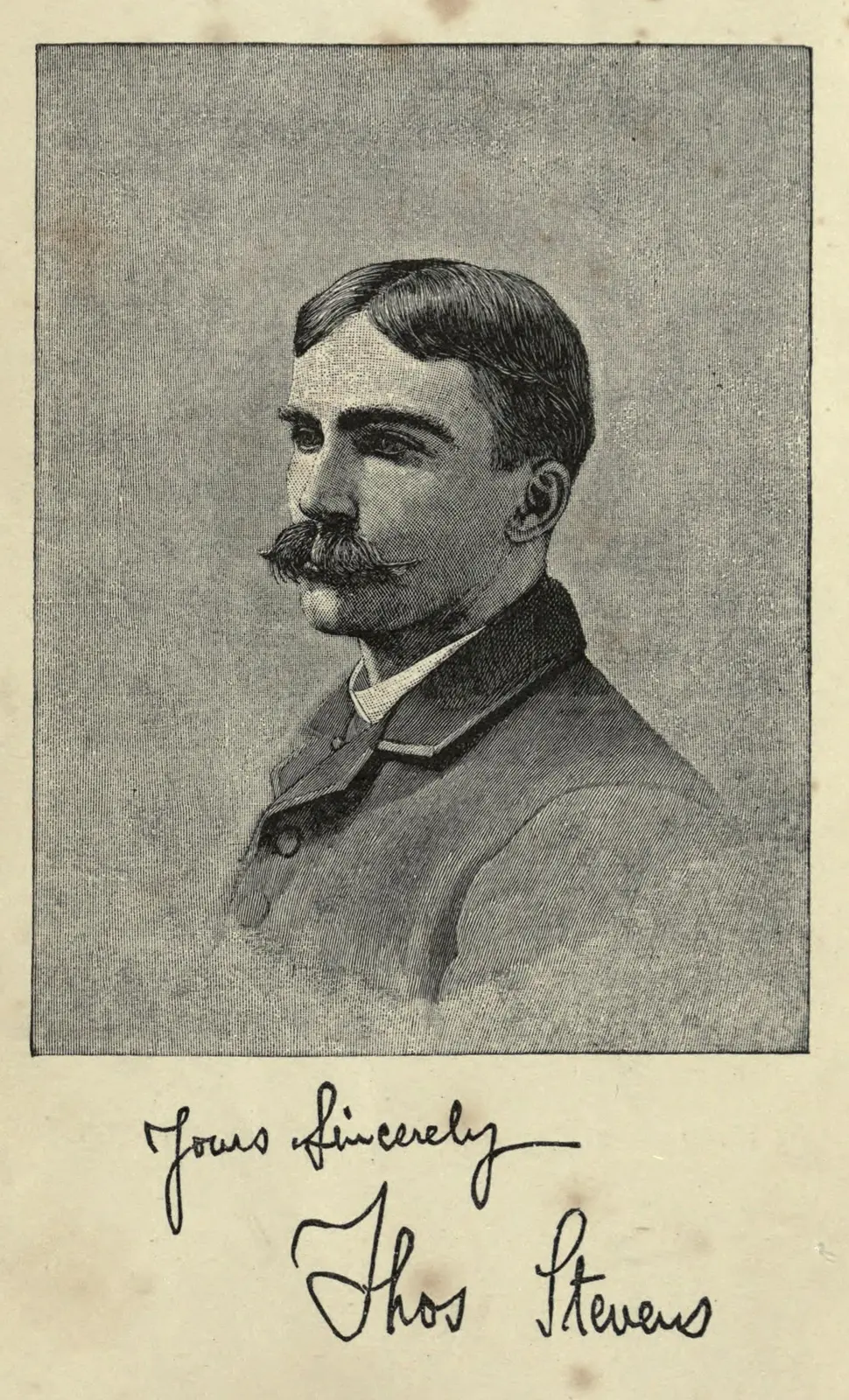
Stevens as shown in his book, published 1887–88, over a facsimile of his signature.
Portrait of Thomas Stevens, from Around the World on a Bicycle by unknown creator, Public domain
Full credit
"Portrait of Thomas Stevens, from Around the World on a Bicycle" by unknown creator — https://commons.wikimedia.org/wiki/File:Thomas_Stevens.jpg — Public domain (US: published in the book, before 1931; elsewhere: no creator named on the plate or file page, published more than 70 years ago); modified: reduced to 1,600 px wide

His account also carries the prejudices of its time in how it describes many of the people he met. Those passages are not quoted here. What is quoted comes from his dates, distances and dealings with the bicycle.
What bicycle did Thomas Stevens ride?
The machine was a high wheel with a fifty-inch front wheel. He calls it “my fifty-inch machine” on the first morning, and later “my Columbia,” with “bright nickeled forks.” His text dates that morning 22 April 1884, while the table at the back of the book prints April 23; the dates here follow the text. The book read here gives no model name. The history of that layout runs through Who Invented the Bicycle, and how any rider stays up on two wheels is a separate question, covered in Why Bikes Stay Upright.
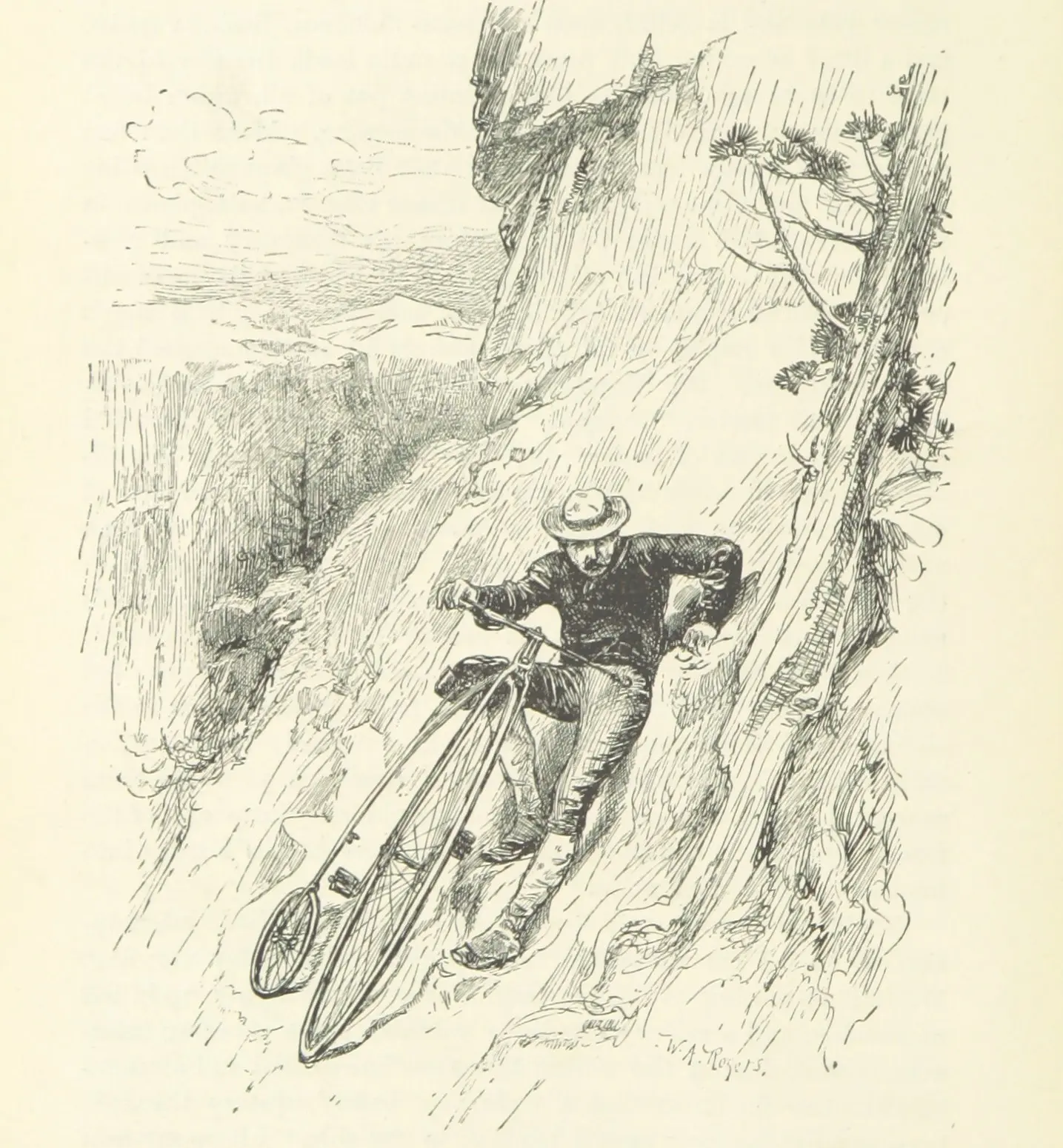
“Crossing the Sierra Nevadas,” W. A. Rogers's drawing for the 1887 book, cropped to remove the page text. Treat it as an artist's picture of the story, not a record of the scene.
Crossing the Sierra Nevadas by W. A. Rogers, Public domain
Full credit
"Crossing the Sierra Nevadas" by W. A. Rogers — https://commons.wikimedia.org/wiki/File:Image_taken_from_page_40_of_%27Around_the_World_on_a_Bicycle_..._From_San_Francisco_to_Teheran._With_..._illustrations._(With_preface_by_T._W._Higginson.)%27_(11186813893).jpg — Public domain (US: published 1887, before 1931; elsewhere: signed W. A. Rogers, read as William Allen Rogers, died 1931, life+70 term expired); modified: cropped: page text above and printed caption below removed; reduced to no more than 1,600 px wide

At Constantinople, before setting out across Asia, he listed what the machine carried: a few extra spokes, a cake of tire cement and a spare rear tire, which he wrapped around the front axle with twenty yards of small, stout rope. A small wedge tent went into the load as well, with a box of revolver cartridges and sewing-machine oil.
The bicycle crossed the Atlantic in a box. On one narrow stream in Persia he took it apart to throw across, and the big wheel rolled back into the water. He went in after it.
How far did he actually ride?
His own figure is about 13,500 miles, or about 21,726 km, and the book lets you test parts of it. The early running totals are in his text. They rest on three different kinds of evidence. A cyclometer, a counter fixed to the wheel, reached him only by mail at Constantinople, and at Teheran he explains the gap: “from Liverpool to Constantinople, where I had no cyclometre, may be roughly estimated at two thousand five hundred.”
| Stretch | His miles | Basis | Straight line, km | Road km per line km |
|---|---|---|---|---|
| San Francisco to Boston | about 3,700 | His statement, no cyclometer | 4,334 | 1.37 |
| Liverpool to Constantinople | 2,500 | Estimate, “roughly estimated” | 2,746 | 1.47 |
| Ismidt to Teheran | 1,576 | Cyclometer; line drawn from Constantinople | 2,037 | 1.25 |
| Teheran to Yokohama, land parts | about 5,724 | Worked out here: 13,500 less the rest; he prints no total | 5,889 | 1.56 |
So 6,200 of his miles were estimates, and 1,576 were measured and stated. The other 5,724 are simply what is left over, since he gives only scattered figures after Teheran, such as 160 miles from Karize to Meshed. The last ratio is the highest of the four. Leave out the two legs under arrest or escort, which were mostly not wheeled, and it climbs to about 1.72, even though the Herat-to-Meshed line still takes in the escorted stretch back to Karize, so the final figure deserves its “about.”
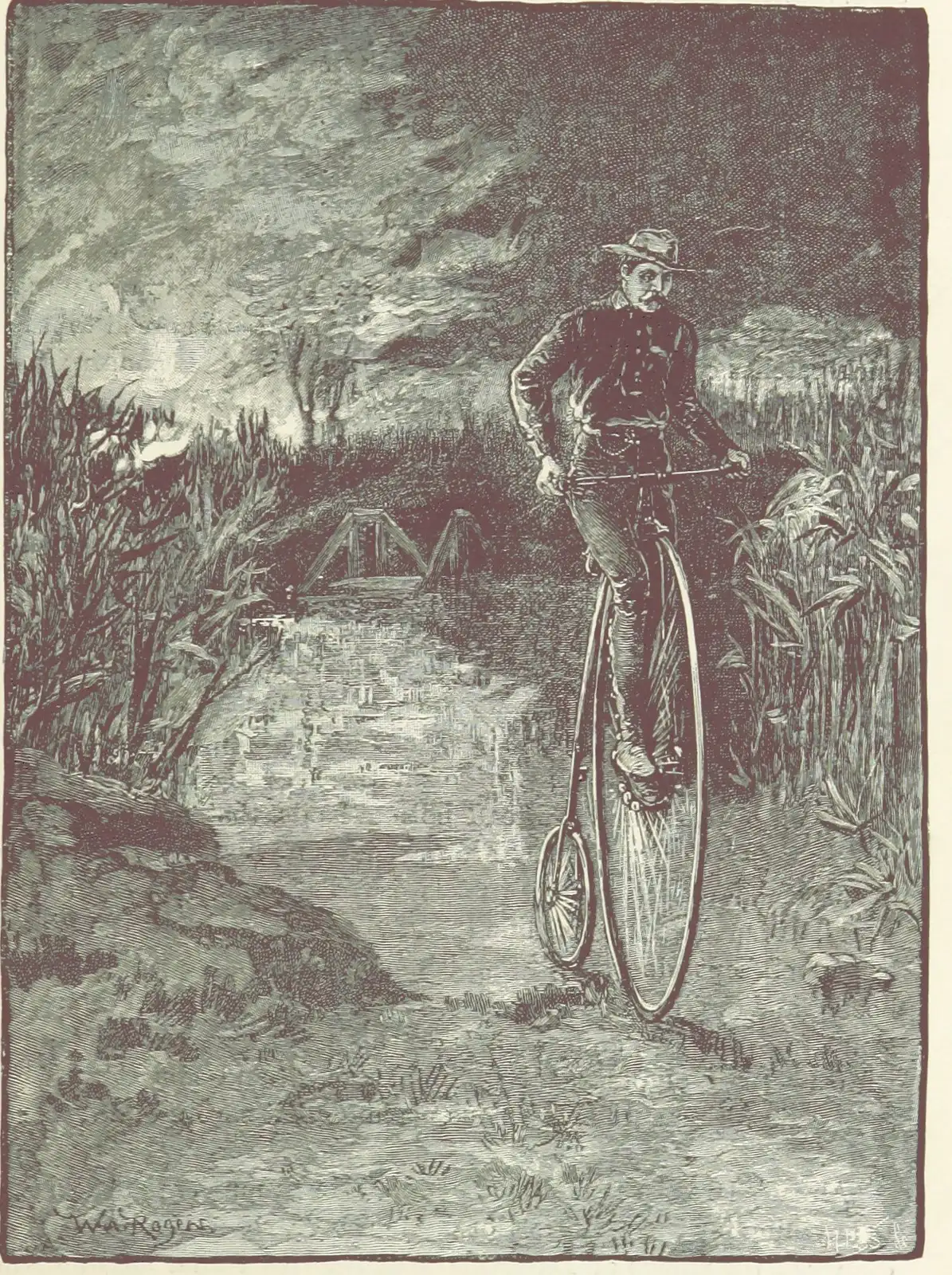
“The Burning Tuiles,” also by W. A. Rogers, 1887, cropped to remove the page text. Stevens writes that a swamp fire in California lit the road for him on his first days out.
The Burning Tuiles by W. A. Rogers, engraved by H.B.S., Public domain
Full credit
"The Burning Tuiles" by W. A. Rogers, engraved by H.B.S. — https://commons.wikimedia.org/wiki/File:Image_taken_from_page_31_of_%27Around_the_World_on_a_Bicycle_..._From_San_Francisco_to_Teheran._With_..._illustrations._(With_preface_by_T._W._Higginson.)%27_(11187684133).jpg — Public domain (US: published 1887, before 1931; elsewhere: drawn by W. A. Rogers, read as William Allen Rogers, died 1931, life+70 term expired; wood-engraved by an engraver signing only the initials H.B.S., not identified, so the engraving is treated as an anonymous work, published 1887, anonymous term of 70 years from publication expired); modified: cropped: page text above and printed caption below removed

“Wheeled” also did not mean ridden. Stevens uses “trundling” for walking the machine, and he trundles often: along snow-covered railway track in the Sierra, through Nevada sand, up the Balkan slopes. Of a smoke-filled tunnel among the snow sheds he wrote that a cyclometer “wouldn't have to exert itself much through here.” He still counted such stretches when he wrote that he had “wheeled about 3,700 miles” to Boston, and the book never splits riding from pushing.
What was the road like from Liverpool to Teheran?
After a winter in New York, Stevens joined Outing as “its special correspondent” and sailed for Liverpool on the City of Chicago. The second start was far larger than the first. He names 2 May 1885 at Edge Hill Church, with about 500 people watching and 25 local cyclists riding out with him along Edge Lane.
Europe then took two months to the day. He reached Constantinople on 2 July, “just two calendar months from the start at Liverpool.” The last stretch had rain and deep mud, and he describes trundling “wooden scraper in hand.”
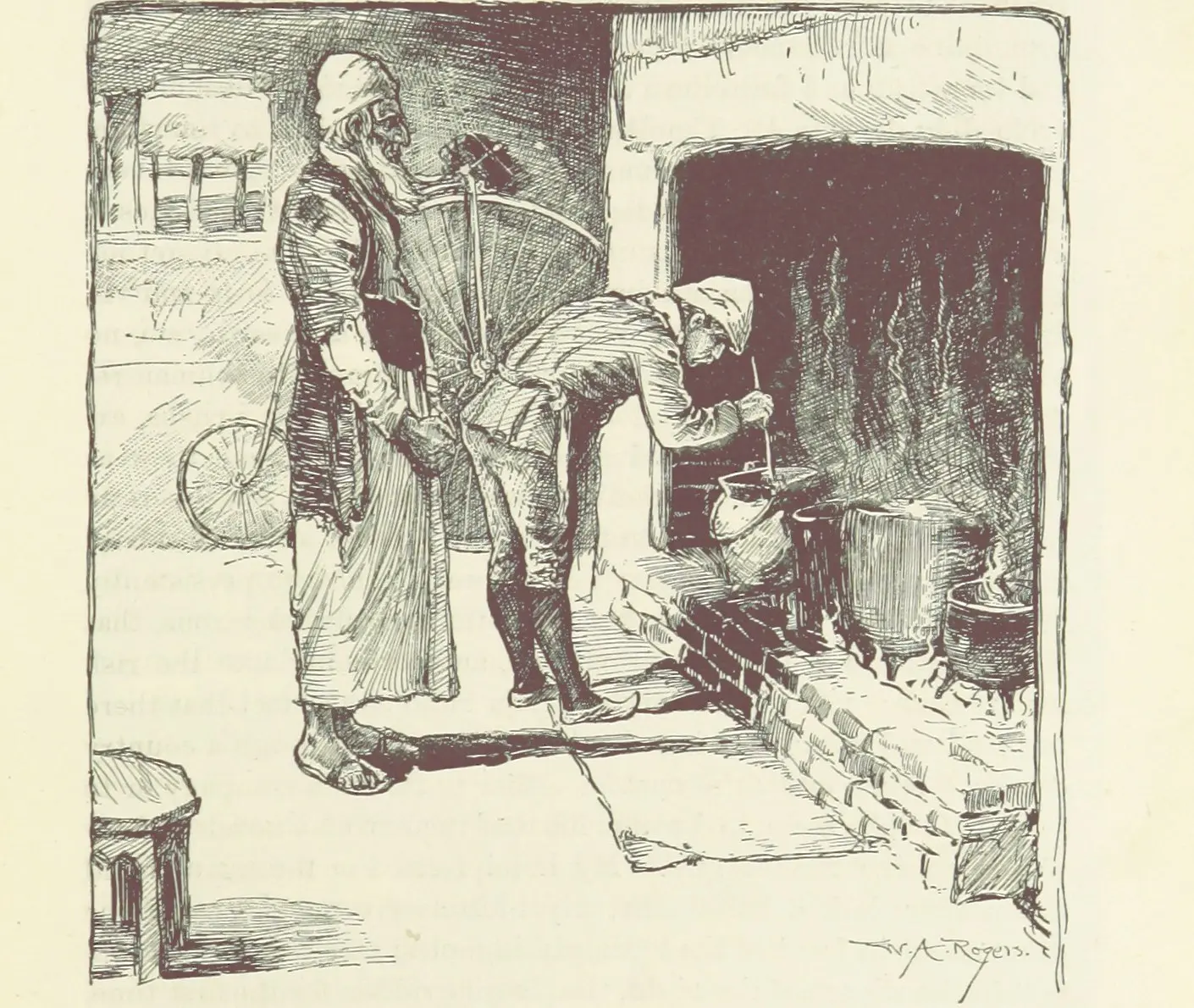
“My Bill of Fare,” by W. A. Rogers, 1887, cropped to remove the page text. Neither man knew much of the other's language, Stevens writes, so the proprietor showed him the pots.
My Bill of Fare by W. A. Rogers, Public domain
Full credit
"My Bill of Fare" by W. A. Rogers — https://commons.wikimedia.org/wiki/File:Image_taken_from_page_285_of_%27Around_the_World_on_a_Bicycle_..._From_San_Francisco_to_Teheran._With_..._illustrations._(With_preface_by_T._W._Higginson.)%27_(11288476584).jpg — Public domain (US: published 1887, before 1931; elsewhere: signed W. A. Rogers, read as William Allen Rogers, died 1931, life+70 term expired); modified: cropped: page text above and printed caption below removed

Asia gave him an instrument at last, and the numbers turn less cheerful. Two days out of Ismidt he read the cyclometer and wrote “forty and one-third miles yesterday and nineteen and a half to-day,” which he called “rather slow progress for a wheelman.” At the Persian border in September it stood “within a fraction of one thousand miles.”
Then came about 576 more miles to Teheran, reached on 30 September, where he stopped for the winter. Those 51 days from Constantinople work out to about 0.41 (overall), slower than either of his earlier stages. Food had changed as soon as he crossed into Asia. At Ismidt, at a hotel kept by an Armenian, he first met pillau, the rice dish he says would form part of his “daily bill of fare for several weeks.”
Which parts of the trip were not on the bicycle?
The oceans are the plain answer, but ships and trains did far more than that. After his release in Persia he took a Russian steamer to Baku, the railway to Batoum, a steamer to Constantinople and another to Alexandria, a train to Suez, a steamer to Karachi and a train to Lahore. Karachi lay in flood, and he went to Lahore partly so “that my purpose of making a continuous trail will be better served.” He wanted the wheeled line to start again as close to Furrah as he could manage, though the gap between them stayed open.
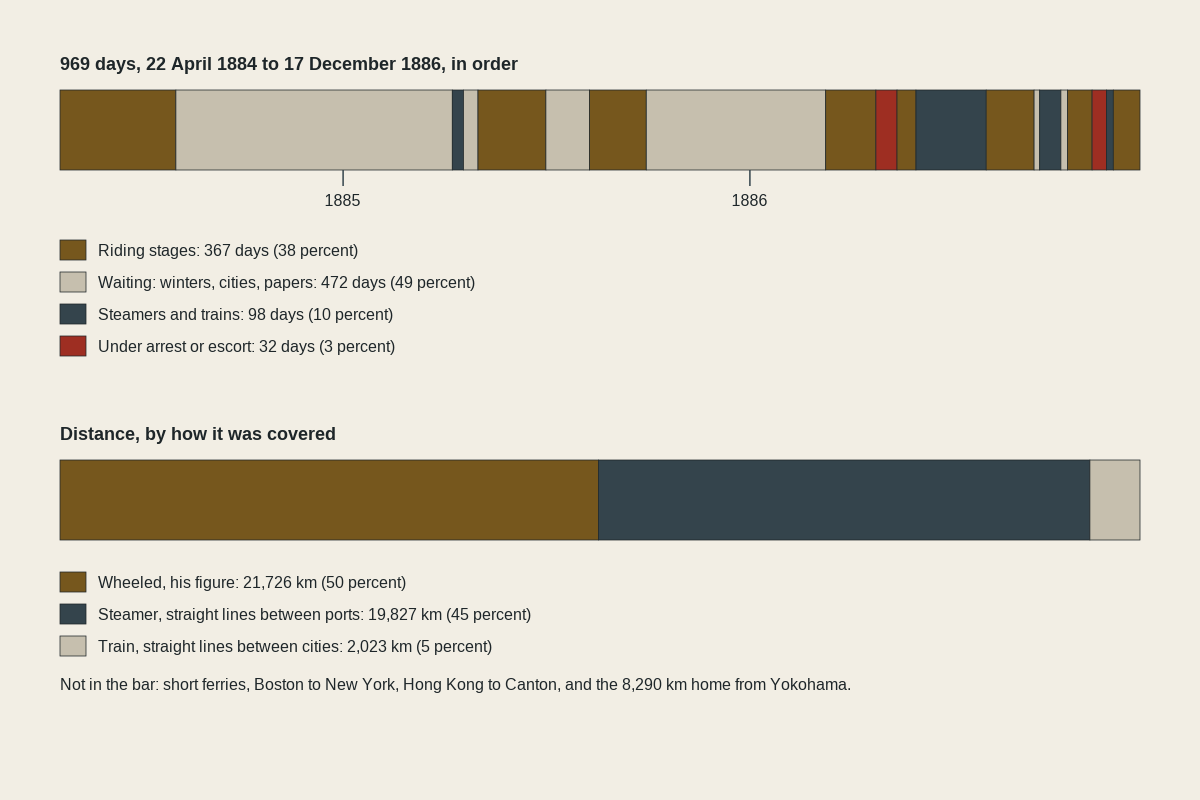
Top, every day of the trip in order, taken from his itinerary. Bottom, his wheeled figure beside straight lines between the ports and cities he names, which understate the true distance by sea and rail.
Keel, Rail & Spoke, CC BY 4.0
Data: Thomas Stevens, Around the World on a Bicycle, vol. 1 (1887), public domain, https://www.gutenberg.org/ebooks/5136, retrieved 2026-11-08; Thomas Stevens, Around the World on a Bicycle, vol. 2, public domain, https://www.gutenberg.org/ebooks/13749, retrieved 2026-11-08; Wikidata coordinates (CC0), https://www.wikidata.org/, retrieved 2026-11-08
Reuse this diagram: credit to copy
"Where the days and the distance went" by Keel, Rail & Spoke, https://keelrailandspoke.com/bicycles/thomas-stevens-around-the-world/, licensed under CC BY 4.0 (https://creativecommons.org/licenses/by/4.0/).
Data behind this diagram: thomas-stevens-around-the-world-stages.csv · Where this data came fromData: Thomas Stevens, Around the World on a Bicycle, vol. 1 (1887), public domain, https://www.gutenberg.org/ebooks/5136, retrieved 2026-11-08; Thomas Stevens, Around the World on a Bicycle, vol. 2, public domain, https://www.gutenberg.org/ebooks/13749, retrieved 2026-11-08 and thomas-stevens-around-the-world-ships-and-rail.csv · Where this data came from
Steamer legs alone come to at least 19,827 km and rail to at least 2,023 km, so about half the distance went by engine. The days lean further still. Riding stages take 367 days, which includes rests in cities along the way, while 472 days fall in stretches counted here as waiting, mostly a winter in New York, a summer stay in Constantinople and the winter of 1885–86 in Teheran.
On those riding stages he averaged about 37 miles a day, or about 59 km. That is about 12 hours of walking at 5 km/h, every day for a year. Stage by stage, the figures he prints give about 0.48 (overall) from San Francisco to Boston and about 0.55 (overall) from Liverpool to Constantinople.
India was the stage he enjoyed most up to that point. At Lahore he spent a couple of days “affixing a new set of tires,” and he set off in heat he put at no less than 130 degrees Fahrenheit in the sun. Even so, he called the Grand Trunk Road “the finest highway in the whole world,” and on reaching Calcutta he judged the ride down it, “except for the heat,” the “most enjoyable part of the whole journey, thus far.”
Why was Stevens arrested at Furrah?
The arrest came at the end of a route he never wanted. At Teheran he chose Turkestan and southern Siberia, then Vladivostok or Peking, and put the distance to Vladivostok at “some six thousand miles.” Then, at Shahrood, a telegram from the British Legation told him that “permission is refused to go through the Turcoman country.” At Meshed the British Chargé d'Affaires wired: “You must not attempt to cross the frontier of Afghanistan at any point.”
He tried it anyway. From Beerjand he crossed what he calls the “Desert of Despair” and rode into Furrah, now Farah. His table gives 24 and 25 April 1886 for the stop. He writes that a guard of twelve soldiers met him as he rode into the principal street and took him to Mahmoud Yusuph Khan, commander of the garrison.
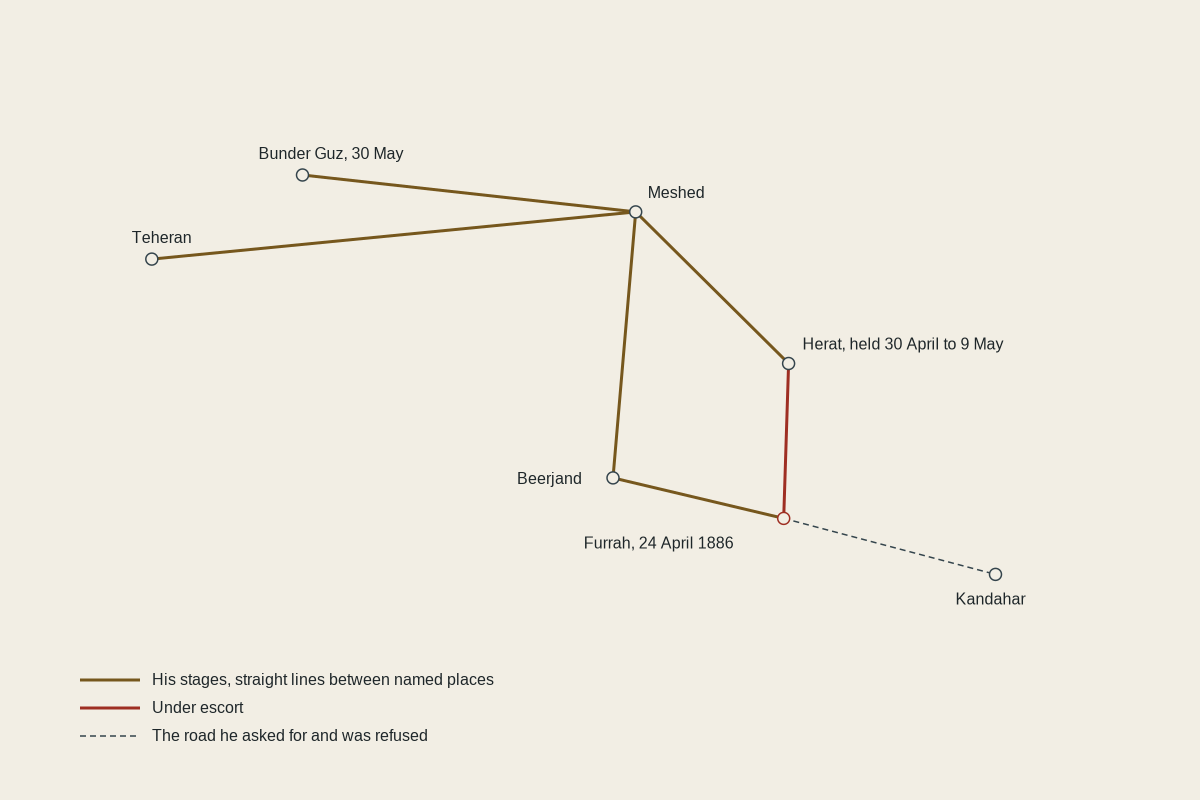
Straight lines between the places he names. The dashed line is his request, not a road he traveled.
Keel, Rail & Spoke, CC BY 4.0
Data: Thomas Stevens, Around the World on a Bicycle, vol. 2, public domain, https://www.gutenberg.org/ebooks/13749, retrieved 2026-11-08; Wikidata coordinates (CC0), https://www.wikidata.org/, retrieved 2026-11-08
Reuse this diagram: credit to copy
"Teheran to Furrah and back, 1886" by Keel, Rail & Spoke, https://keelrailandspoke.com/bicycles/thomas-stevens-around-the-world/, licensed under CC BY 4.0 (https://creativecommons.org/licenses/by/4.0/).
By his account, tension after the Penjdeh incident made the garrison wary, and “At first it is painfully evident that he suspects me of being a Russian spy.” Stevens asked for the road to Kandahar and Quetta and offered to go alone. The answer, in Persian as he reports it, was “Kandahar neis”: no Kandahar (translated by Keel, Rail & Spoke).
The khan said the Ameer had little control over the tribes in Zemindavar and that Stevens would be sure to get killed. A letter from Mr. Merk of the Boundary Commission later backed that reasoning.
Only Stevens's side of this is in the record read here. He was escorted to Herat, held under guard in a little garden from 30 April to 9 May, then taken back to Karize on the Persian side, where the table says “released by Afghans” on 13 May.
Eleven spokes on the road to Herat
The worst damage to the machine came from a horse. After a night near Subzowar the escort insisted he ride a horse, so he took the bicycle apart and fastened the big wheel on top of a pack-horse load, a black stallion that kept trying to attack the others. That night the wheel came off the load “with no less than eleven spokes broken, and the rim considerably twisted out of shape.”
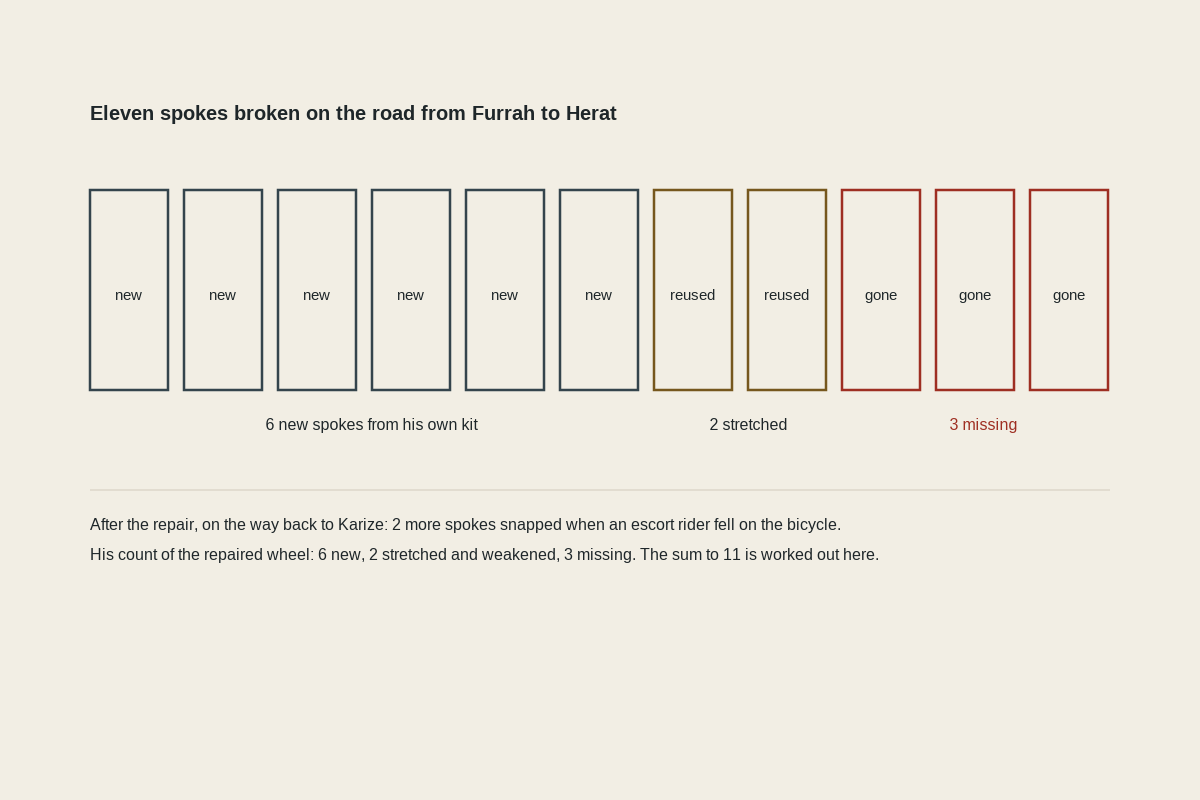
His count of the repaired wheel. He gives the three parts, and the total of eleven comes from his earlier sentence.
Keel, Rail & Spoke, CC BY 4.0
Data: Thomas Stevens, Around the World on a Bicycle, vol. 2, public domain, https://www.gutenberg.org/ebooks/13749, retrieved 2026-11-08
Reuse this diagram: credit to copy
"The spoke count at Herat" by Keel, Rail & Spoke, https://keelrailandspoke.com/bicycles/thomas-stevens-around-the-world/, licensed under CC BY 4.0 (https://creativecommons.org/licenses/by/4.0/).
The repair radius here can only be given as a stand-in, about 222 km, the straight line from Furrah to Herat, because the camp past Subzowar where the wheel broke cannot be placed. Three Herat gunsmiths did the work over two days, with bellows, bow drills and a small forge. The rest came from his bags: six new spokes and “the handy little spoke-vice,” without which, he says, truing the wheel “would have been impossible.” He adds that he might otherwise have had to carry the bicycle out of the country on horseback.
The spares ran out there. After the gunsmiths and “my own resources” were spent, three spokes stayed missing.
Yet this is not a last spare in the site's sense, since the ride went on, so that field reads not applicable. Two more spokes snapped when an escort rider tried trundling and fell on it. Even so, he wrote that he made the 160 miles from Karize to Meshed in two days and a half, about 0.86 (overall), on “a bicycle that has been tinkered up by Herati gunsmiths.”
How did he get through China and Japan?
China was the least wheeled part of the land route. His passport came on 12 October at Canton, and he says he lost no time in starting. Within a week he was on a sampan, a small river boat, and his table lists four nights aboard in a row. Hired men carried the bicycle over the Mae-ling Mountains, and boatmen carried it below Nam-ngan where the river ran too low.
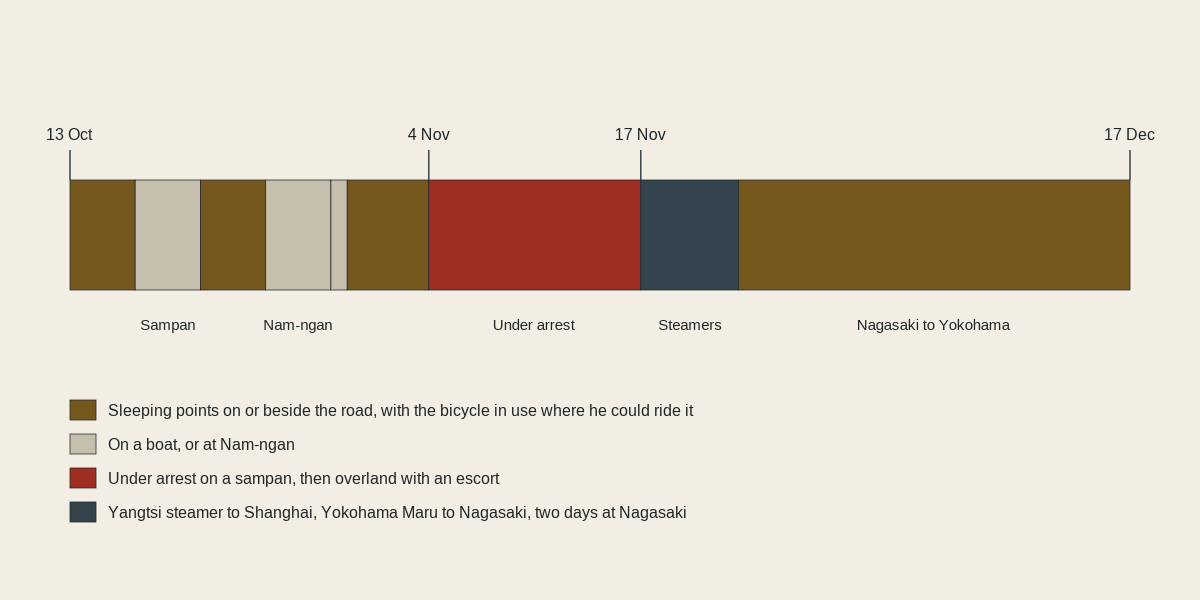
Dates from his table of sleeping points. The brown blocks mean he was on the road, not that every mile in them was ridden.
Keel, Rail & Spoke, CC BY 4.0
Data: Thomas Stevens, Around the World on a Bicycle, vol. 2, public domain, https://www.gutenberg.org/ebooks/13749, retrieved 2026-11-08
Reuse this diagram: credit to copy
"China and Japan by date, 1886" by Keel, Rail & Spoke, https://keelrailandspoke.com/bicycles/thomas-stevens-around-the-world/, licensed under CC BY 4.0 (https://creativecommons.org/licenses/by/4.0/).
At Ki-ngan-foo, on 4 November, a crowd followed him down the main street and began to throw stones. His pith helmet took the hits, a runner from the magistrate's office was hurt in the arm, and the bicycle lost “a couple of spokes.”
The magistrate brought him inside, and that night had him taken aboard a sampan under guard. His table reads “Under arrest on sampan” until 15 November. He gives only his own view of why the crowd turned on him.
He then went overland with an escort to Kui-Kiang, where men from the English consulate and the steamer Peking saw him riding along the bund. “Well, well, well! nobody expected to ever see anything of you again,” they called out.
Steamers took him to Shanghai and Nagasaki, and the road across Japan took the last 24 days, broken by a ferry at Moji. On the Hakone Pass two men carried the machine over sixteen miles of boulder road while he walked behind them.
The Ibry strip: 969 days, San Francisco to Yokohama
A time-distance strip shows the shape of the trip better than any total. Time runs left to right, distance runs up, and a flat part means no wheeled miles are counted there.
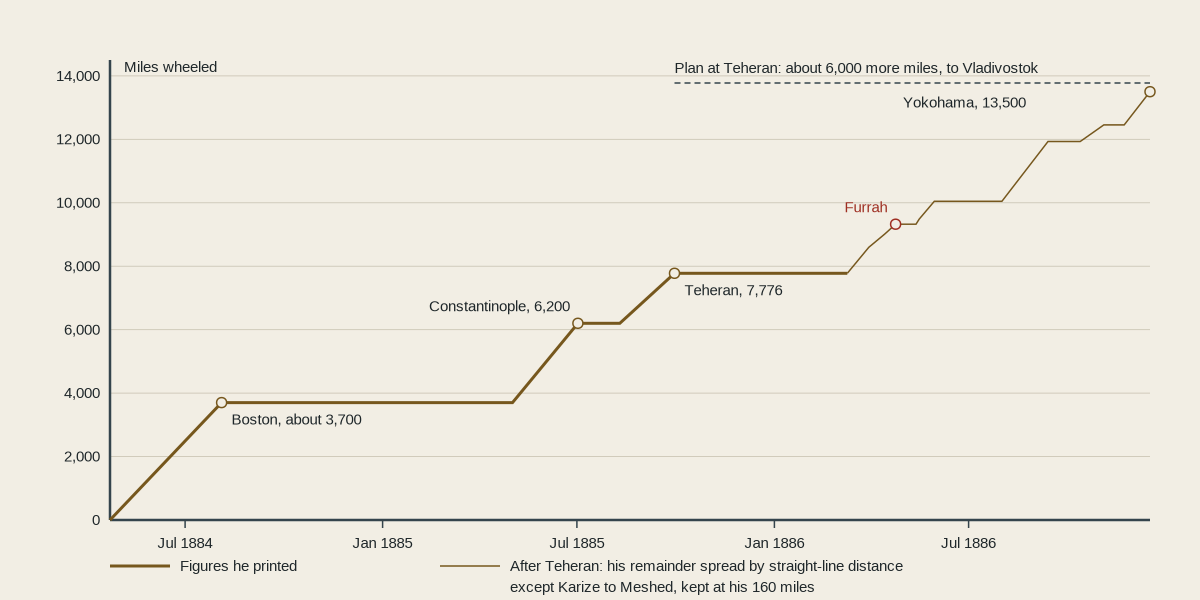
Heavy line: running totals from the stage figures he prints, 3,700 at Boston, then 2,500 and 1,576 more, giving 6,200 at Constantinople and 7,776 at Teheran. Thin line: an estimate made here, not his record, of the other 5,724 miles, with the 160 he gives for Karize to Meshed and the rest spread by straight line.
Keel, Rail & Spoke, CC BY 4.0
Data: Thomas Stevens, Around the World on a Bicycle, vol. 1 (1887), public domain, https://www.gutenberg.org/ebooks/5136, retrieved 2026-11-08; Thomas Stevens, Around the World on a Bicycle, vol. 2, public domain, https://www.gutenberg.org/ebooks/13749, retrieved 2026-11-08; Wikidata coordinates (CC0), https://www.wikidata.org/, retrieved 2026-11-08
Reuse this diagram: credit to copy
"Thomas Stevens: time-distance strip, 1884 to 1886" by Keel, Rail & Spoke, https://keelrailandspoke.com/bicycles/thomas-stevens-around-the-world/, licensed under CC BY 4.0 (https://creativecommons.org/licenses/by/4.0/).
Data behind this diagram: thomas-stevens-around-the-world-stages.csv · Where this data came fromData: Thomas Stevens, Around the World on a Bicycle, vol. 1 (1887), public domain, https://www.gutenberg.org/ebooks/5136, retrieved 2026-11-08; Thomas Stevens, Around the World on a Bicycle, vol. 2, public domain, https://www.gutenberg.org/ebooks/13749, retrieved 2026-11-08
The dashed line is the plan he made at Teheran, 7,776 miles done and “some six thousand” to go. On those round figures he finished roughly 300 miles under that level, by a different road on a different side of Asia. In 1889 and 1890 Nellie Bly made her trip around the world on ships and trains, the part of Stevens's route that sits flat on this strip.
From Yokohama the City of Peking took him “in seventeen days” to San Francisco, about 8,290 km in a straight line and outside the 969 days. His closing paragraph says nothing of a day gained or lost on that crossing, the effect that showed up when the Victoria, the one ship of Ferdinand Magellan's fleet to finish, reached Cape Verde.
He rode the last eleven miles from Totsuka with a south wind behind him. At Kanagawa one clock said eight, another eleven and a third half past nine. The clock at the Club Hotel on the Yokohama bund, as he tells it, was just about striking ten when he made “the last vault from the saddle.”
Sources
- Thomas Stevens, Around the World on a Bicycle, vol. 1, From San Francisco to Teheran, preface by Thomas Wentworth Higginson (1887). Project Gutenberg eBook 5136. https://www.gutenberg.org/ebooks/5136Read: chapters and passages: preface, opening chapter, close of chapter 4, Liverpool, Constantinople, the start across Asia, the Persian frontier, the arrival at Teheran
- Thomas Stevens, Around the World on a Bicycle, vol. 2, From Teheran to Yokohama (1887–88; preface dated 1887, catalog records give 1888). Project Gutenberg eBook 13749. https://www.gutenberg.org/ebooks/13749Read: chapters and passages: first chapter; chapters on Furrah, Herat and the return to Persia; passages on the steamers, Karachi, Lahore, Calcutta, Canton, Ki-ngan-foo, Kui-kiang and Hakone; closing pages; the full itinerary
- Wikidata, coordinate location (P625) of the modern cities on the route, including San Francisco (Q62), Boston (Q100), Liverpool (Q24826), Istanbul (Q406), Tehran (Q3616), Mashhad (Q121157), Farah (Q593156), Herat (Q45313), Lahore (Q11739), Kolkata (Q1348), Guangzhou (Q16572) and Yokohama (Q38283); the full list is in the ships and rail file and the route data. CC0. https://www.wikidata.org/wiki/Q38283Read: full page of each of 28 items, coordinates used
Cite this page
Keel, Rail & Spoke. "Bicycle Around the World: Stevens Counted About 13,500 Miles." Published 2026-11-08. https://keelrailandspoke.com/bicycles/thomas-stevens-around-the-world/. Accessed on the date you read it.
How facts are checked · Corrections · Contact
Found a mistake on this page? Write to contact@keelrailandspoke.com.
More from Bicycles
Bicycles
Cornell Reported a 2011 Test Bicycle Balanced With No Gyroscope Effect
A self-stable bicycle steers into its own lean. Cornell reported a 2011 test bike doing so with its gyroscopic effect cancelled, though it can help other bikes.
Picture credit
"Man leert vrouw fietsen, vermoedelijk in Frankrijk" by unknown creator — https://commons.wikimedia.org/wiki/File:Man_leert_vrouw_fietsen,_vermoedelijk_in_Frankrijk,_RP-F-F01164-57-4.jpg — CC0 1.0 (https://creativecommons.org/publicdomain/zero/1.0/)
Bicycles
Who Invented the Bicycle? Drais’s 1817 Machine Had No Pedals
No single inventor made the bicycle. Karl Drais rode a steered two-wheeler pushed by his feet in 1817; pedals, the rear chain and air-filled tires came later.
Picture credit
"Die Laufmaschine des Freiherrn Carl von Drais" by Wilhelm Siegrist — https://commons.wikimedia.org/wiki/File:Draisine1817.jpg — Public domain (US: published 1817, before 1931; elsewhere: published 1817, engraver Wilhelm Siegrist (1797–1843?) per the file page, life+70 term long expired); modified: cropped: rider and machine in side view, down to the ground line; plan view and legend below left out

