Journeys & Expeditions · Journey file
Nellie Bly: Two Women Set Off Around the World the Same Day
On 14 November 1889 Nellie Bly sailed east from Hoboken and Elizabeth Bisland took a train west from New York, and neither woman's book names the other.
Keel, Rail & Spoke · Published
TL;DR
- Nellie Bly of the New York World left Hoboken on 14 November 1889 and reached Jersey City on 25 January 1890: 72 days, 6 hours and 11 minutes by her own table.
- Elizabeth Bisland of Cosmopolitan magazine left New York that evening going west and finished in 76 days by her own count. She blames a false report in France for four of them.
- By Bly's account she first heard of the other woman at Hong Kong on 23 December, and she answered, “I am not racing with anyone.”
Leg card
- Departure
- Hoboken, 14 November 1889, at 9.40.30 by her book
- Arrival
- Jersey City, 25 January 1890, 3.51 p.m.
- Distance
- 21,740 miles by her table, about 39,034 km if the sea rows are nautical miles and the rail rows statute, a reading made here. Detour of 179.5 miles and at least 1,500 miles at ports not counted
- Machine
- Steamships Augusta Victoria, Victoria, Oriental and Oceanic, with mail and special trains
- Elapsed
- 72 days, 6 hours and 11 minutes, her own total
- Walking multiple
- about 4.5 (overall): about 39,034 km, reading her sea rows as nautical miles and her rail rows as statute (a reading made here), over 1,734 hours at 5 km/h. Straight lines between her stops alone give at least 4.2
- Repair radius
- n/a: no breakdown held up the trip in her book
- The last spare
- not applicable: the trip was completed
- Key source
- Nellie Bly, Nellie Bly's Book: Around the World in Seventy-Two Days (1890)
Download this card (CSV) · Where this data came from
Data: Nellie Bly, Nellie Bly's Book: Around the World in Seventy-Two Days (1890), public domain, https://digital.library.upenn.edu/women/bly/world/world.html, retrieved 2026-11-07; Wikidata coordinates (CC0), https://www.wikidata.org/, retrieved 2026-11-08
What the card means: walking multiple, repair radius, last spare.
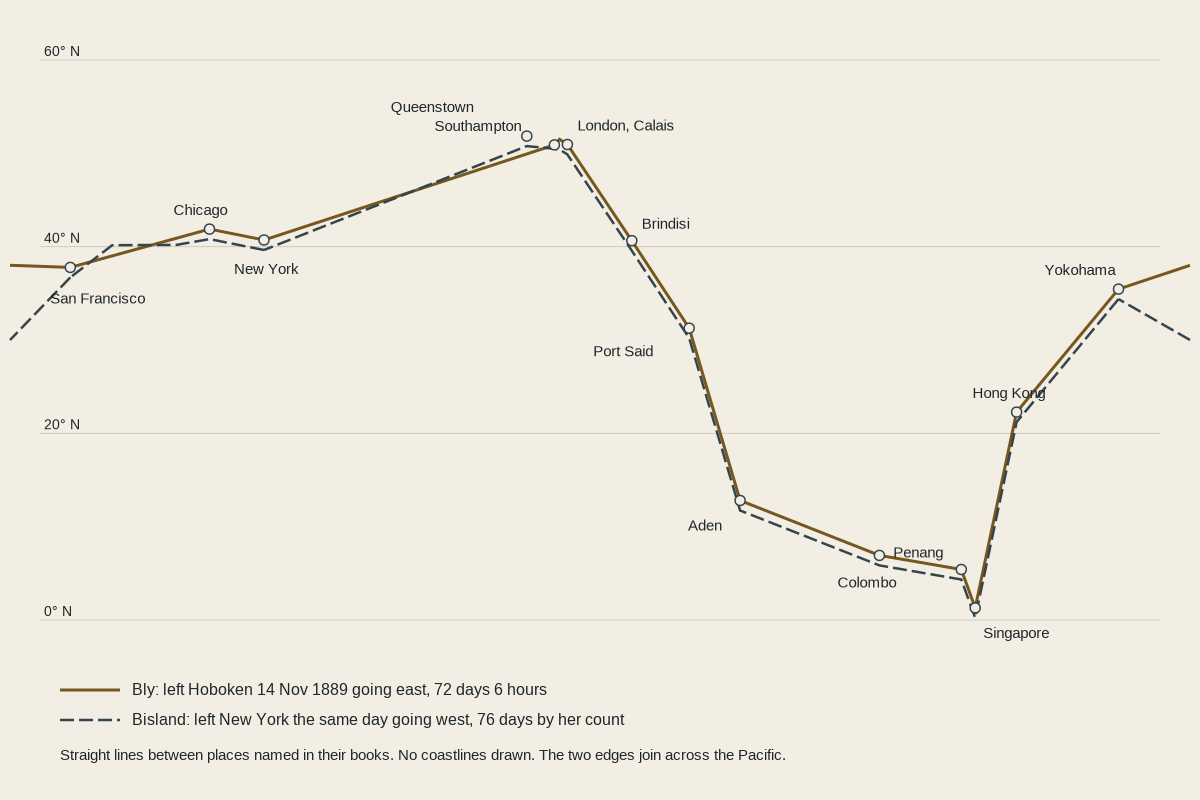
Both routes as straight lines between places named in the two books. The real tracks ran longer than any line here.
Keel, Rail & Spoke, CC BY 4.0
Data: Nellie Bly, Nellie Bly's Book: Around the World in Seventy-Two Days (1890), public domain, https://digital.library.upenn.edu/women/bly/world/world.html, retrieved 2026-11-07; Elizabeth Bisland, In Seven Stages (1891), public domain, https://digital.library.upenn.edu/women/bisland/stages/stages.html, retrieved 2026-11-07; Wikidata coordinates (CC0), https://www.wikidata.org/, retrieved 2026-11-08
Reuse this diagram: credit to copy
"Two routes around the world, 1889 to 1890" by Keel, Rail & Spoke, https://keelrailandspoke.com/journeys/nellie-bly-1889/, licensed under CC BY 4.0 (https://creativecommons.org/licenses/by/4.0/).
Data behind this diagram: nellie-bly-1889-two-routes.csv · Where this data came from
At 9.40.30 on 14 November 1889, the Augusta Victoria carried Nellie Bly out of Hoboken on a 21,740-mile trip. The time and the distance are her own, printed in Nellie Bly's Book (1890) with a table of every stage. Elizabeth Bisland, an editor at Cosmopolitan in New York, had read her morning papers and heard nothing of any trip, and her summons came at half past ten, she writes, with a train going the other way by evening. Neither book names the other woman.
Over the whole trip Bly's walking multiple was about 4.5 (overall) on the reading of her miles explained below, four and a half times a 5 km/h walk, kept up day and night for 72 days. Thomas Stevens, who wheeled around the world on a bicycle a few years earlier, comes out at about 0.19 on the same measure. The repair radius on the card reads n/a, because no breakdown held up Bly's trip in her book, and the last spare reads not applicable, because she finished.
Stops on this page (9)
Who was Nellie Bly?
Nellie Bly was a reporter for the New York World, and the name was a pseudonym: the Library of Congress gives Elizabeth Jane Cochran(e), later Elizabeth Cochrane Seaman. She was already known for an earlier assignment. In Ten Days in a Mad-House, entered for copyright in 1887, she writes that the World asked her on 22 September whether she could get herself committed to an asylum in New York to report on how patients were treated. She pretended to be insane and was sent to the insane ward at Blackwell's Island, where she “spent ten days and nights.”
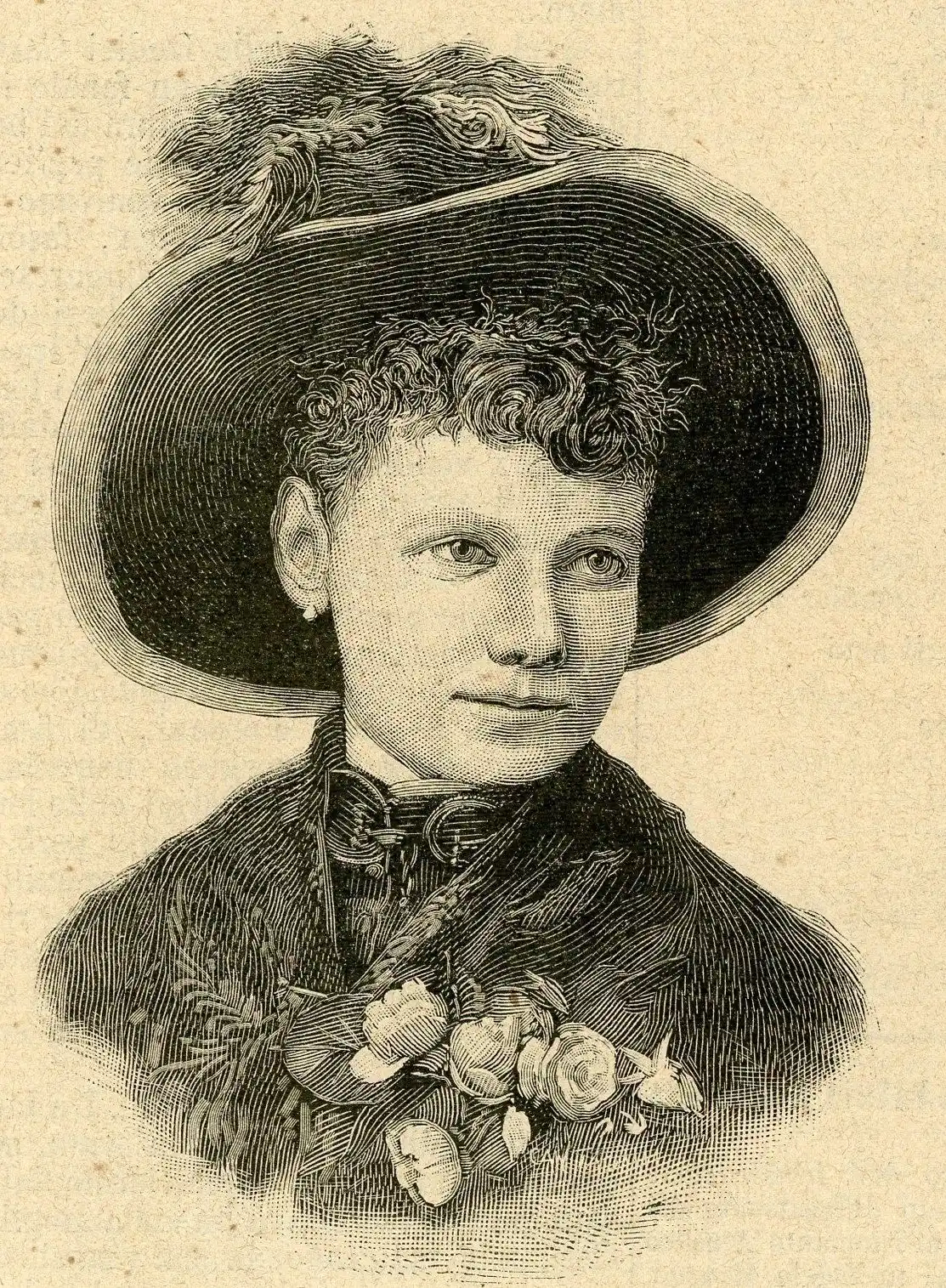
A wood engraving from L'Illustrazione popolare (Milan, 1890), named as Bly in the file's title.
Miss Nellie Bly (xilografia) by unknown creator, Public domain
Full credit
"Miss Nellie Bly (xilografia)" by unknown creator — https://commons.wikimedia.org/wiki/File:Miss_Nellie_Bly_(xilografia).jpg — Public domain (US: published 1890, before 1931; elsewhere: no creator named on the print or file page, published more than 70 years ago); modified: re-saved as JPEG at the same size

She says she proposed the trip herself, and her office replied that it had thought of the idea already and meant to send a man. Her answer, as she tells it: “Start the man, and I'll start the same day for some other newspaper and beat him.” About a year later the editor asked, “Can you start around the world day after tomorrow?”
For the trip she took one hand-bag and one dress, plus a silk bodice squeezed in beside a jar of cold cream, and £200 in gold and Bank of England notes. Her promise to her editor was 75 days, set against what she calls “the record made by a hero of fiction.”
Who was Elizabeth Bisland?
Bisland was an editor in New York, and her book, In Seven Stages (1891), says only “the magazine of which I was one of the editors.” The magazine version says more. In The Cosmopolitan for April 1890, the same sentence reads “the office of the Cosmopolitan Magazine—of which I am one of the editors.”
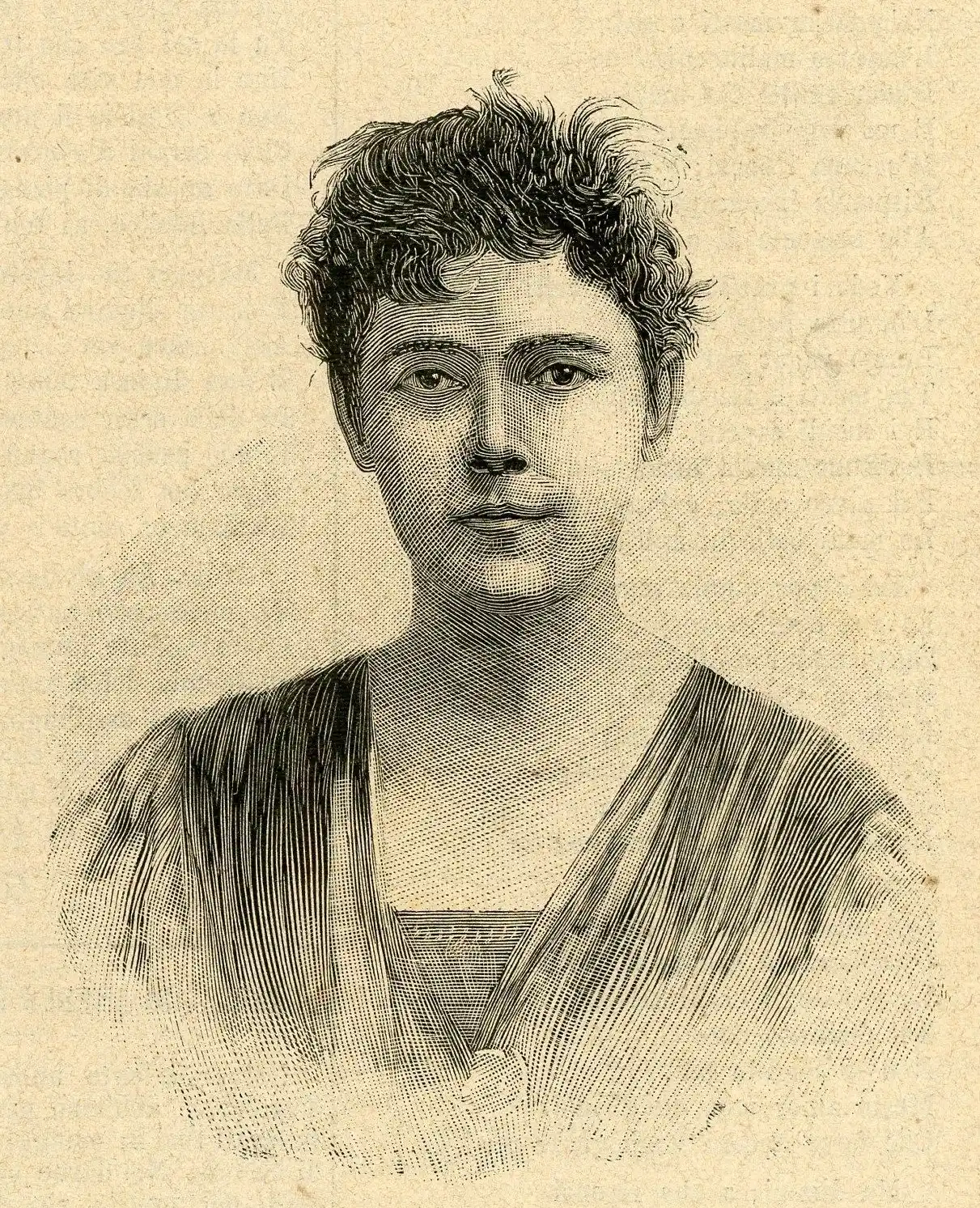
A wood engraving from the same Milan magazine in 1890, named as Bisland in the file's title.
Miss Elisabetta Bisland (xilografia) by unknown creator, Public domain
Full credit
"Miss Elisabetta Bisland (xilografia)" by unknown creator — https://commons.wikimedia.org/wiki/File:Miss_Elisabetta_Bisland_(xilografia).jpg — Public domain (US: published 1890, before 1931; elsewhere: no creator named on the print or file page, published more than 70 years ago); modified: re-saved as JPEG at the same size

The editor and owner asked her to leave that evening for San Francisco. She said no, and gave her reasons: she didn't want to, she had guests coming to tea on the 15th, she had no clothes ready, and she dreaded seeing her name in the papers. About an hour later she gave in, with no account of what changed her mind beyond “substantial arguments.”
Then she had a gown to fit by six o'clock, and “five hours” to get ready for “a seventy-five days' voyage,” which gave her the same target as Bly. Her goal in her own words was “lowering the circumnavigatory record.”
How long did Nellie Bly take?
Bly took 72 days, 6 hours and 11 minutes, or 1,734 hours and 11 minutes. She prints both figures. She also prints the schedule published the morning she left, which lets you check her against her own plan. The record says the trip ran close to schedule for most of its length.
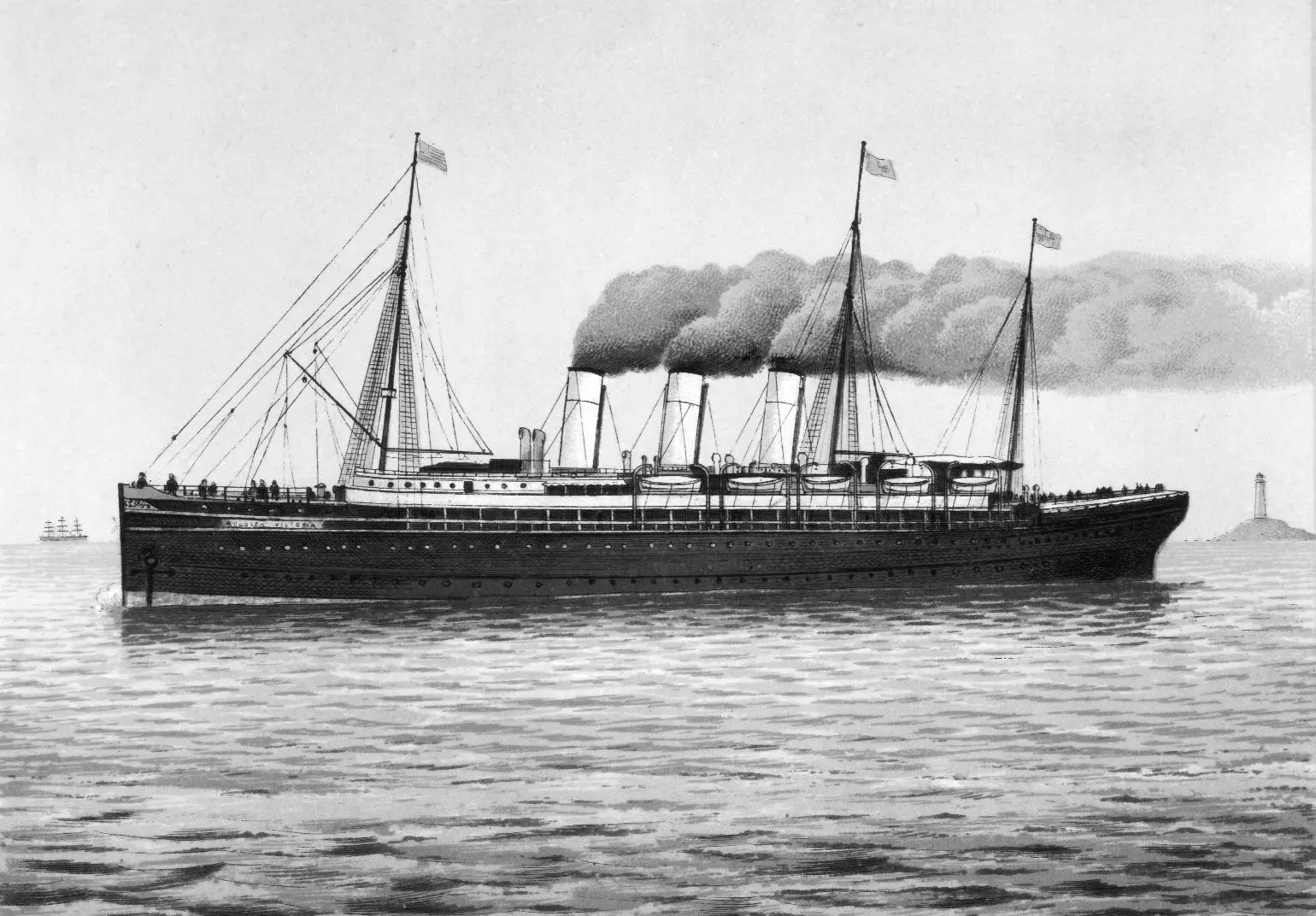
The Augusta Victoria around 1890, in a plate from an album of Hamburg, as identified by its file page and the name on her stern. She carried Bly as far as Southampton.
Augusta Victoria (Schiff) by unknown creator, Public domain
Full credit
"Augusta Victoria (Schiff)" by unknown creator — https://commons.wikimedia.org/wiki/File:Augusta_Victoria_(Schiff).jpg — Public domain (US: in the book Album von Hamburg, dated about 1890 on the file page, before 1931; elsewhere: book published without an author name, more than 70 years ago); modified: re-saved as JPEG at the same size

| Point | Schedule | As traveled |
|---|---|---|
| Southampton | due 21 Nov | 22 Nov, 2.30 a.m. |
| Colombo | 10 Dec | 8 Dec |
| Penang | 16 Dec | 16 Dec |
| Hong Kong | 25 Dec | 23 Dec |
| Leave Hong Kong | 28 Dec | 28 Dec |
| Leave Yokohama | 7 Jan | 7 Jan |
| San Francisco | due 22 Jan | 21 Jan |
| New York or Jersey City | due 27 Jan | 25 Jan |
At sea before Hong Kong she gained two days and then gave them back, because her schedule already had her waiting for the next ship. She left Hong Kong and Yokohama on the very days the schedule named. Her whole margin of two days came after Yokohama, one on the Pacific and one on the American railroads.
The Hong Kong date needs a note. The itinerary in the Penn text prints 25 December for her arrival. Her chapter puts the evening of December 22 on board and the city in the early morning after, calling it her “thirty-ninth day,” and the hours in her table also land on 23 December.
Where did the 72 days go?
Bly's table splits the trip into 1,356 hours and 41 minutes traveling and 377 hours and 30 minutes delayed. Of that delay, 330 hours and 20 minutes went at three ports: Colombo, Hong Kong and Yokohama. Each one was a wait for the next ship to sail.
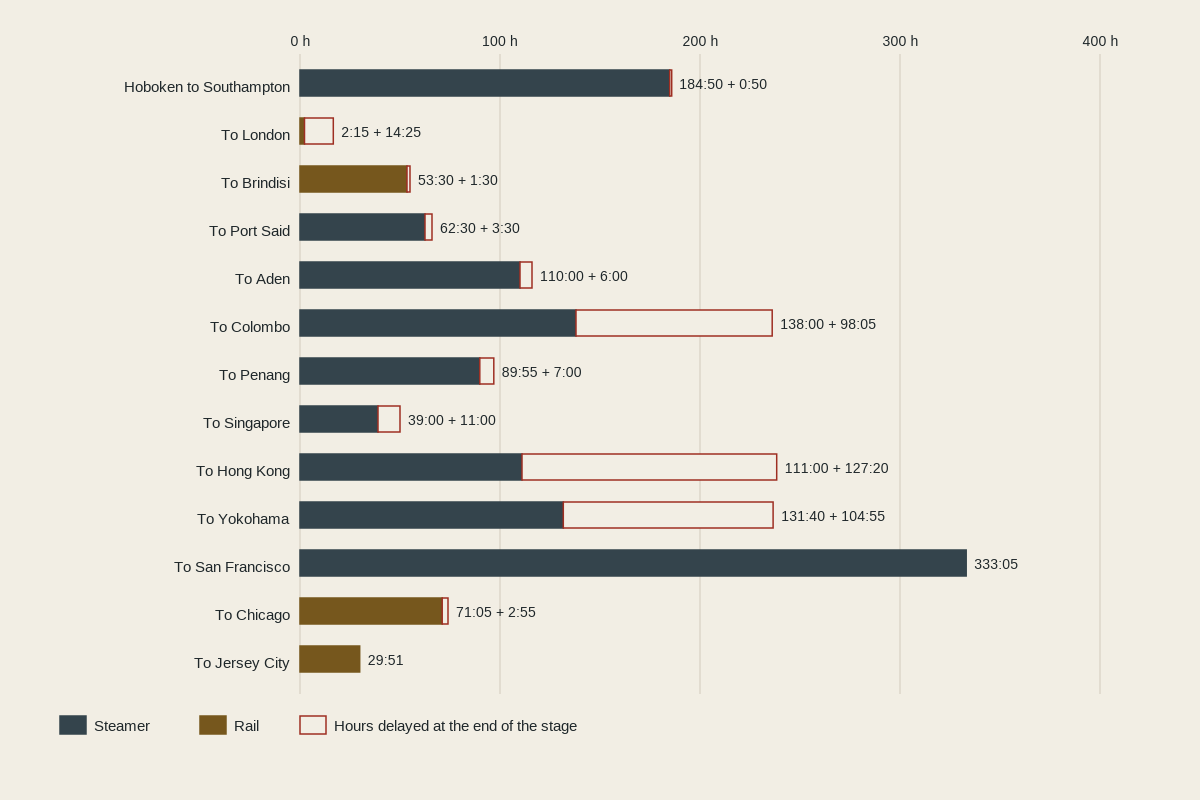
Her table drawn to scale. Pale bars are the hours she lists as delayed at the end of each stage.
Keel, Rail & Spoke, CC BY 4.0
Data: Nellie Bly, Nellie Bly's Book: Around the World in Seventy-Two Days (1890), public domain, https://digital.library.upenn.edu/women/bly/world/world.html, retrieved 2026-11-07
Reuse this diagram: credit to copy
"Bly's own table: hours traveling and hours delayed" by Keel, Rail & Spoke, https://keelrailandspoke.com/journeys/nellie-bly-1889/, licensed under CC BY 4.0 (https://creativecommons.org/licenses/by/4.0/).
Data behind this diagram: nellie-bly-1889-bly-table.csv · Where this data came from
| Stage | Miles | Traveling | Delayed |
|---|---|---|---|
| Hoboken to Southampton | 3,041 | 184:50 | 0:50 |
| To London | 90 | 2:15 | 14:25 |
| To Brindisi | 1,450 | 53:30 | 1:30 |
| To Port Said | 930 | 62:30 | 3:30 |
| To Aden | 1,394 | 110:00 | 6:00 |
| To Colombo | 2,093 | 138:00 | 98:05 |
| To Penang | 1,278 | 89:55 | 7:00 |
| To Singapore | 381 | 39:00 | 11:00 |
| To Hong Kong | 1,437 | 111:00 | 127:20 |
| To Yokohama | 1,597 | 131:40 | 104:55 |
| To San Francisco | 4,525 | 333:05 | none |
| To Chicago | 2,573 | 71:05 | 2:55 |
| To Jersey City | 951 | 29:51 | none |
The columns add up to her totals to the minute. Her hours run on local clocks, though, so a single row can hide a time change, and the errors only cancel over the full circle.
Colombo cost her the most temper. The Oriental would not sail until the Nepaul came in with passengers, and the chief engineer told her, “She's a slow old boat.” Bly says she answered that she hoped the Nepaul would go to the bottom of the bay. The 14 hours and 25 minutes at London include a call on a novelist at Amiens, 179 and a half miles off her line, and she still caught the weekly mail train at Calais.
What kind of miles were they?
Rail carried 23 percent of the miles in her table in 12 percent of the moving hours, and steamers did the rest. Those shares come straight from her table, counting the Brindisi row as rail even though it includes the Channel crossing. Read with her sea miles as nautical, as below, rail's share of the distance is about 21 percent.
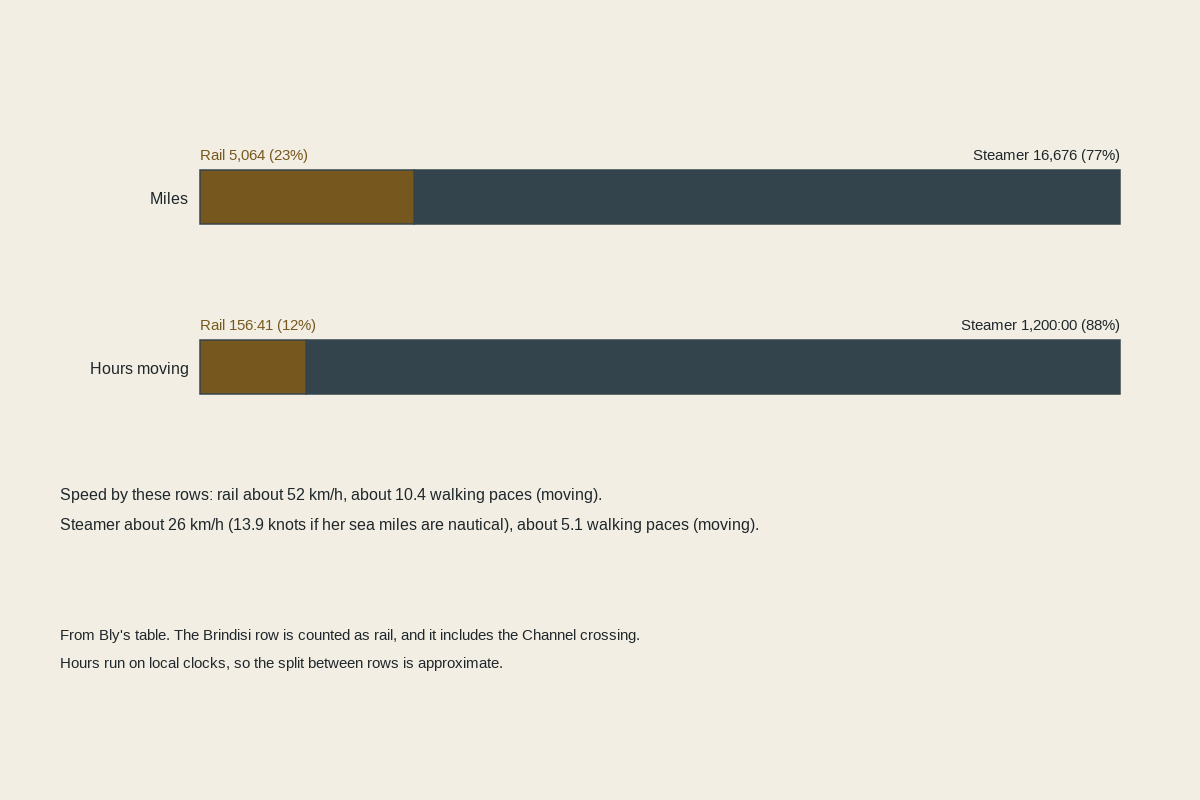
Rail in brown, steamer in blue. The text at the foot of the chart gives the speeds that follow from these rows.
Keel, Rail & Spoke, CC BY 4.0
Data: Nellie Bly, Nellie Bly's Book: Around the World in Seventy-Two Days (1890), public domain, https://digital.library.upenn.edu/women/bly/world/world.html, retrieved 2026-11-07
Reuse this diagram: credit to copy
"Rail and steamer in Bly's own table" by Keel, Rail & Spoke, https://keelrailandspoke.com/journeys/nellie-bly-1889/, licensed under CC BY 4.0 (https://creativecommons.org/licenses/by/4.0/).
| Mode | Miles in her table | Hours moving | Speed | Walking multiple |
|---|---|---|---|---|
| Rail | 5,064 | 156:41 | about 52 km/h | about 10.4 (moving) |
| Steamer | 16,676 | 1,200:00 | about 26 km/h | about 5.1 (moving) |
The speeds read her rail miles as land miles and her sea miles as nautical, the reading explained next. They also use her table's local-clock hours, so they are approximate.
She never says which kind of “miles” she means. Take her sea rows as ordinary land miles and eight of the nine come out shorter than a straight line between the two ports. Hoboken to Southampton would be 4,894 km, and the straight line is 5,507 km. Read as nautical miles, all nine clear the line, and the steamers average 13.9 knots.
That reading gives about 39,034 km, or about 24,254 land miles, and it is the distance behind the 4.5 on the card. It is an inference made here, not something she states. Straight lines between her stops give a floor of 36,154 km, or about 4.2 (overall).
Her record chapter also prints two average speeds, 22.47 miles an hour “exclusive of stops” and 28.71 “including stops.” Neither can be recalculated from her table in miles, where the plain figures are about 16.0 and 12.5, and a speed can't rise when the stops go in. The only match found here puts the mixed distance into kilometers and swaps the labels, which gives 28.8 and 22.5. The match could be chance, since the book gives no working.
The fast part was the American railroad. From San Francisco to Chicago her table gives 2,573 miles in 71 hours and 5 minutes on its local clocks, and her text gives 2,566 miles in 69 hours, which works out to about 60 km/h, or about 12.0 (moving). A special train of one sleeping car and an engine carried her. Her book calls the run the fastest on record between those cities, a claim that is hers alone.
San Francisco to Jersey City took her 103 hours and 51 minutes on her table's clocks, against the 4 days and 20 hours Bisland gives for New York to San Francisco. The Lewis and Clark Expedition had gone across part of the same continent at about 0.12 (overall) some 80 years before. Europe's railways still had gaps of their own: six years earlier the first run of the Orient Express finished on a Lloyd steamer out of Varna.
British ports, and the words of the two books
Both routes ran through the same British ports. Bly lists Aden, Colombo, Penang, Singapore and Hong Kong as “British possessions,” and at Singapore she describes Chinese laborers carrying coal aboard, two by two, in baskets slung from a pole.
The two books also speak in the language of 1890. Penn's editions flag both for race and ethnicity. At Hong Kong Bly writes, “I knew we were trying to keep the Chinamen out of America, so I decided to see all of them I could while in their land.” Crossing the English Channel on the way home, Bisland writes, “It fills my soul with a passion of pride that I, too, am an Anglo-Saxon.”
When did Bly find out about Bisland?
She found out at Hong Kong on 23 December, her book says, in the office of the Occidental and Oriental line. “You are going to be beaten,” the agent told her. Bly thought he meant time. “Time? I don't think that's her name,” he said, and went on: “The day you left New York another woman started out to beat your time, and she's going to do it.”
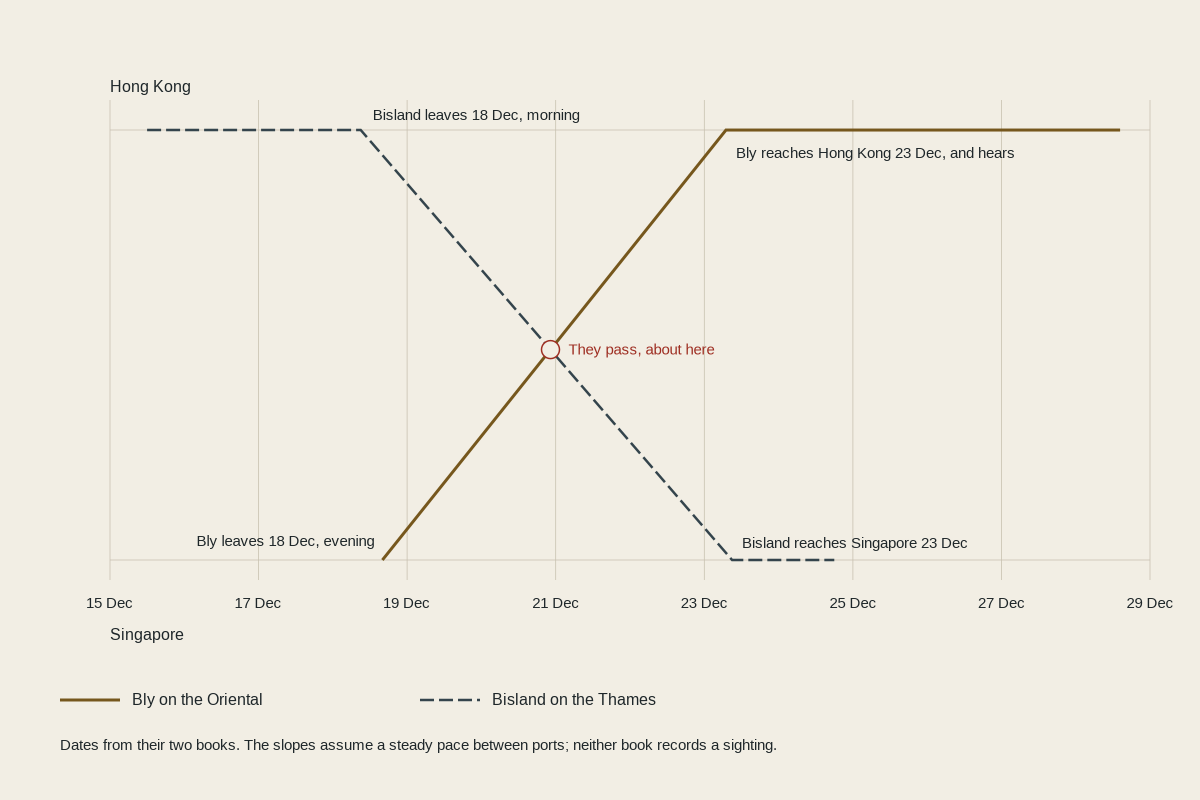
Dates from the two books. The slopes assume a steady pace between the ports, so the crossing point is an estimate, and neither book records a sighting.
Keel, Rail & Spoke, CC BY 4.0
Data: Nellie Bly, Nellie Bly's Book: Around the World in Seventy-Two Days (1890), public domain, https://digital.library.upenn.edu/women/bly/world/world.html, retrieved 2026-11-07; Elizabeth Bisland, In Seven Stages (1891), public domain, https://digital.library.upenn.edu/women/bisland/stages/stages.html, retrieved 2026-11-07
Reuse this diagram: credit to copy
"The same run in opposite directions, December 1889" by Keel, Rail & Spoke, https://keelrailandspoke.com/journeys/nellie-bly-1889/, licensed under CC BY 4.0 (https://creativecommons.org/licenses/by/4.0/).
A contest fits the agent's story better than it fits Bly's. She told the purser, “I am not racing with anyone. I would not race.” The agent said the other woman “led us to suppose that it was an arranged race,” which only Bly reports. Bisland's own book never uses Bly's name or mentions a contest with another traveler.
The agent got other details wrong. He said she “worked for the same newspaper,” and The Cosmopolitan was a magazine. He said she had left “three days ago,” but Bisland dates her own sailing from Hong Kong to the morning of 18 December, which was five days earlier. He guessed they had met “somewhere near the Straits of Malacca.”
Their books suggest somewhere else. Bly's table has her leaving Singapore for Hong Kong on 18 December, and she writes that the ship sailed that evening. Bisland sailed from Hong Kong for Singapore that same morning on the Thames, and sighted Singapore on the morning of the 23rd, the day Bly landed at Hong Kong.
For five days, then, they were on the same run going opposite ways. At a steady pace on a shared track they would have drawn level around 20 or 21 December. Neither book records a sighting, or any sign that either knew.
Bisland's calendar had already jumped a day on the way west. She counts “sixteen days” from San Francisco to Japan, though 21 November to 8 December is 17 by the date, which fits a westbound crossing of the date line. Sailing west cost the crew of the Victoria, the one ship of Ferdinand Magellan's fleet to finish, a day too, and they found out at Cape Verde.
What happened to Bisland on the way home?
Bisland reached Brindisi on the morning of 16 January, and at that moment the two women were about level. By the same straight-line count she had come 28,720 km. Bly, out on the Pacific, had come about 29,060 km if the Oceanic held a steady pace. Then the European connections failed her.
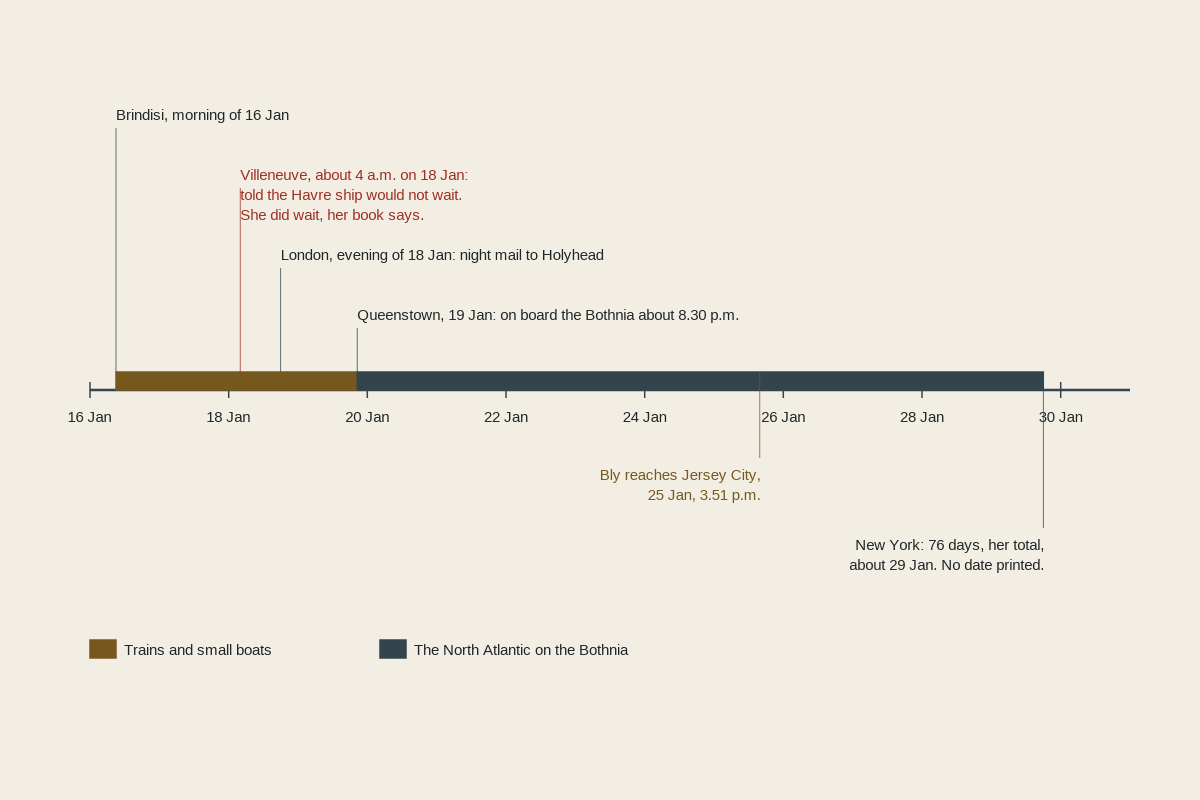
Her dates as printed. Her book gives no arrival date, so the last point sits 76 days after she left.
Keel, Rail & Spoke, CC BY 4.0
Data: Nellie Bly, Nellie Bly's Book: Around the World in Seventy-Two Days (1890), public domain, https://digital.library.upenn.edu/women/bly/world/world.html, retrieved 2026-11-07; Elizabeth Bisland, In Seven Stages (1891), public domain, https://digital.library.upenn.edu/women/bisland/stages/stages.html, retrieved 2026-11-07
Reuse this diagram: credit to copy
"Bisland's last two weeks, January 1890" by Keel, Rail & Spoke, https://keelrailandspoke.com/journeys/nellie-bly-1889/, licensed under CC BY 4.0 (https://creativecommons.org/licenses/by/4.0/).
A ship of the French line was to wait for her at Havre. At about 4 a.m. on 18 January, at Villeneuve, an agent met her train with word that the ship had refused to wait. Only in America did she learn “this is a mistake,” and that the captain had held on for several hours and then another half hour outside the bar. She writes that the cause “was never satisfactorily ascertained,” and that it “succeeded in lengthening the voyage four days.”
In London she learned her Southampton ship had been withdrawn, so she took the night mail from Euston to Holyhead and crossed to Ireland, and at Queenstown on Sunday she waited all afternoon for the Bothnia before spending two and a half hours in a tender in sleet and wind. She fell hard on the ship's deck as she came aboard, and her book calls the crossing a season of January storms “long to be remembered.”
The Ibry strip: two lines, 72 and 76 days
Time runs left to right and distance runs up, so a steep line is fast and a flat one is a wait. Each line counts straight-line distance along her own route from New York, which puts the two women on one scale even though they were going opposite ways.
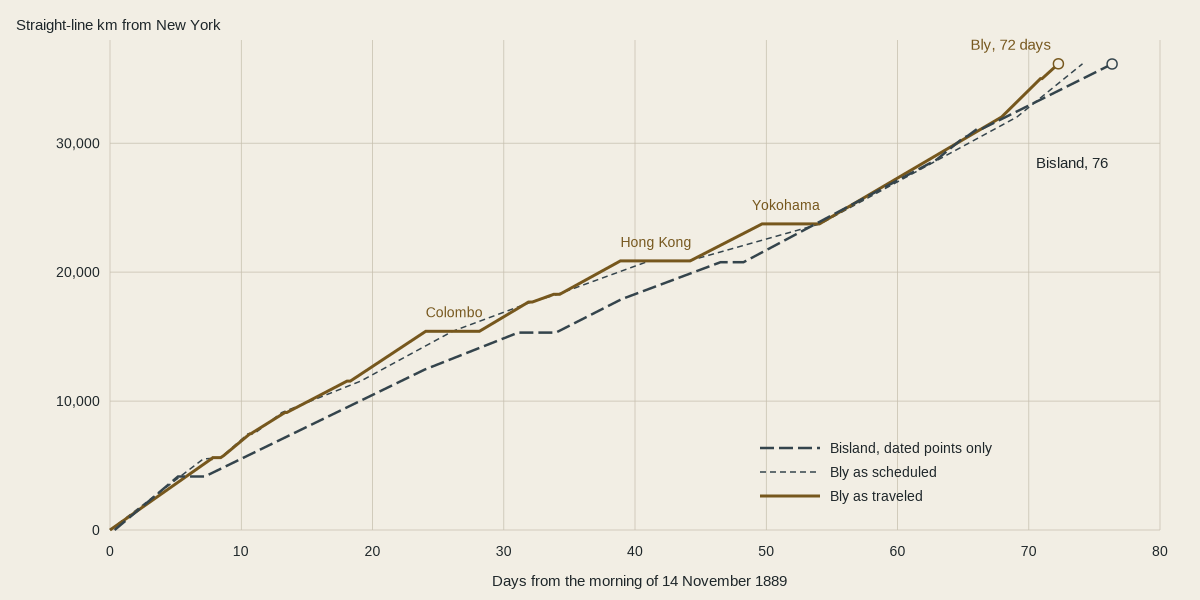
Heavy brown line: Bly as traveled, from her table. Thin dashed line: Bly's published schedule. Heavy dashed line: Bisland, joining only the points her book dates.
Keel, Rail & Spoke, CC BY 4.0
Data: Nellie Bly, Nellie Bly's Book: Around the World in Seventy-Two Days (1890), public domain, https://digital.library.upenn.edu/women/bly/world/world.html, retrieved 2026-11-07; Elizabeth Bisland, In Seven Stages (1891), public domain, https://digital.library.upenn.edu/women/bisland/stages/stages.html, retrieved 2026-11-07; Wikidata coordinates (CC0), https://www.wikidata.org/, retrieved 2026-11-08
Reuse this diagram: credit to copy
"Bly and Bisland: time-distance strip, 1889 to 1890" by Keel, Rail & Spoke, https://keelrailandspoke.com/journeys/nellie-bly-1889/, licensed under CC BY 4.0 (https://creativecommons.org/licenses/by/4.0/).
| Measure | Nellie Bly | Elizabeth Bisland |
|---|---|---|
| Left | Hoboken, 14 Nov 1889, morning, going east | New York, 14 Nov 1889, evening, going west |
| Finished | Jersey City, 25 Jan 1890, 3.51 p.m. | New York, no date printed |
| Elapsed, her figure | 72 days, 6 hours, 11 minutes | 76 days |
| Distance, her figure | 21,740 miles | “twenty-five-thousand-mile path” |
| Straight lines between stops | 36,154 km | 36,141 km |
| Walking multiple on straight lines | about 4.2 (overall) | about 4.0 (overall) |
At Bisland's dated points the two lines stay within about 3,000 km of each other through Queenstown on day 66, and hers drops back only on the Atlantic at the top right. The strip can't say more than its dated points do, and Bisland's book skips the dates at Chicago, Ogden, Penang, Aden and Port Said.
Who won?
Bly finished first. By the two books' own figures she was about four days ahead. She also beat her promised 75 days, while Bisland, with the same 75 in view, took 76.
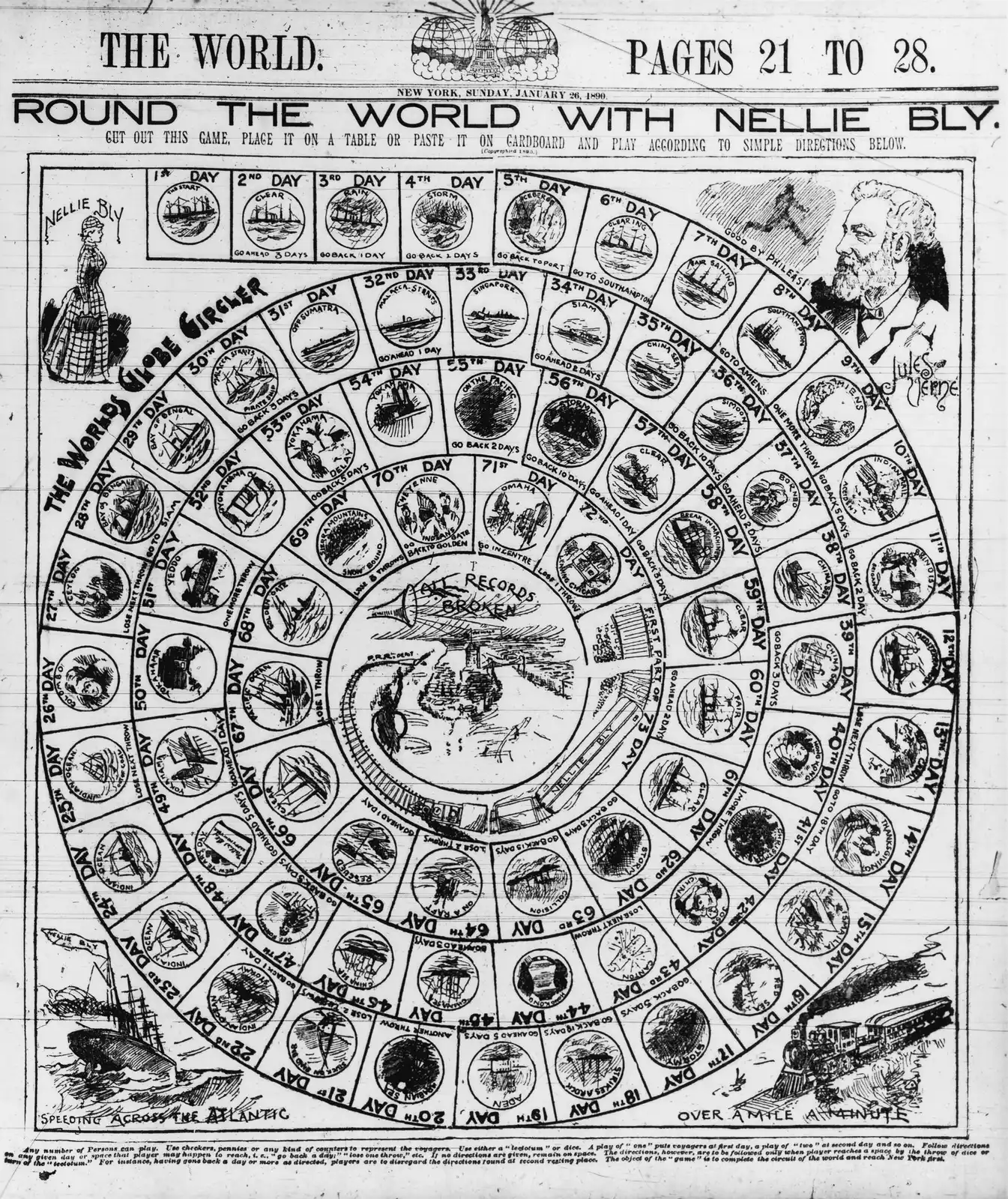
The World of 26 January 1890, printed the day after Bly finished. Small drawings on some squares, such as the 42nd and 70th days, show people along the route as the paper pictured them.
Round the world with Nellie Bly - The World's globe circler by unknown creator, Public domain
Full credit
"Round the world with Nellie Bly - The World's globe circler" by unknown creator — https://commons.wikimedia.org/wiki/File:Round_the_world_with_Nellie_Bly-The_Worlds_globe_circler_LCCN2002716792.jpg — Public domain (US: printed in The World, New York, 26 January 1890, before 1931; elsewhere: newspaper page with no creator named, published more than 70 years ago); modified: reduced to 1,600 px wide

Take four days from Bisland's 76 and you get 72, level with Bly. That is only a sum, since nobody can say what the French ship would have met in the Atlantic, and Bisland herself doesn't claim she would have won.
Bly's paper came out the next morning with the trip as a cut-out game. Its spiral of squares runs to the first part of the 73rd day, with a directions line under the board: “The object of the ‘game’ is to complete the circuit of the world and reach New York first.” That Sunday, by her own count of 76 days, Elizabeth Bisland was still on the Bothnia in the North Atlantic.
Sources
- Nellie Bly, Nellie Bly's Book: Around the World in Seventy-Two Days (New York: Pictorial Weeklies, 1890). Online edition, A Celebration of Women Writers, University of Pennsylvania. https://digital.library.upenn.edu/women/bly/world/world.htmlRead: chapters and passages, whole text also searched: chapters I, II and XVIII, the Hong Kong chapter, the Colombo, Singapore and Pacific passages and the crossing of the continent
- Elizabeth Bisland, In Seven Stages: A Flying Trip Around the World (New York: Harper & Brothers, 1891). Online edition, A Celebration of Women Writers, University of Pennsylvania. https://digital.library.upenn.edu/women/bisland/stages/stages.htmlRead: chapters and passages, whole text also searched: the first stage, every dated passage, and the last stage from Brindisi
- Elizabeth Bisland, “A Flying Trip Around the World,” The Cosmopolitan 8, no. 6 (April 1890). https://archive.org/details/sim_cosmopolitan_1890-04_8_6Read: chapter: opening pages of the article, text layer only
- Nellie Bly, Ten Days in a Mad-House; or, Nellie Bly's Experience on Blackwell's Island (New York: Norman L. Munro, entered 1887). Online edition, A Celebration of Women Writers, University of Pennsylvania. https://digital.library.upenn.edu/women/bly/madhouse/madhouse.htmlRead: chapter: title pages, introduction and opening of chapter I
- Library of Congress, “Print Resources,” Nellie Bly: A Resource Guide, Research Guides. https://guides.loc.gov/nellie-bly/print-resourcesRead: chapter: the note on her names
- Wikidata, coordinate location (P625) of the modern cities on the two routes, including New York City (Q60), Southampton (Q79848), Brindisi (Q13496), Colombo (Q35381), Hong Kong (Q8646), Yokohama (Q38283), San Francisco (Q62) and Cobh (Q733093); the full list is in the two-routes file. CC0. https://www.wikidata.org/wiki/Q60Read: full page of each of 17 items, coordinates used
Cite this page
Keel, Rail & Spoke. "Nellie Bly: Two Women Set Off Around the World the Same Day." Published 2026-11-08. https://keelrailandspoke.com/journeys/nellie-bly-1889/. Accessed on the date you read it.
How facts are checked · Corrections · Contact
Found a mistake on this page? Write to contact@keelrailandspoke.com.
More from Journeys & Expeditions
Journeys & Expeditions
Lewis and Clark Expedition: Lewis’s Iron Boat Leaked, 1805
The Lewis and Clark Expedition took 862 days. Clark put the way out at 4,134 miles, and Lewis's iron-framed boat leaked at the Great Falls in July 1805.
Picture credit
"Captain Clark and his men shooting bears" by unknown creator — https://commons.wikimedia.org/wiki/File:Captain_Clark_and_his_men_shooting_bears_LCCN2001699664.jpg — Public domain (US: published 1810, before 1931; elsewhere: creator unknown, published more than 200 years ago, every term expired); modified: cropped: printed title and page number removed
Journeys & Expeditions
Robert Falcon Scott: The Motors Gave Out Before the Ponies
Scott's two motor sledges stopped by 1 November 1911, about 50 miles out and near 78° S by reckoning. His ponies, dogs and men went on. The records, dated.
Picture credit
"The Motor Party" by Herbert Ponting — https://commons.wikimedia.org/wiki/File:The_great_white_South_BHL46249112.jpg — Public domain (US: published no later than 1923, the date on the file page, before 1931; elsewhere: Herbert Ponting died 1935, life plus 70 expired); modified: cropped: plate only, book page margins, caption and two other photographs removed
Journeys & Expeditions
Fridtjof Nansen: Had the Fram Built to Freeze In, Then Left
Nansen had the Fram built to freeze into the pack. By her printed fixes she drifted about 3.20 km a day; he left in March 1895 and turned back near 86° 14′ N.
Picture credit
"Fram i isen" by Fridtjof Nansen — https://commons.wikimedia.org/wiki/File:Fram_i_isen,_1895_(4594586561).jpg — Public domain (US: photographer died 1930; if first printed in Farthest North 1897, published before 1931; if not printed then, unpublished-work term expired; elsewhere: Fridtjof Nansen died 1930, life plus 70 expired)


