Railways · Journey file
Orient Express, 1883: The Last Leg Was a Boat From Varna
The train that left Paris for Constantinople on 4 October 1883 stopped at the Danube, and its passengers finished the trip by ferry, a second train and a steamer.
Keel, Rail & Spoke · Published
TL;DR
- The inaugural Orient Express left Paris on 4 October 1883, but by the 1884 accounts of Edmond About and Henri de Blowitz it ran only as far as Giurgevo on the Danube.
- From there passengers took a steam ferry to Rustchuk, a different train to Varna, and the Lloyd steamer Espero across the Black Sea to Constantinople.
- A winter 1888-89 poster advertises Paris to Constantinople with no change of carriages, by way of Belgrade.
Leg card
- Departure
- Paris, Gare de l'Est (About also calls it the Gare de Strasbourg); Thursday 4 October 1883, 19:30
- Arrival
- Constantinople, landing at Top-Hane; Tuesday 9 October 1883, after daybreak; hour not recorded
- Distance
- About 2,492 km (1,549 mi) as a sum of straight lines between 16 named places, leaving out the Sinaia side trip; the track and sea lane were longer
- Machine
- Compagnie Internationale des Wagons-Lits train with borrowed locomotives to Giurgevo; steam ferry; Rustchuk-Varna railway train; Lloyd steamer Espero
- Elapsed
- About 107 to 112.5 hours by local clocks if arrival fell in an assumed window of 06:30 to noon, since the hour is not recorded; includes a planned halt of about a day in Romania; the printed timetable without the halt came to 83 clock hours
- Walking multiple
- about 4.5 (overall), at the 109.75-hour midpoint of an assumed arrival window; a low figure because it uses the sum of straight lines, not the track
- Repair radius
- About 121 km by About's account, straight line Ulm to Munich, as a stand-in: he gives no exact point, so the real distance is unknown. Fault: hot axle on the restaurant car, noticed in Bavaria not far from Ulm. Repair site: Munich, by About. Blowitz says a wheel overheated and the car was left at Augsburg
- The last spare
- Not applicable: the journey was completed and no source read ties it to a supply running out
- Key source
- Edmond About, De Pontoise a Stamboul (1884); Henri de Blowitz, Une course a Constantinople (1884)
Download this card (CSV) · Where this data came from
Data: Edmond About, De Pontoise a Stamboul (1884), https://www.gutenberg.org/ebooks/69794; Henri de Blowitz, Une course a Constantinople (1884), https://archive.org/details/unecourseconst00blowuoft; Wikidata coordinates (CC0), https://www.wikidata.org/, retrieved 2026-11-08
What the card means: walking multiple, repair radius, last spare.
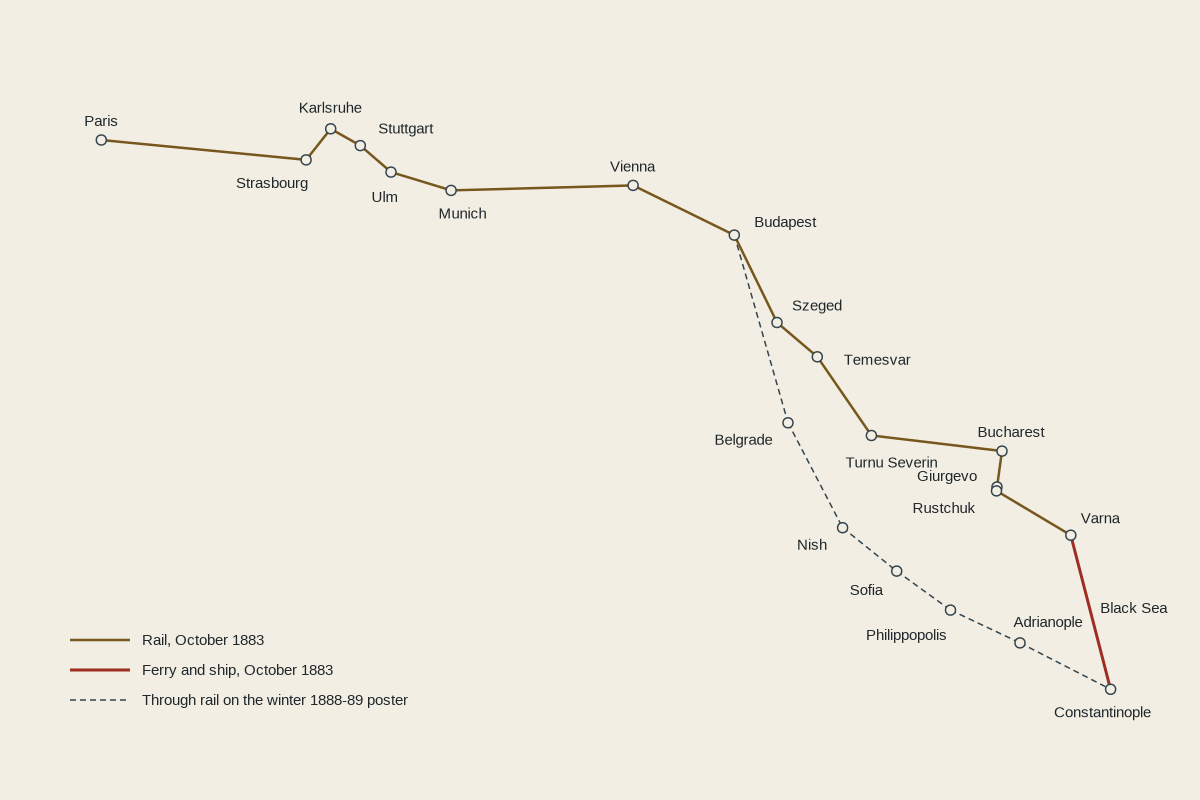
The October 1883 route, with the through line of the winter 1888-89 poster dashed. Places are plotted from their coordinates and joined by straight lines, so the real track and sea lane were longer. No coastline is drawn.
Keel, Rail & Spoke, CC BY 4.0
Data: Edmond About, De Pontoise a Stamboul (1884), https://www.gutenberg.org/ebooks/69794; Henri de Blowitz, Une course a Constantinople (1884), https://archive.org/details/unecourseconst00blowuoft; Orient Express poster, winter 1888-89, https://commons.wikimedia.org/wiki/File:Aff_ciwl_orient_express4_jw.jpg; Handbook for Travellers in Constantinople (Murray, 1900), https://archive.org/details/handbookfortrave00murr_2; Wikidata coordinates (CC0), https://www.wikidata.org/, retrieved 2026-11-08

Reuse this diagram: credit to copy
"Orient Express route, October 1883 and winter 1888-89" by Keel, Rail & Spoke, https://keelrailandspoke.com/railways/orient-express-1883/, licensed under CC BY 4.0 (https://creativecommons.org/licenses/by/4.0/).
Data behind this diagram: orient-express-1883-route-legs.csv · Where this data came from
The Orient Express stopped at Giurgevo on the Danube, about 404 km short of Constantinople in a straight line. Edmond About and Henri de Blowitz were both aboard when it left Paris on 4 October 1883, and both published their accounts in 1884. About says the train connected with “le bateau de Varna”, the Varna boat (translated by Keel, Rail & Spoke). The rails ran out before the trip did.
Readers looking for Agatha Christie's novel Murder on the Orient Express want a different page: this one covers the real train and has no plot. Today's trains that use the name are also outside this account, which stops at 1900.
Stops on this page (6)
What was the first Orient Express?
The train of 4 October 1883 was an inaugural run for invited guests: the Compagnie Internationale des Wagons-Lits, the sleeping-car company run by Georges Nagelmackers, asked about 40 officials, engineers and journalists along to inaugurate its new cars. Blowitz, the correspondent of the Times, calls it the “premier train de l’organisation définitive”, the first train of the final arrangement (translated by Keel, Rail & Spoke).
That wording matters for the word “first”. About mentions an ordinary train that left Paris the next evening and made the same connection with the Varna boat, so the gala train was not the only service on the line. In this account, “first run” means this inaugural train, as the two passengers describe it, and the sources read here do not say what ran before it.
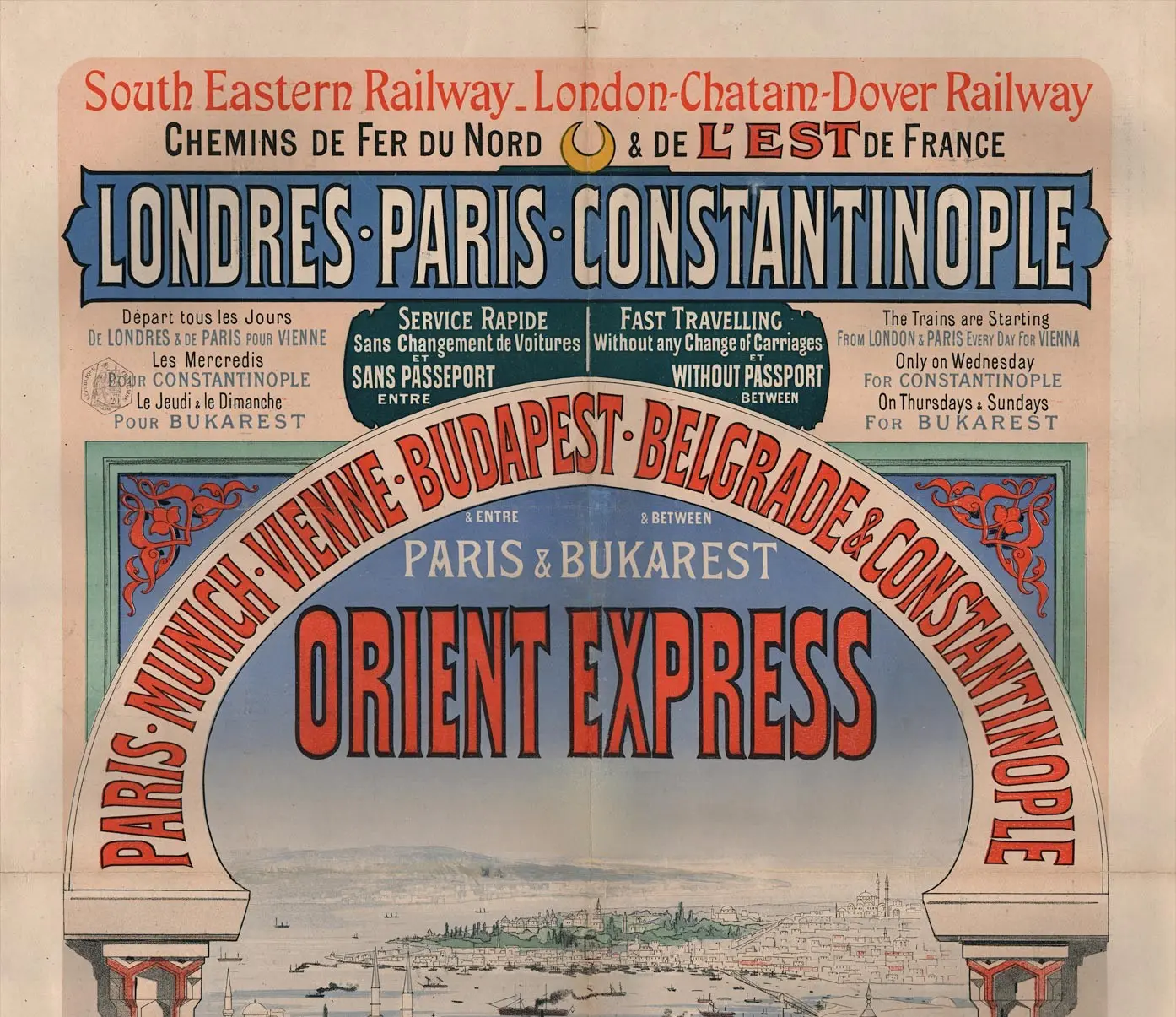
The top half of the company's poster for winter 1888-89, cropped. Its arch names Belgrade, a route the train of 1883 did not take.
Londres-Paris-Constantinople, Orient Express, poster, winter 1888-89 (top half) by Jules Chéret or Imp. Chaix (Succ. Chéret), Public domain
Full credit
"Londres-Paris-Constantinople, Orient Express, poster, winter 1888-89 (top half)" by Jules Chéret or Imp. Chaix (Succ. Chéret) — https://commons.wikimedia.org/wiki/File:Aff_ciwl_orient_express4_jw.jpg — Public domain (US: published 1888, before 1931; elsewhere: the file page credits Jules Chéret (died 1932) and the sheet is signed Imp. Chaix (Succ. Chéret); term expired on either reading); modified: cropped: top half of the sheet, above the route map and timetable
Blowitz counts two sleeping cars, two baggage and provision vans, one restaurant car, the engine and its tender, 75 meters in all. About gives each of the three new cars a length of 17.5 meters, built of teak and glass, heated by steam and lit by gas. By Blowitz's count, each sleeping car had 20 beds.
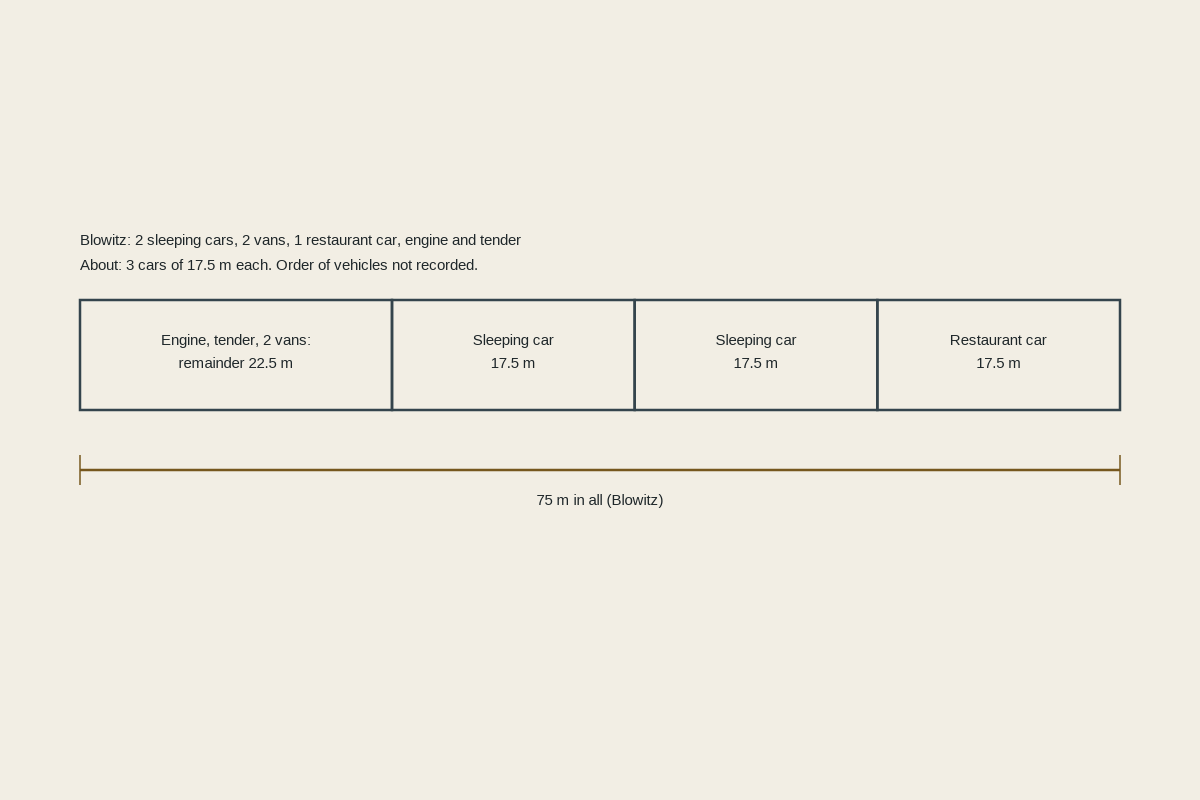
The train as the two writers describe it. Neither records the order of the vehicles, so the order here is only for layout. The 22.5 m is what is left of Blowitz's total after About's three cars; neither writer gives it.
Keel, Rail & Spoke, CC BY 4.0
Data: Edmond About, De Pontoise a Stamboul (1884), https://www.gutenberg.org/ebooks/69794; Henri de Blowitz, Une course a Constantinople (1884), https://archive.org/details/unecourseconst00blowuoft
Reuse this diagram: credit to copy
"The Orient Express train of 4 October 1883" by Keel, Rail & Spoke, https://keelrailandspoke.com/railways/orient-express-1883/, licensed under CC BY 4.0 (https://creativecommons.org/licenses/by/4.0/).
The company owned the cars and not the engines. About explains that it borrowed the traction of different railway companies for a single trip. Neither writer names the locomotives. How those engines worked is the subject of Steam Locomotive, and two early machines in their line are the First Steam Locomotive and Stephenson's Rocket.
Both writers mention speed while praising the smooth ride: About reports moments of 90 km/h while Blowitz writes of 80 km/h, which is 18 and 16 times a 5 km/h walk. Those figures are momentary. Over the whole trip the walking multiple (a speed divided by a 5 km/h walk) comes out far lower.
Paris to Bucharest in about 56 hours
Dinner was due a quarter of an hour after the train left the Gare de l'Est, and About was surprised to see stemmed glasses set out on a moving table without anything to hold them down, though nothing spilled. That night's service ran so slowly that he did not reach his bed until close to midnight, and by the time he woke the train was rolling through Baden toward Karlsruhe in full daylight. A few of the engineers had stepped off at Strasbourg during the night to look at the new station and its electric lamps.
The second day ran through Württemberg and Bavaria to Vienna, where midnight was sounding as the train came in. Four of the French guests left there for the electrical exhibition, and an Austrian railway official named Von Scala came aboard with his wife and sister-in-law. Blowitz has the train at Budapest toward six the next morning, which is close to the 6:09 in his timetable.
Saturday crossed the Hungarian plain, and somewhere past Budapest a band climbed aboard at a station stop and played in the restaurant car while the younger guests pushed the tables aside to dance. About says the party lasted until Szeged. Blowitz has the musicians getting off at Temesvar after two and a half hours, so the two accounts differ by a stop.
Toward evening the line climbed into the Carpathians, where About saw a gang of laborers shoring up a slope, because a train had come off the track there the week before. Night caught the train at Herculesbad, and Blowitz logged the frontier station of Verciorova at 6:30 by Bucharest time.
The hot axle before Munich
The one mechanical fault either writer records on the way out came on the second day. In Bavaria, not far from Ulm by About's account, the engineers aboard smelled burning grease, and the axle of the new restaurant car turned out to be running hot. A repair was needed, About writes, and it could not be done on the road.
The stationmaster at Munich had the car uncoupled just as the coffee arrived, by About's account, and a second, older restaurant car took its place, with the cook and staff aboard in under five minutes. Accounts differ on the details. Blowitz writes that a wheel overheated, that the car was left at Augsburg, and that its replacement came that afternoon. Both agree the fault was minor.
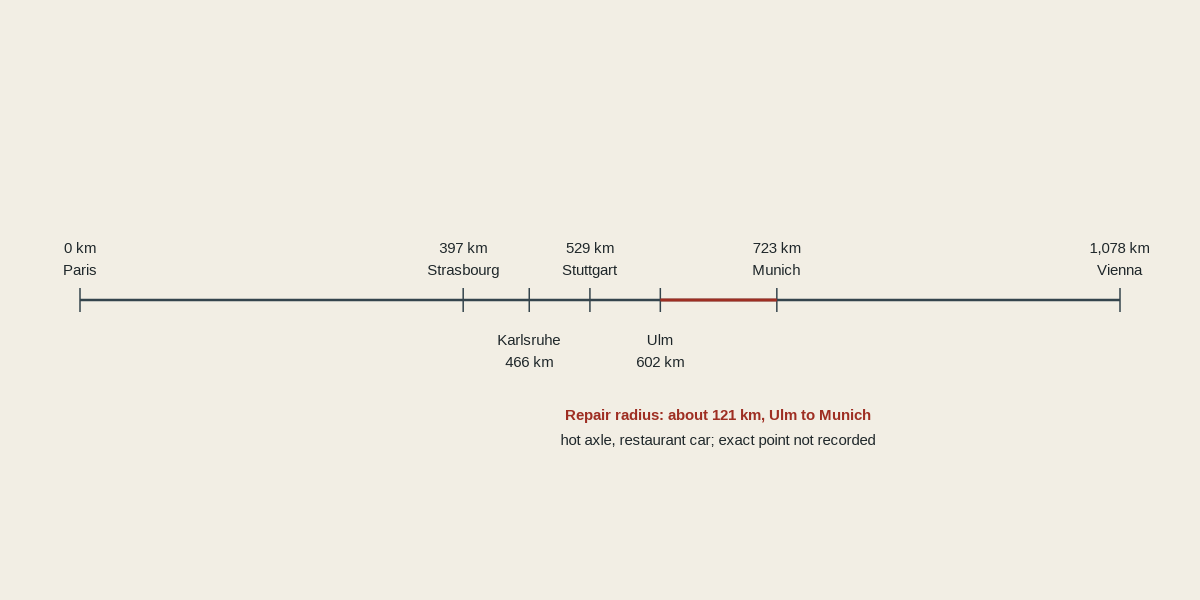
Straight-line distances from Paris. About places the fault not far from Ulm without giving a point, so the marked stretch to Munich, where he says the car was repaired, stands in for a distance nobody recorded.
Keel, Rail & Spoke, CC BY 4.0
Data: Edmond About, De Pontoise a Stamboul (1884), https://www.gutenberg.org/ebooks/69794; Wikidata coordinates (CC0), https://www.wikidata.org/, retrieved 2026-11-08
Reuse this diagram: credit to copy
"Hot axle near Ulm, repaired at Munich, 5 October 1883" by Keel, Rail & Spoke, https://keelrailandspoke.com/railways/orient-express-1883/, licensed under CC BY 4.0 (https://creativecommons.org/licenses/by/4.0/).
The repair radius is this site's measure of the distance from a fault to the nearest place on record that could fix it. Here that is about 121 km by About's account, the straight line from Ulm to his repair site at Munich. It is a stand-in, because he gives no exact point for the fault. Neither writer reports any delay to the train from the swap.
Why did the run take about a day longer than the timetable?
Blowitz prints the timetable he says he traveled on: Paris on Thursday at 7:30, Vienna on Friday at 11:15, Budapest on Saturday at 6:09, Bucharest on Sunday at 4:45, Giurgevo at 6:00, Varna at 4:30 and Constantinople on Monday at 6:30 in the morning. He writes most of these hours without a.m. or p.m., so the table further down reads them by context.
He gives the total as 82 hours. The clock faces give 83. Blowitz later notes that Constantinople ran an hour and three quarters ahead of Paris, which may help explain the difference.
The inaugural train stayed close to that schedule as far as Bucharest, arriving at 4:00 on Sunday 7 October by Blowitz's account. About says it was not yet five.
Then the program called for a stop of 24 hours. The stated reason was to wait for the ordinary train, and by About's account the company filled the day with a run to Sinaia, on the day of the opening of the Romanian king's new palace. Blowitz says the train was due to leave for the mountains at about 8:30 and has the party boarding at 9:30. It was back in Bucharest at about 10:00 that night.
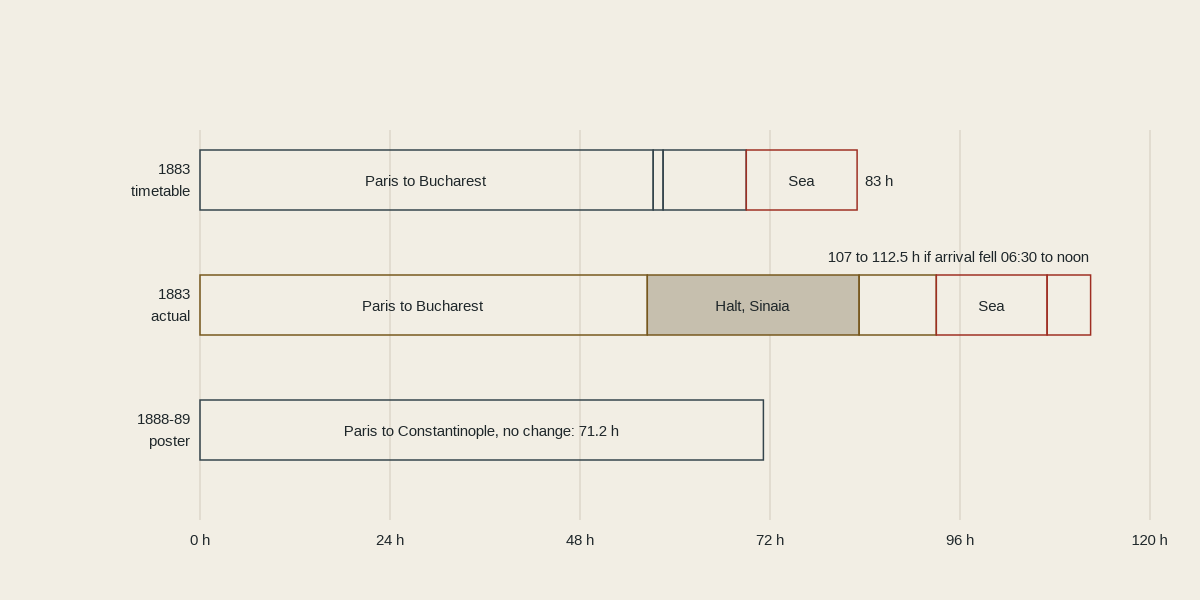
Clock hours after leaving Paris, not corrected for time zones. The shaded box runs from reaching Bucharest to reaching Giurgevo. The unmarked boxes on the first two bars are the other rail and ferry stages before Varna. The last box on the actual bar is an assumed range, 6:30 to noon, for the unrecorded arrival hour.
Keel, Rail & Spoke, CC BY 4.0
Data: Edmond About, De Pontoise a Stamboul (1884), https://www.gutenberg.org/ebooks/69794; Henri de Blowitz, Une course a Constantinople (1884), https://archive.org/details/unecourseconst00blowuoft; Orient Express poster, winter 1888-89, https://commons.wikimedia.org/wiki/File:Aff_ciwl_orient_express4_jw.jpg
Reuse this diagram: credit to copy
"Clock hours from Paris to Constantinople" by Keel, Rail & Spoke, https://keelrailandspoke.com/railways/orient-express-1883/, licensed under CC BY 4.0 (https://creativecommons.org/licenses/by/4.0/).
Neither writer gives the hour of arrival at Constantinople. About woke to daylight at the mouth of the Bosphorus on Tuesday 9 October, and after landing and an hour of washing he sat down to lunch at the hotel. If the arrival fell between the timetable's 6:30 and noon, an assumed window, the trip took 107 to 112.5 clock hours. The gap over the timetable is about one day, which is the halt.
Using a straight-line distance of about 2,492 km, which leaves out Sinaia, the Leg card gives a walking multiple of about 4.5 (overall). That figure includes the halt and uses the midpoint of the assumed arrival range. Correcting for the 1 hour 45 minutes of clock difference moves it to about 4.6. The printed timetable, on the same distance and the same clock basis, works out to about 6.0.
Whose clock?
Every hour on this page is a local reading, and that was already a problem in 1883. About counts the time standards as they went by: German time, Stuttgart time and Munich time, then Prague time at the Austrian frontier at Simbach, while the Austrian monarchy kept a second standard at Pest. He gave up resetting his watch after Strasbourg. The clock in the restaurant car solved the matter in its own way, he jokes, by leaving its key in Paris.
The last spare entry on the Leg card is “not applicable”: the journey was completed, and nothing read ties it to a shortage.
Where did the rails stop?
Blowitz calls Giurgevo the “station terminus”, the end of the line (translated by Keel, Rail & Spoke). He found a deserted plain and a few wooden sheds on the bank of the Danube. About's train stopped there at 6:45 on Monday 8 October, and 20 porters took the bags. The river had to be crossed by ferry, and Blowitz wondered why the Congress of Berlin had not made the European states pay for a bridge.
The rest of the trip took five more vehicles while the Wagons-Lits cars stayed behind on the Romanian bank, which is why About felt, stepping down into the mud of the riverbank, that he was no longer at home.

The handoffs of 8 and 9 October 1883, from About's account. Water stages are outlined in red.
Keel, Rail & Spoke, CC BY 4.0
Data: Edmond About, De Pontoise a Stamboul (1884), https://www.gutenberg.org/ebooks/69794; Henri de Blowitz, Une course a Constantinople (1884), https://archive.org/details/unecourseconst00blowuoft
Reuse this diagram: credit to copy
"From Giurgevo to Constantinople, 8 and 9 October 1883" by Keel, Rail & Spoke, https://keelrailandspoke.com/railways/orient-express-1883/, licensed under CC BY 4.0 (https://creativecommons.org/licenses/by/4.0/).
| Stage | Vehicle | Time on record | Source |
|---|---|---|---|
| Giurgevo to Rustchuk | Small steam ferry | Under 30 minutes, reaching the station by 08:00 | About |
| Wait at Rustchuk | None | Arrived 08:00; boarding due 09:30, departure not recorded | About |
| Rustchuk to Varna | Train of the Bulgarian line | Seven hours | About, Blowitz |
| Varna shore to steamer | Five or six rowing boats | Not given | About |
| Varna to the Bosphorus | Lloyd steamer Espero | About 14 hours | About |
| Bosphorus to Top-Hane | Espero, then a Lloyd launch | After daybreak; hour not given | About |
On the Rustchuk to Varna line, the sources need to sit side by side. Blowitz says it runs more than 300 km. Murray's 1900 handbook gives 140 miles, about 225 km, and the straight line between the two towns is about 173 km. About adds that the builder, paid by the kilometer, skirted the towns and passed about 25 km from Shumla without turning aside.
The line was a rough place to work in 1883, on About's evidence. Only two trains passed in 24 hours, and no fence kept cattle off the track, so the engine carried an iron guard strong enough to sweep a bullock aside. He reports that two stations had been robbed in the previous two weeks and that 15 rails had been stolen and built into a house at Varna. The guests ate lunch at the station of Scheytandjik at 1:15, and the inspector of the line, a Frenchman named De Gisors, warned them at the halfway point that the Black Sea would be rough.
Measured on the map and leaving out the Sinaia side trip, the journey was still mostly rail. About 89 percent of the straight-line distance was covered by train and about 11 percent by water, and almost all of that water was one crossing of about 260 km.
The last leg: rowing boats and the Espero
Varna had no real harbor. About calls its anchorage the most inhospitable port in Europe and notes that a passenger cannot embark there every day, and Blowitz, on the way home, calls the transfer by boat primitive. The sea was passable that evening. Five or six heavy boats, rowed by Greek crews, carried the party and the luggage over the swell to the Espero, moored well offshore.
Blowitz, a poor sailor by his own account, was sorry to see the waves. About noticed something else: the steamer was packed with Turkish peasants who had left Bulgaria with their families, and he describes women and children crowded below deck for the 14 hours, worse housed in his view than the sheep in the cargo hold. The guests from Paris went down to dinner in a low room lit by oil lamps, and many of them soon left the table.
Stand at the rail of the Espero the next morning, as About did, and the trip looks like a sea voyage. He was woken with the news that it was daylight and they were in the Bosphorus, which the Ottoman authorities closed to shipping from dusk until sunrise. The steamer stopped off the city, a Lloyd launch took the baggage, and the party landed at the gate of Top-Hane, the imperial gun foundry, and carriages then took them up to the Grand Hotel in Pera.
When could the train reach Constantinople by rail?
Murray's handbook of 1900 dates “the opening of direct railway communication with Western Europe” to 1888. It does not say when the Orient Express itself first ran through. Neither do the other sources read for this page. Baedeker's 1891 handbook still describes the older connection by Smarda, Rustchuk and Varna.
A poster gives a dated offer of the through service. Headed winter 1888-89, it advertises Paris to Constantinople “Without any Change of Carriages”, leaving on Wednesday at 7:30 p.m. and reaching Belgrade on Friday at 12:32 p.m. and Constantinople on Saturday at 6:40 p.m. That is 71.2 clock hours, and it is an advertisement rather than a record of a run.
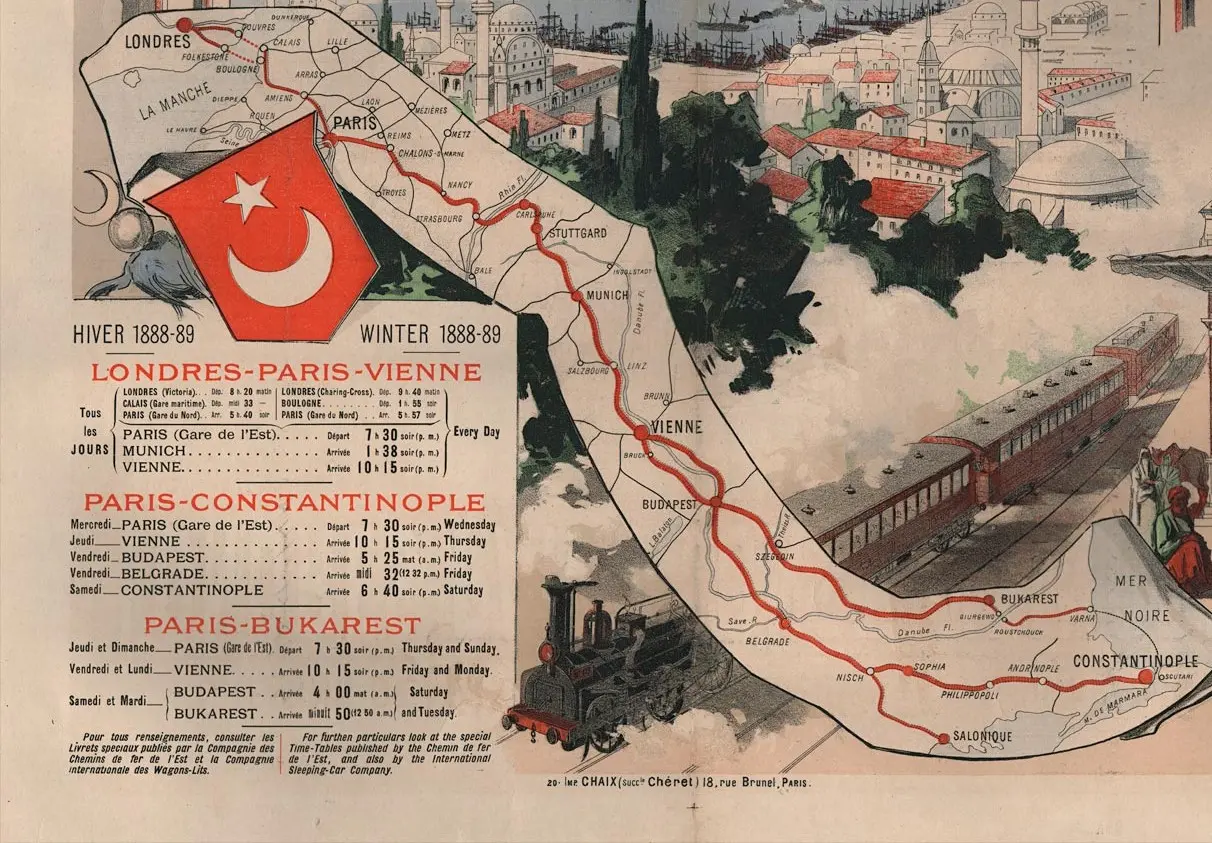
The lower part of the same poster for winter 1888-89, cropped. The timetable at left gives the Paris to Constantinople times, and the map shows the line through Belgrade, Nish and Sofia.
Londres-Paris-Constantinople, Orient Express, poster, winter 1888-89 (lower part) by Jules Chéret or Imp. Chaix (Succ. Chéret), Public domain
Full credit
"Londres-Paris-Constantinople, Orient Express, poster, winter 1888-89 (lower part)" by Jules Chéret or Imp. Chaix (Succ. Chéret) — https://commons.wikimedia.org/wiki/File:Aff_ciwl_orient_express4_jw.jpg — Public domain (US: published 1888, before 1931; elsewhere: the file page credits Jules Chéret (died 1932) and the sheet is signed Imp. Chaix (Succ. Chéret); term expired on either reading); modified: cropped: lower part of the sheet with the timetable and route map; right edge trimmed
The saving is plainest from London. Blowitz gives 92 hours for London to Constantinople in 1883, and Murray gives 75 hours in 1900. The old route had not vanished. Murray still lists Giurgevo, Rustchuk and Varna, but says the route has lost its importance and is often closed from December to February, when ice stops traffic on the Danube.
The Ibry strip: 1883 against 1888-89
An Ibry strip plots time across and distance up, so a steeper line means more ground covered per hour. This one puts the printed 1883 timetable, the run of October 1883 and the winter 1888-89 poster on the same axes. Its distances are straight lines and its clocks are uncorrected, so the slopes show progress along the route and not the speed of any machine. The flat stretch at Bucharest is the halt, with the Sinaia trip left out of the distance.
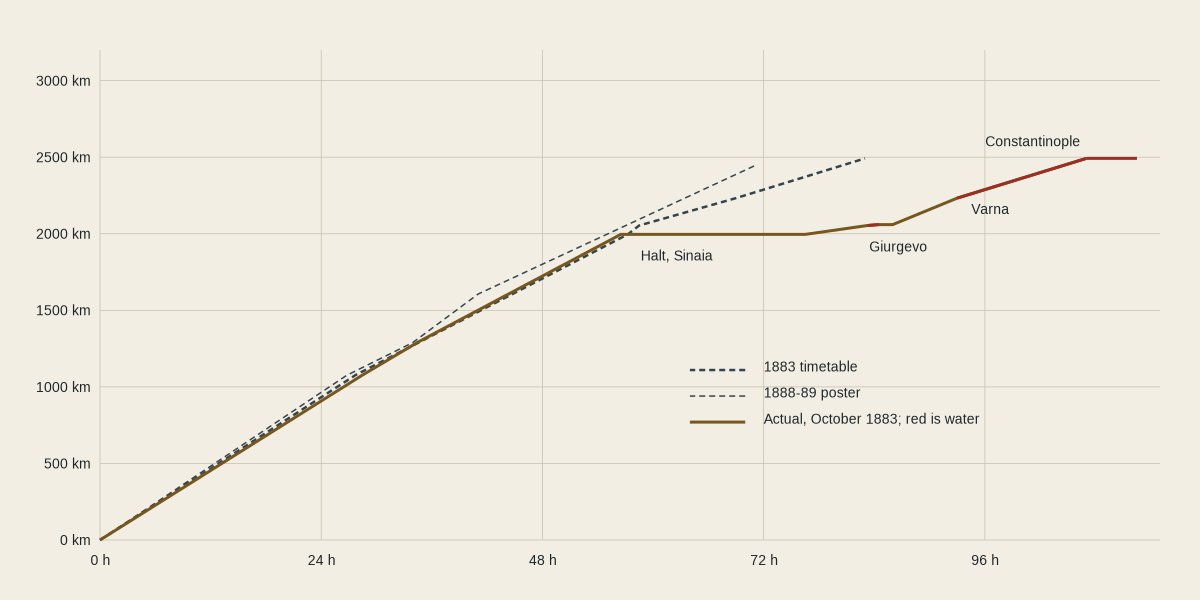
Hours after leaving Paris against straight-line distance. The poster's line has its own distances by way of Belgrade, about 2,449 km. Local clocks are not corrected for time zones, the Bucharest departure is plotted at midnight because the hour is not recorded, and the flat red end of the line is an assumed range for the arrival hour.
Keel, Rail & Spoke, CC BY 4.0
Data: Edmond About, De Pontoise a Stamboul (1884), https://www.gutenberg.org/ebooks/69794; Henri de Blowitz, Une course a Constantinople (1884), https://archive.org/details/unecourseconst00blowuoft; Orient Express poster, winter 1888-89, https://commons.wikimedia.org/wiki/File:Aff_ciwl_orient_express4_jw.jpg; Wikidata coordinates (CC0), https://www.wikidata.org/, retrieved 2026-11-08
Reuse this diagram: credit to copy
"Orient Express time-distance strip, 1883 and 1888-89" by Keel, Rail & Spoke, https://keelrailandspoke.com/railways/orient-express-1883/, licensed under CC BY 4.0 (https://creativecommons.org/licenses/by/4.0/).
Data behind this diagram: orient-express-1883-timepoints.csv · Where this data came from
| Place | 1883 timetable | October 1883 run | Winter 1888-89 poster |
|---|---|---|---|
| Paris | Thu 19:30 | Thu 4 Oct 19:30 | Wed 19:30 |
| Vienna | Fri 23:15 | Fri 5 Oct, about midnight | Thu 22:15 |
| Budapest | Sat 06:09 | Sat 6 Oct, about 06:00 | Fri 05:25 |
| Belgrade | Not on the route | Not on the route | Fri 12:32 |
| Bucharest | Sun 04:45 | Sun 7 Oct 04:00 | Not on the Constantinople table |
| Giurgevo | Sun 06:00 | Mon 8 Oct 06:45 | Not on the route |
| Varna | Sun 16:30 | Mon 8 Oct, about 16:30 if the train left as due | Not on the route |
| Constantinople | Mon 06:30 | Tue 9 Oct, after daybreak; hour not recorded | Sat 18:40 |
The return ran the same way in reverse. The Espero left on Saturday 13 October at 2:00 in the afternoon, and at about 3:00 the next morning her captain put the passengers ashore at Varna in the dark, before the wind rose. At Giurgevo, About found the restaurant car from Munich waiting, repaired. It rolled to Paris without heating again, and the train came in at 6:00 p.m. on Tuesday.
Sources
- Edmond About, De Pontoise à Stamboul (Paris: Hachette, 1884). Public domain; About died in 1885. https://www.gutenberg.org/ebooks/69794Read: chapters I to V, the start of chapter VII and the return trip of the title essay, in the original French
- Henri Opper de Blowitz, Une course à Constantinople (Paris: E. Plon, Nourrit, 1884). Public domain; Blowitz died in 1903. https://archive.org/details/unecourseconst00blowuoftRead: chapters on the outward trip and the return, in part, not the whole book, in the original French
- Compagnie Internationale des Wagons-Lits and partner railways, Londres-Paris-Constantinople, Orient Express, poster, winter 1888-89 (Paris: Imp. Chaix, Succ. Chéret). https://commons.wikimedia.org/wiki/File:Aff_ciwl_orient_express4_jw.jpgRead: full page, the whole poster sheet
- Handbook for Travellers in Constantinople, Brûsa, and the Troad (London: John Murray, 1900). https://archive.org/details/handbookfortrave00murr_2Read: sections on routes, railways and history
- Karl Baedeker, Southern Germany and Austria, including Hungary, Dalmatia and Bosnia (Leipsic: K. Baedeker, 1891), route from Bucharest to Giurgevo and Smarda. https://archive.org/details/southerngermanya00karlRead: chapter on Romania, route entry only
- Wikidata. Coordinate statements (P625) for Paris (Q90), Strasbourg (Q6602), Karlsruhe (Q1040), Stuttgart (Q1022), Ulm (Q3012), Munich (Q1726), Vienna (Q1741), Budapest (Q1781), Szeged (Q81581), Timișoara (Q83404), Drobeta-Turnu Severin (Q193890), Bucharest (Q19660), Giurgiu (Q202351), Ruse (Q160173), Varna (Q6506), Istanbul (Q406), Belgrade (Q3711), Niš (Q129259), Sofia (Q472), Plovdiv (Q459), Edirne (Q43387). https://www.wikidata.org/wiki/Special:EntityData/Q90.jsonRead: entity data, coordinates only
Cite this page
Keel, Rail & Spoke. "Orient Express, 1883: The Last Leg Was a Boat From Varna." Published 2026-11-08. https://keelrailandspoke.com/railways/orient-express-1883/. Accessed on the date you read it.
How facts are checked · Corrections · Contact
Found a mistake on this page? Write to contact@keelrailandspoke.com.
More from Railways
Railways
How a Steam Locomotive Works: Its Exhaust Drives the Draft
A steam locomotive burns fuel such as coal to boil water, and steam pressure pushes pistons that turn its wheels. Used steam then pulls air through the fire.
Picture credit
"Amerikaanse stoomlocomotief, RP-F-2001-7-998-11 (cropped)" by unknown creator — https://commons.wikimedia.org/wiki/File:Amerikaanse_stoomlocomotief,_RP-F-2001-7-998-11_(cropped).jpg — CC0 1.0 (https://creativecommons.org/publicdomain/zero/1.0/); modified: cropped: the crop published on Wikimedia Commons, cut from the album page; no further change here
Railways
First Known Steam Locomotive Run: 1804, Slower Than a Walk
Richard Trevithick's 1804 letter gives his tram engine above nine miles in 4 hours 5 minutes. With stops, the 9 to 9¾ miles on record average below a walk.
Picture credit
"Newcastle Locomotive, drawing dated 1804" by Richard Trevithick (as credited on the file page) — https://commons.wikimedia.org/wiki/File:WP_Trevithick_-_Newcastle_Locomotive.jpg — Public domain (US: drawing dated 1804, creator died 1833; the 1934 book printing named on the file page is a faithful copy; earlier publication not traced, not traced back; elsewhere: creator died 1833, life plus 70 expired)
Railways
Stephenson’s Rocket, 1829: Booth Claimed the Tube Boiler
Stephenson’s Rocket won the Rainhill trials in October 1829. Henry Booth claimed its many-tube boiler in 1830; the steam blast has rival claimants too.
Picture credit
"George Stephenson's Locomotive, the "Rocket" (cropped)" by unknown creator — https://commons.wikimedia.org/wiki/File:George_Stephenson%27s_Locomotive,_the_%22Rocket%22_-_DPLA_-_eecacab18bb21c2739be253c7d20c0be.jpg — Public domain (US: published in London in 1888 per the sleeve note and the file page, before 1931; elsewhere: engraver unnamed; a working engraver of 1888 would have to have died after 1955 for the life+70 term to still run); modified: cropped: engraving only, archive sleeve and printed caption removed


