Railways · Machine file
Stephenson’s Rocket, 1829: Booth Claimed the Tube Boiler
The railway’s own treasurer put his claim to Rocket’s boiler in print in 1830, and the machine’s other famous part has rival claimants of its own.
Keel, Rail & Spoke · Published
TL;DR
- Stephenson’s Rocket, built by Robert Stephenson and Co., was awarded the £500 prize at the Rainhill trials on the Liverpool and Manchester Railway in October 1829.
- Henry Booth, the railway’s treasurer, claimed its many-tube boiler in 1830 and in an undated letter to Samuel Smiles; earlier tube boilers existed.
- Smiles credits George Stephenson with the steam blast and G. A. Sekon credits Timothy Hackworth. Rainhill speeds vary by source: about 11 mph with stops from Booth’s times, 13.42 mph on average over Sekon’s first twenty trips.
Machine file
- Machine
- Rocket, built by Robert Stephenson and Co., Newcastle, for the Rainhill trials
- First built
- 1829
- Converts
- Coke heat to steam pressure, pressure to piston thrust, thrust to wheel turn
- Working speed
- 13.42 mph (21.6 km/h), average of the first twenty trips with 12 3/4 tons of load and tender, as printed by Sekon, who does not say how the trips were timed; used here as a reading, not a settled result; other sources give other figures, listed on this page
- Walking multiple
- about 4.3 (working): 13.42 mph divided by a 5 km/h walk
- Key patent or drawing
- Engine plate in Booth, An Account of the Liverpool and Manchester Railway, 1830; no patent for Rocket was read
Download this card (CSV) · Where this data came from
Data: Booth 1830, https://archive.org/details/accountofliverpo00boot, retrieved 2026-11-08; Smiles 1868, https://www.gutenberg.org/ebooks/46229, retrieved 2026-11-08; Sekon 1899, https://www.gutenberg.org/ebooks/73518, retrieved 2026-11-08
What the card means: walking multiple.
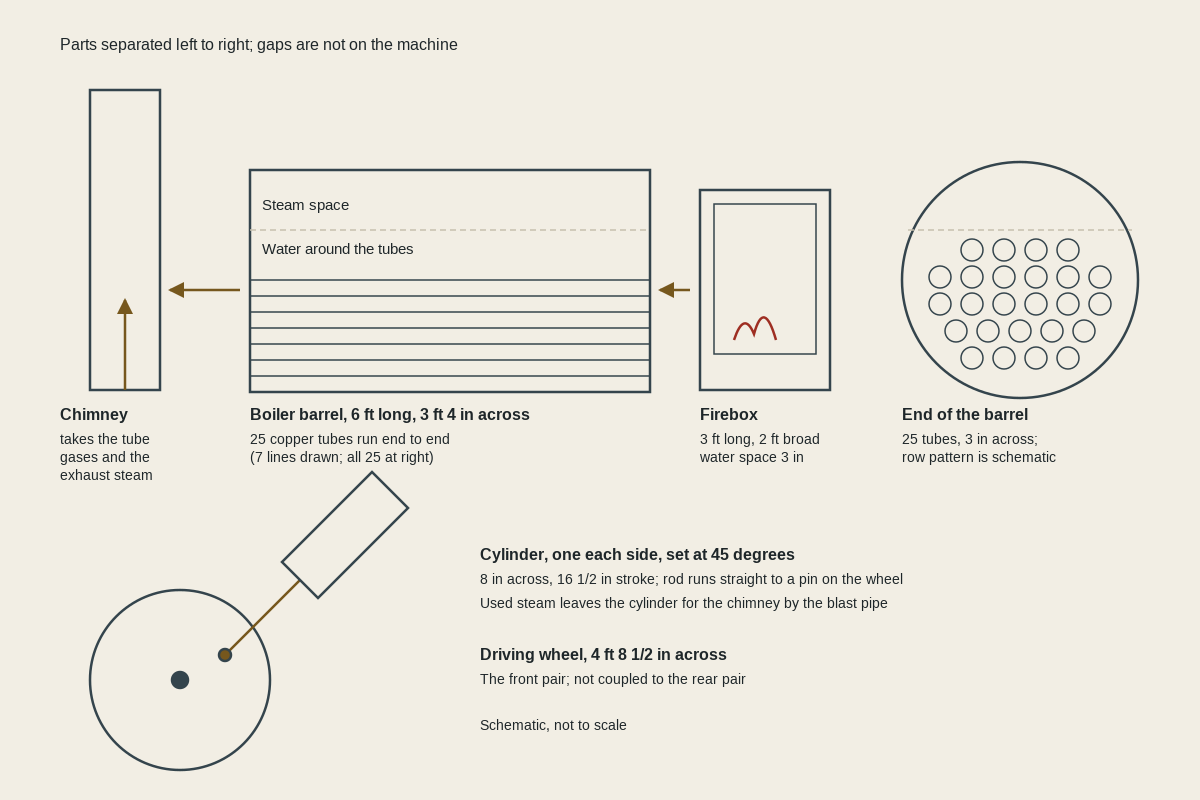
Rocket taken apart along its gas path. Hot gases leave the firebox, run through 25 copper tubes in the barrel and enter the chimney, where the used steam joins them. Sizes come from Smiles and Sekon; the drawing is a schematic, not to scale.
Keel, Rail & Spoke, CC BY 4.0
Data: Booth 1830, https://archive.org/details/accountofliverpo00boot, retrieved 2026-11-08; Smiles 1868, https://www.gutenberg.org/ebooks/46229, retrieved 2026-11-08; Sekon 1899, https://www.gutenberg.org/ebooks/73518, retrieved 2026-11-08
Reuse this diagram: credit to copy
"Rocket's boiler, parts separated" by Keel, Rail & Spoke, https://keelrailandspoke.com/railways/stephensons-rocket-1829/, licensed under CC BY 4.0 (https://creativecommons.org/licenses/by/4.0/).
Data behind this diagram: stephensons-rocket-1829-specs.csv · Where this data came from
Rocket ran a 1¾-mile level at Rainhill 40 times on 8 October 1829, drawing about 13 tons. The earliest account read for this page is by Henry Booth, treasurer of the Liverpool and Manchester Railway, in a book dated June 1830. He says the engine was built by Robert Stephenson and Co., “with a boiler of a new construction, suggested by the writer of this account.” The usual name for the machine leaves him out.
Stops on this page (7)
What did the Rainhill trials ask of Rocket?
The railway’s directors resolved on 20 April 1829 to offer £500 for the “most improved Locomotive Engine.” Their conditions, printed by Booth, asked a six-ton engine to draw 20 tons at 10 miles an hour, which is 16.1 km/h or about 3.2 times a 5 km/h walk, on steam of no more than 50 pounds per square inch. An engine of four and a half tons or less could run on four wheels, and Rocket weighed 4 tons 5 cwt, or 4¼ tons, with water in the boiler. The judges were Mr. Rastrick of Stourbridge, Nicholas Wood and John Kennedy.
The test distance was 70 miles, and Booth says “the circumstances of the Railway” forced it onto one short stretch. The engine went back and forth over a level plane of 1¾ miles, 40 passes with 40 stops, regaining its speed each time.
Sekon, writing in 1899, gives a 1½-mile course with ⅛ mile at each end for getting up speed and stopping, and his 40 runs make 60 miles on the course. Smiles rounds the ground to about two miles and counts 20 trips, there and back, for 70 miles. Once the run-ups are added, the three counts fit one another.
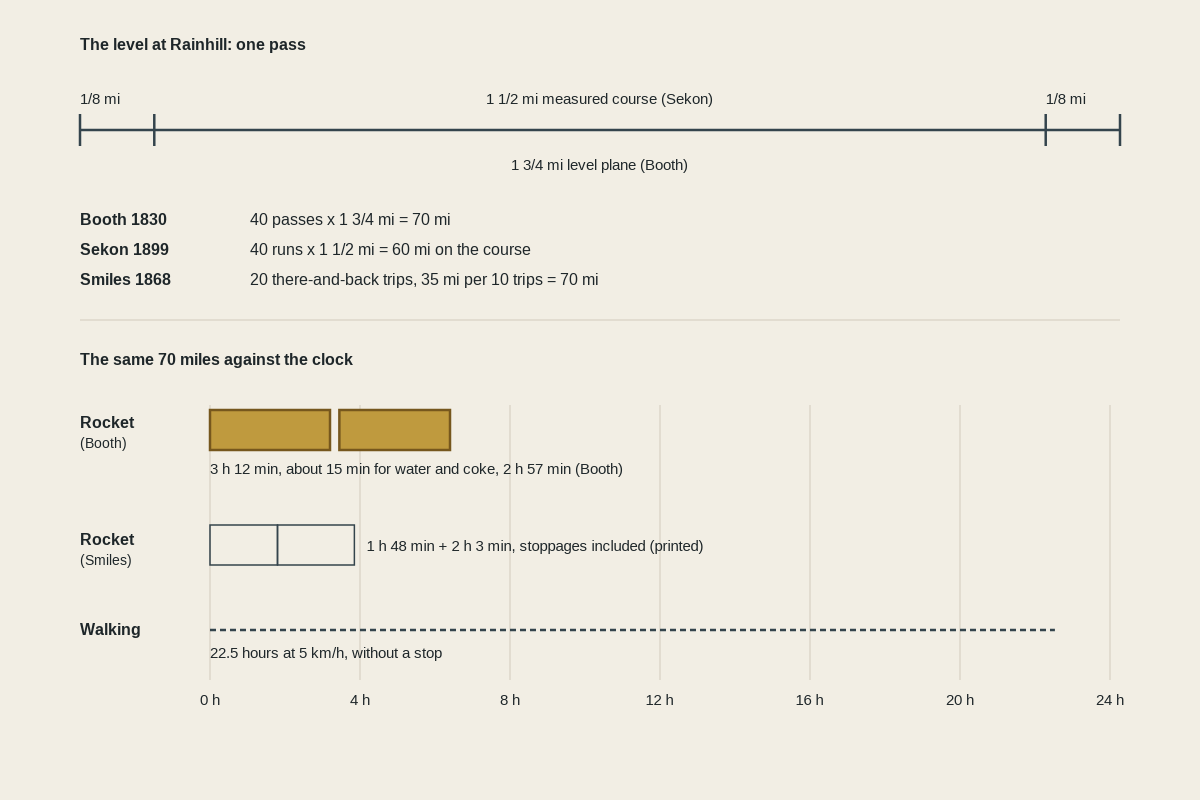
One pass of the Rainhill level, and the 70 miles as a clock. The top bar uses Booth’s times, the second bar Smiles’s, and the dashed line a steady 5 km/h walk.
Keel, Rail & Spoke, CC BY 4.0
Data: Booth 1830, https://archive.org/details/accountofliverpo00boot, retrieved 2026-11-08; Smiles 1868, https://www.gutenberg.org/ebooks/46229, retrieved 2026-11-08; Sekon 1899, https://www.gutenberg.org/ebooks/73518, retrieved 2026-11-08
Reuse this diagram: credit to copy
"The Rainhill level and the 70 miles against the clock" by Keel, Rail & Spoke, https://keelrailandspoke.com/railways/stephensons-rocket-1829/, licensed under CC BY 4.0 (https://creativecommons.org/licenses/by/4.0/).
Booth has Rocket starting at about half past ten on the morning of 8 October. The first 35 miles took 3 hours 12 minutes, about 15 minutes went on water and coke, and the second 35 miles took 2 hours 57 minutes. That makes 6 hours 24 minutes, which fits his “under six hours and a half.” A walker would need about 22.5 hours without a stop.
How fast did Rocket go at Rainhill?
The sources do not agree, and they are not measuring the same thing. Read the table by row. Each walking multiple here is the speed divided by a 5 km/h walk, and only figures with the same label compare.
| Source | What the figure measures | mph | km/h | Walking multiple |
|---|---|---|---|---|
| Booth 1830 | Whole 70 miles, with stops, calculated from his times | 10.94 | 17.6 | 3.5 (overall) |
| Booth 1830 | Over the ground with the load, “frequently” | 18 | 29.0 | 5.8 (working, peak) |
| Sekon 1899 | First twenty trips, average, 12¾ tons of load and tender | 13.42 | 21.6 | 4.3 (working) |
| Sekon 1899 | First twenty trips, maximum, same load | 24.43 | 39.3 | 7.9 (working, peak) |
| Sekon 1899 | Second twenty trips, average, same load | 14.2 | 22.9 | 4.6 (working) |
| Smiles 1868 | Average of “the whole of the journeys” | 15 | 24.1 | 4.8 (working) |
| Smiles 1868 | First 35 miles, calculated from 1 h 48 min, stops included | 19.44 | 31.3 | 6.3 (overall) |
| Smiles 1868 | Maximum on the trial, about 13 tons | 29 | 46.7 | 9.3 (working, peak) |
| Smiles 1868 | Two trips with no load, 14 October by the order of his account | 35 | 56.3 | 11.3 (working, peak) |
Smiles’s page does not add up as printed. His two timings, 1 hour 48 minutes and 2 hours 3 minutes for 35 miles each, come to 19.44 and 17.07 miles an hour with stops, yet the same page gives an average of 15. Over 70 miles that average needs 4 hours 40 minutes, 49 more than his timings total, and he mentions no such wait. Booth’s times are much longer and are the earliest read for this page, though he shared in the prize.
The machine card uses Sekon’s 13.42 miles an hour, a stated average for loaded running, which gives about 4.3 (working). Sekon does not say how the trips were timed, so the choice is a reading of his figure and not a settled result.
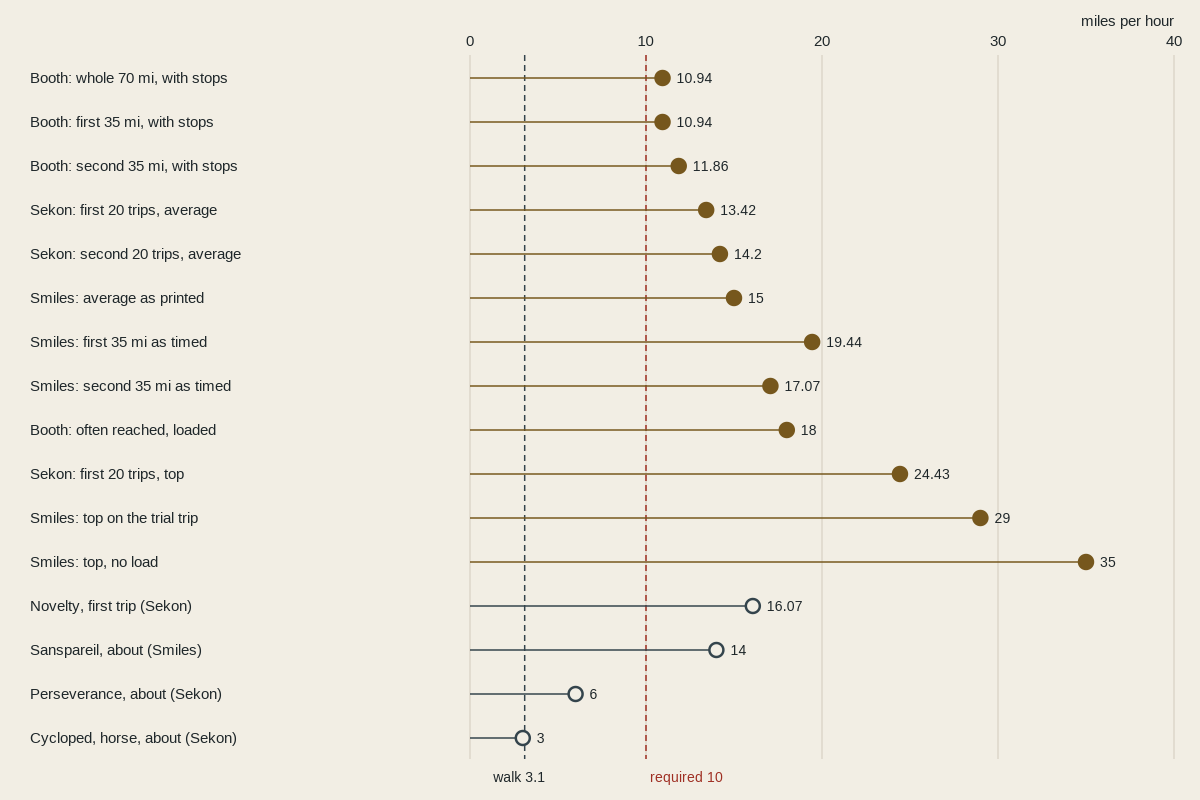
Speeds as printed or calculated, by source. Brown marks Rocket, and open circles mark its rivals. Stop-inclusive, average and peak figures are all shown, so bars on different kinds of measure do not compare.
Keel, Rail & Spoke, CC BY 4.0
Data: Booth 1830, https://archive.org/details/accountofliverpo00boot, retrieved 2026-11-08; Smiles 1868, https://www.gutenberg.org/ebooks/46229, retrieved 2026-11-08; Sekon 1899, https://www.gutenberg.org/ebooks/73518, retrieved 2026-11-08
Reuse this diagram: credit to copy
"Rainhill speeds by source" by Keel, Rail & Spoke, https://keelrailandspoke.com/railways/stephensons-rocket-1829/, licensed under CC BY 4.0 (https://creativecommons.org/licenses/by/4.0/).
Data behind this diagram: stephensons-rocket-1829-rainhill-speeds.csv · Where this data came from
Three other steam engines came to the ground. Novelty, by Braithwaite and Ericsson, covered its first timed trip at 16.07 miles an hour by Sekon’s figure and its second at 13½, then burst the pipe from its pump, and on 14 October it broke down again. Hackworth’s Sanspareil averaged about 14 miles an hour until its eighth trip, according to Smiles, who blames the cold-water pump. Sekon blames a burst cylinder, and Booth and Smiles both add that it was over the weight limit, by 5 cwt and 4 cwt respectively.
Burstall’s Perseverance managed about 5 or 6 miles an hour and withdrew. The fifth entry, Brandreth’s Cycloped, was a horse walking on a moving floor. Its 3 miles an hour with fifty passengers, by Sekon’s account, is 0.97 of a walk.
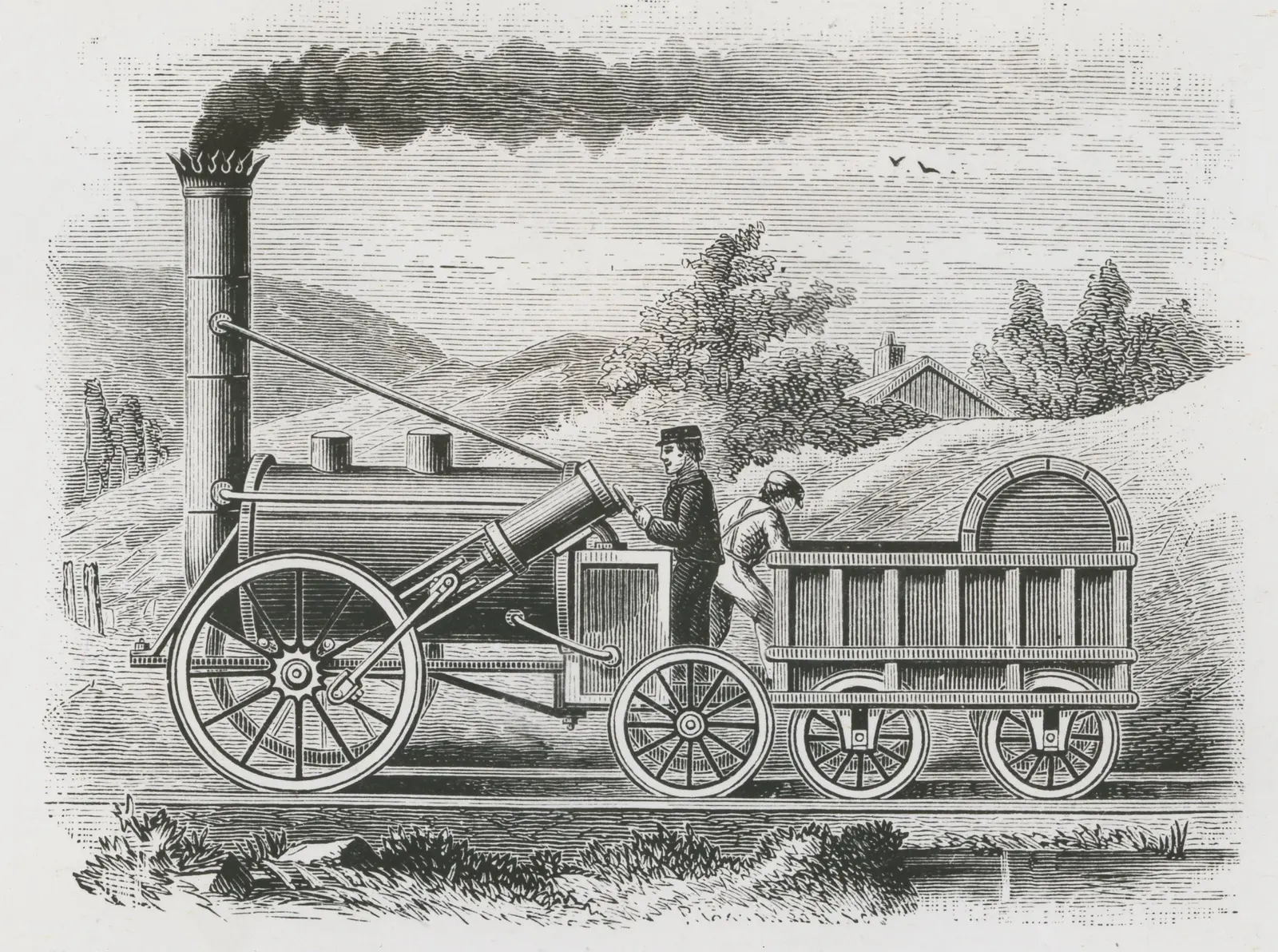
Rocket as a later engraver saw it, from Athol Maudslay’s Highways and Horses, London, 1888, cropped from an archive sleeve. The book’s caption, cropped away here, gives 29 miles an hour with 13 tons and 35 with no load.
George Stephenson's Locomotive, the "Rocket" (cropped) by unknown creator, Public domain
Full credit
"George Stephenson's Locomotive, the "Rocket" (cropped)" by unknown creator — https://commons.wikimedia.org/wiki/File:George_Stephenson%27s_Locomotive,_the_%22Rocket%22_-_DPLA_-_eecacab18bb21c2739be253c7d20c0be.jpg — Public domain (US: published in London in 1888 per the sleeve note and the file page, before 1931; elsewhere: engraver unnamed; a working engraver of 1888 would have to have died after 1955 for the life+70 term to still run); modified: cropped: engraving only, archive sleeve and printed caption removed

Who thought of Rocket’s many-tube boiler?
By his own account, Henry Booth did. His 1830 sentence is short and sits in the middle of a list of entrants. The fuller version is a letter to Samuel Smiles, printed in The Life of George Stephenson in the 1868 edition and undated there: “I was not aware that he had any intention of competing for the prize till I communicated to him my scheme of a multitubular boiler.”
Booth’s letter also gives the engineers their share. He proposed that he and Stephenson “should jointly construct an engine,” and he writes that Stephenson “settled the mode in which the fire-box and tubes were to be mutually arranged and connected.” Smiles adds, from Robert Stephenson, that the first tubes leaked so badly under test that the factory floor flooded. Robert then bored clean holes in the boiler ends, fitted smooth copper tubes and soldered them, and raised steam until they expanded tight.
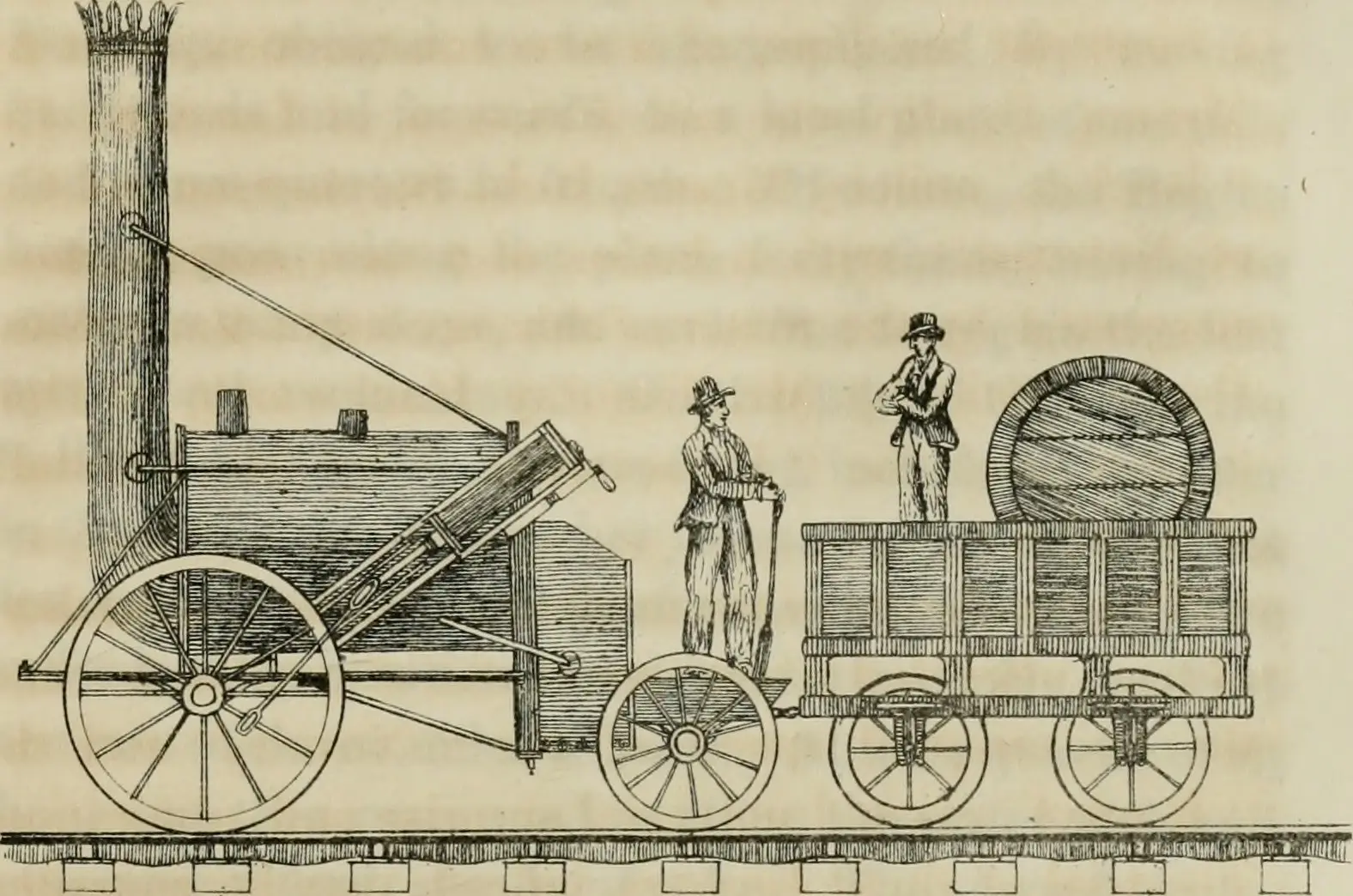
The engine as printed in Booth’s own 1830 book, cropped as published on its file page, with printed text showing through the paper.
Rocket, Locomotive, from An Account of the Liverpool and Manchester Railway by unknown creator, Public domain
Full credit
"Rocket, Locomotive, from An Account of the Liverpool and Manchester Railway" by unknown creator — https://commons.wikimedia.org/wiki/File:An_account_of_the_Liverpool_and_Manchester_Railway_-_comprising_a_history_of_the_parliamentary_proceedings_preparatory_to_the_passing_of_the_act,_a_description_of_the_railway_in_an_excursion_from_(14779811233).jpg — Public domain (US: published in Liverpool in 1830, before 1931; elsewhere: anonymous plate published more than 70 years ago, author of the book died 1869); modified: cropped: the crop published on Wikimedia Commons; no further change here

The idea itself was older, and Booth’s claim stops at England: “I claim to be the inventor in England,” he wrote, adding that he was “ignorant of M. Seguin’s proceedings in France.” Smiles lists Matthew Boulton’s copper tubes at the Wheal Busy engine in Cornwall in 1780, never patented, and James Neville’s patent of 1826, never used, both unknown to Booth in Smiles’s telling. Smiles writes that Seguin “is said to have adopted” horizontal tubes after two Stephenson engines reached his railway in 1829. Sekon dates Seguin’s patent to 22 February 1828, which would put it before them, and says Booth “states that he was unaware” of it.
Smiles’s own verdict is narrow: Booth deserves “the merit of inventing the method” by which the principle was applied on Rocket. Sekon’s is blunt: “The idea of the tubular boiler did not originate with the Stephensons.”
On the money, Booth says the directors awarded the premium to him “and the Messrs. Stephensons,” and Smiles agrees. Sekon says the £500 “was divided” between Robert Stephenson and Booth. None of the three gives the shares.
How did Rocket’s boiler work?
Heat had to cross from fire to water through metal, so the sum that counted was how much metal the two touched. Booth’s letter compares a single flue, 18 inches across and about half an inch thick, with “numerous small tubes” under an eighth of an inch thick. Rocket got 25 of them, each 3 inches across, running from firebox to chimney through the lower half of the barrel.
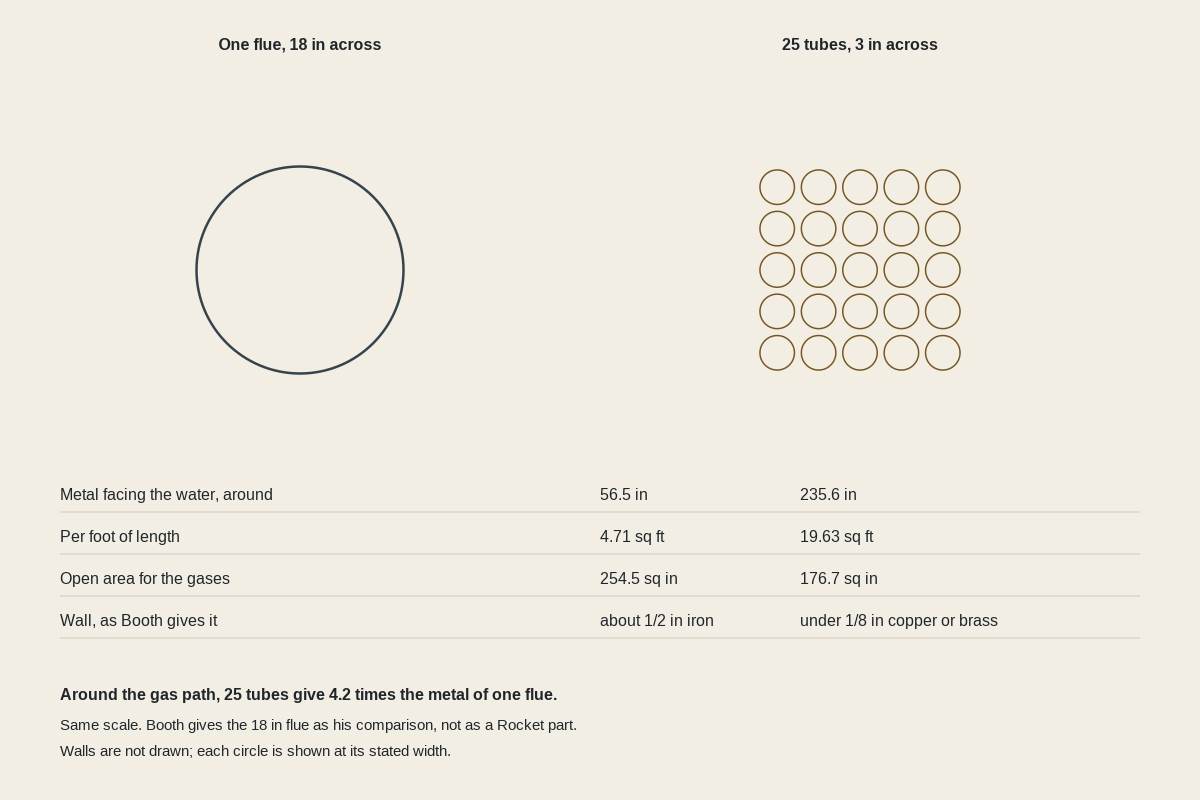
The sum behind Booth’s scheme, at one scale. The 18-inch flue is his comparison and not a part of Rocket. All the figures come from his letter and from Smiles, and the areas are recalculated: more metal for the tubes, but less open area for the gases, 176.7 square inches against 254.5.
Keel, Rail & Spoke, CC BY 4.0
Data: Booth 1830, https://archive.org/details/accountofliverpo00boot, retrieved 2026-11-08; Smiles 1868, https://www.gutenberg.org/ebooks/46229, retrieved 2026-11-08; Sekon 1899, https://www.gutenberg.org/ebooks/73518, retrieved 2026-11-08
Reuse this diagram: credit to copy
"One flue against 25 tubes" by Keel, Rail & Spoke, https://keelrailandspoke.com/railways/stephensons-rocket-1829/, licensed under CC BY 4.0 (https://creativecommons.org/licenses/by/4.0/).
Around the gas path, that is 235.6 inches of metal against 56.5, or 4.2 times as much, recalculated from those two sizes. Sekon says the tubes tripled the boiler’s evaporating power and cut coke use by 40 percent, though he gives no test behind those numbers. Smiles says the boiler raised steam “in a quantity which then appeared marvelous” on trial at Killingworth. That is praise and not a measurement.
| Part | Rocket, 1829 | Metric | Source |
|---|---|---|---|
| Weight with water | 4 tons 5 cwt | 4.32 t | Booth, Sekon |
| Boiler barrel | 6 ft long, 3 ft 4 in across | 1.83 m, 1.02 m | Smiles, Sekon |
| Fire tubes | 25, copper, 3 in across | 76 mm | Smiles, Sekon |
| Firebox | 3 ft long, 2 ft broad, about 3 ft deep | 0.91, 0.61, about 0.91 m | Sekon; Smiles says 2 ft wide, 3 ft high |
| Cylinders | Two, 8 in across, 16½ in stroke, at 45° | 203 mm, 419 mm | Sekon; Smiles for one on each side |
| Driving wheels | 4 ft 8½ in across | 1.44 m | Sekon |
| Steam at the start | 50 psi, after 57 minutes of firing | 345 kPa | Smiles |
The whole machine answered to the trial’s weight limit, which is why a lighter way to make steam mattered. Smiles says the double-flued Lancashire Witch came to about twelve tons, twice what the conditions allowed.
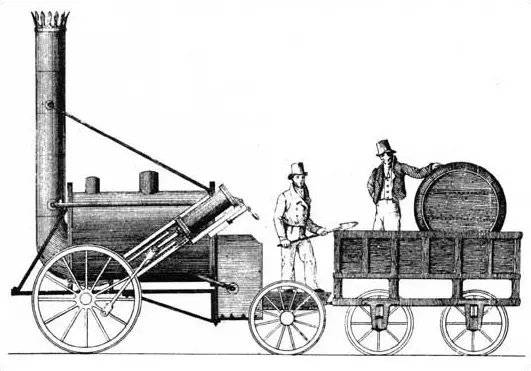
A side view of Rocket with its water barrel, said on its file page to come from an 1829 magazine. The magazine’s reports of the trials were not read for this page.
"Stephenson's Rocket drawing" by unknown creator — https://commons.wikimedia.org/wiki/File:Stephenson%27s_Rocket_drawing.jpg — Public domain (US: file page gives publication in 1829, before 1931; elsewhere: anonymous work published more than 70 years ago)

Who gave Rocket its steam blast?
The steam blast sends used steam up the chimney in a jet, which pulls air through the fire. Steam Locomotive explains how that works. Here the two main sources part ways, and each has a side to defend.
Smiles prints Robert Stephenson on his own father: at Killingworth in 1815, George turned the waste steam into the chimney, and the power of the engine “became more than doubled.” For Rocket, Smiles reports from Robert that the blast at first seemed too weak, so the pipe ends were hammered narrower and pipes of different sizes were tried. Before the engine left the factory, a glass tube dipped in a bucket showed water rising three inches.
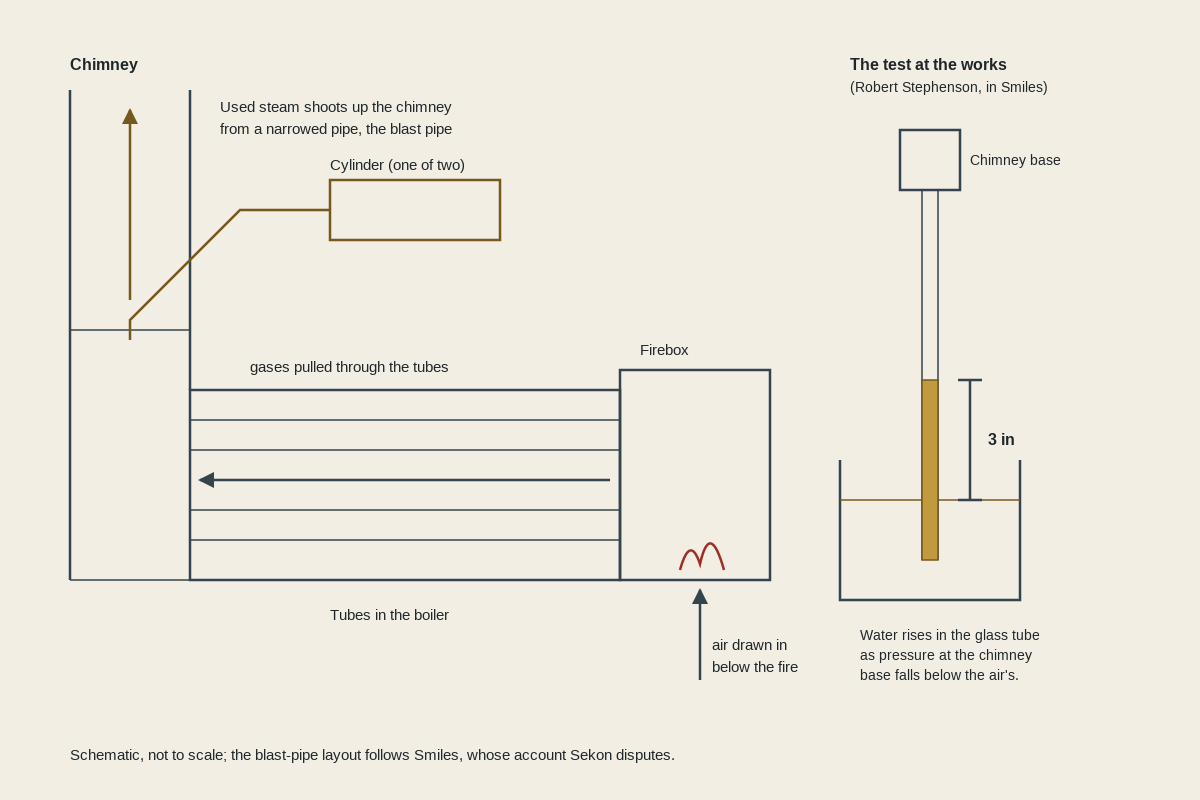
The blast as Smiles describes it, with Robert Stephenson’s water test beside it. Smiles calls the place measured the smoke-box; Sekon says Rocket got a smoke-box only when rebuilt, so the label here stays general.
Keel, Rail & Spoke, CC BY 4.0
Data: Booth 1830, https://archive.org/details/accountofliverpo00boot, retrieved 2026-11-08; Smiles 1868, https://www.gutenberg.org/ebooks/46229, retrieved 2026-11-08; Sekon 1899, https://www.gutenberg.org/ebooks/73518, retrieved 2026-11-08
Reuse this diagram: credit to copy
"The steam blast and the water test" by Keel, Rail & Spoke, https://keelrailandspoke.com/railways/stephensons-rocket-1829/, licensed under CC BY 4.0 (https://creativecommons.org/licenses/by/4.0/).
Sekon says George Stephenson did not understand the blast at all. He credits Timothy Hackworth’s Royal George of 1827 with the first true blast, and he says earlier engines merely got rid of steam up the chimney. As evidence he quotes George Stephenson’s letter of 25 July 1828 on the Lancashire Witch: “we have also tried the blast to it for burning coke, and I believe it will answer. There are two bellows, worked by eccentrics underneath the tender.” He then tells a story he labels the version of John Thompson, Hackworth’s foreman, in which two men climbed out of the Sanspareil’s shed at night and Rocket appeared the next evening with a similar pipe.
For backing, Sekon turns to a line from Zerah Colburn, read here only as Sekon quotes it: Rocket on its first day “derived but little benefit from the discharge of the exhaust steam up the chimney.” Smiles, for his part, counts among the objections to Sanspareil the coke it consumed or wasted, about 692 pounds an hour when traveling, because its sharp blast blew burning coke into the air. The Mechanics’ Magazine of 1829 and the treatise by the judge Nicholas Wood stand closer to the event, and neither was read here, so this page sets the claims out and does not choose. An earlier sentence on the same effect is on First Steam Locomotive.
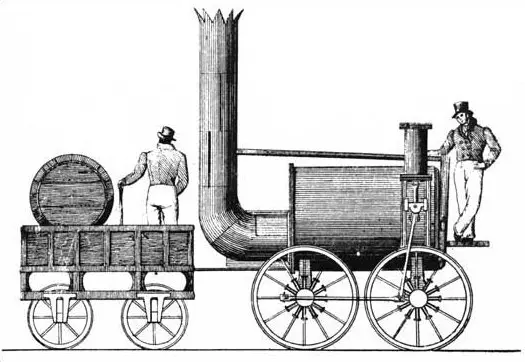
Hackworth’s Sanspareil, said on its file page to come from the same 1829 magazine. The chimney stands at the same end as the fire, as Sekon describes.
"Sans Pareil" by unknown creator — https://commons.wikimedia.org/wiki/File:Sans_Pareil.jpg — Public domain (US: file page gives publication in 1829, before 1931; elsewhere: anonymous work published more than 70 years ago)

| What | Credited to | Said by | Where |
|---|---|---|---|
| Rocket’s many-tube boiler | Henry Booth | Booth himself | Booth 1830, p. 74; letter in Smiles, p. 318 |
| The method of applying the many-tube principle on Rocket | Henry Booth | Smiles | Smiles 1868, p. 319 |
| Tube boiler, Wheal Busy, 1780 | Matthew Boulton | Smiles | Smiles 1868, pp. 316–318 |
| Boiler patent, 1826 | James Neville | Smiles | Smiles 1868, pp. 317–318 |
| French locomotive boiler patent, 1828 | M. Seguin | Sekon | Sekon 1899, p. 36 |
| Steam blast, Killingworth, 1815 | George Stephenson | Robert Stephenson, his son | Smiles 1868, pp. 168–170 |
| Steam blast, Royal George, 1827 | Timothy Hackworth | Sekon | Sekon 1899, pp. 23–25 |
| Rocket’s blast copied at Rainhill | Taken from Hackworth | John Thompson, as told by Sekon | Sekon 1899, pp. 33–34 |
Data behind this table: stephensons-rocket-1829-claims.csv · Where this data came from
How many times did Rocket exhaust per wheel turn?
Rocket’s driving wheels, 4 feet 8½ inches across, rolled about 4.51 meters in a turn. If its two cylinders were double-acting, their four ends sent four bursts of steam up the chimney each turn. The bursts fall evenly only if the cranks sit at right angles, a layout Sekon describes on an earlier engine. No source read here states either point for Rocket.
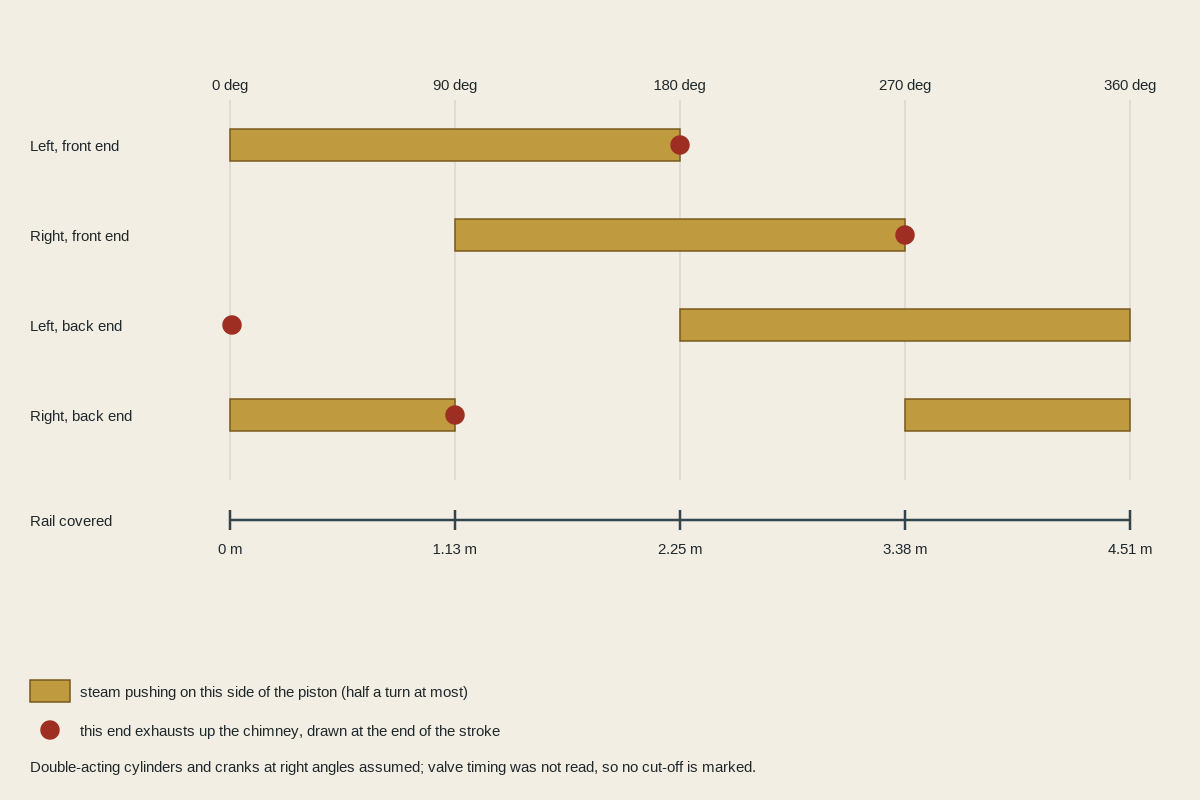
One wheel turn, assuming double-acting cylinders and cranks at right angles. The four ends exhaust in turn at 90, 180, 270 and 360 degrees. Valve timing for Rocket was not read, so the drawing marks the end of each stroke and no cut-off.
Keel, Rail & Spoke, CC BY 4.0
Data: Booth 1830, https://archive.org/details/accountofliverpo00boot, retrieved 2026-11-08; Smiles 1868, https://www.gutenberg.org/ebooks/46229, retrieved 2026-11-08; Sekon 1899, https://www.gutenberg.org/ebooks/73518, retrieved 2026-11-08
Reuse this diagram: credit to copy
"One wheel turn of Rocket" by Keel, Rail & Spoke, https://keelrailandspoke.com/railways/stephensons-rocket-1829/, licensed under CC BY 4.0 (https://creativecommons.org/licenses/by/4.0/).
Those assumptions put the bursts 1.13 meters of rail apart. At Sekon’s 13.42 miles an hour the wheels turn about 80 times a minute, with 5.3 exhausts a second. At his top figure of 24.43 miles an hour, or 39.3 km/h, the rate is about 145 turns a minute and 9.7 exhausts a second.
What happened to Rocket after 1829?
On the first day of 1830, Booth writes, Rocket crossed Chat Moss with a carriage and company, on the one roadway then laid. The same book already writes of “an Engine on the ‘Rocket’ principle, with the latest improvements.” At the railway’s opening, Smiles writes, Rocket struck Mr. Huskisson, who died that evening. By 1883 the Orient Express could borrow its traction from the railways it crossed.
Rocket itself did not stay as it was. Sekon says it was rebuilt within about a year, with the cylinders lowered to a slight incline and a smoke-box added. Smiles and Sekon both say it was sold in 1837 to Mr. Thompson of Kirkhouse, lessee of the Earl of Carlisle’s coal and lime works, and that it hauled coal on the Midgeholme line for five or six years. A 1973 letter in The Industrial Railway Record differs: citing the railway’s records, it puts the purchase in October 1836, and it has Rocket at work from April 1837, on the Thompson family’s word, until 1840.
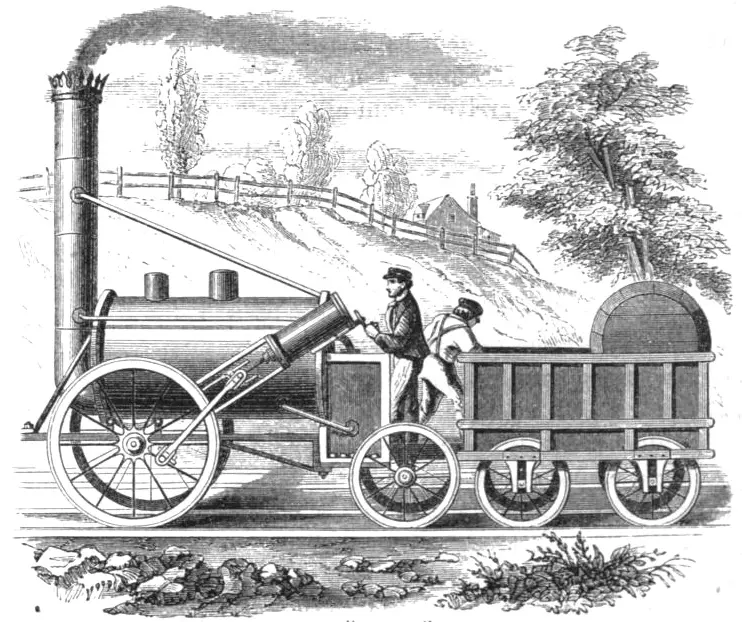
The engine as printed in Smiles’s 1868 edition, by an uncredited engraver.
Rocket (Smiles) by unknown creator, Public domain
Full credit
"Rocket (Smiles)" by unknown creator — https://commons.wikimedia.org/wiki/File:Rocket_(Smiles).jpg — Public domain (US: published in New York in 1868, before 1931; elsewhere: uncredited engraving published more than 70 years ago, author of the book died 1904)

Both Smiles and Sekon tell one more run. During the East Cumberland election, Rocket carried the state of the poll from Midgeholme to Kirkhouse, upward of four miles in 4½ minutes, which they call nearly 60 miles an hour. Four miles in that time works out at 53.3 miles an hour, or 86 km/h, so the run would have to be about 4½ miles to reach their figure.
Heavier engines then pushed it aside, and it was laid up in the yard at Kirkhouse. Smiles’s 1868 edition places it next in the Museum of Patents at Kensington, and Sekon’s 1899 book in the South Kensington Museum. Sekon adds a warning about the engine on show there: it “has been rebuilt, and its design considerably altered, since the Rainhill competition of 1829.”
Sources
- Booth, Henry. An Account of the Liverpool and Manchester Railway. Liverpool: Wales and Baines, 1830. Public domain; published 1830. https://archive.org/details/accountofliverpo00bootRead: pages 71 to 81 and the passages on Rainhill bridge and Chat Moss, from a scanned text
- Smiles, Samuel. The Life of George Stephenson and of His Son Robert Stephenson. New York: Harper & Brothers, 1868. Public domain; published 1868. https://www.gutenberg.org/ebooks/46229Read: chapter XII and notes 70 to 74, pages 168 to 170, and index entries
- Sekon, G. A. [George Augustus Nokes]. The Evolution of the Steam Locomotive (1803 to 1898). London: The Railway Publishing Co., 1899. Public domain; published 1899. https://www.gutenberg.org/ebooks/73518Read: chapters II and III, pages 23 to 39
- Letter on Rocket, Correspondence, The Industrial Railway Record, no. 51, November 1973, pp. 155-159. https://shop.irsociety.co.uk/Archives/51/Letters%2051.htmRead: full page of correspondence, the letter headed Rocket; the page shows no signature
Cite this page
Keel, Rail & Spoke. "Stephenson’s Rocket, 1829: Booth Claimed the Tube Boiler." Published 2026-11-08. https://keelrailandspoke.com/railways/stephensons-rocket-1829/. Accessed on the date you read it.
How facts are checked · Corrections · Contact
Found a mistake on this page? Write to contact@keelrailandspoke.com.
More from Railways
Railways
How a Steam Locomotive Works: Its Exhaust Drives the Draft
A steam locomotive burns fuel such as coal to boil water, and steam pressure pushes pistons that turn its wheels. Used steam then pulls air through the fire.
Picture credit
"Amerikaanse stoomlocomotief, RP-F-2001-7-998-11 (cropped)" by unknown creator — https://commons.wikimedia.org/wiki/File:Amerikaanse_stoomlocomotief,_RP-F-2001-7-998-11_(cropped).jpg — CC0 1.0 (https://creativecommons.org/publicdomain/zero/1.0/); modified: cropped: the crop published on Wikimedia Commons, cut from the album page; no further change here
Railways
Orient Express, 1883: The Last Leg Was a Boat From Varna
The inaugural Orient Express left Paris on 4 October 1883 but stopped at the Danube. Two 1884 accounts show its last leg to Constantinople was by ship.
Picture credit
"Londres-Paris-Constantinople, Orient Express, poster, winter 1888-89 (top half)" by Jules Chéret or Imp. Chaix (Succ. Chéret) — https://commons.wikimedia.org/wiki/File:Aff_ciwl_orient_express4_jw.jpg — Public domain (US: published 1888, before 1931; elsewhere: the file page credits Jules Chéret (died 1932) and the sheet is signed Imp. Chaix (Succ. Chéret); term expired on either reading); modified: cropped: top half of the sheet, above the route map and timetable
Railways
First Known Steam Locomotive Run: 1804, Slower Than a Walk
Richard Trevithick's 1804 letter gives his tram engine above nine miles in 4 hours 5 minutes. With stops, the 9 to 9¾ miles on record average below a walk.
Picture credit
"Newcastle Locomotive, drawing dated 1804" by Richard Trevithick (as credited on the file page) — https://commons.wikimedia.org/wiki/File:WP_Trevithick_-_Newcastle_Locomotive.jpg — Public domain (US: drawing dated 1804, creator died 1833; the 1934 book printing named on the file page is a faithful copy; earlier publication not traced, not traced back; elsewhere: creator died 1833, life plus 70 expired)


