Railways · Journey file
First Known Steam Locomotive Run: 1804, Slower Than a Walk
By Richard Trevithick's own letter, his tram engine took four hours and five minutes over above nine miles of Welsh tramroad, stops included.
Keel, Rail & Spoke · Published
TL;DR
- In the sources read here, the first steam locomotive with a dated record on rails is Richard Trevithick's tram engine at Penydarren, South Wales, in February 1804.
- His letter of 22 February reports “above nine miles” in “four hours and five minutes”. At the 9 to 9¾ miles in his letters, that is an overall average of about 3.5 to 3.8 km/h with stops, below a 5 km/h walk.
- The same letter says the engine, “while working, went nearly five miles per hour”, about 8 km/h.
Leg card
- Departure
- Penydarren ironworks, Merthyr Tydfil, South Wales; Tuesday 21 February 1804; hour not recorded
- Arrival
- The shipping place of the iron on the canal, which F. Trevithick calls the Basin; same day; hour not recorded
- Distance
- Above nine miles (over 14.5 km) by the letter of 22 February 1804; 9.75 miles (15.7 km) to the far end of the road as provisionally read in the letter of 20 February, the fraction being unclear in the OCR of that volume; along the tramroad
- Machine
- Richard Trevithick's tram engine, unnamed in his letters, drawing five wagons
- Elapsed
- Four hours and five minutes, stops included
- Walking multiple
- about 0.7 (overall), 0.71 to 0.77 taking nine and 9.75 miles as the distance; above nine miles sets no upper limit; no split times, so no moving figure
- Repair radius
- At most about 8.0 to 9.3 km (5 to 5.75 mi) along the tramroad, by subtraction from nine and 9.75 miles, back to the ironworks. Repair capability there is inferred, because the Ellis note says the engine was partly built there. Fault: a small bolt broke and the boiler emptied, about four miles from the shipping place. The letter does not say where the bolt was mended
- The last spare
- Not applicable: the outward trip was completed, and a broken bolt stopped the return, not a supply running out
- Key source
- Richard Trevithick's letter to Davies Giddy, 22 February 1804, printed in F. Trevithick, Life of Richard Trevithick, vol. 1 (1872), pp. 161-162
Download this card (CSV) · Where this data came from
Data: Francis Trevithick, Life of Richard Trevithick, vol. 1 (1872), https://archive.org/details/india.history.resource.85210
What the card means: walking multiple, repair radius, last spare.
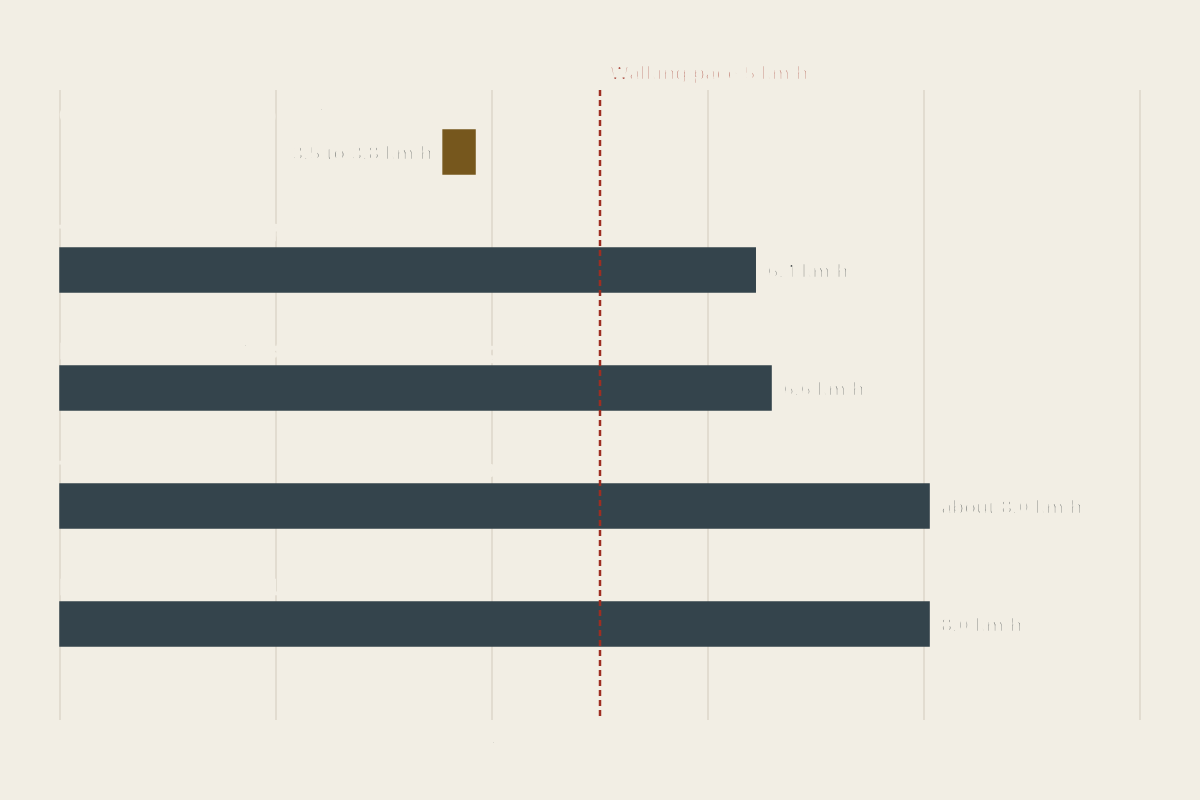
One engine, five speeds. The overall average from the 1804 letter sits below walking pace. The other bars are what Trevithick and a later encyclopedia gave for the engine in motion, and one is calculated from his stroke figures on a different day.
Keel, Rail & Spoke, CC BY 4.0
Data: Francis Trevithick, Life of Richard Trevithick, vol. 1 (1872), https://archive.org/details/india.history.resource.85210; Francis Trevithick, Life of Richard Trevithick, vol. 2 (1872), https://www.gutenberg.org/ebooks/46634
Reuse this diagram: credit to copy
"Speeds given for the 1804 engine" by Keel, Rail & Spoke, https://keelrailandspoke.com/railways/first-steam-locomotive-1804/, licensed under CC BY 4.0 (https://creativecommons.org/licenses/by/4.0/).
Data behind this diagram: first-steam-locomotive-1804-accounts.csv · Where this data came fromData: Francis Trevithick, Life of Richard Trevithick, vol. 1 (1872), https://archive.org/details/india.history.resource.85210; Francis Trevithick, Life of Richard Trevithick, vol. 2 (1872), https://www.gutenberg.org/ebooks/46634; G. A. Sekon, The Evolution of the Steam Locomotive (1899), https://www.gutenberg.org/ebooks/73518
On 21 February 1804, Richard Trevithick's tram engine ran above nine miles in four hours and five minutes. The figures come from his letter of the next day to his friend Davies Giddy, later Davies Gilbert, printed by his son Francis Trevithick in 1872, and at the 9 to 9¾ miles his letters give, the trip averaged about 3.5 to 3.8 km/h, so a person walking at 5 km/h would have arrived about an hour sooner. The same letter says the engine went nearly five miles per hour. Both numbers rest on his own letter.
Stops on this page (9)
- What was the first steam locomotive?
- How slow was the 1804 run?
- Where did Trevithick's engine run?
- What did the train carry?
- Why did high-pressure steam matter?
- A repair radius of at most about 5 to 5.75 miles
- The Ibry strip: a start, an end and no stops timed
- Who won the 500-guinea bet?
- Why did the locomotive not catch on right away?
What was the first steam locomotive?
Steam reached the roads before the rails. Davies Gilbert recalled in 1839 that Trevithick's road engine left Camborne on 28 December 1801 and broke down after a few hundred yards. Francis Trevithick notes William Murdoch's attempt at a steam carriage in 1784.
Rails are the harder claim. In a letter dated 22 August 1802, Trevithick wrote from Coalbrookdale that the company there had “begun a carriage at their own cost for the railroads”. Francis Trevithick found “no further trace” of it in his father's papers and wrote, “We have no account of the railway work done” by that engine.
G. A. Sekon, a railway historian writing in 1899, says Trevithick “appears to have constructed” it, then captions his drawing of the Welsh engine “The first railway locomotive of which authentic particulars are known”.
So “first known” has a limit on this page. It means the earliest locomotive on rails with a dated record of its running in the sources read here. An engine at Coalbrookdale may have run sooner, but nothing read here records it. The word “first” causes the same trouble with Who Invented the Bicycle.
The dated record starts with a letter of 15 February 1804, written from Penydarren, which says the fire was lit “Last Saturday”, meaning 11 February, and “On Monday we put it on the tramroad”, meaning the 13th. By 20 February the engine had been “but two miles on the road and back again”, and Trevithick planned to run it down that day to meet Homfray, take the horses out of his coach, and draw the coach home behind the engine. Francis Trevithick says that happened, and that the coach wheels matched the gauge of the road. The long run came the next day, and no earlier run read here has both a distance and a time.
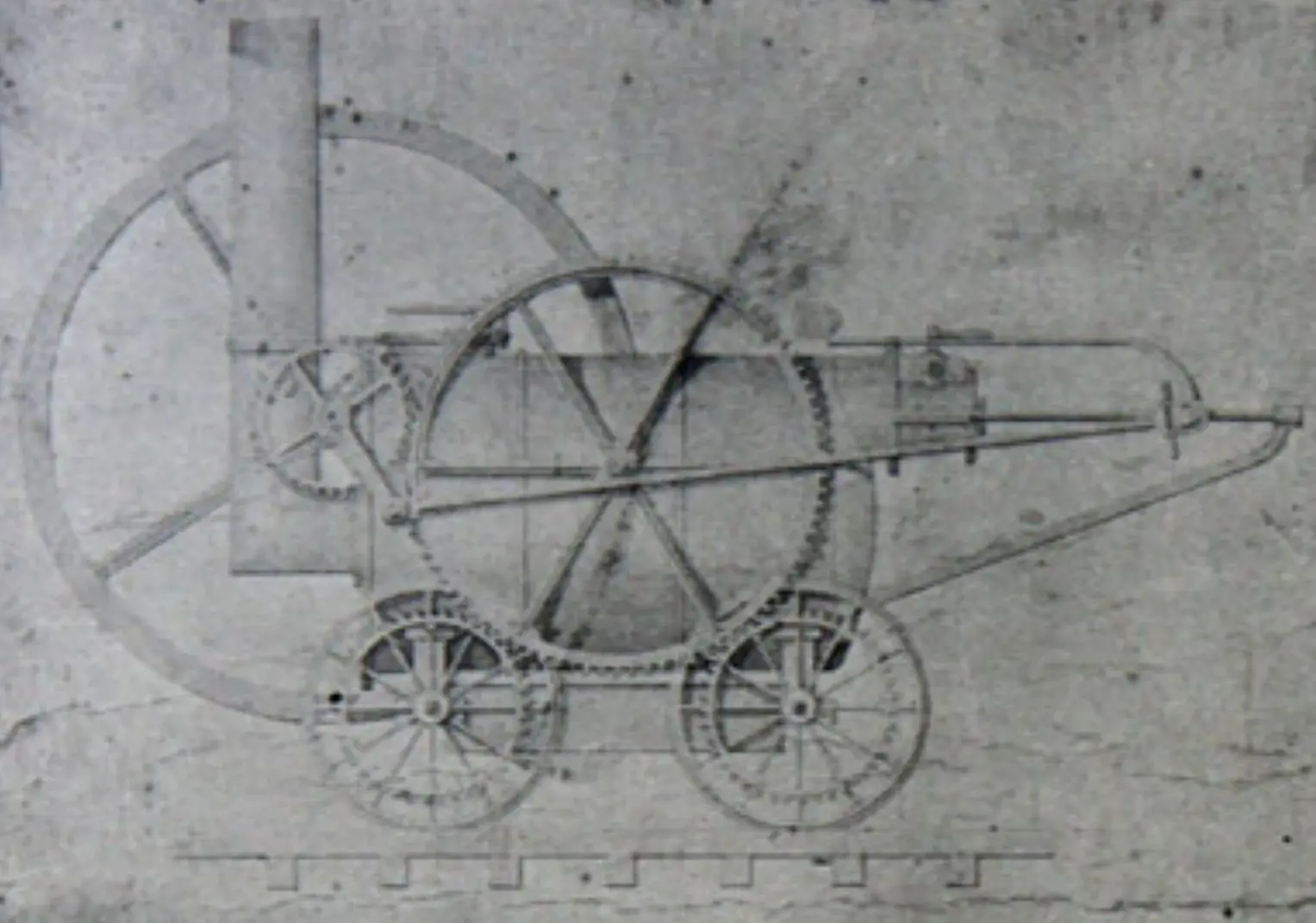
A drawing dated 1804. Its file page identifies it as the Newcastle locomotive and credits Richard Trevithick. This is a different engine from the one on this trip, shown because Francis Trevithick calls the two similar in general outline.
Newcastle Locomotive, drawing dated 1804 by Richard Trevithick (as credited on the file page), Public domain
Full credit
"Newcastle Locomotive, drawing dated 1804" by Richard Trevithick (as credited on the file page) — https://commons.wikimedia.org/wiki/File:WP_Trevithick_-_Newcastle_Locomotive.jpg — Public domain (US: drawing dated 1804, creator died 1833; the 1934 book printing named on the file page is a faithful copy; earlier publication not traced, not traced back; elsewhere: creator died 1833, life plus 70 expired)

How slow was the 1804 run?
Trevithick gives two distances in three days. On 20 February he put the other end of the road at what reads as 9¾ miles, though the fraction is unclear in the scanned text of the volume read here, and his 1812 letter prints 9¾ plainly. On 22 February he wrote “above nine miles”, which sets a floor and no ceiling. Taking nine and 9¾ as the two working figures gives 14.5 to 15.7 km, which divided by 4 hours 5 minutes comes to 3.55 to 3.84 km/h, or about 2.2 to 2.4 miles per hour.
That gives a walking multiple, meaning speed divided by a 5 km/h walk, of about 0.7 (overall). The range on those two figures is 0.71 to 0.77, and overall means that stops are included in the time. At 5 km/h, a person on foot needs 2 h 54 min to 3 h 08 min for the same distance, 57 to 71 minutes less than the engine took. The average stays below a 5 km/h walk for any distance up to about 12.7 miles, more than any source read here gives.
The record says the delay was not all in the machine. “We had to cut down some trees and remove some large rocks out of the road,” Trevithick wrote, and then: “The engine, while working, went nearly five miles per hour.” His son says it “was obliged to stop frequently”, and Sekon gives the time as “including several stoppages”. Eight years later Trevithick remembered the speed as “four miles per hour”, and added that the engine alone, without the load, ran “sixteen miles per hour”, about 26 km/h, a figure that no earlier letter read here supports.
| Figure | Who gave it, and when | km/h | Compared with a 5 km/h walk |
|---|---|---|---|
| Overall average, stops included | Recalculated from the 9 to 9¾ miles in his letters and the time in the letter of 22 February 1804 | 3.5 to 3.8 | Slower |
| “Four miles per hour” | Trevithick, letter of 26 April 1812 | 6.4 | Faster |
| 40 strokes a minute at 9 feet a stroke, empty wagons | Calculated from the letter of 20 February 1804, a different run | 6.6 | Faster |
| “Nearly five miles per hour” while working | Trevithick, letter of 22 February 1804 | About 8.0 | Faster |
| “Five miles per hour” or “five miles an hour” | Rees's Cyclopaedia, 1819, as quoted by Francis Trevithick; Francis Trevithick, 1872; Sekon, 1899 | 8.0 | Faster |
His stroke count offers one check. On 20 February he wrote that the engine went up a grade of 2 inches in a yard, or 1 in 18, at forty strokes a minute with the empty wagons, moving 9 feet at every stroke. That works out to 360 feet a minute, or 4.1 miles per hour, close to the speeds he claimed, though on a different day and with a lighter train.
No one recorded how long the engine stood still on the long run. If it ran at 5 miles per hour over nine miles, it was moving for 1 h 48 min and standing for 2 h 17 min, and if it ran at 4 miles per hour over 9¾ miles, it stood for 1 h 39 min. Those are two what-if cases from round figures, not bounds and not a log, so this page gives no moving multiple, which would need timed segments.
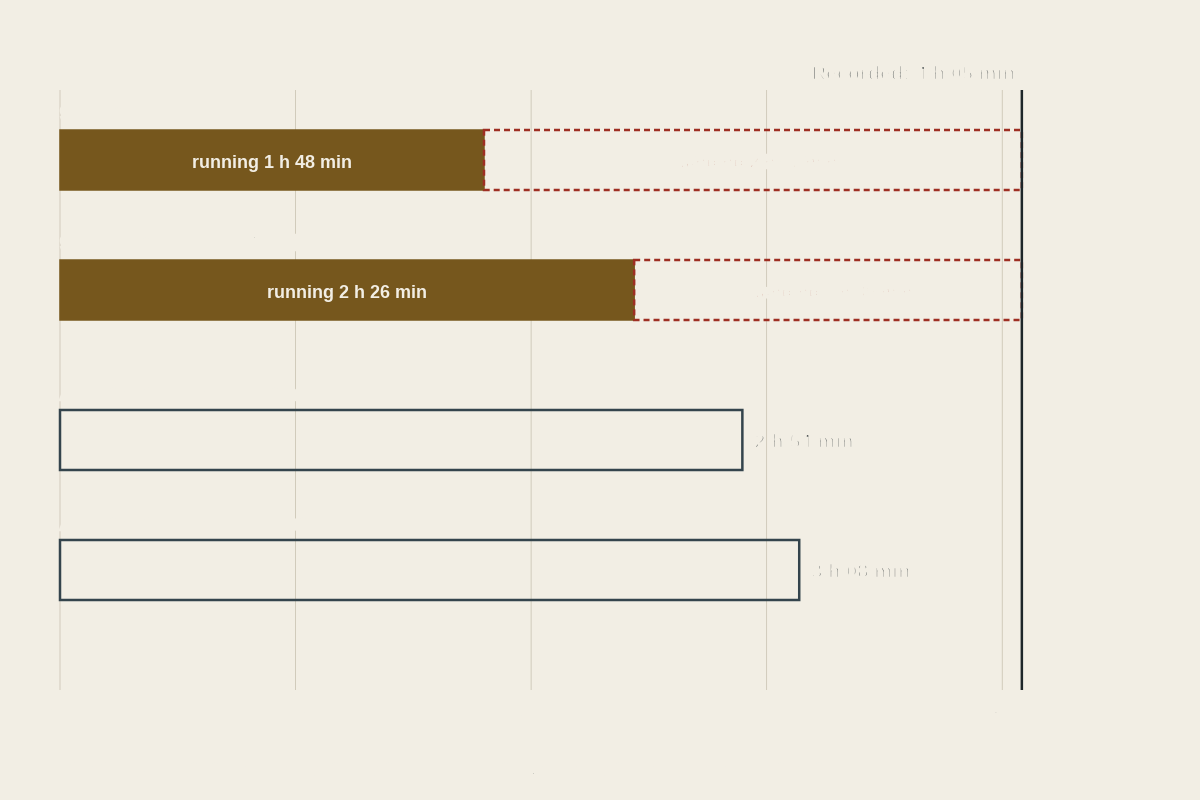
Two what-if splits of the recorded 4 hours 5 minutes, using round speeds from the letters; the real stops were not timed. A walker at 5 km/h finishes in 2 hours 54 minutes to 3 hours 8 minutes.
Keel, Rail & Spoke, CC BY 4.0
Data: Francis Trevithick, Life of Richard Trevithick, vol. 1 (1872), https://archive.org/details/india.history.resource.85210; Francis Trevithick, Life of Richard Trevithick, vol. 2 (1872), https://www.gutenberg.org/ebooks/46634
Reuse this diagram: credit to copy
"Running and standing within 4 hours 5 minutes" by Keel, Rail & Spoke, https://keelrailandspoke.com/railways/first-steam-locomotive-1804/, licensed under CC BY 4.0 (https://creativecommons.org/licenses/by/4.0/).
Where did Trevithick's engine run?
The trip began at the Penydarren ironworks at Merthyr Tydfil, owned by Samuel Homfray, and ran down a tramroad, a track of cast-iron plates that horse-drawn wagons used. Its far end has several names. Trevithick calls it “the shipping-place of the iron”, his son calls it “the Basin”, a note by the engineer Thomas Ellis calls it the Navigation House, and Trevithick's 1812 letter says “the Quaker's-yard”.
The Abercynon history blog places the Basin and Navigation House at what grew into Abercynon, where the Merthyr Tramroad met the Glamorganshire Canal. From the Wikidata points for the ironworks and modern Abercynon, the straight line is 12.4 km, and Quakers Yard is 11.1 km. By the 9 to 9¾ miles in the letters, the tramroad took 14.5 to 15.7 km, and Francis Trevithick describes “sharp curves” along it.
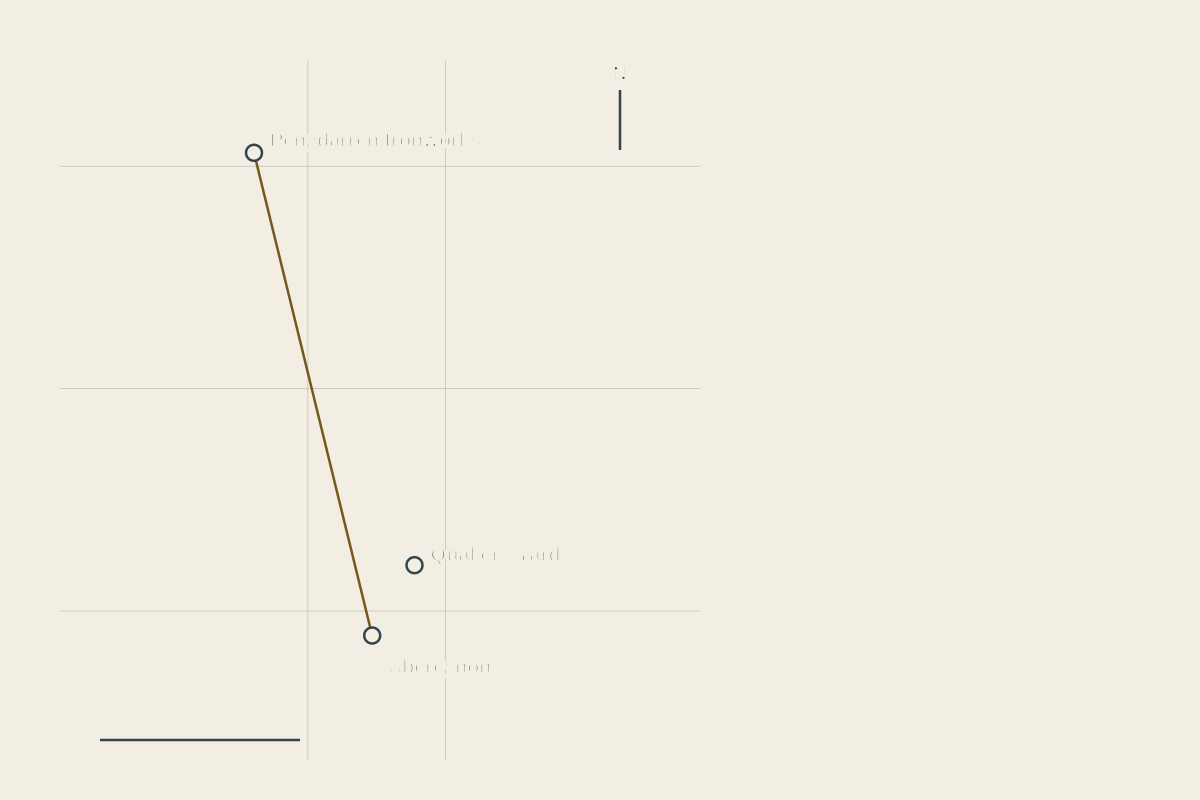
Places are plotted from their coordinates, joined by a straight line. The tramroad's own line is not drawn, and the points mark modern places and not the 1804 wharf.
Keel, Rail & Spoke, CC BY 4.0
Data: Francis Trevithick, Life of Richard Trevithick, vol. 1 (1872), https://archive.org/details/india.history.resource.85210; Francis Trevithick, Life of Richard Trevithick, vol. 2 (1872), https://www.gutenberg.org/ebooks/46634; Wikidata coordinates (CC0), https://www.wikidata.org/, retrieved 2026-11-08
Reuse this diagram: credit to copy
"From the Penydarren ironworks toward Abercynon" by Keel, Rail & Spoke, https://keelrailandspoke.com/railways/first-steam-locomotive-1804/, licensed under CC BY 4.0 (https://creativecommons.org/licenses/by/4.0/).
Data behind this diagram: first-steam-locomotive-1804-route.csv · Where this data came fromData: Wikidata coordinates (CC0), https://www.wikidata.org/, retrieved 2026-11-08
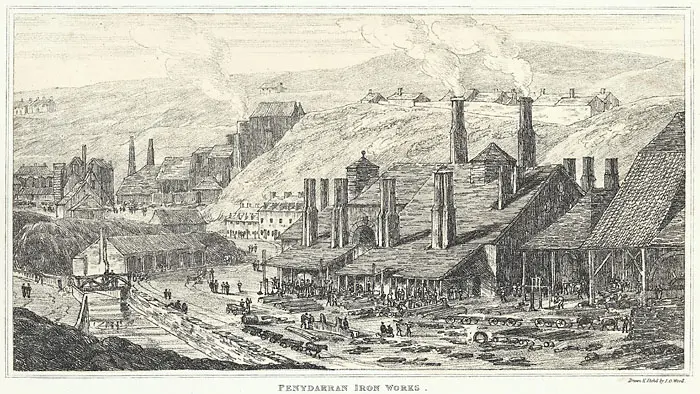
Penydarren iron works as J. G. Wood drew it in a print dated 1811, seven years after the trip. The sources read here do not say where on this site the engine was put together.
"Penydarran iron works, print, 1811" by John George Wood — https://commons.wikimedia.org/wiki/File:Penydarran_iron_works.jpeg — Public domain (US: published 1811, before 1931; elsewhere: John George Wood died 1838, life plus 70 expired)

What did the train carry?
Trevithick's letter gives the load plainly: “we carried 10 tons of iron, five waggons, and seventy men riding on them the whole of the journey.” The engine itself, “with water included”, was “about 5 tons” by his letter of 20 February. It burned 2 cwt of coal, about 102 kg, and “no water was put into the boiler” until the far end.
The total weight needs care, because no source says anyone weighed it. Francis Trevithick takes the men and their tools at 7 tons, for a net 17 tons, and a gross 25 tons with five wagons, which leaves 8 tons for the wagons. His father's 1812 letter also says “about 25 tons”, but with four wagons, and the letter written the day after the run is the better witness on that point. If 25 tons is close, the engine was moving about five times its own weight behind it.
| Source | Iron | Wagons | Men | Total behind the engine |
|---|---|---|---|---|
| Trevithick, letter of 22 February 1804 | 10 tons | Five | Seventy | Not given |
| Francis Trevithick, 1872 | 10 tons | Five, 8 tons by subtraction | Seventy, 7 tons with tools | 25 tons gross |
| Trevithick, letter of 26 April 1812 | 2½ tons a wagon, 10 tons | Four | Seventy | About 25 tons |

Three accounts of the load, with weights as the sources write them. Dashed boxes are weights no source gives directly, or that come only by subtraction.
Keel, Rail & Spoke, CC BY 4.0
Data: Francis Trevithick, Life of Richard Trevithick, vol. 1 (1872), https://archive.org/details/india.history.resource.85210; Francis Trevithick, Life of Richard Trevithick, vol. 2 (1872), https://www.gutenberg.org/ebooks/46634
Reuse this diagram: credit to copy
"Three accounts of the load, 1804 to 1872" by Keel, Rail & Spoke, https://keelrailandspoke.com/railways/first-steam-locomotive-1804/, licensed under CC BY 4.0 (https://creativecommons.org/licenses/by/4.0/).
Why did high-pressure steam matter?
The engines of James Watt worked with steam close to atmospheric pressure, and a condenser made a vacuum that helped pull the piston, which meant condensing water that Francis Trevithick infers a Watt carriage would have had to carry. He says his father raised the pressure from one atmosphere to “50 or 60 lbs.” and dropped the vacuum altogether. Watt, as quoted in the same book, gave up on high-pressure steam carriages partly “because of the danger of bursting”.
The letters read here give no pressure for the February run. An 8-inch engine tried at Penydarren and then moved to Swansea needed “about 46 or 48 lbs. to the inch”, by Trevithick's letter of 5 January 1804. Rees Jones, a fitter on the tram engine, said in 1858 that it used “about 40 lbs. to the inch”.
The tram engine had one cylinder of 8¼ inches and a stroke of 4½ feet, by Francis Trevithick and Sekon, with a large flywheel and gears to the wheels. Accounts differ on the rest: Thomas Ellis senior of the Tredegar Works, writing in 1854 from informants aged seventy and seventy-six, gives an 8-inch cylinder, a 2-foot stroke and about 7 tons, while Francis gives driving wheels of 3 feet 9 inches and Sekon gives 4 feet 6 inches.
A later note signed by the engineer Thomas Ellis names Rees Jones as a fitter who helped build the engine and William Richards as its driver, which is more than the 1804 letters do. A note on a boiler plate, signed by Henry Crawshay in 1850 and quoted by Francis Trevithick, says the engine was built “with two cylinders”, against the one cylinder in the accounts above. Nothing read here settles that.
Used steam went up the chimney, and “the fire burns much better when the steam goes up the chimney than when the engine is idle,” Trevithick wrote on 20 February. Accounts differ on what that shows: his son reads it as the blast pipe already at work, and Sekon says the steam was turned in only to get rid of the vapor. How a Steam Locomotive Works explains what that exhaust later came to do.
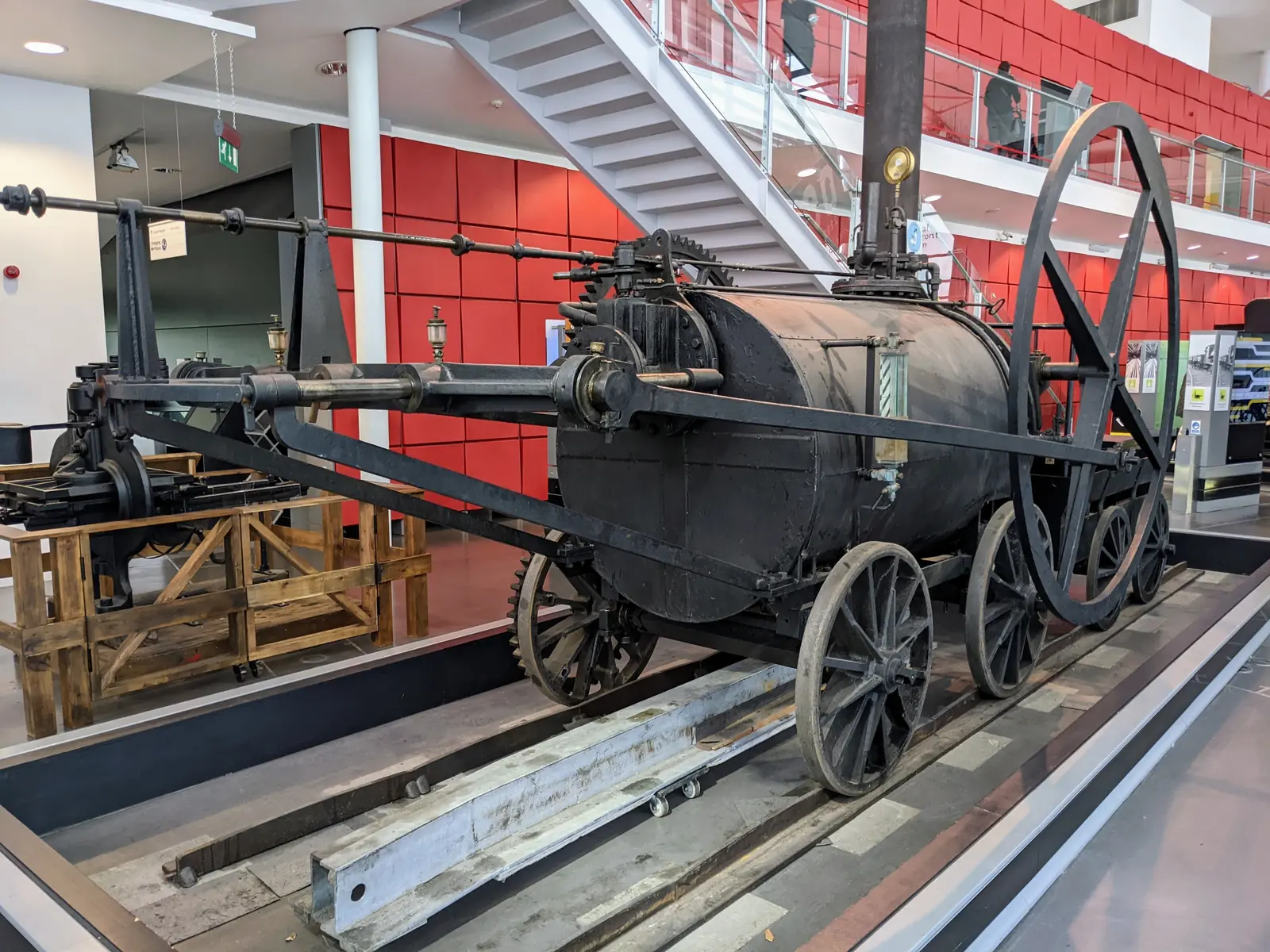
A replica, not the original, at the National Waterfront Museum in Swansea. Its file page says it was built in 1979 and 1980.
"Replica of Trevithick's Penydarren locomotive" by The wub — https://commons.wikimedia.org/wiki/File:Replica_of_Trevithick%27s_Penydarren_locomotive_-_2022-08-22.jpg — CC BY-SA 4.0 (https://creativecommons.org/licenses/by-sa/4.0)

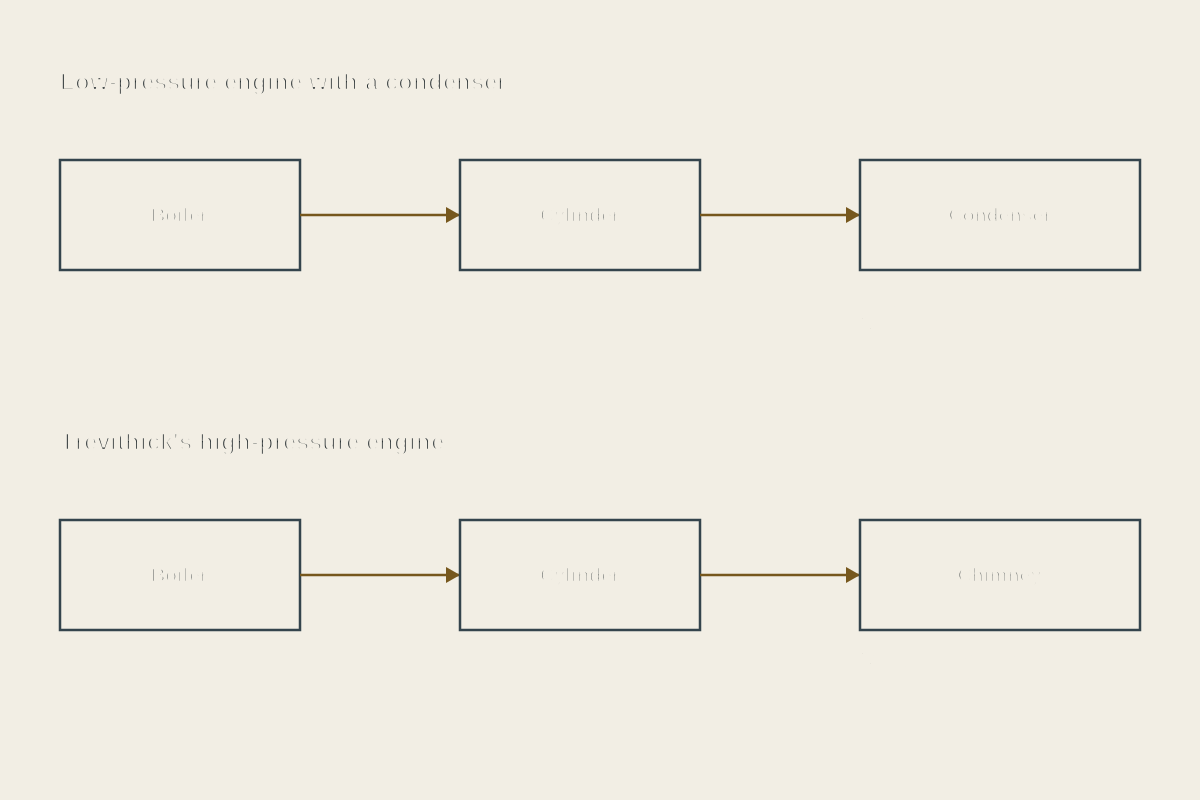
The difference in outline only. This is a plain flow diagram, not a drawing of any one engine. The pressures are the ones Francis Trevithick gives.
Keel, Rail & Spoke, CC BY 4.0
Data: Francis Trevithick, Life of Richard Trevithick, vol. 1 (1872), https://archive.org/details/india.history.resource.85210
Reuse this diagram: credit to copy
"Low-pressure and high-pressure steam in outline" by Keel, Rail & Spoke, https://keelrailandspoke.com/railways/first-steam-locomotive-1804/, licensed under CC BY 4.0 (https://creativecommons.org/licenses/by/4.0/).
A repair radius of at most about 5 to 5.75 miles
The trip home is where the machine failed. “On our return home, about four miles from the shipping-place of the iron, one of the small bolts that fastened the axle to the boiler broke, and all the water ran out of the boiler, which prevented the return of the engine until this evening.” The letter is dated 22 February, so the engine sat out for about a day.
The repair radius is the distance from a fault to the nearest place on record that could fix it. This page counts the ironworks by inference: the Ellis note says the engine was built partly there, but no source says outright that the works could replace this bolt. Taking about four miles from the 9 to 9¾ miles of road leaves about 5 to 5.75 miles, or 8.0 to 9.3 km, about 1.6 to 1.9 hours at walking pace. That figure is “at most”, because the letter does not say where the bolt was mended or who mended it.
The last spare on this trip is not applicable. The boiler did empty, but a broken bolt caused that, not a supply running out, and the outward trip was already done.
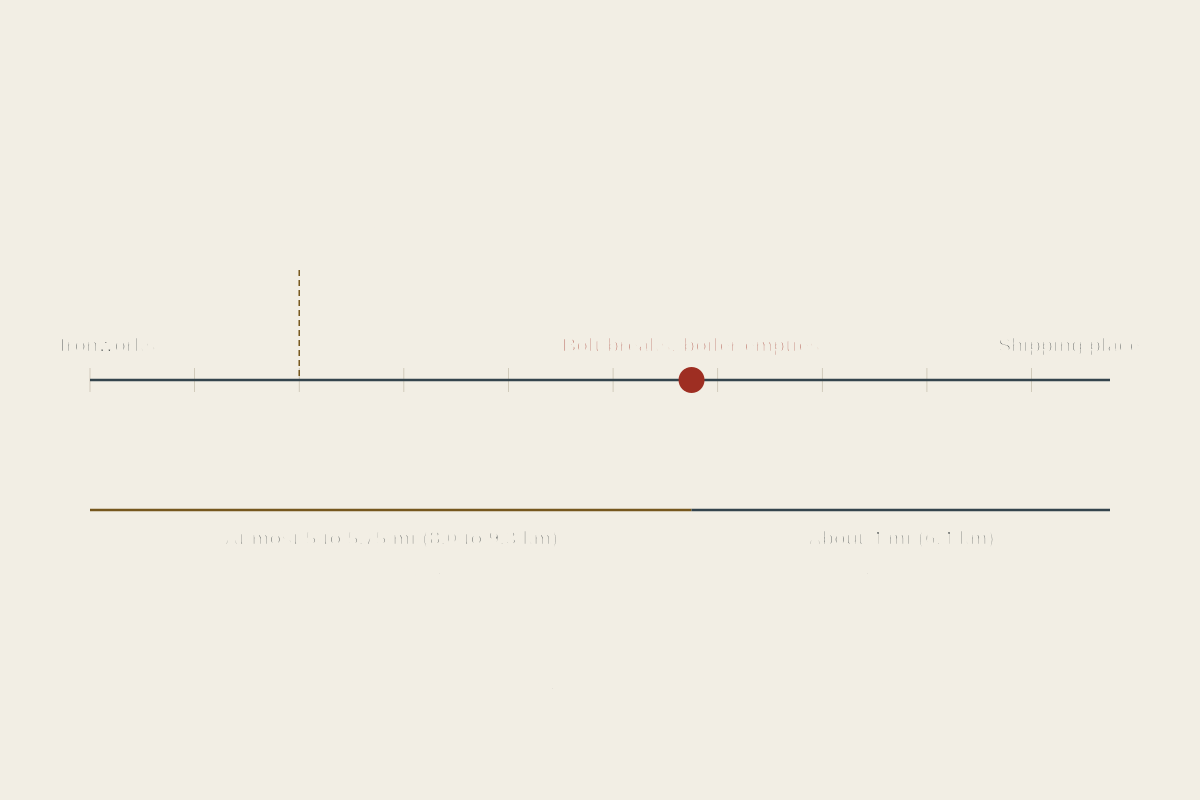
The breakdown on the way home. The miles to the ironworks come by subtraction from the letters, and the strip shows order and distance only.
Keel, Rail & Spoke, CC BY 4.0
Data: Francis Trevithick, Life of Richard Trevithick, vol. 1 (1872), https://archive.org/details/india.history.resource.85210
Reuse this diagram: credit to copy
"Where the bolt broke on the way home" by Keel, Rail & Spoke, https://keelrailandspoke.com/railways/first-steam-locomotive-1804/, licensed under CC BY 4.0 (https://creativecommons.org/licenses/by/4.0/).
The Ibry strip: a start, an end and no stops timed
An Ibry strip plots time across and distance up, so a steeper line means a faster machine. This one has only two recorded points. The straight lines from start to finish are an average and not a path, since the engine stopped and started on the way.
Beside the dashed lines, the recorded trip comes out flatter than a walk and much flatter than 5 miles per hour without stops. Set off on foot at the same moment at 5 km/h and you reach the canal about an hour ahead of the engine. The strip for the Orient Express of 1883 has times to plot down the line. This one has a start, an end and a letter.
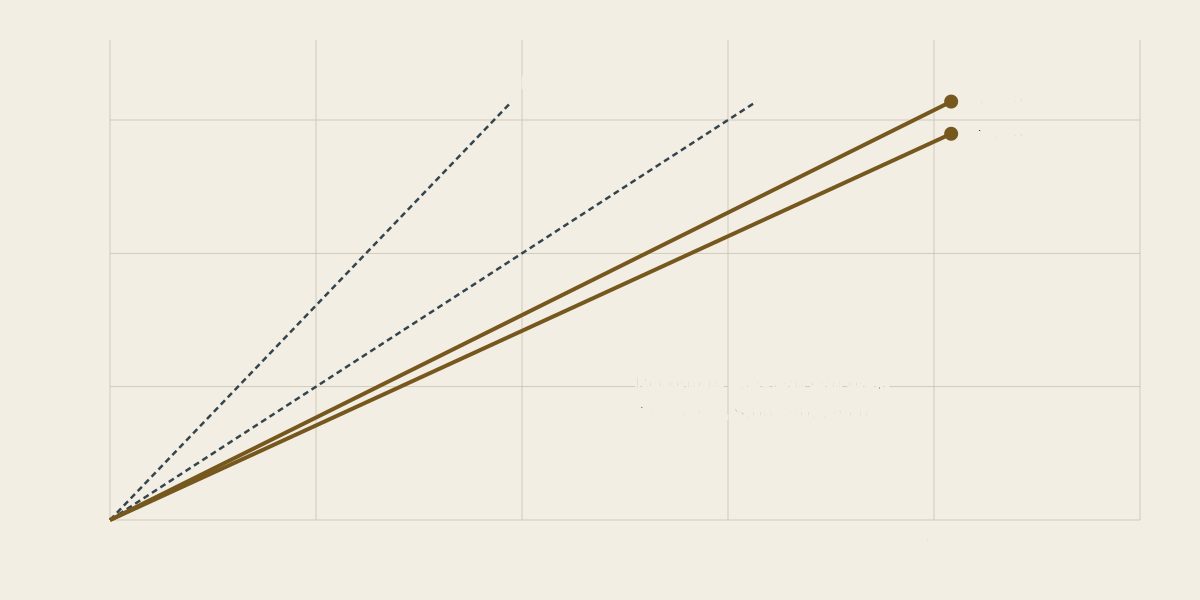
Time-distance strip for 21 February 1804. The solid lines join the start to the two working distances, 14.5 km and 15.7 km. The dashed lines show a 5 km/h walk and 5 miles per hour with no stops.
Keel, Rail & Spoke, CC BY 4.0
Data: Francis Trevithick, Life of Richard Trevithick, vol. 1 (1872), https://archive.org/details/india.history.resource.85210
Reuse this diagram: credit to copy
"Time-distance strip, 21 February 1804" by Keel, Rail & Spoke, https://keelrailandspoke.com/railways/first-steam-locomotive-1804/, licensed under CC BY 4.0 (https://creativecommons.org/licenses/by/4.0/).
Data behind this diagram: first-steam-locomotive-1804-run.csv · Where this data came from
Who won the 500-guinea bet?
The bet is real in the letters, but they do not settle its outcome. Each side of it is reported here by name. On 22 February Trevithick wrote that “the gentleman that bet 500 guineas against it rode the whole of the journey with us, and is satisfied that he has lost the bet.” That is the winning side speaking, one day later.
By July the story had changed. Samuel Homfray wrote on 10 July 1804 that a Mr. Hill, apparently the same man, “does not yet allow the 500 guineas”, because the engine did not return with the empty trams in the time horses took. Trevithick wrote on 5 July that Hill “will not pay the bet” because some plates in the tunnel had been moved, and he expected “a lawsuit”.
Later writers tell it more neatly. The Ellis note, published some fifty years on, has a bet of 1,000 guineas between Homfray and the ironmaster Richard Crawshay, and says Homfray “won his wager”. Sekon in 1899 calls the sum “a variable quantity” and says Homfray “won the bet”. Nothing read here records a payment, so the winner on paper stays open.

Dates from the letters, spaced evenly and not to scale. The 21 February run and the broken bolt are marked.
Keel, Rail & Spoke, CC BY 4.0
Data: Francis Trevithick, Life of Richard Trevithick, vol. 1 (1872), https://archive.org/details/india.history.resource.85210; Francis Trevithick, Life of Richard Trevithick, vol. 2 (1872), https://www.gutenberg.org/ebooks/46634
Reuse this diagram: credit to copy
"Dated events, February to July 1804" by Keel, Rail & Spoke, https://keelrailandspoke.com/railways/first-steam-locomotive-1804/, licensed under CC BY 4.0 (https://creativecommons.org/licenses/by/4.0/).
| Date in 1804 | What the letters say |
|---|---|
| 11 February | Fire lit, engine worked without its wheels |
| 13 February | Put on the tramroad |
| 20 February | Two miles and back so far; the bet is 500 guineas |
| 21 February | The long run; the bolt breaks on the way home |
| 22 February | Engine back in the evening; Trevithick says the gentleman has lost |
| 9 March | Official trials put off, because Homfray has been hurt in a gig accident |
| 5 July | Hill will not pay; the engine is working a hammer |
| 10 July | Homfray says Hill does not yet allow the 500 guineas |
Why did the locomotive not catch on right away?
No single reason fits every source, but the tramroad is the one named most often. Davies Gilbert recalled in 1839 that on a later trial “a large number of rails broke” under the weight on four wheels, and “on the whole the experiment was considered a failure”. The Ellis note blames heavy gradients, sharp curves and the “frangible nature of the cast-iron trackway”, and Rees Jones understood the reason to be “the weakness of the road”. Francis Trevithick, who worked engines on the same road in 1837, says men still had to jump from the trains to replace broken plates.
The engine itself did not stop at once. Trevithick had written that he would “take 40 tons the next journey”, on 4 March he wrote of trying “25 tons of iron”, and by July he reports two more loads of 10 tons to the shipping place. Rees Jones remembered it differently in 1858: one journey down the Basin road, off the road before the Basin, back behind horses, and “never used as a locomotive after this”. Thomas Ellis senior wrote in 1854 of three journeys to the Basin in all, with both axles broken coming back up on the third, “the road being only common tramroad-plates 3 feet long”.
Attention moved elsewhere too. Francis Trevithick says his father and Homfray were then eager to spread the high-pressure engine in general, “causing the partial neglect of the locomotive”, and Trevithick's letter of 5 July is full of engines for rolling iron, winding coal and a glover's workshop. Trevithick also wrote that Boulton and Watt had tried for “a Bill in the House” against such engines, which is his claim and not a finding, and in 1812 he complained that the experiment “has so far remained buried”. Francis Trevithick sets the rough tramroad against the “well-prepared level railway” of the Liverpool and Manchester line a quarter of a century later, the line of Stephenson's Rocket.
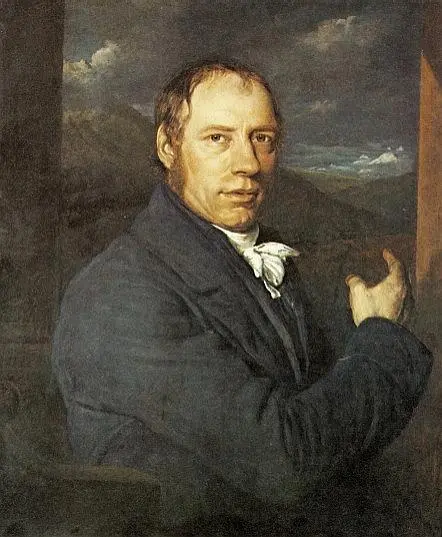
Richard Trevithick, painted by John Linnell. The file page dates the painting 1816, twelve years after the trip.
Richard Trevithick, painting, 1816 by John Linnell, Public domain
Full credit
"Richard Trevithick, painting, 1816" by John Linnell — https://commons.wikimedia.org/wiki/File:Trevithick_Richard_Linnell.jpg — Public domain (US: the file page tags it published before 1931; elsewhere: John Linnell died 1882, life plus 70 expired)

The engine had a job waiting from the start. “This engine is to work a hammer,” Trevithick wrote on 20 February, the day before the long run, and he planned “a smaller engine for the road”. His letter of 5 July, from Stourbridge, promises another trial and a lawsuit, then adds one more line: “The travelling engine is now working a hammer.”
Sources
- Francis Trevithick, Life of Richard Trevithick, with an Account of His Inventions, vol. 1 (London: E. and F. N. Spon, 1872). Prints Richard Trevithick's letters of 22 August 1802, 15, 20 and 22 February and 4 and 9 March 1804, Samuel Homfray's letter of 10 July 1804, and later notes by Davies Gilbert, Thomas Ellis and Rees Jones. Public domain; Francis Trevithick died in 1877. https://archive.org/details/india.history.resource.85210Read: pages on the Camborne road engine, Watt and high pressure, the Coalbrookdale engine, the tramroad locomotive and the Newcastle engine, pp. 114-124 and 153-183
- Francis Trevithick, Life of Richard Trevithick, with an Account of His Inventions, vol. 2 (London: E. and F. N. Spon, 1872). Prints Trevithick's letters of 5 January and 5 July 1804 and 26 April 1812. Public domain; Francis Trevithick died in 1877. https://www.gutenberg.org/ebooks/46634Read: chapter pages 42, 67-68, 128 and 132-133
- G. A. Sekon (George Augustus Nokes), The Evolution of the Steam Locomotive (1803 to 1898) (London: The Railway Publishing Co., 1899). Public domain; the author died in 1948. https://www.gutenberg.org/ebooks/73518Read: chapter pages 1-5
- "The Basin", The Abercynon history blog, 10 August 2016. https://abercynonhistoryblog.wordpress.com/2016/08/10/the-basin/Read: full page; one fact restated, nothing quoted
- Wikidata. Coordinate statements (P625) for Penydarren Ironworks (Q15265938), Quakers Yard (Q7268591), Abercynon (Q3404663). https://www.wikidata.org/wiki/Special:EntityData/Q15265938.jsonRead: entity data, coordinates only
Cite this page
Keel, Rail & Spoke. "First Known Steam Locomotive Run: 1804, Slower Than a Walk." Published 2026-11-08. https://keelrailandspoke.com/railways/first-steam-locomotive-1804/. Accessed on the date you read it.
How facts are checked · Corrections · Contact
Found a mistake on this page? Write to contact@keelrailandspoke.com.
More from Railways
Railways
How a Steam Locomotive Works: Its Exhaust Drives the Draft
A steam locomotive burns fuel such as coal to boil water, and steam pressure pushes pistons that turn its wheels. Used steam then pulls air through the fire.
Picture credit
"Amerikaanse stoomlocomotief, RP-F-2001-7-998-11 (cropped)" by unknown creator — https://commons.wikimedia.org/wiki/File:Amerikaanse_stoomlocomotief,_RP-F-2001-7-998-11_(cropped).jpg — CC0 1.0 (https://creativecommons.org/publicdomain/zero/1.0/); modified: cropped: the crop published on Wikimedia Commons, cut from the album page; no further change here
Railways
Orient Express, 1883: The Last Leg Was a Boat From Varna
The inaugural Orient Express left Paris on 4 October 1883 but stopped at the Danube. Two 1884 accounts show its last leg to Constantinople was by ship.
Picture credit
"Londres-Paris-Constantinople, Orient Express, poster, winter 1888-89 (top half)" by Jules Chéret or Imp. Chaix (Succ. Chéret) — https://commons.wikimedia.org/wiki/File:Aff_ciwl_orient_express4_jw.jpg — Public domain (US: published 1888, before 1931; elsewhere: the file page credits Jules Chéret (died 1932) and the sheet is signed Imp. Chaix (Succ. Chéret); term expired on either reading); modified: cropped: top half of the sheet, above the route map and timetable
Railways
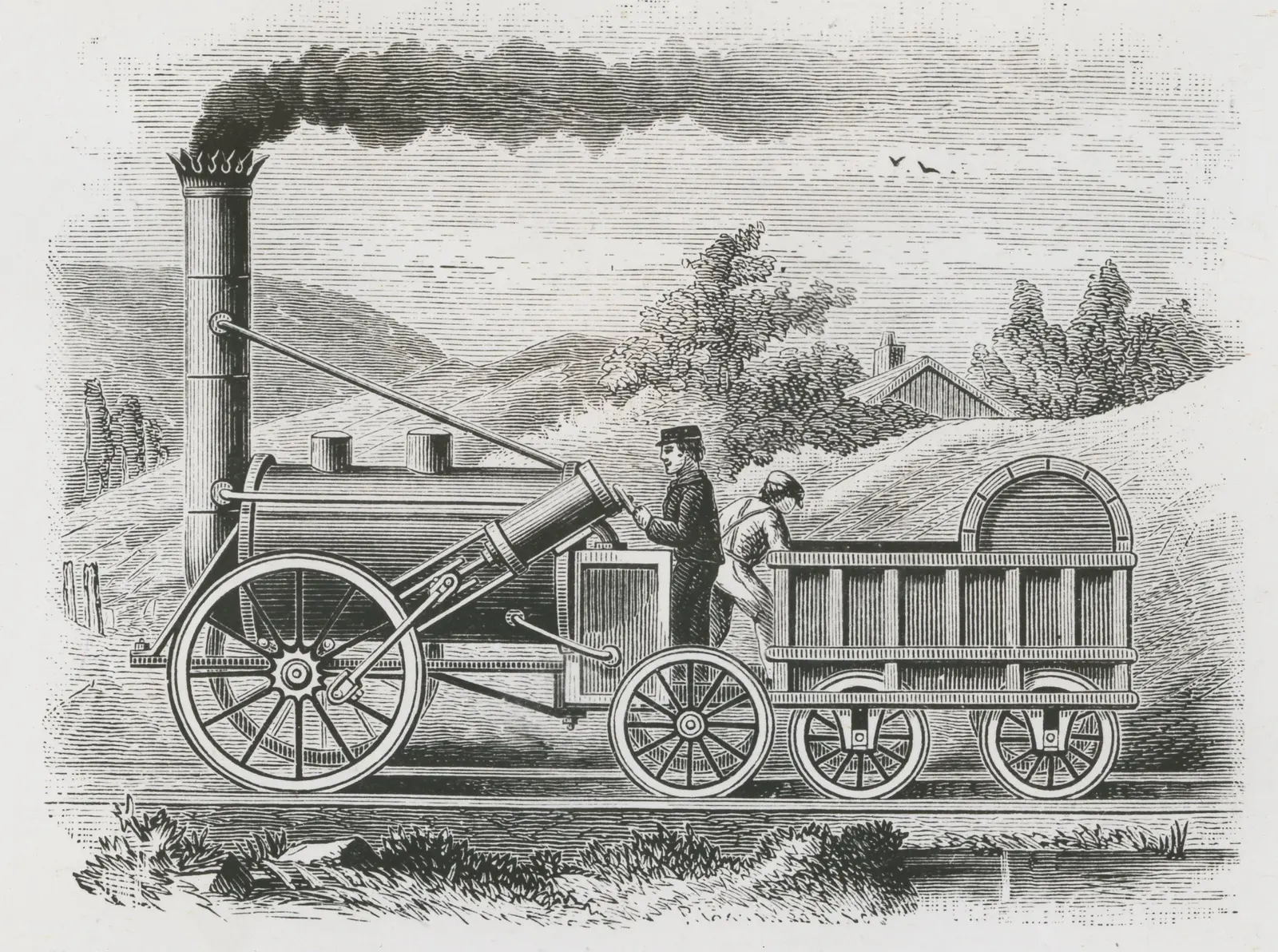
Stephenson’s Rocket, 1829: Booth Claimed the Tube Boiler
Stephenson’s Rocket won the Rainhill trials in October 1829. Henry Booth claimed its many-tube boiler in 1830; the steam blast has rival claimants too.
Picture credit
"George Stephenson's Locomotive, the "Rocket" (cropped)" by unknown creator — https://commons.wikimedia.org/wiki/File:George_Stephenson%27s_Locomotive,_the_%22Rocket%22_-_DPLA_-_eecacab18bb21c2739be253c7d20c0be.jpg — Public domain (US: published in London in 1888 per the sleeve note and the file page, before 1931; elsewhere: engraver unnamed; a working engraver of 1888 would have to have died after 1955 for the life+70 term to still run); modified: cropped: engraving only, archive sleeve and printed caption removed


