Bicycles · Evolution strip
Who Invented the Bicycle? Drais’s 1817 Machine Had No Pedals
A rider pushing with his feet in 1817, pedals in a US patent of 1866, then a rear chain and air in the tire: the bicycle has several inventors.
Keel, Rail & Spoke · Published
TL;DR
- No single inventor made the bicycle as it is now; each well-known claim covers one part.
- Karl Drais rode a steered two-wheeler with no pedals on 12 June 1817, by a report printed that July, pushing with his feet on the ground.
- US Patent 59,915 (1866) put treadles on the front wheel; Henry Lawson's British patent (1879) and the Rover (1885) ran a chain to the rear wheel; air-filled tires came from Thomson (1847 US patent, for carriages) and Dunlop (late 1888 per Schwalbach and Wilcox, for cycles).
Machine file
- Machine
- Bicycle, from Karl Drais’s two-wheeler of 1817 to the Rover safety of 1885 and the air-filled tire
- First built
- 1817: Drais rode his two-wheeler 4 Poststunden of road in one hour on 12 June, by a report printed in Baden on 29 July that rests on testimony and gives no km figure; the Neue Deutsche Biographie of 1959 says 12 July
- Converts
- Feet pushing on the ground into forward motion (1817); foot pressure on cranks into wheel rotation (US patent 1866); cranks to the rear wheel by chain (British patent 1879)
- Working speed
- About 6 to 7 miles an hour (9.7 to 11.3 km/h) on a level: a promotional claim of 1818 reported in 1869, not a measurement
- Walking multiple
- unknown (working): no measured speed read; the 1818 claim works out to about 2.1 times a 5 km/h walk at its midpoint, 6.5 miles an hour, not a measurement
- Key patent or drawing
- Drais plate, 1817; US 59,915 (Lallement, 1866); US 345,851 (Lawson, British date 1879); US 5,104 (Thomson, 1847); US 435,995 (Dunlop, 1890)
Download this card (CSV) · Where this data came from
Data: Badwochenblatt, Baden, 29 July 1817, https://commons.wikimedia.org/wiki/File:Badwochenblatt_29._July_1817,_Bericht_%C3%BCber_den_Freiherrn_von_Drais.tif, retrieved 2026-11-08; Scott 1889, https://archive.org/details/cyclingartenergy00scot, retrieved 2026-11-08; Goddard 1869, https://www.gutenberg.org/ebooks/66727, retrieved 2026-11-08; Schwalbach and Wilcox 1898, https://www.gutenberg.org/ebooks/58444, retrieved 2026-11-08; US patents 59,915, 345,851, 5,104 and 435,995, https://patents.google.com/, retrieved 2026-11-08; Rover advertisement 1885, https://commons.wikimedia.org/wiki/File:1885_Rover_bicycle_advertisement.jpg, retrieved 2026-11-08; Gormully & Jeffery catalog page, https://commons.wikimedia.org/wiki/File:Commercial_catalog,_Gormully_and_Jeffery_(page_14)_(14170215446).jpg, retrieved 2026-11-08; Neue Deutsche Biographie 4 (1959), https://www.deutsche-biographie.de/gnd118702459.html#ndbcontent, retrieved 2026-11-08


What the card means: walking multiple.
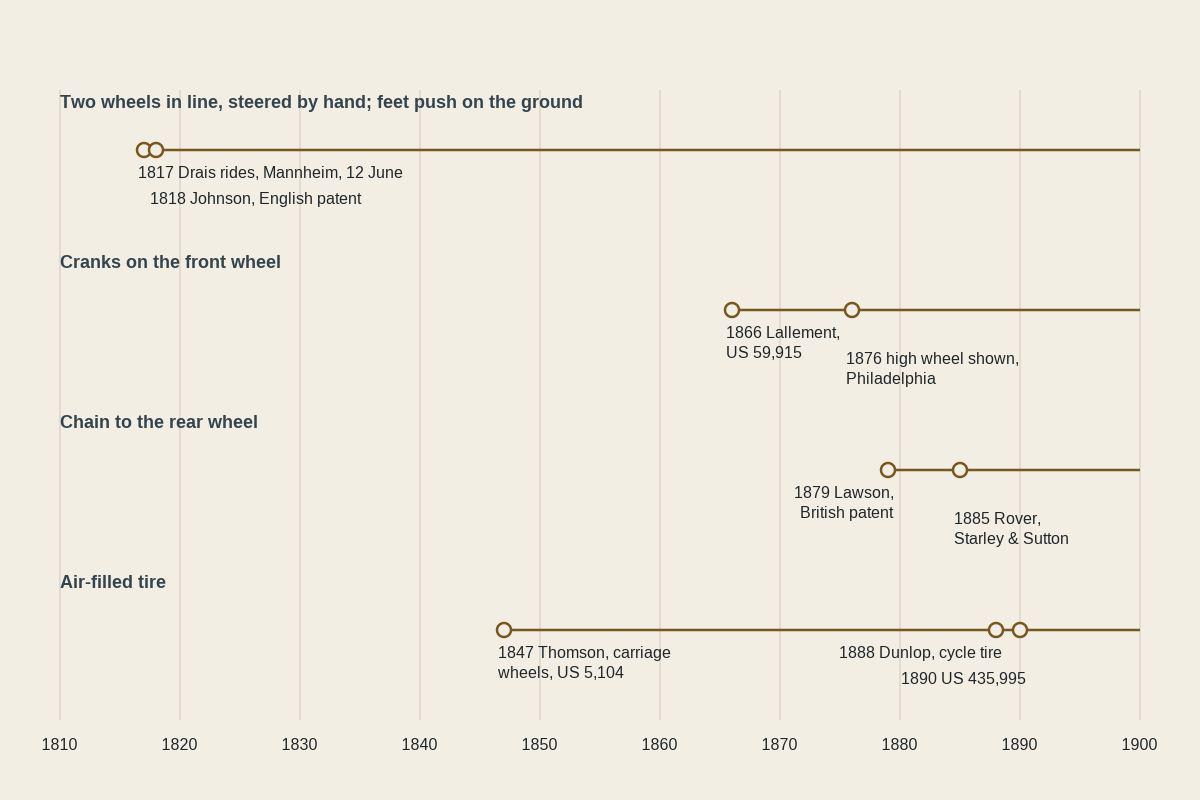
The bicycle part by part, 1817 to 1890. Each lane starts at the earliest claim read with a full date for that part; rivals with only a year, such as 1816 and Dalzell's 1845, are in the text. Thomson's 1847 air-filled belt was made for carriages. Dates carry their limits in the data file.
Keel, Rail & Spoke, CC BY 4.0
Data: Badwochenblatt, Baden, 29 July 1817, https://commons.wikimedia.org/wiki/File:Badwochenblatt_29._July_1817,_Bericht_%C3%BCber_den_Freiherrn_von_Drais.tif, retrieved 2026-11-08; Scott 1889, https://archive.org/details/cyclingartenergy00scot, retrieved 2026-11-08; Goddard 1869, https://www.gutenberg.org/ebooks/66727, retrieved 2026-11-08; Schwalbach and Wilcox 1898, https://www.gutenberg.org/ebooks/58444, retrieved 2026-11-08; US patents 59,915, 345,851, 5,104 and 435,995, https://patents.google.com/, retrieved 2026-11-08; Rover advertisement 1885, https://commons.wikimedia.org/wiki/File:1885_Rover_bicycle_advertisement.jpg, retrieved 2026-11-08; Gormully & Jeffery catalog page, https://commons.wikimedia.org/wiki/File:Commercial_catalog,_Gormully_and_Jeffery_(page_14)_(14170215446).jpg, retrieved 2026-11-08; Neue Deutsche Biographie 4 (1959), https://www.deutsche-biographie.de/gnd118702459.html#ndbcontent, retrieved 2026-11-08
Reuse this diagram: credit to copy
"The bicycle, part by part, 1817–1890" by Keel, Rail & Spoke, https://keelrailandspoke.com/bicycles/who-invented-the-bicycle/, licensed under CC BY 4.0 (https://creativecommons.org/licenses/by/4.0/).
Data behind this diagram: who-invented-the-bicycle-evolution.csv · Where this data came fromData: Badwochenblatt, Baden, 29 July 1817, https://commons.wikimedia.org/wiki/File:Badwochenblatt_29._July_1817,_Bericht_%C3%BCber_den_Freiherrn_von_Drais.tif, retrieved 2026-11-08; Scott 1889, https://archive.org/details/cyclingartenergy00scot, retrieved 2026-11-08; Goddard 1869, https://www.gutenberg.org/ebooks/66727, retrieved 2026-11-08; Schwalbach and Wilcox 1898, https://www.gutenberg.org/ebooks/58444, retrieved 2026-11-08; US patents 59,915, 345,851, 5,104 and 435,995, https://patents.google.com/, retrieved 2026-11-08; Rover advertisement 1885, https://commons.wikimedia.org/wiki/File:1885_Rover_bicycle_advertisement.jpg, retrieved 2026-11-08; Gormully & Jeffery catalog page, https://commons.wikimedia.org/wiki/File:Commercial_catalog,_Gormully_and_Jeffery_(page_14)_(14170215446).jpg, retrieved 2026-11-08
Karl Drais's two-wheeler covered four post-hours of road in one hour on 12 June 1817, with no pedals. That figure comes from the Badwochenblatt, the weekly paper of the town of Baden, in its issue of 29 July 1817, for a trip from Mannheim to the Schwetzingen relay house and back. The post-hour (Poststunde) is the report's own road measure, and on the next page the report says how the machine moved: a seat on wheels, pushed along with the feet on the ground. So Drais has a claim to part of the bicycle, and the pedals belong to someone else.
The short answer to who invented the bicycle is that no one person did. Drais has a dated, printed claim to two wheels in line, steered by hand. The pedal, the rear chain and the air-filled tire each arrived later, each with its own patent and its own dispute.
Stops on this page (6)
What did Karl Drais build in 1817?
The 1817 report calls the machine LODA, eine neuerfundene Fahrmaschine, a newly invented riding machine. Its central idea, the report says, came from ice skating, and it fits in one line: einen Sitz auf Rädern mit den Füßen auf dem Boden fortzustoßen, “a seat on wheels, to be pushed onward with the feet on the ground” (translated by Keel, Rail & Spoke). There is no crank in the description, and no chain.
The rider sat astride on two wheels, two feet high by the report's measure, one running behind the other. A small padded board in front carried the arms, and a small steering bar in the hands set the direction. The report puts the weight under 50 pounds and the price at 4 Carolin at most, travel bags included.
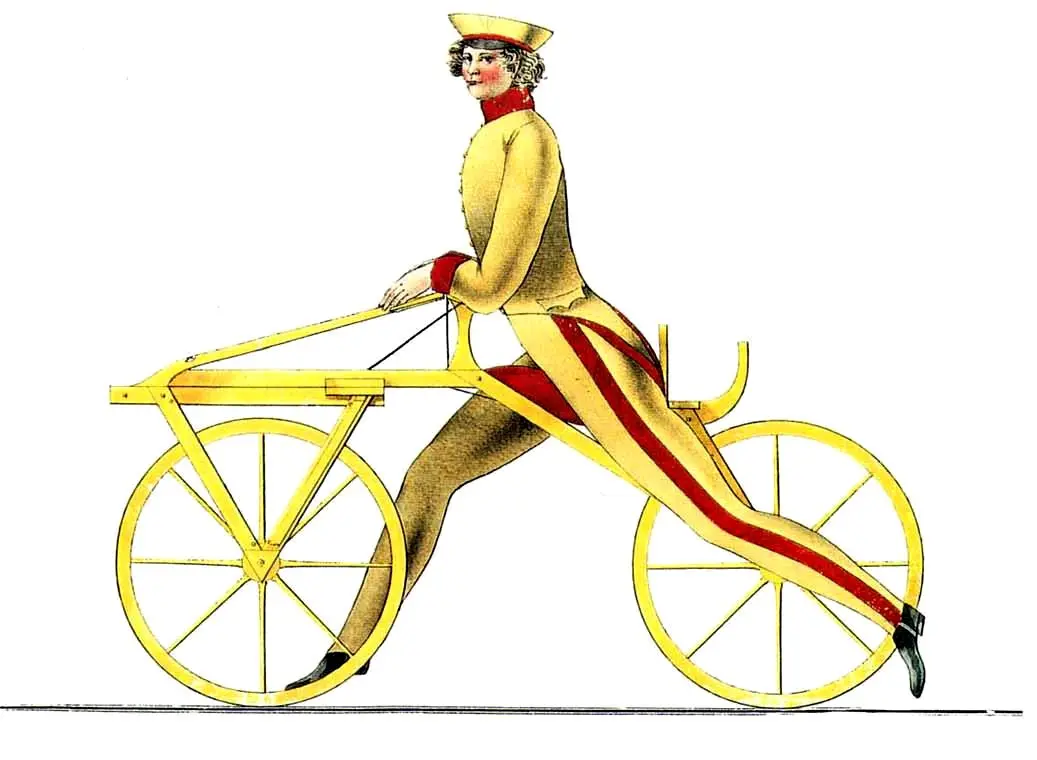
A plate signed W. Siegrist, Mannheim, 1817, which its file page places in Drais's printed description of that year, cropped here to its side view. One foot is on the road and the other leg trails behind; neither axle carries a crank.
Die Laufmaschine des Freiherrn Carl von Drais by Wilhelm Siegrist, Public domain
Full credit
"Die Laufmaschine des Freiherrn Carl von Drais" by Wilhelm Siegrist — https://commons.wikimedia.org/wiki/File:Draisine1817.jpg — Public domain (US: published 1817, before 1931; elsewhere: published 1817, engraver Wilhelm Siegrist (1797–1843?) per the file page, life+70 term long expired); modified: cropped: rider and machine in side view, down to the ground line; plan view and legend below left out

Sources split on the date of the ride. The report says Thursday 12 June, while the Neue Deutsche Biographie of 1959 says 12 July. The calendar favors the report, because 12 June 1817 was a Thursday and 12 July a Saturday. The report still hedges: it rests the ride on what it calls credible testimony (nach glaubwürdigen Zeugnissen), and it adds a steep mountain road of two hours from Gernsbach to Baden done in about one hour.
Drais was not starting from nothing. The same biography gives him a patent request in 1813 for a four-wheeled carriage driven by the person sitting in it, and a Baden privilege for the two-wheeler on 12 January 1818. It also says he never improved the design further and made no money from it.
How fast was a machine with no pedals?
The 1817 ride cannot be turned into a speed here. The report gives the road only in post-hours, and the sources read for this account do not convert that unit, so the Machine card leaves the ride as recorded.
The nearest figure is a sales claim. J. T. Goddard, writing in 1869, reports English promotion of 1818 saying the machine would average “six or seven miles an hour” on a level. The same promotion promised it would climb a hill as fast as a man could walk.
Six to seven miles an hour is 9.7 to 11.3 km/h. Against a 5 km/h walk, the claim works out to about 2.1 times walking pace at its midpoint, 6.5 miles an hour. It is a sales figure, not a measured working speed, so the Machine card gives the walking multiple as unknown. Stand beside a walker and the machine, if the advertisement was honest, pulls away at about twice the pace.
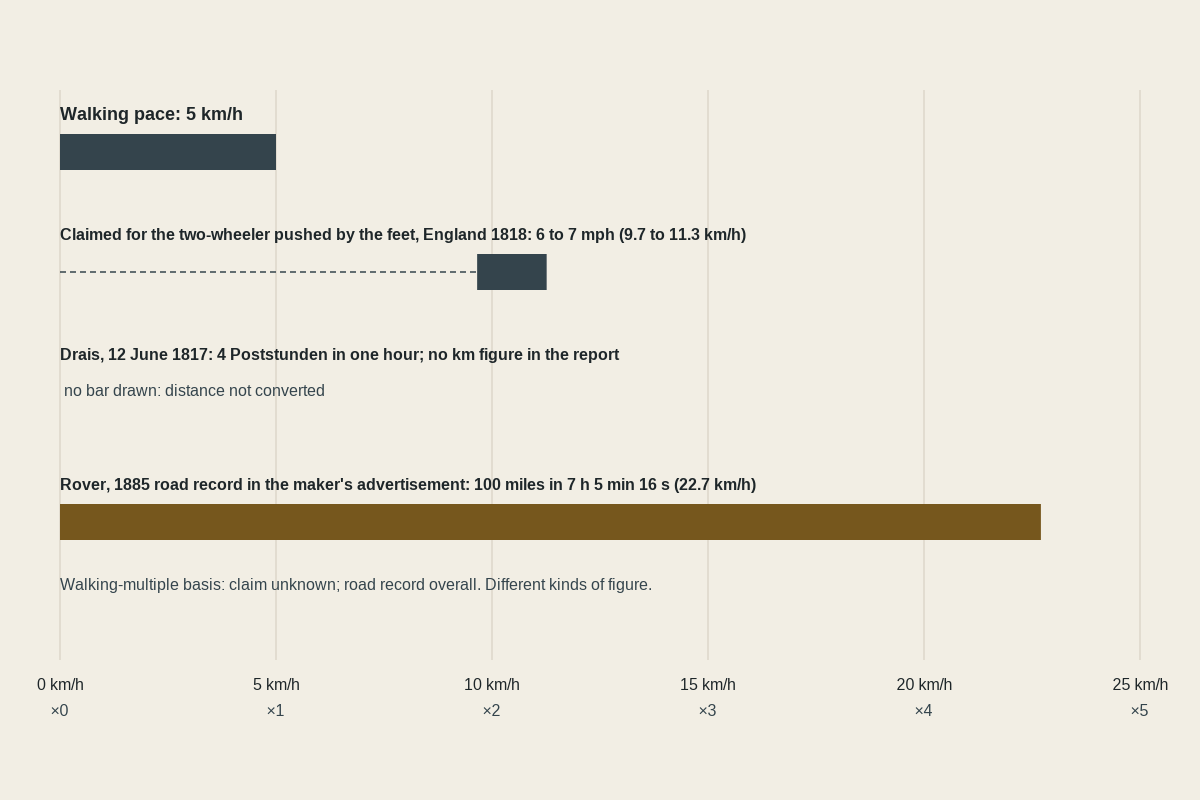
Speed figures against a 5 km/h walk. The 1818 band is a promoter's claim reported in 1869, with no basis to label it, and the 1885 bar is an overall figure from a road record printed in the maker's advertisement, so the two are not a like-for-like pair. The 1817 ride has no bar because its distance is not converted.
Keel, Rail & Spoke, CC BY 4.0
Data: Goddard 1869, https://www.gutenberg.org/ebooks/66727, retrieved 2026-11-08; Rover advertisement 1885, https://commons.wikimedia.org/wiki/File:1885_Rover_bicycle_advertisement.jpg, retrieved 2026-11-08; Badwochenblatt, Baden, 29 July 1817, https://commons.wikimedia.org/wiki/File:Badwochenblatt_29._July_1817,_Bericht_%C3%BCber_den_Freiherrn_von_Drais.tif, retrieved 2026-11-08
Reuse this diagram: credit to copy
"Speed figures against a walking pace" by Keel, Rail & Spoke, https://keelrailandspoke.com/bicycles/who-invented-the-bicycle/, licensed under CC BY 4.0 (https://creativecommons.org/licenses/by/4.0/).
Data behind this diagram: who-invented-the-bicycle-speeds.csv · Where this data came fromData: Goddard 1869, https://www.gutenberg.org/ebooks/66727, retrieved 2026-11-08; Rover advertisement 1885, https://commons.wikimedia.org/wiki/File:1885_Rover_bicycle_advertisement.jpg, retrieved 2026-11-08; Badwochenblatt 1817, https://commons.wikimedia.org/wiki/File:Badwochenblatt_29._July_1817,_Bericht_%C3%BCber_den_Freiherrn_von_Drais.tif, retrieved 2026-11-08
The fashion was real and short. The Neue Deutsche Biographie calls the machine a popular but passing craze, mainly in France and England, and Goddard says it sank to a plaything for young people.
The year itself has rivals. Goddard dates the debut to 1816, in a Paris garden, under the name Célérifère, and Schwalbach and Wilcox, in 1898, also start the two-wheeler in 1816. Neither book gives a dated ride, so 1817 is the firmest year read here.
Patents add another name. Robert P. Scott, in 1889, gives Dennis Johnson's English patent No. 4321 of December 1818 and calls him the first patentee of a single-track balancing machine. The German biography lists an English patent for Drais's machine that same month, dated 22 December. In Scott's words, the Johnson rider's feet were still “touching the ground.”
Who put pedals on the bicycle?
The first patent read for pedals is US 59,915, granted on 20 November 1866, which is 49 years after the Mannheim ride. Pierre Lallement of Paris, then living at New Haven, Connecticut, assigned it to himself and James Carroll. He fixed cranks to the front axle and hung a rocking treadle on each one. His claim covers “the two wheels, A and B, provided with the treadles F, and the guiding-arms D.”
The patent turned out to be worth money. Goddard reports that its later owner, Calvin Witty, charged American makers at least ten dollars a machine in 1869, and Goddard blames the old machine's unpopularity on its “lack of these cranks.” Schwalbach and Wilcox call it the most valuable patent behind the suits that followed.
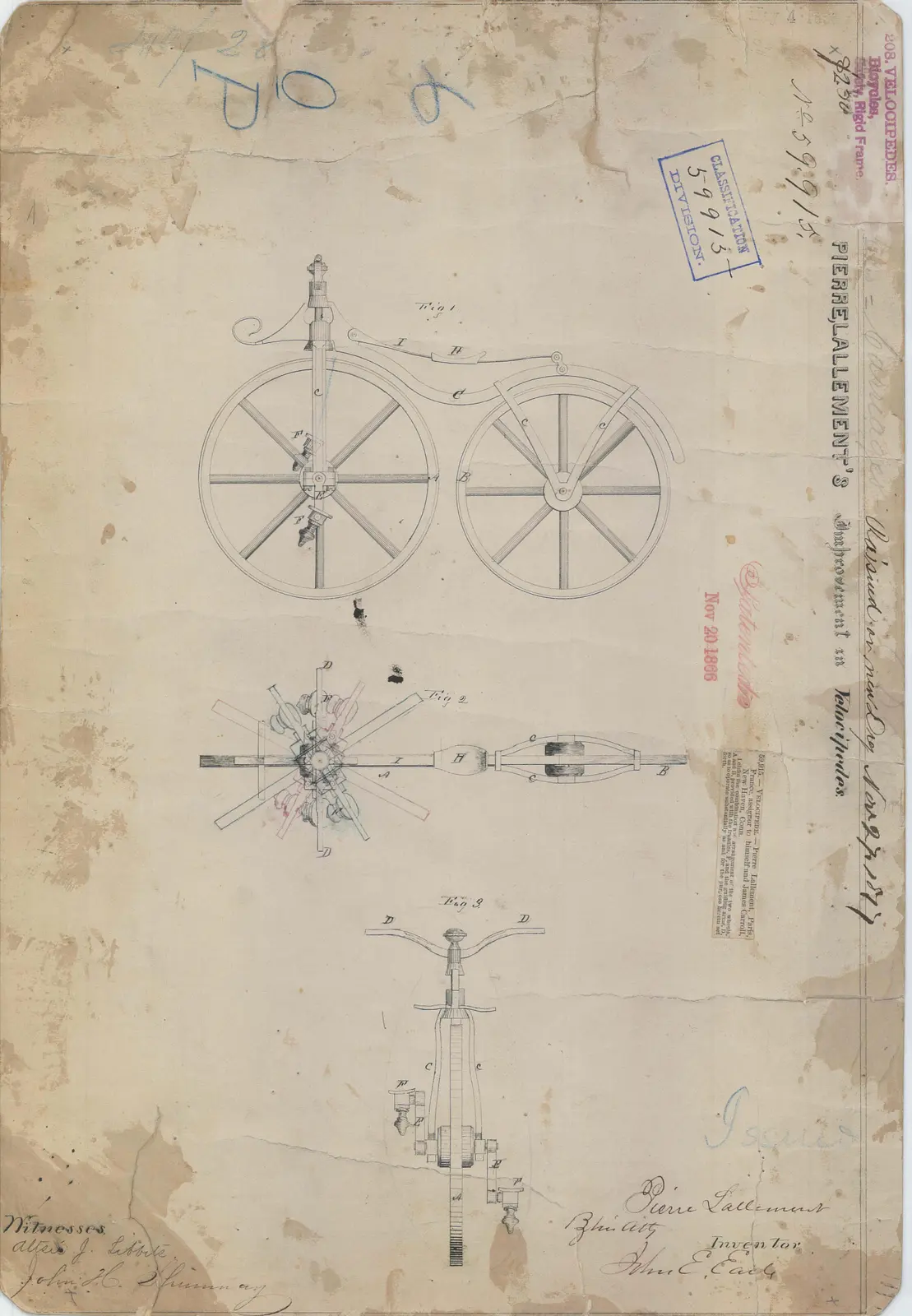
Lallement's patent drawing of 1866, from the US National Archives. Figure 1 at the top shows the side view, with the treadles at the front axle.
Patent Drawing for Pierre Lallement’s Improvement in Velocipedes by Pierre Lallement, Public domain
Full credit
"Patent Drawing for Pierre Lallement’s Improvement in Velocipedes" by Pierre Lallement — https://commons.wikimedia.org/wiki/File:Patent_Drawing_for_Pierre_Lallement's_Improvement_in_Velocipedes_-_NARA_-_6277639.jpg — Public domain (US: US patent drawing of 1866, published before 1931; elsewhere: published 1866 over the inventor’s signature; a life+70 term could run today only if an adult of 1866 had died after 1955)

The patent also holds a line on balance: “The greater the velocity, the more easily the upright position is maintained.” That rider is steering. The physics of a riderless bicycle is a separate question.
A patent does not settle who rode first, and the early books say so. Goddard has Lallement fitting the treadles and selling his machine to Michaux & Co. of Paris. Schwalbach and Wilcox give more credit to Michaux, write that “Lallement invented nothing,” and report that Wilcox saw a velocipede ridden in Brooklyn nearly two years before the patent.
Scott notes a rival claim for a man named Dalzell, whose machine he captions 1845, and says it was “stoutly maintained in Coventry” that others used cranks first. Accounts differ, so the safe statement is narrower. US 59,915 is the earliest pedal patent read here, and Scott's fallback, if the Dalzell claim holds, leaves Lallement “the first patentee.” Credit quarrels of this shape are not rare, as Stephenson's Rocket shows, and the word “first” gives trouble with the First Steam Locomotive too.
Did Leonardo da Vinci draw a bicycle?
Probably not, on the case summarized by Pryor Dodge on his website. A bicycle sketch on a sheet of the Codex Atlanticus was thought to come from the studio of Leonardo da Vinci. Hans-Erhard Lessing argued in 1997 that it was a forgery, citing Carlo Pedretti, who saw only faint traces of circles on that sheet in 1961.
Lessing dated the drawing to between 1967 and 1974. This account rests on Dodge's summary, not on Lessing's papers.
Why did the front wheel grow, then shrink?
The next part was about reach. Schwalbach and Wilcox explain that a larger front wheel gave “a longer run for each foot-stroke,” so the wheel grew as large as the rider could reach and the back wheel shrank to 16 to 18 inches. This is the high wheel, or ordinary: a Chicago maker's catalog page lists a 50-inch front wheel for a 33-inch inside leg, so the rider's leg set the size of the machine. Thomas Stevens took a high wheel around the world in the 1880s.
The fix put the feet between the wheels. Henry John Lawson's US Patent 345,851 of 1886 cites a British patent of 30 September 1879, with the pedal axle between the wheels and “an endless driving-chain” to the rear wheel.
Its stated purpose is to keep the rider from being thrown forward over the front wheel, and the patent also admits that others had already proposed a chain to a larger rear wheel. Scott, printing the claim in 1889, wrote that the English patent would make Lawson “an early, but negligent, inventor” of the rear-driving safety.
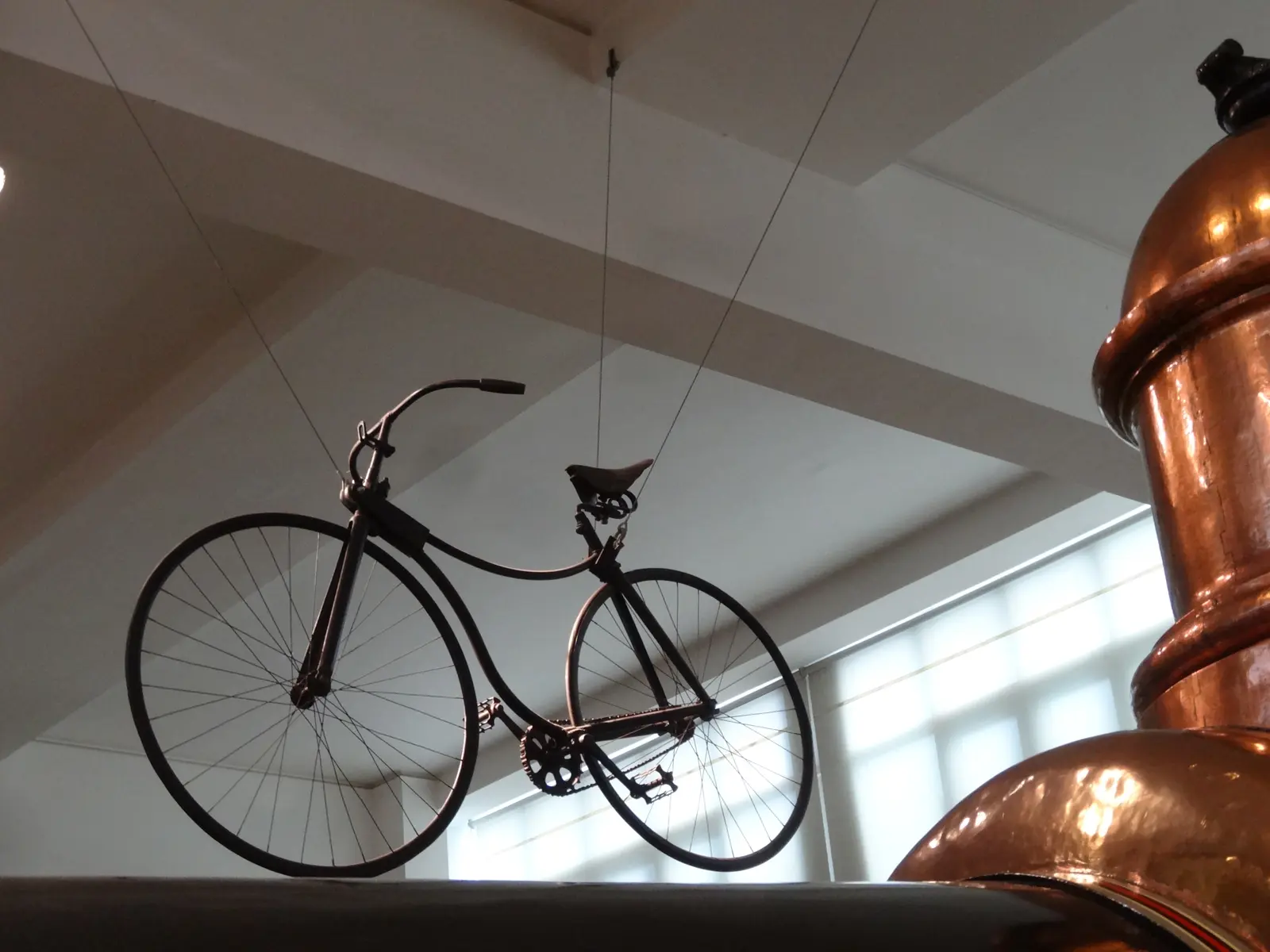
A Rover safety bicycle of 1885, as identified by the photographer's file page, hanging in the Science Museum in London. Photographed in 2016.
"Rover safety bicycle of 1885 (left)" by Jonathan Cardy — https://commons.wikimedia.org/wiki/File:Rover_safety_bicycle_of_1885_(left).jpg — CC BY-SA 3.0 (https://creativecommons.org/licenses/by-sa/3.0)

The Rover made that layout stick. Starley & Sutton of Coventry advertised it in May 1885 with a 36-inch front wheel and a 30-inch back wheel. Scott was in Coventry that summer and admits he joined the general laugh at it.
By November the maker was printing a road record by George Smith: 100 miles in 7 hours 5 minutes 16 seconds. That is 22.7 km/h, or a walking multiple of about 4.5 (overall), though a maker's record is not the same kind of figure as the claim of 1818. Schwalbach and Wilcox say that by 1898 most riders knew this type simply as “the bicycle.” One caution on dates: they caption their Rover picture 1878, while they call the 1879 “Bicyclette” the earlier specimen.
Who added the air-filled tire?
On these dates, the idea is older than the bicycle's chain. Robert William Thomson's US Patent 5,104, dated 8 May 1847, describes “a hollow belt” of rubberized material, inflated with air, around the wheels of carriages. That is 41 years before the date given for John Boyd Dunlop's cycle tire. Thomson's patent is about carriages, and the pages read do not say whether Dunlop knew of it.
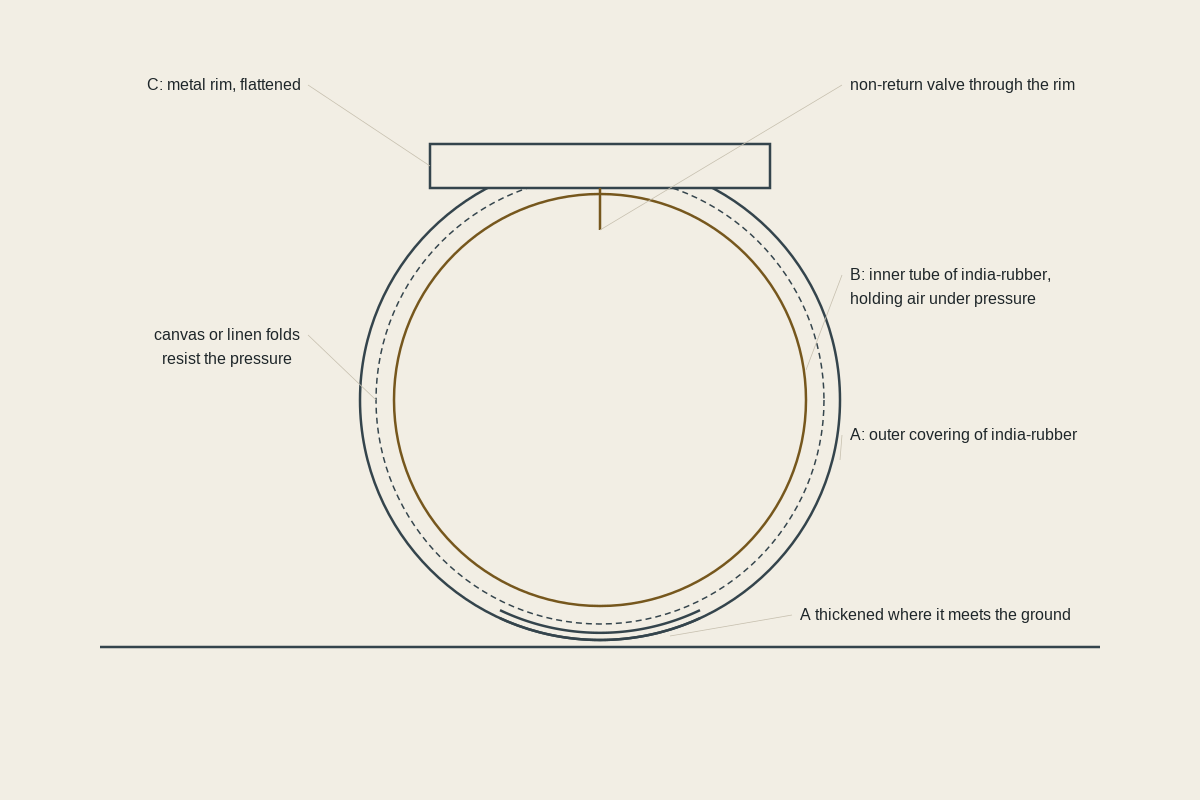
A tire section drawn from the text of US 435,995, not traced from its figure. Sizes are not to scale.
Keel, Rail & Spoke, CC BY 4.0
Data: US 435,995, https://patents.google.com/patent/US435995A/en, retrieved 2026-11-08
Reuse this diagram: credit to copy
"Dunlop’s tire, drawn from the patent text" by Keel, Rail & Spoke, https://keelrailandspoke.com/bicycles/who-invented-the-bicycle/, licensed under CC BY 4.0 (https://creativecommons.org/licenses/by/4.0/).
Dunlop's US 435,995, “Wheel Tire for Cycles,” is dated 9 September 1890. It describes an inner tube of india-rubber holding air under pressure, inside an outer covering thickened where it meets the ground, with canvas or linen folds to take the strain. Schwalbach and Wilcox say Dunlop, a veterinary surgeon of Belfast, invented it late in 1888, and that the first ones reached the United States in the fall of 1889. Those early tires were about 2 inches in diameter, and the authors describe a puncture as almost a day's work to repair.
Six claims, each missing a part
Set side by side, the claims read like a parts list. No row below describes a whole modern bicycle, and each row carries the source of its date.
| Claim | Date as read | What it added | What it lacked |
|---|---|---|---|
| Karl Drais | Ride on 12 June 1817, per the Badwochenblatt; 12 July, per the Neue Deutsche Biographie | Two wheels in line, steered by hand | Any drive; feet pushed the road |
| Pierre Lallement, US 59,915 | 20 November 1866 | Treadles on cranks at the front axle | Chain; air-filled tire |
| Henry J. Lawson | British patent, 30 September 1879 | Chain to the rear wheel, low seat | Air-filled tire |
| Starley & Sutton, Rover | Advertised May 1885 | That layout on sale, 36-inch and 30-inch wheels | Air-filled tire in the advertisement |
| R. W. Thomson, US 5,104 | 8 May 1847 | Air-filled belt | Written for carriages, not cycles |
| J. B. Dunlop, US 435,995 | Late 1888, per Schwalbach and Wilcox; patent 9 September 1890 | Inner tube and cover for cycles | Rest of the machine |
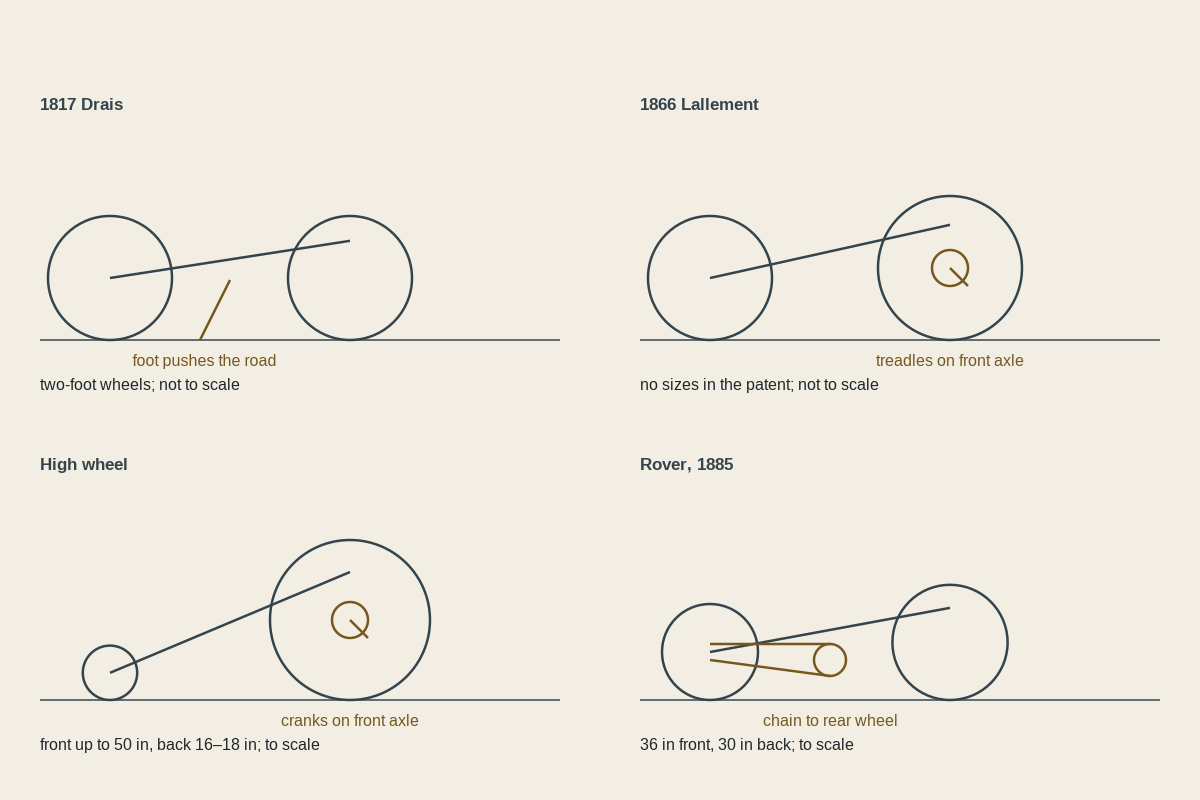
Where the foot does its work on four machines. The high wheel and the Rover are to scale from printed sizes; the two earlier profiles are not, because the sources give no usable dimensions.
Keel, Rail & Spoke, CC BY 4.0
Data: Badwochenblatt 1817, https://commons.wikimedia.org/wiki/File:Badwochenblatt_29._July_1817,_Bericht_%C3%BCber_den_Freiherrn_von_Drais.tif, retrieved 2026-11-08; US 59,915, https://patents.google.com/patent/US59915A/en, retrieved 2026-11-08; Gormully & Jeffery catalog page, https://commons.wikimedia.org/wiki/File:Commercial_catalog,_Gormully_and_Jeffery_(page_14)_(14170215446).jpg, retrieved 2026-11-08; Schwalbach and Wilcox 1898, https://www.gutenberg.org/ebooks/58444, retrieved 2026-11-08; Rover advertisement 1885, https://commons.wikimedia.org/wiki/File:1885_Rover_bicycle_advertisement.jpg, retrieved 2026-11-08
Reuse this diagram: credit to copy
"Where the foot works, 1817–1885" by Keel, Rail & Spoke, https://keelrailandspoke.com/bicycles/who-invented-the-bicycle/, licensed under CC BY 4.0 (https://creativecommons.org/licenses/by/4.0/).
The earliest of these records calls the machine newly invented and leaves it there. It closes on its plain sales facts, under 50 pounds and 4 Carolin at most, and then a date line: Baden, am 28. July 1817.
Sources
- "LODA, eine neuerfundene Fahrmaschine." Badwochenblatt für die Großherzogliche Stadt Baden, No. 24, 29 July 1817, pp. 188–189. https://commons.wikimedia.org/wiki/File:Badwochenblatt_29._July_1817,_Bericht_%C3%BCber_den_Freiherrn_von_Drais.tifRead: full report, read from page scans, in the original German
- Lallement, Pierre. Improvement in velocipedes. US Patent 59,915, 20 November 1866. https://patents.google.com/patent/US59915A/enRead: full specification, from a scanned text checked against the drawing and the copies printed by Goddard and Scott
- Lawson, Henry John. Velocipede. US Patent 345,851, 20 July 1886. https://patents.google.com/patent/US345851A/enRead: full page, from a scanned text
- Thomson, Robert William. Improvement in carriage-wheels. US Patent 5,104, 8 May 1847. https://patents.google.com/patent/US5104A/enRead: full page, from a scanned text
- Dunlop, John Boyd. Wheel tire for cycles. US Patent 435,995, 9 September 1890. https://patents.google.com/patent/US435995A/enRead: full page, from a scanned text
- Starley & Sutton. Advertisements for the Rover safety bicycle, dated May and November 1885; the file page cites the C.T.C. Monthly Gazette for May 1885. https://commons.wikimedia.org/wiki/File:1885_Rover_bicycle_advertisement.jpgRead: full page: both advertisements as reproduced on the file page
- Gormully & Jeffery. Catalog page 14, The Ideal Bicycle, Chicago, no year on the page. https://commons.wikimedia.org/wiki/File:Commercial_catalog,_Gormully_and_Jeffery_(page_14)_(14170215446).jpgRead: full page: the single catalog page
- Goddard, J. T. The Velocipede: Its History, Varieties, and Practice. New York: Hurd and Houghton, 1869. https://www.gutenberg.org/ebooks/66727Read: chapters on history and the patents
- Scott, Robert P. Cycling Art, Energy, and Locomotion. Philadelphia: Lippincott, 1889. https://archive.org/details/cyclingartenergy00scotRead: chapters on the early machines, the Rover and the patent digest
- Schwalbach, A., and J. Wilcox. The Modern Bicycle and Its Accessories. New York: Commercial Advertiser Association, 1898. https://www.gutenberg.org/ebooks/58444Read: chapters on evolution and tires
- Weiher, Sigfrid von. "Drais von Sauerbronn, Karl Friedrich Christian Ludwig Freiherr." Neue Deutsche Biographie 4 (1959), pp. 100–101. https://www.deutsche-biographie.de/gnd118702459.html#ndbcontentRead: full entry, in German
- Dodge, Pryor. "The Leonardo da Vinci Bicycle Hoax." https://pryordodge.com/The_Bicycle_Leonardo.htmlRead: full page; summary of Lessing 1997 and 1998, not the papers themselves
Cite this page
Keel, Rail & Spoke. "Who Invented the Bicycle? Drais’s 1817 Machine Had No Pedals." Published 2026-11-08. https://keelrailandspoke.com/bicycles/who-invented-the-bicycle/. Accessed on the date you read it.
How facts are checked · Corrections · Contact
Found a mistake on this page? Write to contact@keelrailandspoke.com.
More from Bicycles
Bicycles
Cornell Reported a 2011 Test Bicycle Balanced With No Gyroscope Effect
A self-stable bicycle steers into its own lean. Cornell reported a 2011 test bike doing so with its gyroscopic effect cancelled, though it can help other bikes.
Picture credit
"Man leert vrouw fietsen, vermoedelijk in Frankrijk" by unknown creator — https://commons.wikimedia.org/wiki/File:Man_leert_vrouw_fietsen,_vermoedelijk_in_Frankrijk,_RP-F-F01164-57-4.jpg — CC0 1.0 (https://creativecommons.org/publicdomain/zero/1.0/)
Bicycles
Bicycle Around the World: Stevens Counted About 13,500 Miles
Thomas Stevens put about 13,500 miles wheeled in his own table, San Francisco to Yokohama, 1884 to 1886: what he rode, what went by ship, his arrest at Furrah.
Picture credit
"Crossing the Sierra Nevadas" by W. A. Rogers — https://commons.wikimedia.org/wiki/File:Image_taken_from_page_40_of_%27Around_the_World_on_a_Bicycle_..._From_San_Francisco_to_Teheran._With_..._illustrations._(With_preface_by_T._W._Higginson.)%27_(11186813893).jpg — Public domain (US: published 1887, before 1931; elsewhere: signed W. A. Rogers, read as William Allen Rogers, died 1931, life+70 term expired); modified: cropped: page text above and printed caption below removed; reduced to no more than 1,600 px wide

