Bicycles · Machine file
Cornell Reported a 2011 Test Bicycle Balanced With No Gyroscope Effect
A self-stable bicycle balances only inside a range of speeds, and a 2011 test machine, Cornell reported, did it with its wheels' gyroscopic effect cancelled.
Keel, Rail & Spoke · Published
TL;DR
- A riderless bicycle that stays up steers into its own lean, which brings the wheels back under it, and this works only in a range of speeds set by the design.
- Cornell reported in 2011 that a riderless test bicycle with counter-rotating disks and slightly negative trail still balanced above about 5 mph, so self-stability does not always need the gyroscopic effect or positive trail.
- Those effects can still help an ordinary bicycle: with its wheel-spin terms removed, the 2007 benchmark model has no self-stable speed up to 30 m/s.
Machine file
- Machine
- Self-stable bicycle: the 2007 benchmark model (equations; a fixed rider mass, no steering input) and the riderless 2011 Two Mass Skate test bicycle (built), kept separate
- First built
- n/a: this page covers balance; the machine's history is on the page Who Invented the Bicycle
- Converts
- Forward speed and a lean into a steering correction that brings the wheels back under the bicycle
- Working speed
- Benchmark model: 4.29 to 6.02 m/s (15.5 to 21.7 km/h), calculated, no rider input. 2011 test bicycle: more than about 5 mph (more than about 8 km/h), as reported by Cornell. Different machines, not to be combined
- Walking multiple
- 3.1 (working): lower edge of the calculated benchmark range; upper edge 4.3. The 2011 test bicycle, at more than about 5 mph as reported by Cornell, is above about 1.6 (working) and is a different machine
- Key patent or drawing
- Meijaard et al. 2007, benchmark and equations; Kooijman et al. 2011, Science 332: 339-342, reported through Cornell Chronicle and CORDIS
Download this card (CSV) · Where this data came from
Data: Meijaard, Papadopoulos, Ruina & Schwab 2007, https://doi.org/10.1098/rspa.2007.1857, author preprint at http://ruina.tam.cornell.edu/research/topics/bicycle_mechanics/stablebicycle/FinalBicyclePaperv45wAppendix.pdf, retrieved 2026-11-07; Cornell Chronicle, 14 April 2011, https://news.cornell.edu/stories/2011/04/researchers-explain-why-bicycles-balance-themselves, retrieved 2026-11-08; CORDIS, 18 April 2011, https://cordis.europa.eu/article/id/33320-new-research-uncovers-why-a-bicycle-stays-stable-when-moving, CC BY 4.0, retrieved 2026-11-08
What the card means: walking multiple.
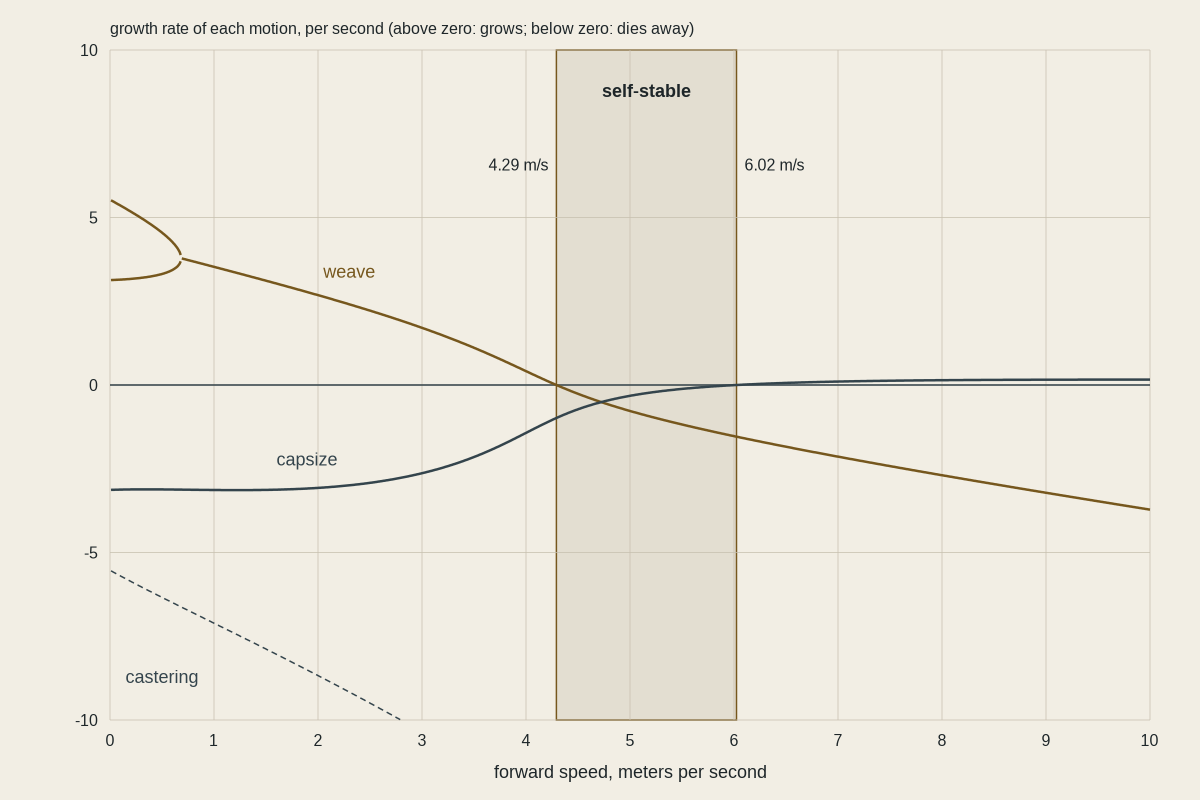
Growth rate of each motion of the benchmark bicycle, recalculated from the published equations. Every motion dies away only in the shaded range, 4.29 to 6.02 m/s. This is a model with a fixed rider mass and no steering input, not a measurement.
Keel, Rail & Spoke, CC BY 4.0
Data: Meijaard, Papadopoulos, Ruina & Schwab 2007, https://doi.org/10.1098/rspa.2007.1857, author preprint at http://ruina.tam.cornell.edu/research/topics/bicycle_mechanics/stablebicycle/FinalBicyclePaperv45wAppendix.pdf, retrieved 2026-11-07
Reuse this diagram: credit to copy
"Benchmark bicycle: growth rate of each motion by speed" by Keel, Rail & Spoke, https://keelrailandspoke.com/bicycles/why-a-bicycle-stays-up/, licensed under CC BY 4.0 (https://creativecommons.org/licenses/by/4.0/).
Data behind this diagram: why-a-bicycle-stays-up-eigenvalues.csv · Where this data came from
The benchmark bicycle of 2007 balances itself only between 4.29 and 6.02 meters per second. That range comes from equations published by Jaap Meijaard, Jim Papadopoulos, Andy Ruina and Arend Schwab in the Proceedings of the Royal Society A. Recalculated here, it is 15.5 to 21.7 km/h, a working walking multiple of 3.1 to 4.3 against a 5 km/h walk. Why it stays up at all is the harder question.
The short answer: a bicycle rolling fast enough can steer itself back under its own lean, and that link between lean and steering keeps it upright with no rider aboard. The bicycle gyroscope explanation names one way to make that link, not the only way. Cornell reported in 2011 that a test machine did it with the gyroscopic effect cancelled.
Stops on this page (6)
Which speeds keep the benchmark bicycle up?
The benchmark is a bicycle defined on paper, so that other researchers can test their equations against it. It has 25 design numbers and a rider fixed rigidly to the frame. Its authors say some values are exaggerated on purpose so that their effects show up in the numbers. It is a test case, and it describes no one bicycle.
Its equations give four growth rates at each speed. Above zero a motion grows, and below zero it dies away. The bicycle balances itself only when every one of them is below zero. The authors name the motions: weave, a sinuous steering with the lean; capsize, a fall into a tightening spiral; and castering, in which the front wheel lines itself up like a swivel wheel on a grocery cart.
| Speed (m/s) | km/h | Working walking multiple (5 km/h walk) | Weave rate (per s) | Capsize rate (per s) | What the model does |
|---|---|---|---|---|---|
| 2 | 7.2 | 1.4 | +2.682 | −3.072 | Benchmark, calculated: falls in growing swings |
| 4 | 14.4 | 2.9 | +0.413 | −1.429 | Benchmark, calculated: falls in slowly growing swings |
| 5 | 18.0 | 3.6 | −0.775 | −0.323 | Benchmark, calculated: recovers |
| 6 | 21.6 | 4.3 | −1.526 | −0.004 | Benchmark, calculated: recovers, barely on capsize |
| 8 | 28.8 | 5.8 | −2.693 | +0.143 | Benchmark, calculated: slowly tips over |
| 10 | 36.0 | 7.2 | −3.720 | +0.161 | Benchmark, calculated: slowly tips over |
That table shows why the slow benchmark falls. Below 4.29 m/s its weave grows, each swing larger than the last. Below about 0.68 m/s there is no swing at all, only two ways of toppling, which the paper compares to an inverted pendulum falling.
The top edge is gentler. Past 6.02 m/s the capsize rate turns positive but stays small: at 10 m/s it is 0.161 per second, so a lean doubles about every 4.3 seconds. The authors call this mildly unstable. The model, like a steam locomotive whose own exhaust drives its draft, does something at speed that it cannot do standing still.
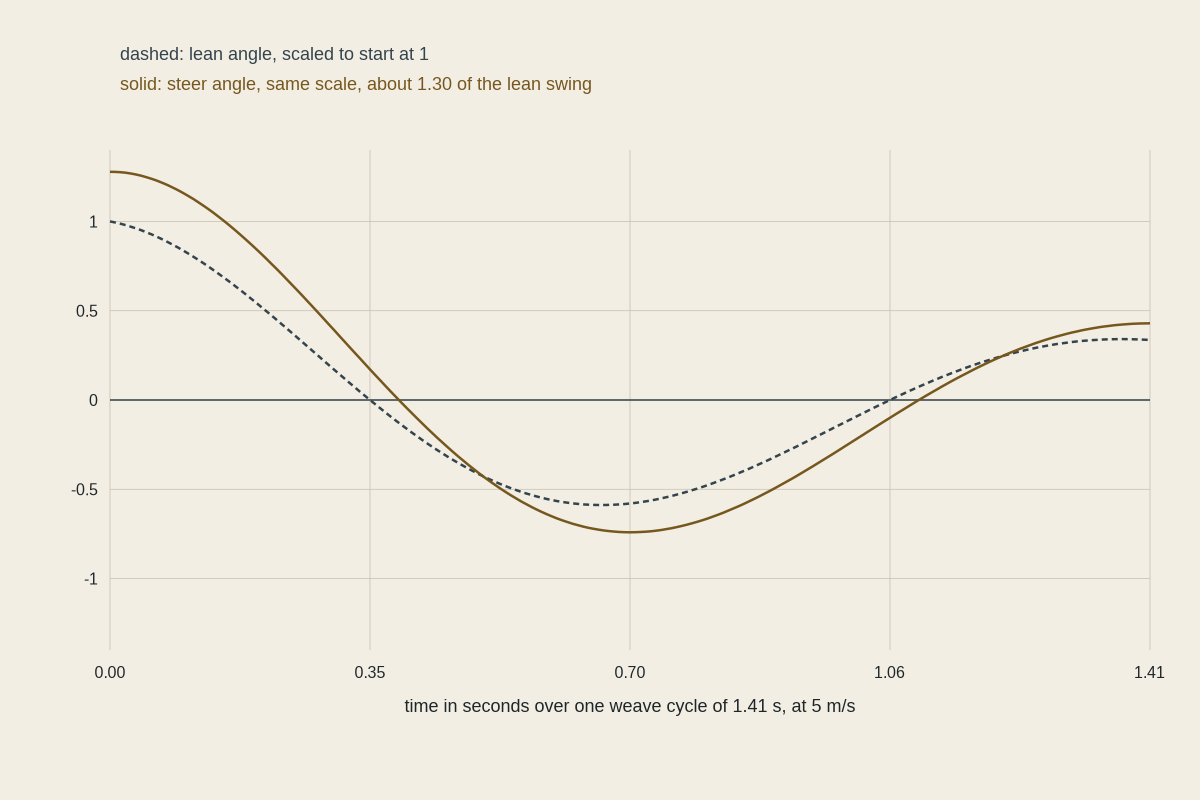
One weave cycle of the benchmark at 5 m/s, recalculated. Steering follows the lean by about 10 degrees of the cycle, and both swings shrink as they go.
Keel, Rail & Spoke, CC BY 4.0
Data: Meijaard, Papadopoulos, Ruina & Schwab 2007, https://doi.org/10.1098/rspa.2007.1857, author preprint at http://ruina.tam.cornell.edu/research/topics/bicycle_mechanics/stablebicycle/FinalBicyclePaperv45wAppendix.pdf, retrieved 2026-11-07
Reuse this diagram: credit to copy
"One weave cycle at 5 m/s" by Keel, Rail & Spoke, https://keelrailandspoke.com/bicycles/why-a-bicycle-stays-up/, licensed under CC BY 4.0 (https://creativecommons.org/licenses/by/4.0/).
Data behind this diagram: why-a-bicycle-stays-up-weave-cycle.csv · Where this data came from
Inside the range, the weave is what recovery looks like. At 5 m/s one cycle takes 1.41 seconds, and the steering peaks about 0.04 seconds after the lean. The swing dies away at 0.775 per second.
What does a leaning bicycle do with its front wheel?
The model has four rigid parts: rear wheel, rear frame with rider, fork and handlebars, and front wheel. They join at the rear axle, at the steering head and at the front axle. Emmanuel Carvallo in 1897, and then Francis Whipple in 1899, used equations for machines like this to show in theory that some bicycles could balance themselves in the right speed range.
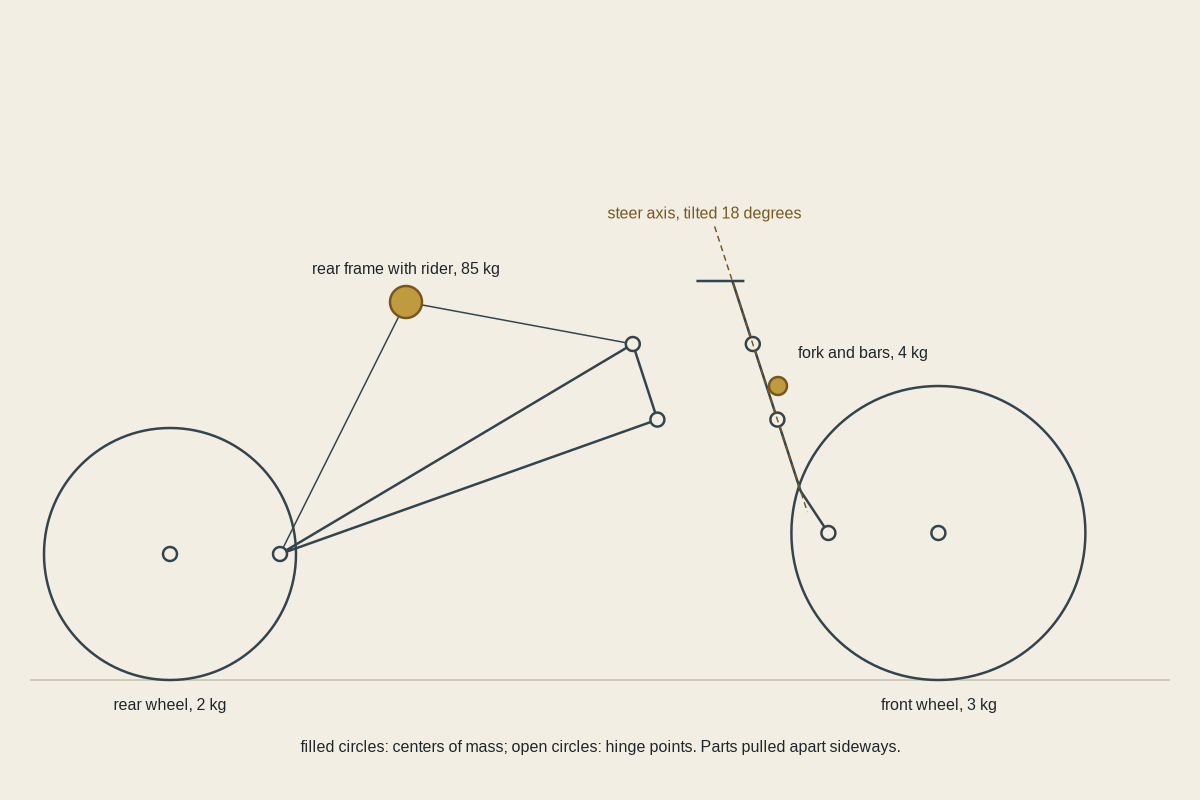
The four parts of the benchmark, pulled apart sideways. Wheel sizes, steering tilt and mass centers are drawn to one scale from its published dimensions; frame outlines are schematic. The wheelbase is 1.02 m, the trail 0.08 m. Most of the 94 kg sits in the rear frame.
Keel, Rail & Spoke, CC BY 4.0
Data: Meijaard, Papadopoulos, Ruina & Schwab 2007, https://doi.org/10.1098/rspa.2007.1857, author preprint at http://ruina.tam.cornell.edu/research/topics/bicycle_mechanics/stablebicycle/FinalBicyclePaperv45wAppendix.pdf, retrieved 2026-11-07
Reuse this diagram: credit to copy
"The bicycle model pulled into four parts" by Keel, Rail & Spoke, https://keelrailandspoke.com/bicycles/why-a-bicycle-stays-up/, licensed under CC BY 4.0 (https://creativecommons.org/licenses/by/4.0/).
The working part is the hinge at the steering head: when a moving bicycle begins to fall, by Cornell's account, a self-stable one turns its handlebars toward the fall, as a rider would. That moves the wheels back under the mass. The authors' page gives turning into a fall, with the words carefully defined, as a necessary condition. The paper's image for the rider's version is a broom balanced upright on an open hand, kept up by moving the hand toward the lean.
What turns the wheel is harder to state. The 2007 paper lists several effects that tie lean to steering: gyroscopic precession, the ground's sideways force at a contact point that trails the steering axis, gravity and inertia acting on a front assembly whose mass sits off that axis, and the way that assembly's inertia is spread. The authors say the equations show that the bicycle stays up, and that no simple explanation looks possible.
There is no brake in any of this. The model has no true damping. The paper says the energy of the dying swings goes into forward speed. In one nonlinear run it reports, started at 4.6 m/s, the bicycle gained about 0.022 m/s.
Is a gyroscope required?
The older answer says yes. The authors' web page traces that view to the 1910 gyroscope treatise of Felix Klein and Arnold Sommerfeld, in a chapter by Fritz Noether. The same page credits a 1970 paper by David Jones in Physics Today with the rival claim, that trail is needed. Trail is the distance the front wheel's ground contact runs behind the point where the steering axis meets the road.
The record of Jones's trials is narrower than the claim. The 2007 paper reports that he had difficulty riding no-hands with a counter-spinning wheel cancelling the front wheel's spin, and could not master no-hands riding with negative trail. Those are research trials, not riding advice, and the same paper doubts that they mark exact limits of what can be stable.
Turning these two effects down in the benchmark shows how much this one machine leans on them. Each row below changes one input and reruns the equations. These are model cases calculated for this page, not bicycles anyone built.
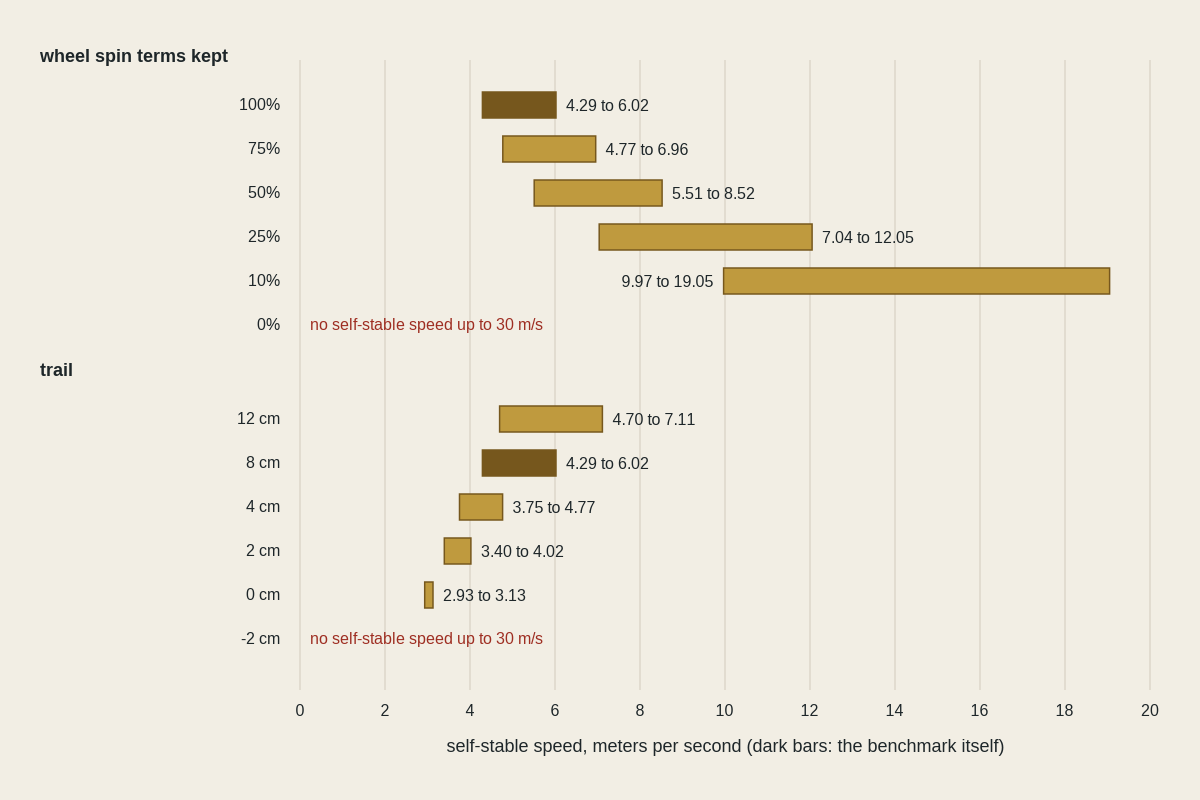
Self-stable speed range of the benchmark with one input changed, searched up to 30 m/s. An empty row applies to this bicycle with its other numbers held, not to every bicycle.
Keel, Rail & Spoke, CC BY 4.0
Data: Meijaard, Papadopoulos, Ruina & Schwab 2007, https://doi.org/10.1098/rspa.2007.1857, author preprint at http://ruina.tam.cornell.edu/research/topics/bicycle_mechanics/stablebicycle/FinalBicyclePaperv45wAppendix.pdf, retrieved 2026-11-07
Reuse this diagram: credit to copy
"Self-stable speed ranges with wheel spin and trail changed" by Keel, Rail & Spoke, https://keelrailandspoke.com/bicycles/why-a-bicycle-stays-up/, licensed under CC BY 4.0 (https://creativecommons.org/licenses/by/4.0/).
Data behind this diagram: why-a-bicycle-stays-up-stable-speed-ranges.csv · Where this data came from
| Input changed | Value | Self-stable speed (m/s) |
|---|---|---|
| Benchmark wheel spin terms | 100% (benchmark) | 4.29 to 6.02, calculated |
| Benchmark wheel spin terms | 75% | 4.77 to 6.96, calculated |
| Benchmark wheel spin terms | 50% | 5.51 to 8.52, calculated |
| Benchmark wheel spin terms | 25% | 7.04 to 12.05, calculated |
| Benchmark wheel spin terms | 10% | 9.97 to 19.05, calculated |
| Benchmark wheel spin terms | 0% | None up to 30, calculated |
| Benchmark trail | 12 cm | 4.70 to 7.11, calculated |
| Benchmark trail | 8 cm (benchmark) | 4.29 to 6.02, calculated |
| Benchmark trail | 4 cm | 3.75 to 4.77, calculated |
| Benchmark trail | 2 cm | 3.40 to 4.02, calculated |
| Benchmark trail | 0 cm | 2.93 to 3.13, calculated |
| Benchmark trail | −2 cm | None up to 30, calculated |
On this one bicycle, the search up to 30 m/s finds no self-stable speed without some wheel spin, and a trail of −2 cm ends the range too. So the claim here is only that not every bicycle requires them. It does not say the gyroscopic effect is unimportant.
What did the 2011 test bicycle show?
The test was published in April 2011, in a paper in Science by J. D. G. Kooijman, Meijaard, Papadopoulos, Ruina and Schwab. This account does not draw on the paper itself. The details here come from Cornell's news story, a CORDIS news item and the authors' own web page.
The machine was called the Two Mass Skate. Cornell describes two small wheels, each matched with a counter-rotating disk to remove the gyro effects, and a steering axis set behind the front wheel's contact point. The authors' page gives the measured trail: −4 mm, with the contact 4 mm ahead of the point where the steering axis meets the ground. They found it by turning the handlebars on a taped-down sheet of paper and reading the arc the wheel marked.
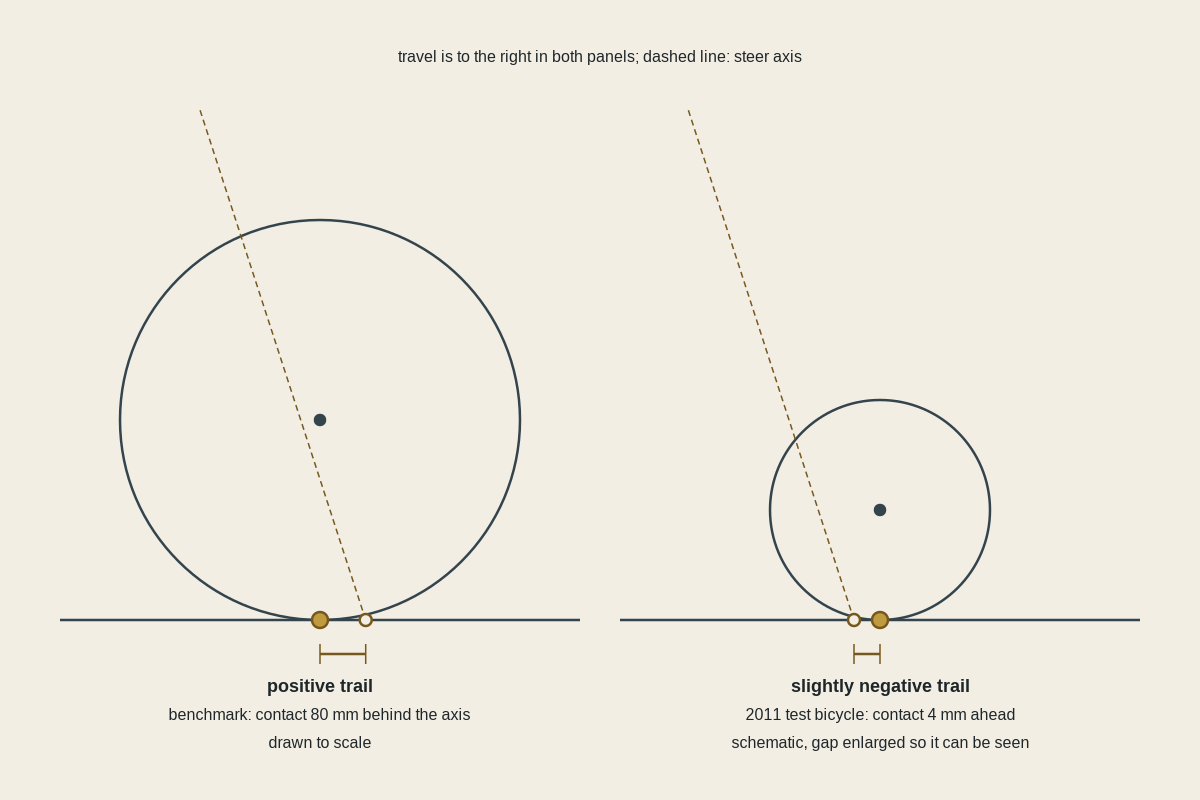
Trail on the benchmark (left, to scale) and on the 2011 test bicycle (right, a schematic with the gap enlarged so it can be seen). The two panels are different machines.
Keel, Rail & Spoke, CC BY 4.0
Data: Meijaard, Papadopoulos, Ruina & Schwab 2007, https://doi.org/10.1098/rspa.2007.1857, author preprint at http://ruina.tam.cornell.edu/research/topics/bicycle_mechanics/stablebicycle/FinalBicyclePaperv45wAppendix.pdf, retrieved 2026-11-07; Authors' web page on the test bicycle, http://ruina.tam.cornell.edu/research/topics/bicycle_mechanics/stablebicycle/index.htm, retrieved 2026-11-07
Reuse this diagram: credit to copy
"Positive and slightly negative trail" by Keel, Rail & Spoke, https://keelrailandspoke.com/bicycles/why-a-bicycle-stays-up/, licensed under CC BY 4.0 (https://creativecommons.org/licenses/by/4.0/).
Given a good push, Cornell reports, the machine coasted and balanced when going more than about 5 mph. That threshold is about 8 km/h, a working walking multiple of about 1.6. Knocked to one side while moving, it straightened itself back upright. That speed belongs to this machine and the 4.29 to 6.02 m/s range to the benchmark, so neither one should be read onto the other.
The result was hard to get. As CORDIS quotes him, Kooijman said that the first prototype did not work, that the team had almost given up, and that the ground needed the right roughness and stiffness. The authors' page says the first successful run came after polyurethane inline-skate wheels gave way to sharp-edged aluminum ones. The same page dates the basic theory to work by Papadopoulos at Cornell from 1985, and the test machine to Delft from 2008.
Schwab, quoted by CORDIS, set the limit on the finding: “Gyroscopic effects and trail do help, but are not essential for stability.”
Where does the steering come from without a gyroscope?
Cornell's account points to mass. On the test bicycle, the center of mass of the front steering assembly sits lower than that of the rear frame and forward of the steering axis. In a fall the front tends to drop faster, and that turns it toward the fall. Ruina added: “There are other ways to distribute the mass and get self-stability without gyro or trail.”
The benchmark's range shifts when its front mass moves, though it is a different machine and this is no test of that explanation. Set the center of mass of the front frame, the fork and handlebars, 0.8 m ahead of the rear contact, and the range is 4.51 to 5.50 m/s. At the benchmark's own 0.9 m it is 4.29 to 6.02 m/s, at 1.0 m 4.55 to 6.52 m/s, at 1.1 m 4.94 to 6.99 m/s, and at 1.2 m 5.37 to 7.44 m/s.
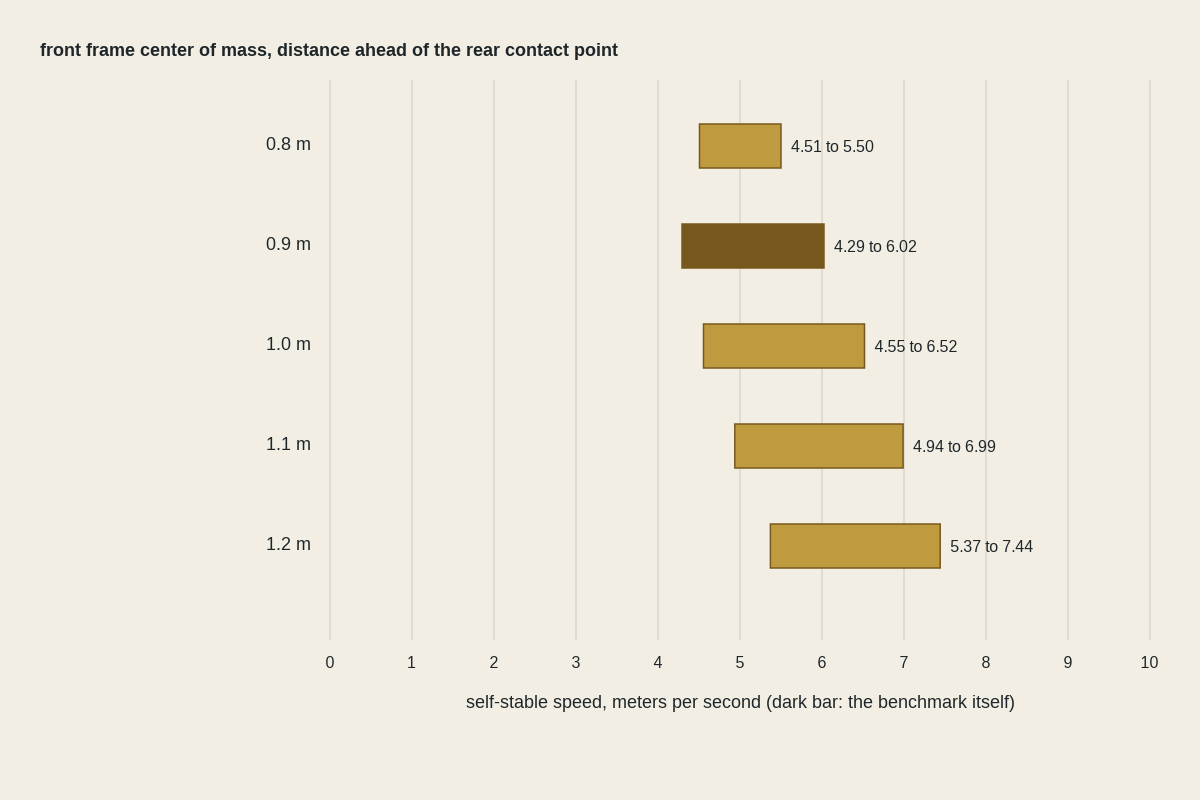
Self-stable speed range of the benchmark as the front frame's center of mass moves, with all other inputs held. Recalculated model cases.
Keel, Rail & Spoke, CC BY 4.0
Data: Meijaard, Papadopoulos, Ruina & Schwab 2007, https://doi.org/10.1098/rspa.2007.1857, author preprint at http://ruina.tam.cornell.edu/research/topics/bicycle_mechanics/stablebicycle/FinalBicyclePaperv45wAppendix.pdf, retrieved 2026-11-07
Reuse this diagram: credit to copy
"Self-stable speed ranges with the front mass moved" by Keel, Rail & Spoke, https://keelrailandspoke.com/bicycles/why-a-bicycle-stays-up/, licensed under CC BY 4.0 (https://creativecommons.org/licenses/by/4.0/).
Data behind this diagram: why-a-bicycle-stays-up-stable-speed-ranges.csv · Where this data came from
None of this makes one cause the winner. According to Kooijman and colleagues (2011), as Cornell quoted them, changing just one of three things can make almost any self-stable bicycle unstable: the trail, the front-wheel gyro or the center-of-mass position of the front assembly. Schwab, again in CORDIS, said that mass distribution is also important, especially the location of the steering mechanism's center of mass.
The model has limits of its own. Its knife-edge wheels do not slip. It leaves out tire and frame flex, hinge friction and any movement by the rider. All the rates above are for small leans.
How does a rider balance a bicycle?
A steering rider is a separate case, and nothing above includes one. The benchmark's rider is only a mass fixed to the frame. The 2007 paper states the rider's part simply: a rider can balance a moving bicycle by turning the front wheel toward an unwanted lean, which moves the ground contacts back under the rider. A bicycle that cannot balance itself can still be ridden: the same paper reports Jones's finding that bicycles unable to balance themselves were, almost without exception, easy for a rider to keep up with the handlebars.
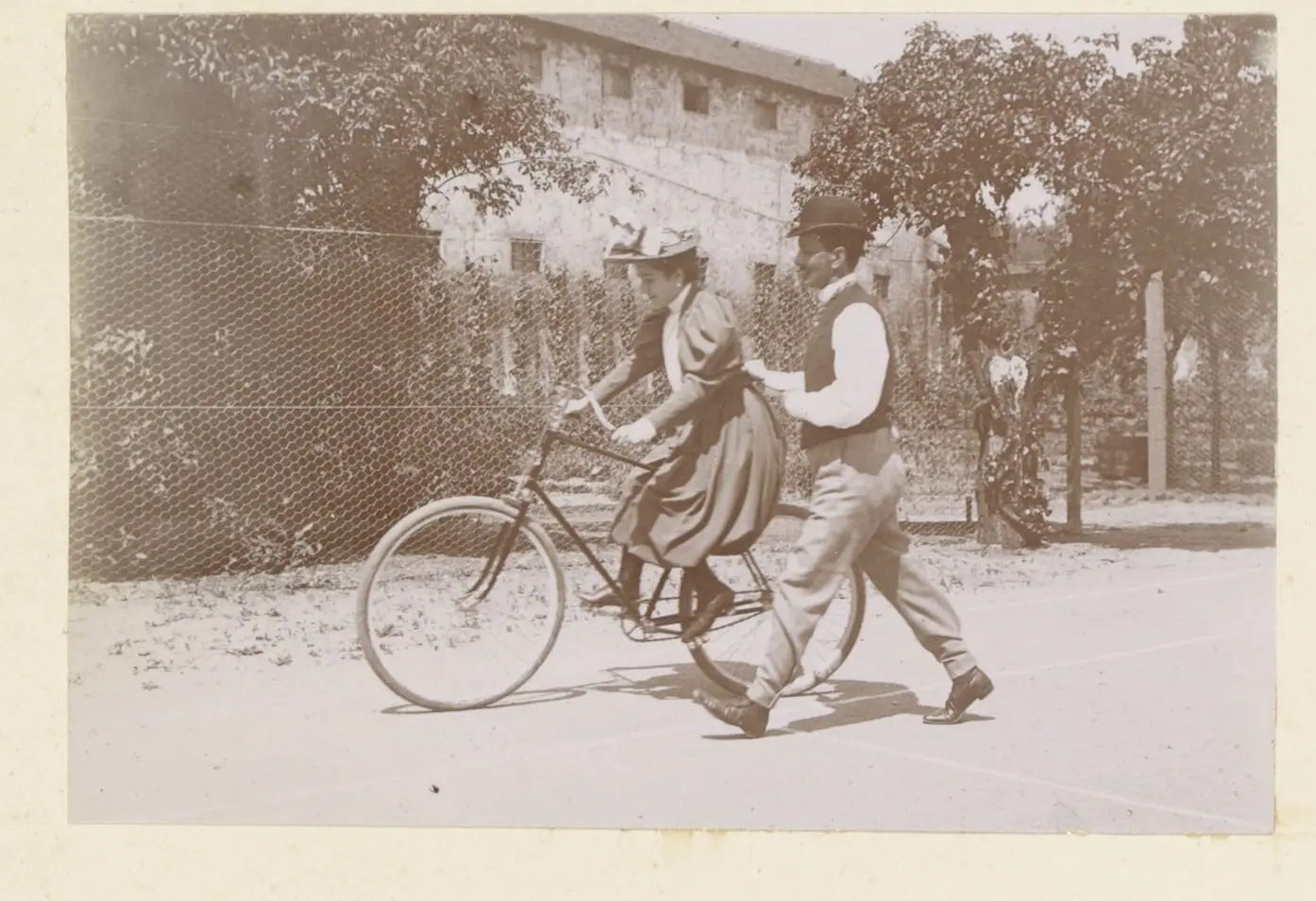
A man steadies a woman on a bicycle, in an album by a French amateur photographer of about 1900 to 1910. The museum's title says he is teaching her to ride, probably in France.
"Man leert vrouw fietsen, vermoedelijk in Frankrijk" by unknown creator — https://commons.wikimedia.org/wiki/File:Man_leert_vrouw_fietsen,_vermoedelijk_in_Frankrijk,_RP-F-F01164-57-4.jpg — CC0 1.0 (https://creativecommons.org/publicdomain/zero/1.0/)

That steering trick is older than the theory: the paper dates it to the earliest two-wheelers, and the machine's own early history is in Who Invented the Bicycle. By the 1890s, the authors write, nearly anyone could learn to balance a safety bicycle. Thomas Stevens had already taken a high wheel around the world, steering it himself. A hull has a stability question of its own, and the Vasa met hers in a test stopped in 1628, before she sailed.
The bicycle with no rider had already reached the movies. The 1949 film Jour de Fête shows a postman chasing his bicycle as it rides away on its own, and Cornell opened its 2011 story with that scene. Its next words were “It could happen.”
Sources
- Meijaard, J. P., Jim M. Papadopoulos, Andy Ruina and A. L. Schwab. "Linearized dynamics equations for the balance and steer of a bicycle: a benchmark and review." Proceedings of the Royal Society A 463 (2007): 1955–1982. https://doi.org/10.1098/rspa.2007.1857Read: authors' preprint: full paper and Appendix A, relevant passages of the history appendix; not the publisher's version
- Steele, Bill. "Researchers explain why bicycles balance themselves." Cornell Chronicle, 14 April 2011. https://news.cornell.edu/stories/2011/04/researchers-explain-why-bicycles-balance-themselvesRead: full story
- CORDIS, European Commission. "New research uncovers why a bicycle stays stable when moving." Last updated 18 April 2011. © European Union, reused under CC BY 4.0; restated and shortened. https://cordis.europa.eu/article/id/33320-new-research-uncovers-why-a-bicycle-stays-stable-when-movingRead: full article
- Kooijman, J. D. G., J. P. Meijaard, Jim M. Papadopoulos, Andy Ruina and A. L. Schwab. "Stable Bicycle" (authors' web page on the test bicycle). http://ruina.tam.cornell.edu/research/topics/bicycle_mechanics/stablebicycle/index.htmRead: full page, text only; videos not viewed
- Kooijman, J. D. G., J. P. Meijaard, Jim M. Papadopoulos, Andy Ruina and A. L. Schwab. "A bicycle can be self-stable without gyroscopic or caster effects." Science 332, no. 6027 (15 April 2011): 339–342. https://doi.org/10.1126/science.1201959Read: bibliography only; the paper is not used for this account, and its results are given as reported by Cornell, CORDIS and the authors' web page
Cite this page
Keel, Rail & Spoke. "Cornell Reported a 2011 Test Bicycle Balanced With No Gyroscope Effect." Published 2026-11-08. https://keelrailandspoke.com/bicycles/why-a-bicycle-stays-up/. Accessed on the date you read it.
How facts are checked · Corrections · Contact
Found a mistake on this page? Write to contact@keelrailandspoke.com.
More from Bicycles
Bicycles
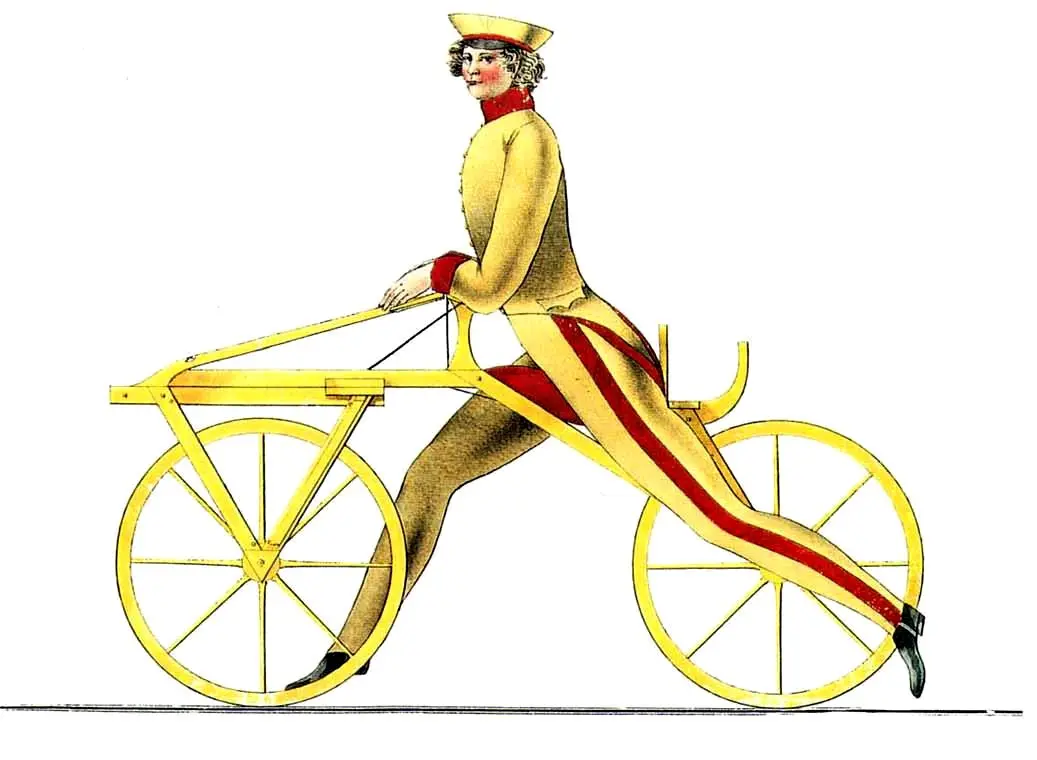
Who Invented the Bicycle? Drais’s 1817 Machine Had No Pedals
No single inventor made the bicycle. Karl Drais rode a steered two-wheeler pushed by his feet in 1817; pedals, the rear chain and air-filled tires came later.
Picture credit
"Die Laufmaschine des Freiherrn Carl von Drais" by Wilhelm Siegrist — https://commons.wikimedia.org/wiki/File:Draisine1817.jpg — Public domain (US: published 1817, before 1931; elsewhere: published 1817, engraver Wilhelm Siegrist (1797–1843?) per the file page, life+70 term long expired); modified: cropped: rider and machine in side view, down to the ground line; plan view and legend below left out
Bicycles
Bicycle Around the World: Stevens Counted About 13,500 Miles
Thomas Stevens put about 13,500 miles wheeled in his own table, San Francisco to Yokohama, 1884 to 1886: what he rode, what went by ship, his arrest at Furrah.
Picture credit
"Crossing the Sierra Nevadas" by W. A. Rogers — https://commons.wikimedia.org/wiki/File:Image_taken_from_page_40_of_%27Around_the_World_on_a_Bicycle_..._From_San_Francisco_to_Teheran._With_..._illustrations._(With_preface_by_T._W._Higginson.)%27_(11186813893).jpg — Public domain (US: published 1887, before 1931; elsewhere: signed W. A. Rogers, read as William Allen Rogers, died 1931, life+70 term expired); modified: cropped: page text above and printed caption below removed; reduced to no more than 1,600 px wide

