Ships & Wrecks · Machine file
How a Sextant Works: A 60° Arc That Measures Up to 120°
A sextant is a small arc of metal and two flat mirrors, and the mirrors make its scale read twice what the arc would suggest.
Keel, Rail & Spoke · Published
TL;DR
- A sextant measures the angle between two things, such as the sun or a star and the horizon, by reflecting one onto the other with two mirrors.
- Turning the moving mirror turns the reflected light through twice that angle, a rule John Hadley printed in 1731, so a sextant’s 60° arc is marked up to 120°.
- A height of the sun at noon leads to latitude. Longitude takes a second step, because it depends on knowing the time at another place.
Machine file
- Machine
- Sextant: a hand-held reflecting instrument for measuring the angle between two things, such as the sun or a star and the horizon
- First built
- unknown; John Robinson (1921) says only that the sextant was devised about 1757, and names no maker
- Converts
- A mirror's turn into twice that turn in the reflected light; the arm is moved by hand
- Working speed
- n/a: a measuring instrument, not a vehicle
- Walking multiple
- n/a
- Key patent or drawing
- Hadley, The Description of a New Instrument for Taking Angles (the octant, not the sextant), communicated 13 May 1731 (Julian calendar), Philosophical Transactions 37, pp. 147-157, Figures I to IV
Download this card (CSV) · Where this data came from
Data: Hadley, The Description of a New Instrument for Taking Angles, Philosophical Transactions 37 (1731), public domain, https://archive.org/details/philtrans09562806, retrieved 2026-11-08; Bowditch, The New American Practical Navigator (1837), public domain, https://archive.org/details/newamericanprac00bowd, retrieved 2026-11-08; Robinson, Old-Time Nautical Instruments (1921), public domain, https://www.gutenberg.org/ebooks/44206, retrieved 2026-11-08
What the card means: walking multiple.
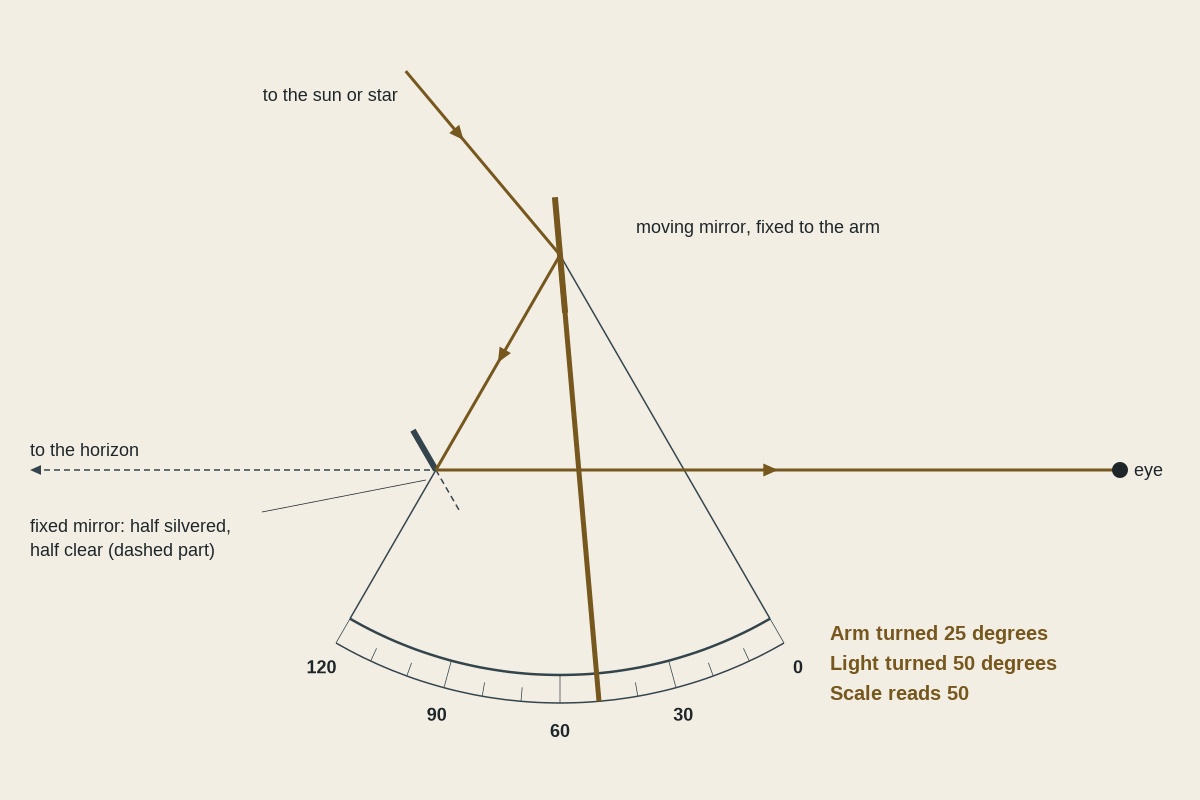
The path of the light through both mirrors, with the arm turned 25 degrees from zero. The horizon comes straight through the clear half of the fixed mirror, and the two meet at the eye. The drawing is a schematic, not to scale.
Keel, Rail & Spoke, CC BY 4.0
Data: Hadley, The Description of a New Instrument for Taking Angles, Philosophical Transactions 37 (1731), public domain, https://archive.org/details/philtrans09562806, retrieved 2026-11-08; Bowditch, The New American Practical Navigator (1802), public domain, https://archive.org/details/newamericanpract00bowd, retrieved 2026-11-08
Reuse this diagram: credit to copy
"A sextant: the path of the light" by Keel, Rail & Spoke, https://keelrailandspoke.com/ships/how-a-sextant-works/, licensed under CC BY 4.0 (https://creativecommons.org/licenses/by/4.0/).
Data behind this diagram: how-a-sextant-works-reflection.csv · Where this data came from
A sextant’s frame holds an arc of 60 degrees, and the scale cut on it runs to 120. Nathaniel Bowditch’s New American Practical Navigator, in its 1837 edition, gives the reason in one line: the arc “contains 60°, but, by reason of the double reflection, is divided into 120°.” Robert Waddington’s 1775 book Of the Reflecting Sextant opens with the same figures. The other 60 degrees come from the mirrors.
Stops on this page (8)
Why does a 60° arc read 120°?
The answer is a rule about flat mirrors. Light leaves a mirror at the same angle to the perpendicular as it arrived. Turn the mirror 20 degrees while the light source stays put, and the perpendicular turns 20 degrees with it.
The arriving light now sits 20 degrees farther from the perpendicular, and the leaving light sits 20 degrees farther on the other side. The reflected ray has swung 40 degrees. A second mirror that does not move passes that swing along unchanged.
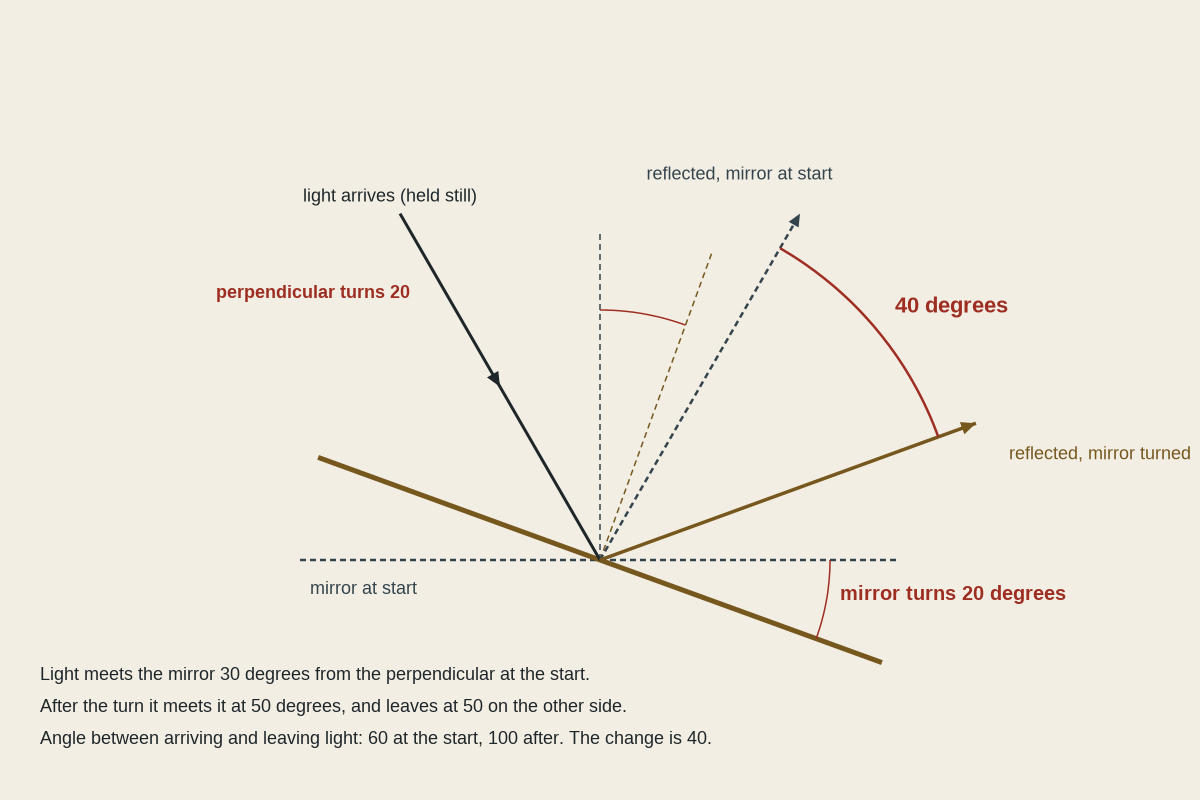
One mirror, two positions. The arriving light does not change. The angle between arriving and leaving light grows from 60 to 100 degrees, a change of 40 for a 20-degree turn of the mirror.
Keel, Rail & Spoke, CC BY 4.0
Data: Hadley, The Description of a New Instrument for Taking Angles, Philosophical Transactions 37 (1731), public domain, https://archive.org/details/philtrans09562806, retrieved 2026-11-08
Reuse this diagram: credit to copy
"A mirror turns 20 degrees, the light turns 40" by Keel, Rail & Spoke, https://keelrailandspoke.com/ships/how-a-sextant-works/, licensed under CC BY 4.0 (https://creativecommons.org/licenses/by/4.0/).
John Hadley, a vice-president of the Royal Society, put the two-mirror case in print in a paper communicated on 13 May 1731. Light reflected twice, he wrote, forms “an Angle double to that of the Inclination of the two polish’d Surfaces.” Inclination here means the angle between the mirrors, and on a sextant that angle is the turn of the arm.
The table below was recalculated by tracing rays through two ideal flat mirrors. Five different incoming directions were tried at each step, and the ray’s turn never differed from double the arm’s turn by more than a rounding error in the calculation.
| Arm turned | Angle between mirrors | Light turned | Scale reads |
|---|---|---|---|
| 0° | 0° | 0° | 0 |
| 15° | 15° | 30° | 30 |
| 30° | 30° | 60° | 60 |
| 45° | 45° | 90° | 90 |
| 60° | 60° | 120° | 120 |
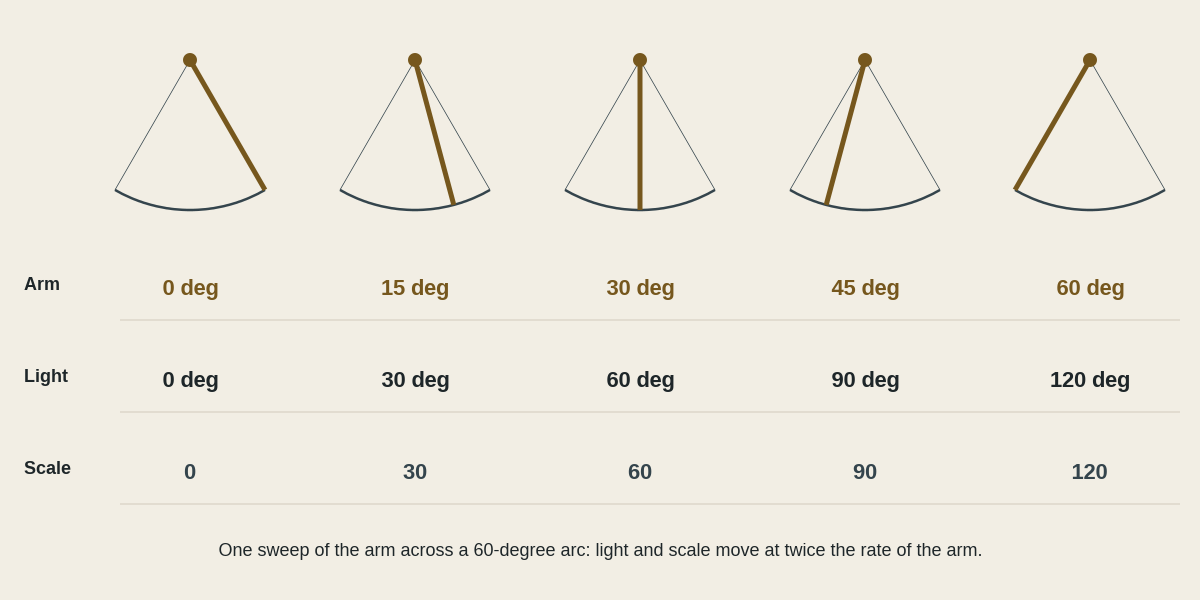
One sweep of the arm, at the same five positions as the table. Each step of 15 degrees on the frame is numbered as 30 on the scale.
Keel, Rail & Spoke, CC BY 4.0
Data: Hadley, The Description of a New Instrument for Taking Angles, Philosophical Transactions 37 (1731), public domain, https://archive.org/details/philtrans09562806, retrieved 2026-11-08; Bowditch, The New American Practical Navigator (1837), public domain, https://archive.org/details/newamericanprac00bowd, retrieved 2026-11-08
Reuse this diagram: credit to copy
"One sweep of the arm" by Keel, Rail & Spoke, https://keelrailandspoke.com/ships/how-a-sextant-works/, licensed under CC BY 4.0 (https://creativecommons.org/licenses/by/4.0/).
What does each part of a sextant do?
Follow the light in the opening diagram. A moving mirror, the index glass, sits at the point of the frame and turns with a long arm. The light of the sun or a star strikes it and goes down to a second mirror, the horizon glass.
The horizon glass is fixed to the frame. Bowditch’s 1802 edition describes it as partly silvered and partly open, so that the observer can look straight through one part.
Two scenes therefore share one view, with the horizon coming through the clear part and the sun by way of the silvered part. Moving the arm slides the reflected sun until it sits on the horizon line. The foot of the arm then marks the angle on the scale.
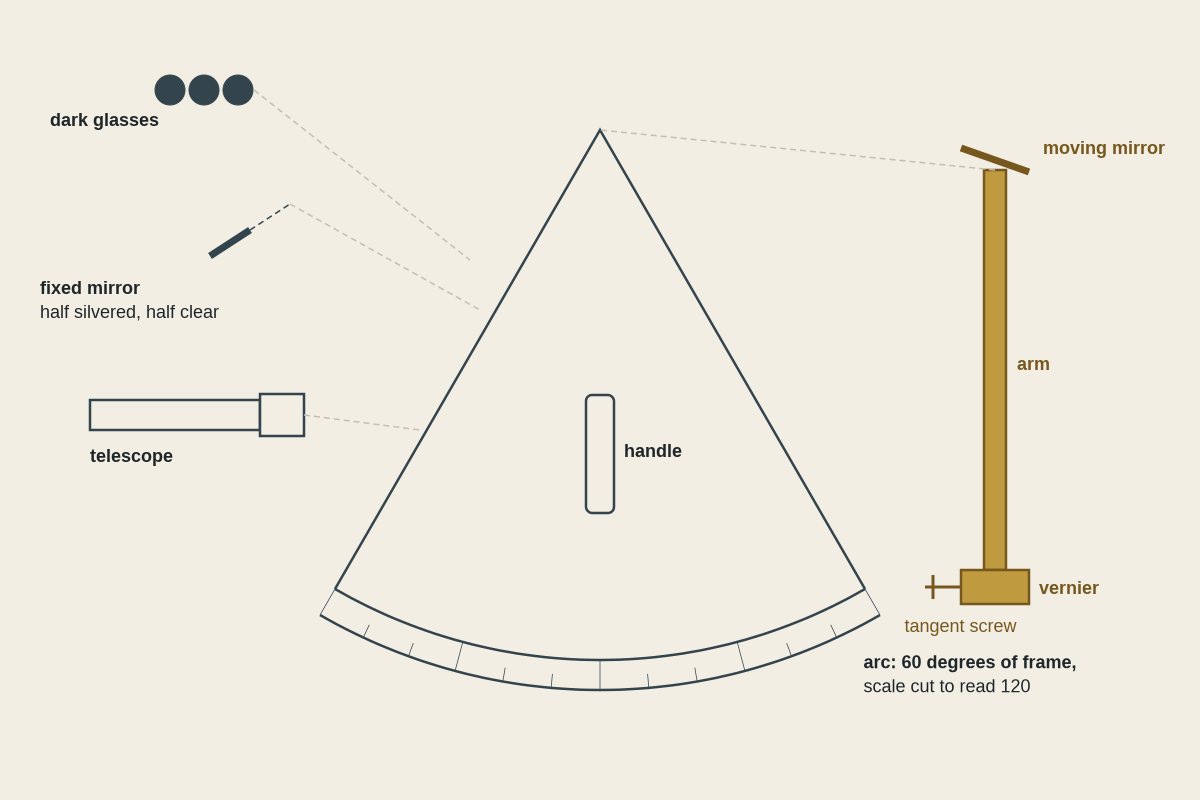
The parts named by Bowditch in 1802 and 1837, drawn apart. This is an independent schematic, not a copy of any one instrument, and it is not to scale.
Keel, Rail & Spoke, CC BY 4.0
Data: Bowditch, The New American Practical Navigator (1802), public domain, https://archive.org/details/newamericanpract00bowd, retrieved 2026-11-08; Bowditch, The New American Practical Navigator (1837), public domain, https://archive.org/details/newamericanprac00bowd, retrieved 2026-11-08
Reuse this diagram: credit to copy
"The parts of a sextant, drawn apart" by Keel, Rail & Spoke, https://keelrailandspoke.com/ships/how-a-sextant-works/, licensed under CC BY 4.0 (https://creativecommons.org/licenses/by/4.0/).
The rest of the instrument serves that one measurement. Bowditch’s 1837 edition gives a frame “generally made of brass, or other hard metal” and a wooden handle at the back. A tangent screw moves the arm in fine steps, and dark glasses cut the glare of the sun. Hadley allowed mirrors of metal or of foiled glass plates.
The vernier, a small sliding scale on the foot of the arm, is what turns coarse marks into fine readings. In the common quadrant Bowditch described in 1802, each degree was cut into three parts of 20 minutes. The vernier spread 20 divisions over a length that took up 21 divisions of the scale, so each vernier step fell one minute out of line with the next. Whichever vernier mark lined up with a scale mark gave the extra minutes, and Bowditch’s worked figure is 6° 47′.
By 1837 his sextant vernier generally showed half or a quarter of a minute of arc, and on some sextants 10 seconds.
The machine card’s walking multiple reads n/a because a sextant carries nobody anywhere.
The two images also ride together. Hadley’s first corollary says the image stays in the same place even if both mirrors are turned around their common axis, as long as the angle between them holds. Waddington’s plainer version is that the reflected image “appears to be fixed, although the instrument be in motion at the time.”
Hadley’s own promise was limited: heights “may be taken at Sea, when it is not too rough.” A ship under sail leans with the wind, as the page on tacking shows, so this was the property that counted.
What doubling does to errors
The doubling works on mistakes as well. Hadley warned that “all Errors committed in the Division are doubled by the Reflections,” so a slip of one minute in cutting the arc costs two minutes in the reading. The sources read here name these causes:
| Source of error | Stated effect | Who says so |
|---|---|---|
| Slip in dividing the arc | Doubled by the reflections | Hadley 1731, p. 154 |
| Curved mirror surface | Blurs the object and shifts its apparent place | Hadley 1731, p. 154 |
| Arm tilting on its axis | Can change the angle between the mirrors | Hadley 1731, p. 154 |
| Arm bending edgeways | Warned against; effect not stated | Hadley 1731, p. 154 |
| Eye above or below the instrument’s plane | Distance shown is always too great | Bowditch 1802, pp. 138–139 |
| Observer standing above the sea | Height is too great by the dip of the horizon | Bowditch 1802, on Table XIV |
Data behind this table: how-a-sextant-works-error-sources.csv · Where this data came from
From Hadley’s octant to the sextant
Hadley’s 1731 instrument was not a sextant. It had “an Arch of 45 Degrees, divided into 90 Parts or half Degrees; each of which answers to a whole Degree in the Observation.” That is an eighth of a circle reading a quarter of one. John Robinson, writing in 1921, notes that Americans called it a quadrant, and that octant is the better name.
His paper came nearly 103 years after Vasa sank in 1628, with both dates on the Julian calendar. Robinson also gives sizes: the early wooden quadrants had arms of 24 inches (61 centimeters), while the metal ones of his day had arms of 10 to 12 inches.
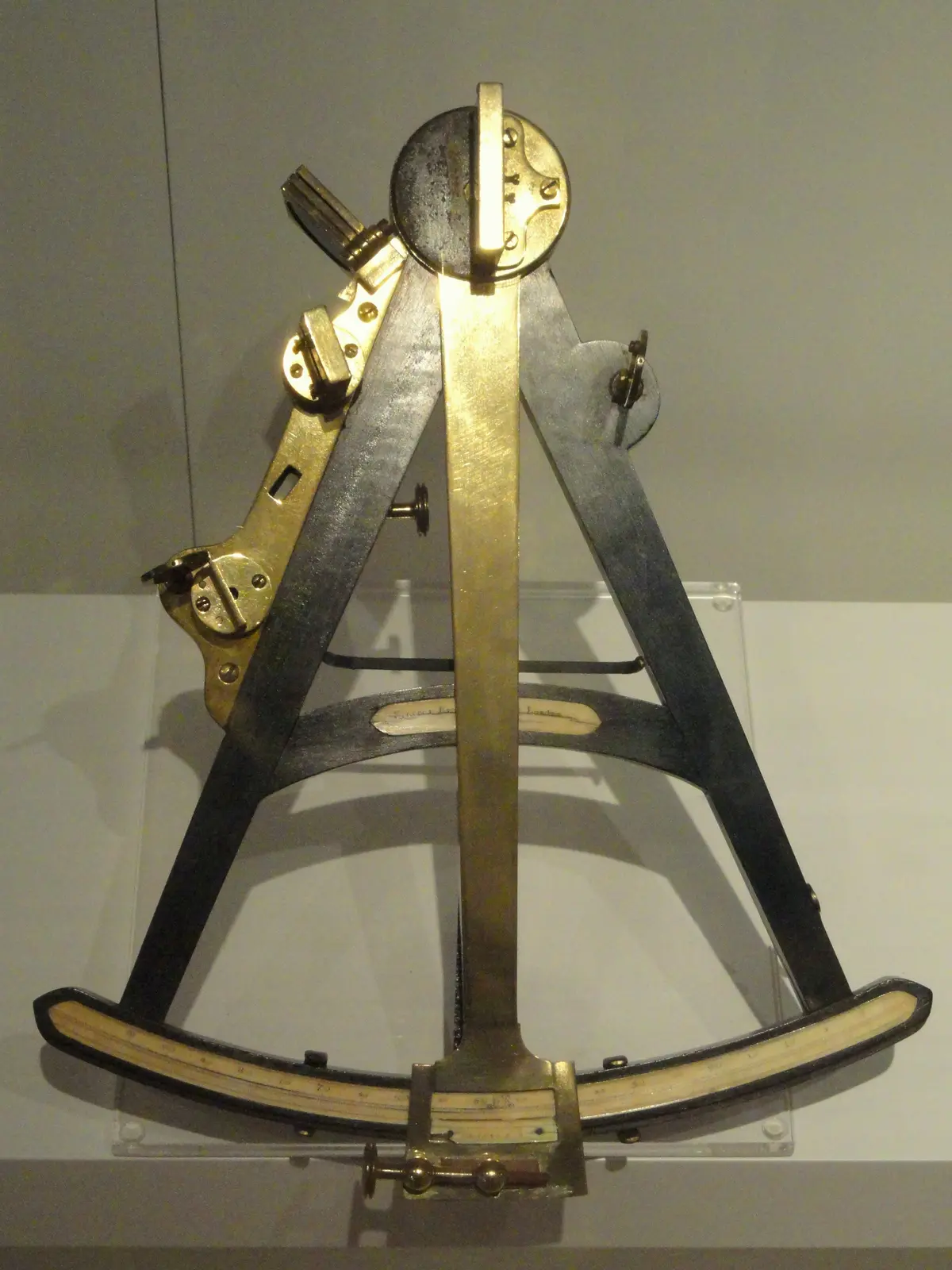
An octant or Hadley quadrant by Spencer, Browning & Rust of London, about 1790 to 1810, in ebony, bone and brass, as described with the museum photograph. Its arc is an eighth of a circle, so its scale stops at 90.
Octant or Hadley quadrant, by Spencer, Browning & Rust, London, England, c. 1790-1810, ebony, bone, brass - Royal Ontario Museum - DSC00258 by Daderot, CC0
Full credit
"Octant or Hadley quadrant, by Spencer, Browning & Rust, London, England, c. 1790-1810, ebony, bone, brass - Royal Ontario Museum - DSC00258" by Daderot — https://commons.wikimedia.org/wiki/File:Octant_or_Hadley_quadrant,_by_Spencer,_Browning_%26_Rust,_London,_England,_c._1790-1810,_ebony,_bone,_brass_-_Royal_Ontario_Museum_-_DSC00258.JPG — CC0 1.0 (https://creativecommons.org/publicdomain/zero/1.0/)

Credit is shared, and the accounts differ on how. Bowditch in 1802 calls Hadley the first to publish. He adds that Isaac Newton had invented a similar instrument “many years before, but never made it public,” and that Thomas Godfrey of Philadelphia contrived one before Hadley’s announcement. Robinson says Hadley and Godfrey invented the octant independently in 1730, and that both received awards.
The sextant itself is harder to pin down, because Robinson says only that it “was devised about 1757” and names no one, so this page gives no inventor. By 1775 Waddington was writing a whole book on it. The longer arc mattered for one job above all: Waddington calls for the sextant when the distance between the Moon and the sun or a star is more than 90 degrees. Hadley had described a rearranged mirror for angles from 90 to 180 degrees, so 90 was not an absolute wall for his design.
Nor was 120 a fixed limit for later makers. Waddington mentions scales numbered to 125, and J. F. Heather’s 1849 treatise describes a sextant graduated to 140. Bowditch’s 1802 edition also notes an arc carried around the whole circumference, called the circle of reflection.
Owning one was far from universal in the sextant’s early decades. Robinson says the American shipmasters who set out on distant voyages had few good charts and that “few had sextants.” He prints a protest from American masters at Christiansand over the brig Hannah, condemned there in 1810 after a prize court called it “absolutely impossible to cross the Atlantic without a chart or sextant.” The masters answered that they had often done so.
Data behind these figures: how-a-sextant-works-arcs.csv · Where this data came fromData: Hadley, The Description of a New Instrument for Taking Angles, Philosophical Transactions 37 (1731), public domain, https://archive.org/details/philtrans09562806, retrieved 2026-11-08; Waddington, Of the Reflecting Sextant (1775), public domain, https://archive.org/details/bim_eighteenth-century_of-the-reflecting-sextan_waddington-robert_1775, retrieved 2026-11-08; Bowditch, The New American Practical Navigator (1837), public domain, https://archive.org/details/newamericanprac00bowd, retrieved 2026-11-08; Heather, A Treatise on Mathematical Instruments (1849), public domain, https://archive.org/details/b22031200, retrieved 2026-11-08
How does a sextant find latitude?
The instrument gives only a height. The rest is a sum, which Bowditch’s 1802 edition sets out for the sun at noon, when it stands highest. Take the corrected height from 90 degrees, and the result is how far the sun stands from straight overhead. Combine that with the sun’s declination, its distance north or south of the equator from the almanac, to get latitude.
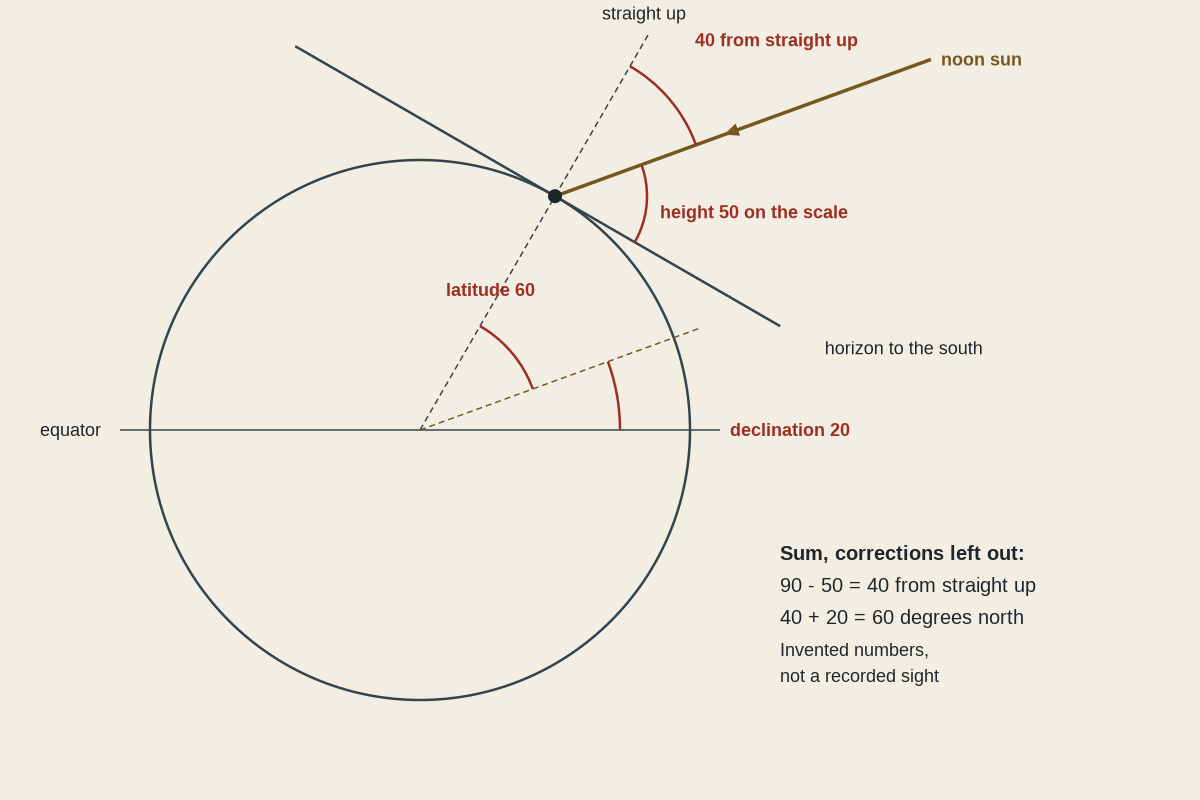
The noon sum with invented numbers, not a recorded sight. A height of 50 degrees with the sun to the south leaves 40 from straight overhead, and 40 plus a declination of 20 north gives 60 north. Real sums first correct the height, so this drawing shows the principle only.
Keel, Rail & Spoke, CC BY 4.0
Data: Bowditch, The New American Practical Navigator (1802), public domain, https://archive.org/details/newamericanpract00bowd, retrieved 2026-11-08
Reuse this diagram: credit to copy
"The noon sum for latitude" by Keel, Rail & Spoke, https://keelrailandspoke.com/ships/how-a-sextant-works/, licensed under CC BY 4.0 (https://creativecommons.org/licenses/by/4.0/).
Hadley’s fuller design added a third mirror for a harder case, taking the sun’s height by “the opposite Part of the Horizon.” Bowditch used that back observation himself. He writes that near Cape Cod the sun shone and the northern horizon was clear, yet it was so foggy to the south that he could not see a quarter of a mile. He does not say which mile. Read as a statute mile, that is about 400 meters, or just under 5 minutes at walking pace; read as a sea mile, about 460 meters.
The sum is older than the mirrors. Francisco Albo’s log, on the voyage of Ferdinand Magellan, already gave latitude from the sun’s altitude and declination. The mirrors changed how the height was taken, not the sum that followed.
How does a sextant help find longitude?
A sextant does not read longitude, because longitude is a difference in time. Its part in the old method was to measure the Moon. Bowditch in 1802 describes an annual almanac giving the Moon’s distance from the sun or a fixed star every three hours, reckoned for Greenwich. A measured distance gave the time at Greenwich, and comparing that with local time gave the “difference of meridians.”
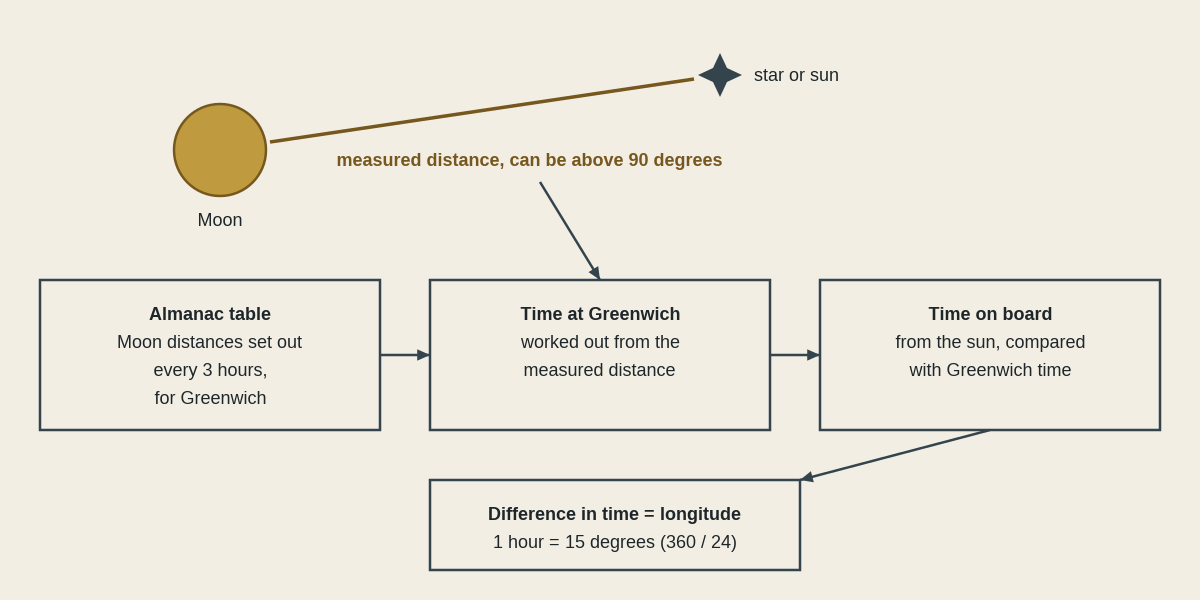
The method of lunar distances as a chain, without its corrections. The Earth turns 360 degrees in 24 hours, so one hour of difference means 15 degrees of longitude.
Keel, Rail & Spoke, CC BY 4.0
Data: Bowditch, The New American Practical Navigator (1802), public domain, https://archive.org/details/newamericanpract00bowd, retrieved 2026-11-08
Reuse this diagram: credit to copy
"From a Moon distance to longitude" by Keel, Rail & Spoke, https://keelrailandspoke.com/ships/how-a-sextant-works/, licensed under CC BY 4.0 (https://creativecommons.org/licenses/by/4.0/).
Bowditch’s 1837 edition says the sextant is “particularly intended” for this measurement. Robinson calls it “a complicated and difficult matter” and says only the most expert could do it. Hadley himself stayed careful in 1731: how far such an instrument might serve for longitude, “I leave to Trials to determine.” Bowditch’s 1802 edition also gives a second route: a time-keeper regulated to a known meridian and compared with local time found from the sun.
Sextant or astrolabe: what changed?
An astrolabe also measures height, but it has no mirrors, and by Robinson’s account it took a larger crew. He says observations “required three persons”: one held the instrument plumb by its ring, another sighted the sun and set the arm, and a third read the scale. He calls the results “far from accurate.” In his account the astrolabe is also the basis of the later instruments of its class, the sextant among them.
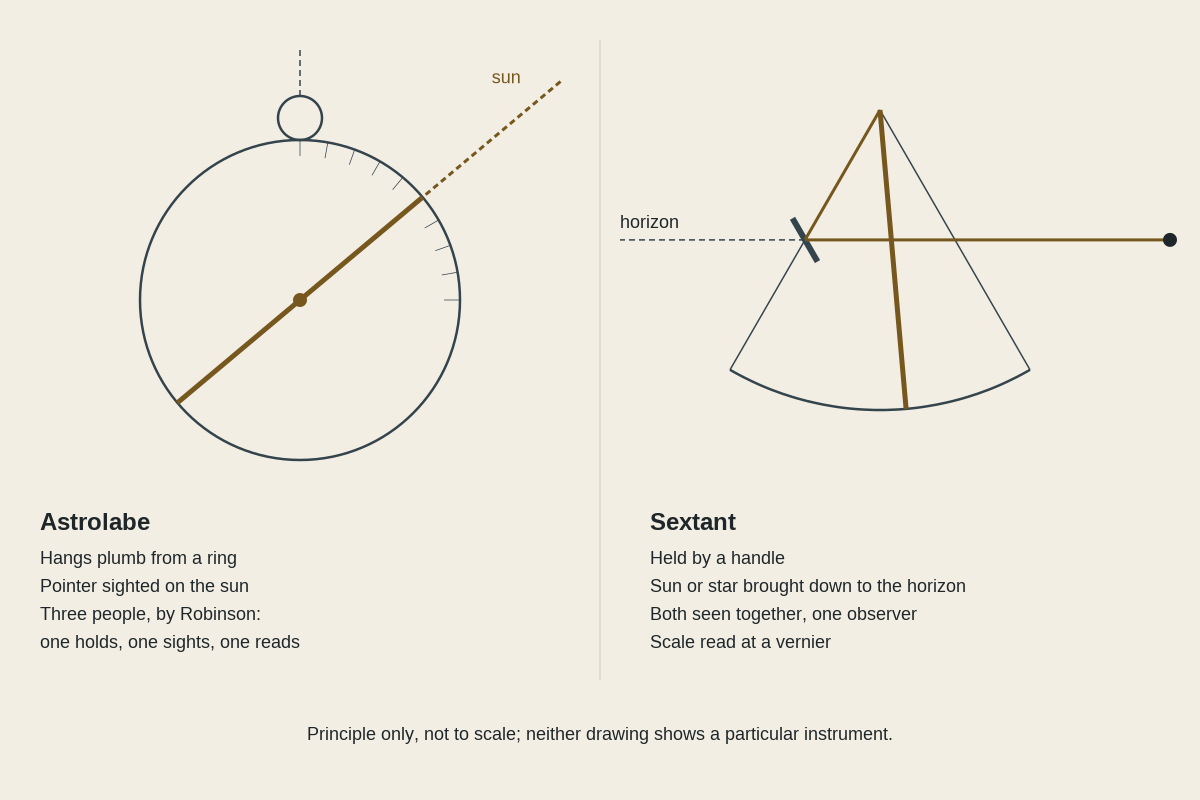
The two instruments in principle, not to scale. The astrolabe measures against the direction of its own hanging. The sextant measures against the horizon, which appears in the same view.
Keel, Rail & Spoke, CC BY 4.0
Data: Robinson, Old-Time Nautical Instruments (1921), public domain, https://www.gutenberg.org/ebooks/44206, retrieved 2026-11-08; Bowditch, The New American Practical Navigator (1837), public domain, https://archive.org/details/newamericanprac00bowd, retrieved 2026-11-08
Reuse this diagram: credit to copy
"Astrolabe and sextant in principle" by Keel, Rail & Spoke, https://keelrailandspoke.com/ships/how-a-sextant-works/, licensed under CC BY 4.0 (https://creativecommons.org/licenses/by/4.0/).
| Question | Mariner’s astrolabe | Sextant |
|---|---|---|
| How is it held? | Plumb, by a ring | By a handle, in one hand |
| Crew needed? | Three, by Robinson | One observer |
| What does it compare? | Sun against a hanging scale | Sun or star against the horizon |
| Any mirrors? | None described | Two |
| Finest reading stated | Not given by Robinson | Half or a quarter minute in general, 10 seconds on some, Bowditch 1837 |
Why is the sextant still used?
The evidence read here is narrow, and it comes in two dates. Robinson wrote in 1921 that the Hadley quadrant was then “still used in its modern form.” About a century later, the United States rule for officers in charge of a navigational watch on vessels of 500 GT or more still lists training in “Terrestrial and celestial navigation, and electronic navigation systems,” as of the October 2024 edition of 46 CFR 11.309. That rule does not name the sextant, and no count of sextants in use was read for this page.
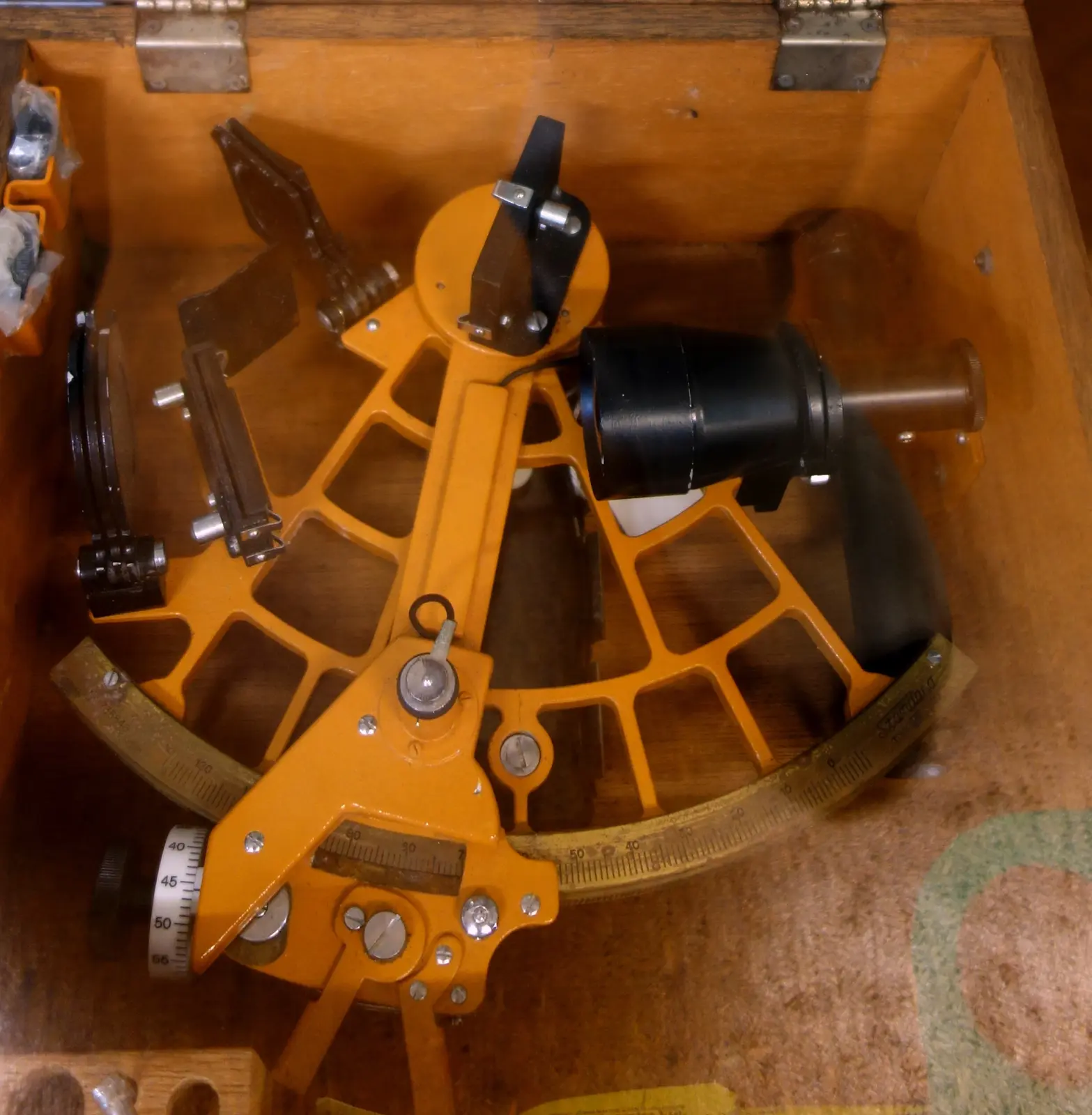
A sextant by Kongo Surveying Instrument Co. of Osaka, as titled on the file page of a photograph taken in 2024 at the Picton Heritage & Whaling Museum in New Zealand. The file page gives no date for the instrument. Cropped.
Sextant, Kongo Surveying Instrument Co., Ltd., Osaka - Picton Heritage & Whaling Museum - Picton, NZ - DSC00270 (cropped) by Daderot, CC0
Full credit
"Sextant, Kongo Surveying Instrument Co., Ltd., Osaka - Picton Heritage & Whaling Museum - Picton, NZ - DSC00270 (cropped)" by Daderot — https://commons.wikimedia.org/wiki/File:Sextant,_Kongo_Surveying_Instrument_Co.,_Ltd.,_Osaka_-_Picton_Heritage_%26_Whaling_Museum_-_Picton,_NZ_-_DSC00270.jpg — CC0 1.0 (https://creativecommons.org/publicdomain/zero/1.0/); modified: cropped: lid with printed certificate and labels, and neighboring exhibits, removed

The machine itself suggests the reason. This is an inference from how it is built. Nothing in the optical path needs power or a signal from elsewhere. For a sight of the sun or a star, the sextant needs that body in view, a visible horizon, an almanac and, for longitude, the time at another place.
What the Bounty’s launch left behind
In the Mutiny on the Bounty of 1789, the launch got a quadrant and a compass. William Bligh’s 1790 Narrative says that Mr. Samuel, who brought them into the boat, “was forbidden, on pain of death, to touch either map, ephemeris, book of astronomical observations, sextant, time-keeper, or any of my surveys or drawings.” The boat kept the instrument that could take a height, and lost the almanac and the clock.
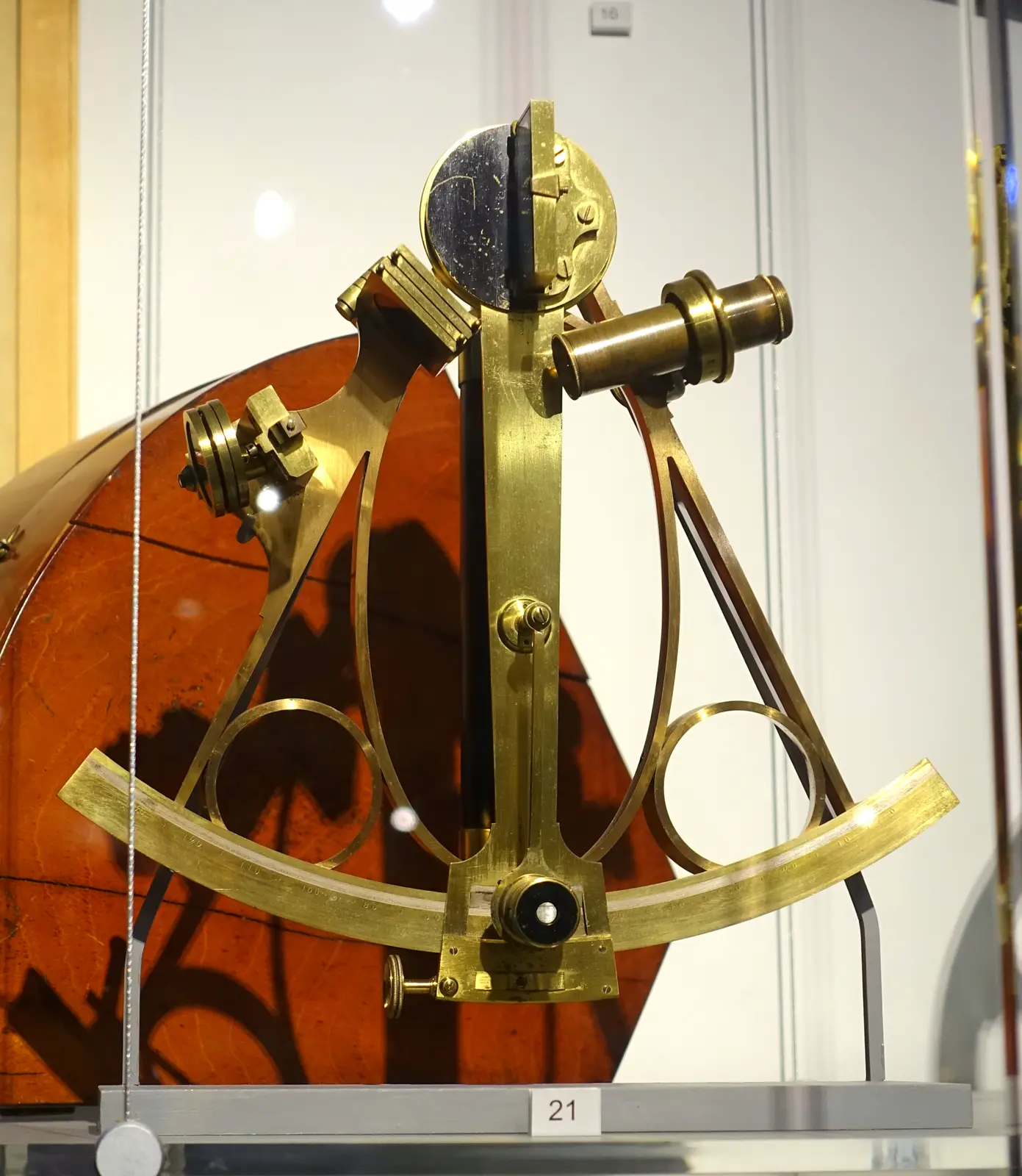
A sextant by George Adams of London, about 1785, as titled on the photograph’s file page, with its keystone-shaped case behind it, in the Putnam Gallery at Harvard University. By that date, the instrument is a few years older than the mutiny.
"Sextant with keystone case, George Adams, London, c. 1785 - Putnam Gallery - Harvard University - DSC07903" by Daderot — https://commons.wikimedia.org/wiki/File:Sextant_with_keystone_case,_George_Adams,_London,_c._1785_-_Putnam_Gallery_-_Harvard_University_-_DSC07903.jpg — CC0 1.0 (https://creativecommons.org/publicdomain/zero/1.0/)

One small piece of the kit came along anyway. Late in May 1789, at the island he named Restoration Island, Bligh lit a fire “by help of a small magnifying glass, that I always carried about me, to read off the divisions of my sextants.”
Sources
- Hadley, John. "The Description of a New Instrument for Taking Angles." Philosophical Transactions 37, pp. 147–157; communicated 13 May 1731. Public domain; read in the copy at https://archive.org/details/philtrans09562806. https://doi.org/10.1098/rstl.1731.0025Read: full paper, from a scanned text
- Waddington, Robert. Of the Reflecting Sextant, and Its Use at Sea. 1775. Public domain. https://archive.org/details/bim_eighteenth-century_of-the-reflecting-sextan_waddington-robert_1775Read: chapter passages only: the opening pages and the section on the arch, from a poor scanned text
- Bowditch, Nathaniel. The New American Practical Navigator. Newburyport: Edmund M. Blunt, 1802. Public domain. https://archive.org/details/newamericanpract00bowdRead: chapter passages only: description and use of the quadrant or sextant, pp. 136–143; latitude by meridian altitude; lunar observations; longitude by a time-keeper; from a scanned text
- Bowditch, Nathaniel. The New American Practical Navigator. 1837 edition. Public domain. https://archive.org/details/newamericanprac00bowdRead: chapter passages only: description and use of a quadrant and of a sextant of reflection, from a scanned text
- Heather, J. F. A Treatise on Mathematical Instruments. 1849. Public domain. https://archive.org/details/b22031200Read: chapter passage only: Hadley's sextant, pp. 144–146, from a scanned text
- Robinson, John. Old-Time Nautical Instruments. Boston, 1921; reprinted from Old-Time New England, April 1921. Public domain; published 1921. https://www.gutenberg.org/ebooks/44206Read: full text
- Bligh, William. A Narrative of the Mutiny, on Board His Majesty's Ship Bounty. London: George Nicol, 1790. Project Gutenberg eBook 20337. https://www.gutenberg.org/ebooks/20337Read: chapter passages only: the loading of the launch and the first days at Restoration Island
- Code of Federal Regulations, Title 46, Section 11.309. October 1, 2024 edition. U.S. Government Publishing Office. https://www.govinfo.gov/content/pkg/CFR-2024-title46-vol1/pdf/CFR-2024-title46-vol1-sec11-309.pdfRead: full page: the section as printed
- Antonio Pigafetta, the Genoese pilot, Francisco Albo, Maximilian Transylvanus and others, The First Voyage Round the World, by Magellan, translated with notes by Lord Stanley of Alderley (London: Hakluyt Society, 1874). The Maximilian letter is translated by James Baynes. https://www.gutenberg.org/ebooks/74723Read: chapters: introduction on the sources, chronology, the Genoese pilot in full, Pigafetta on the main events and the treatise on navigation, Herrera's names, Albo's log in full, the account of the Trinity, the cost account
Cite this page
Keel, Rail & Spoke. "How a Sextant Works: A 60° Arc That Measures Up to 120°." Published 2026-11-08. https://keelrailandspoke.com/ships/how-a-sextant-works/. Accessed on the date you read it.
How facts are checked · Corrections · Contact
Found a mistake on this page? Write to contact@keelrailandspoke.com.
More from Ships & Wrecks
Ships & Wrecks
Vasa Ship, 1628: Stability Test Stopped, Then She Sailed
The Vasa ship sank about 1,300 m into her 1628 maiden voyage. About a month before, her master testified, thirty men rolled her so far the test was stopped.
Picture credit
"Vasa 2" by MLeb — https://commons.wikimedia.org/wiki/File:Vasa_2.jpg — Public domain (released into the public domain worldwide by the photographer)
Ships & Wrecks
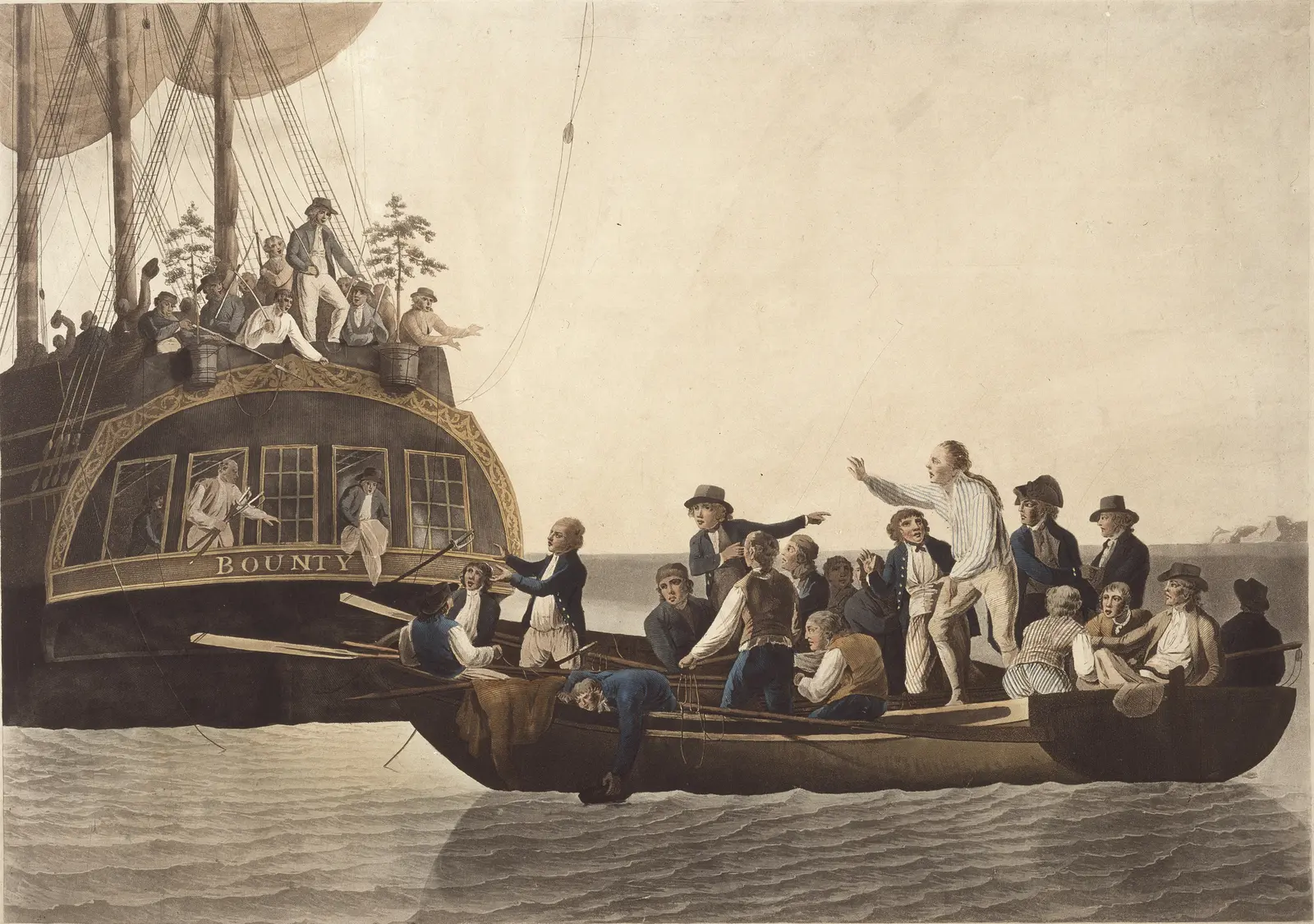
Mutiny on the Bounty: 3,618 Miles in 41 Days, by Bligh’s Log
After the 1789 mutiny on the Bounty, William Bligh logged 3,618 miles to Timor in 41 days in an open launch. His noon positions rechecked, and 44 men's fates.
Picture credit
"The Mutineers turning Lt Bligh and part of the Officers and Crew adrift from His Majesty's Ship the Bounty" by Robert Dodd; State Library of New South Wales, DL Pf 137 — https://commons.wikimedia.org/wiki/File:Mutiny_HMS_Bounty.jpg — Public domain (US: published 1790, before 1931; elsewhere: creator died 1815, life+70 term expired); modified: cropped: paper margin and printed text below the image removed; reduced to 2,400 px wide
Ships & Wrecks
Spanish Armada, 1588: One Undated Spanish List Says 65 Lost
One English report of 1588 said the Spanish Armada had lost at least 16 ships; an undated Spanish list printed in 1899 totals 65. Each count, with who gave it.
Picture credit
"The Spanish Armada off the English Coast in 1588" by Cornelis Claesz van Wieringen; Rijksmuseum, SK-A-1629 — https://commons.wikimedia.org/wiki/File:The_Spanish_Armada_off_the_English_Coast_in_1588_(by_Cornelis_Claesz_van_Wieringen)_-_Rijksmuseum,_Amsterdam_(SK-A-1629).jpg — Public domain (US: painted about 1620 to 1625, every term expired; elsewhere: creator died 1633, life+70 term expired; Rijksmuseum marks it public domain)


