Ships & Wrecks · Machine file
Tacking: How a Square-Rigged Ship Sailed Against the Wind
A sailing ship cannot hold a course straight into the wind, so it zigzags. One old manual’s angle, and a compass, show what that zigzag cost.
Keel, Rail & Spoke · Published
TL;DR
- A sailing ship cannot hold a course straight into the wind, so it zigzags with the wind first on one side and then on the other. That is tacking.
- Darcy Lever’s seamanship manual (1843 American edition) says a square-rigged ship could lie no nearer the wind than six points, or 67.5° on his compass.
- At that one angle, by geometry alone and with no drift, the zigzag is about 2.6 times the straight-line distance.
Machine file
- Machine
- Square-rigged sailing ship, as described by Lever; compared with the fore-and-aft rigs described by Frazar and Knight
- First built
- n/a: a kind of rig, not one machine; this page does not date its first use
- Converts
- Wind pressure on the sails to motion ahead and sideways, with the water resisting the sideways part (Knight 1889)
- Working speed
- unknown: the manuals read here give no close-hauled speed for these ships
- Walking multiple
- unknown (working): no close-hauled speed in the manuals read here
- Key patent or drawing
- Lever, The Young Sea Officer's Sheet Anchor, 1843 American edition, text on the compass and tacking, pp. 75-77, which refers to Figs. 396-397 and 399-408; plates not opened
Download this card (CSV) · Where this data came from
Data: Lever, The Young Sea Officer's Sheet Anchor, 1843 American edition, https://archive.org/details/youngseaofficers00leve, retrieved 2026-11-07; Frazar, Practical Boat-Sailing, 1879, https://www.gutenberg.org/ebooks/39805, retrieved 2026-11-08; Knight, Sailing, 1889, https://www.gutenberg.org/ebooks/56394, retrieved 2026-11-08
What the card means: walking multiple.
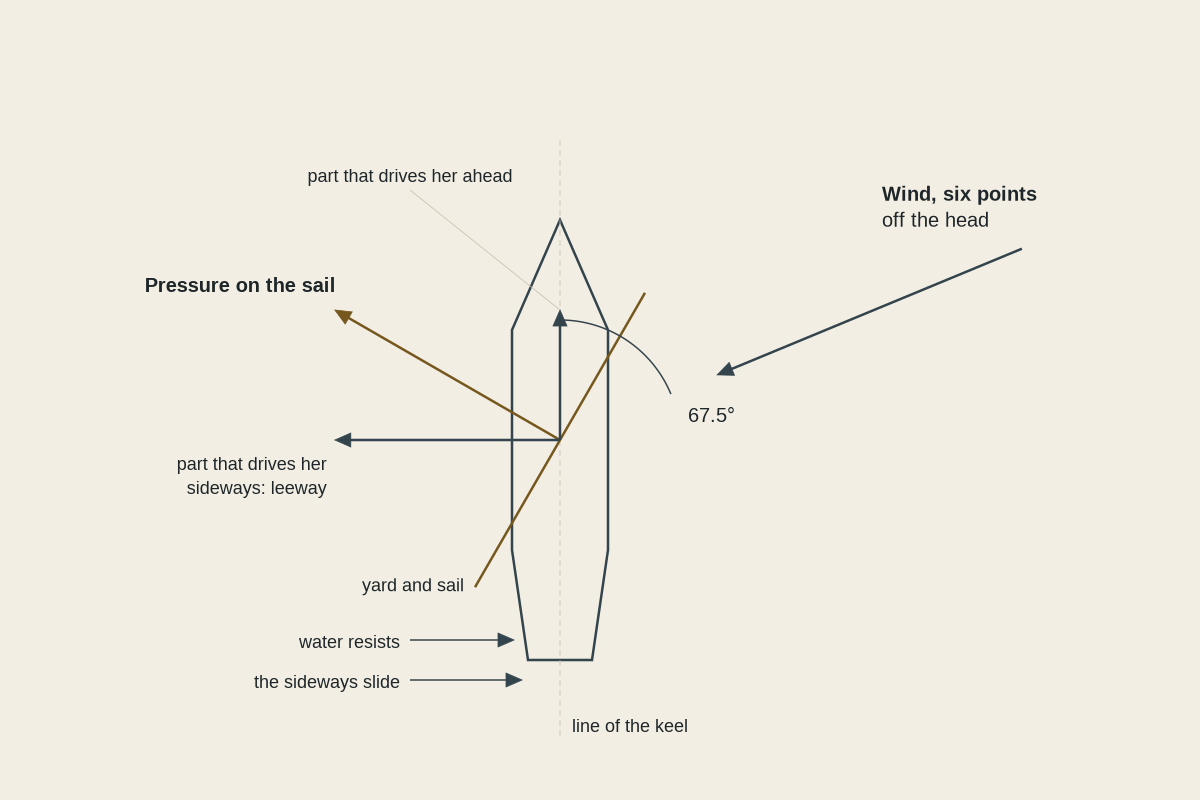
Six points off the wind, seen from above. The pressure on the sail splits into a part that drives the ship ahead and a part that drives her sideways, and the water resists the sideways part. A schematic: the arrow lengths are not measurements.
Keel, Rail & Spoke, CC BY 4.0
Data: Lever, The Young Sea Officer's Sheet Anchor, 1843 American edition, https://archive.org/details/youngseaofficers00leve, retrieved 2026-11-07; Knight, Sailing, 1889, https://www.gutenberg.org/ebooks/56394, retrieved 2026-11-08
Reuse this diagram: credit to copy
"Six points off the wind: the forces" by Keel, Rail & Spoke, https://keelrailandspoke.com/ships/how-sailing-ships-sail-upwind/, licensed under CC BY 4.0 (https://creativecommons.org/licenses/by/4.0/).
Data behind this diagram: how-sailing-ships-sail-upwind-upwind-vmg.csv · Where this data came from
A square-rigged ship six points off the wind sails 2.61 miles to gain 1 mile upwind. The angle comes from Darcy Lever’s The Young Sea Officer’s Sheet Anchor, in the 1843 American edition. The miles are arithmetic recalculated from that angle, and they leave out drift, current and time lost in turning. Lever’s page also prints a second angle, and it does not fit.
Stops on this page (7)
Why can’t a sailing ship sail straight into the wind?
A steam locomotive carries its own fire and goes where the rails point. A sailing ship takes its power from a single direction, and the manuals explain the limit by describing what happens to the sails. When Lever’s ship swings toward the wind and comes within three points of it, the wind is “blowing on the leeches or extremities of the after sails,” the outer edges of the sails nearest the stern, which “made them shake.” Head to wind, in the older method of tacking he sets out, he calls her “liable to sternway,” meaning she may begin to move backward through the water.
Douglas Frazar, writing about yachts in 1879, reaches the same conclusion from the other direction. If the boom that holds the foot of the sail is brought over the line of the keel, he says, the yacht “would not advance, but would simply be pushed to leeward by the wind.” Leeward is the side the wind blows toward, and windward is the side it comes from. The Bounty launch met this limit in an open boat in 1789, as that page sets out.
Lever gives the limit as a number. “A square rigged vessel when close hauled (i. e. as close to the wind as she can possibly lie), can approach no nearer to it than six points,” he writes on page 75. A point is one division of the mariner’s compass, and his compass “has eight points in each quarter, equal to ninety degrees,” which makes one point 11.25° and six points 67.5°.
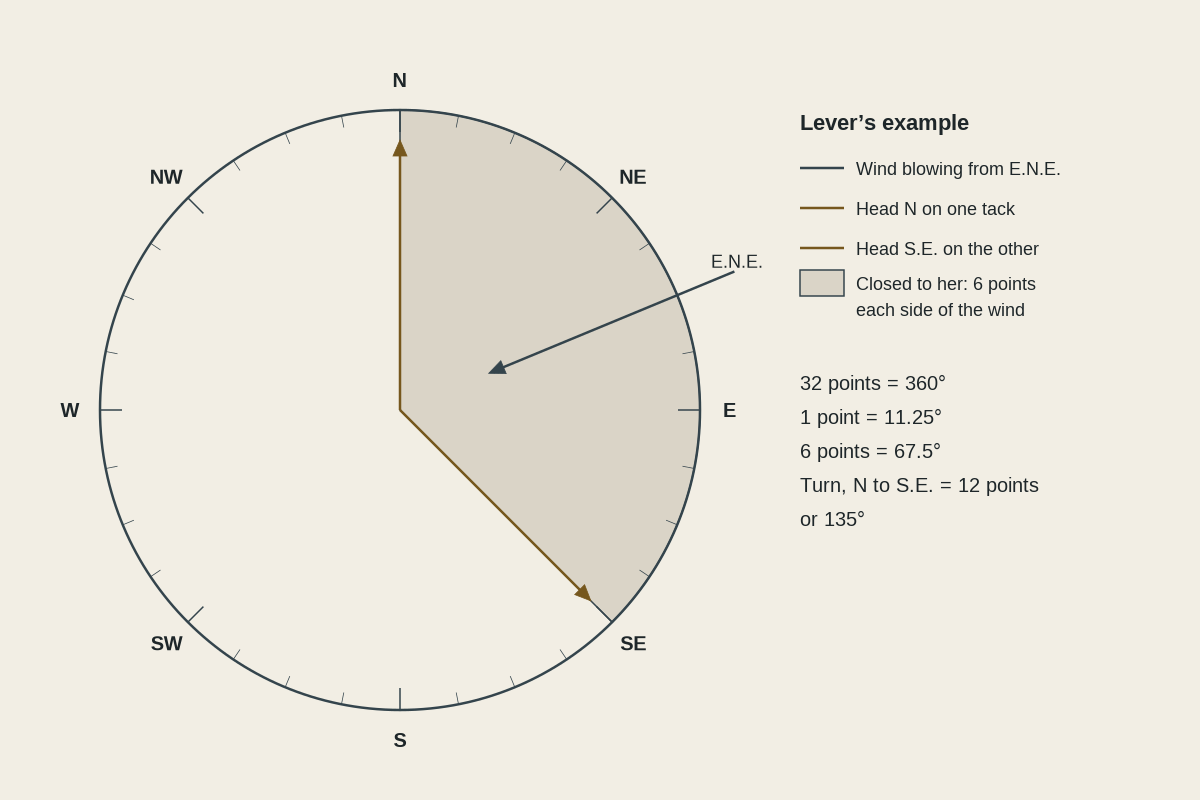
Lever’s example on the compass. With the wind at E.N.E., the ship can head N on one side or S.E. on the other. Everything between them, 135° of the circle, is closed to her.
Keel, Rail & Spoke, CC BY 4.0
Data: Lever, The Young Sea Officer's Sheet Anchor, 1843 American edition, https://archive.org/details/youngseaofficers00leve, retrieved 2026-11-07
Reuse this diagram: credit to copy
"Lever's six points on the compass" by Keel, Rail & Spoke, https://keelrailandspoke.com/ships/how-sailing-ships-sail-upwind/, licensed under CC BY 4.0 (https://creativecommons.org/licenses/by/4.0/).
The same page then says the wind forms an angle with the keel “of six points, or sixty-three degrees forty-five minutes.” That does not match. On his own compass 63°45′ is about 5.67 points, while his worked example, with the head at N and the wind at E.N.E., is exactly six. This page uses 67.5° and lists the printed figure beside it. Only the 1843 edition was read, so the origin of the 63°45′ is still an open question.
The same compass names every other angle. One point further from the wind, Lever says, the ship has it “one point free”; at eight points it is “on the beam,” blowing square across the hull; further aft it is on the quarter, and at sixteen points she is before the wind.
What is tacking?
E. F. Knight’s Sailing, published in 1889, gives a plain definition. Tacking is “sailing a certain distance close hauled with the wind on one side, and then turning round and sailing close hauled with the wind on the other side.” Close-hauled means as near the wind as the ship will lie. Frazar calls the same zigzag “beating to windward,” and he adds that when the wind is not exactly ahead of the destination, the track becomes “a long and a short leg.”
The names of the two tacks come from the rigging. Lever explains that a rope called the tack holds down the windward corner of a square sail, and that this is the reason a ship with the wind on her starboard side is said to be on the starboard tack.
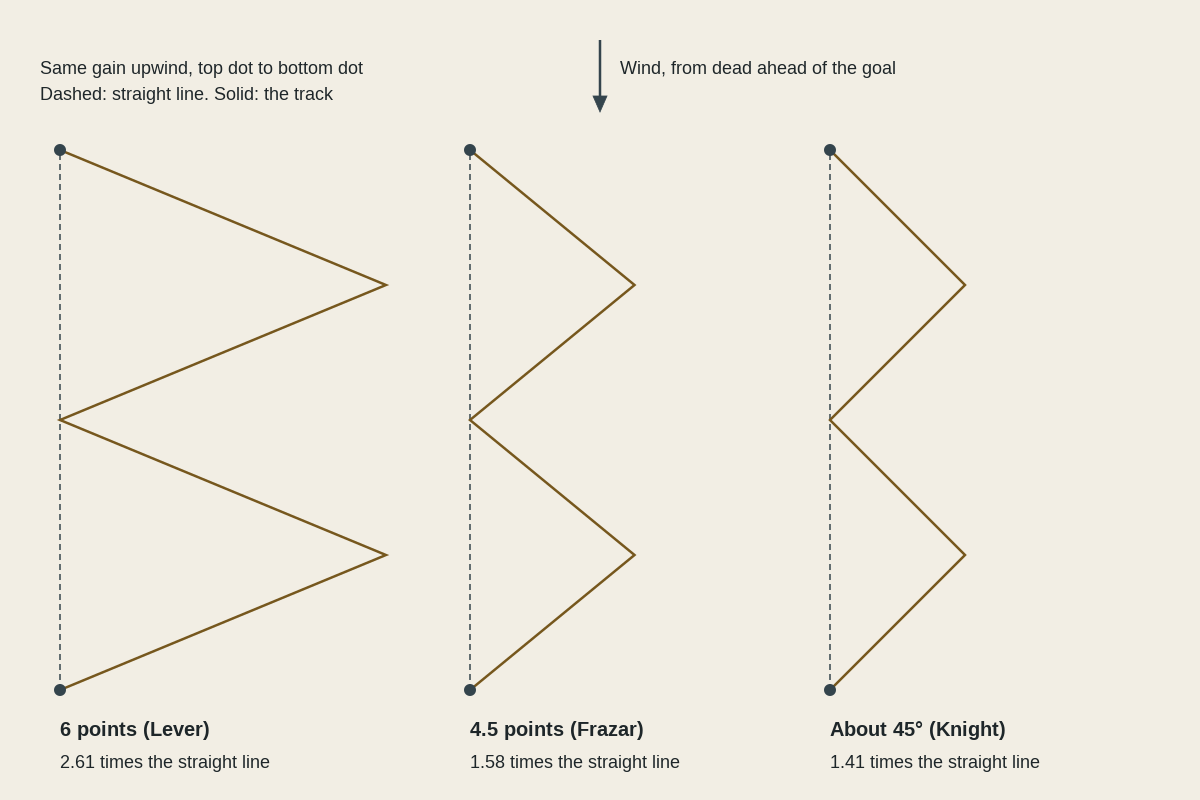
The same gain upwind at three angles. Each solid track is longer than the dashed straight line by the same factor however many turns it makes. Geometry only, with no drift, current or time lost turning.
Keel, Rail & Spoke, CC BY 4.0
Data: Lever, The Young Sea Officer's Sheet Anchor, 1843 American edition, https://archive.org/details/youngseaofficers00leve, retrieved 2026-11-07; Frazar, Practical Boat-Sailing, 1879, https://www.gutenberg.org/ebooks/39805, retrieved 2026-11-08; Knight, Sailing, 1889, https://www.gutenberg.org/ebooks/56394, retrieved 2026-11-08
Reuse this diagram: credit to copy
"One gain upwind at three angles" by Keel, Rail & Spoke, https://keelrailandspoke.com/ships/how-sailing-ships-sail-upwind/, licensed under CC BY 4.0 (https://creativecommons.org/licenses/by/4.0/).
Stand at the start of the dashed line and walk it. The ship leaves you at an angle and crosses your path again further along, having covered a good deal more water for the same ground. Each mile on a leg gains only the cosine of the angle off the wind, so the total depends on the angle, not on the number of turns.
A destination slightly off the wind changes the shares and little else. With a port one point away from dead upwind, a ship at six points would sail 1.39 units on the long leg and 1.18 on the short one for each unit of direct distance, which comes to 2.56 in all.
How much farther does tacking make a ship sail?
The table sets out the calculation for every angle in these books. A multiple of 2.61 means 2.61 miles or kilometers sailed for each one gained straight upwind, so a port 100 km dead to windward would take 261 km of sailing. The last column runs the sum the other way: how fast the ship must move through the water to gain ground upwind as fast as a person walking at 5 km/h.
| Angle, and who gives it | Degrees off the wind | Gain upwind per mile sailed | Distance multiple | Speed needed to match a 5 km/h walk upwind |
|---|---|---|---|---|
| Seven points (Lever, wind one point free) | 78.75° | 0.20 | 5.13 | 25.63 km/h |
| Six points (Lever, square rig) | 67.5° | 0.38 | 2.61 | 13.07 km/h |
| 63°45′ (as printed in Lever, 1843) | 63.75° | 0.44 | 2.26 | 11.30 km/h |
| Usually within four points and a half (Frazar, fore-and-aft) | 50.625° | 0.63 | 1.58 | 7.88 km/h |
| About 45° (Knight, fore-and-aft boat) | 45° | 0.71 | 1.41 | 7.07 km/h |
| Eight points (Lever, wind on the beam) | 90° | 0 | none | none |
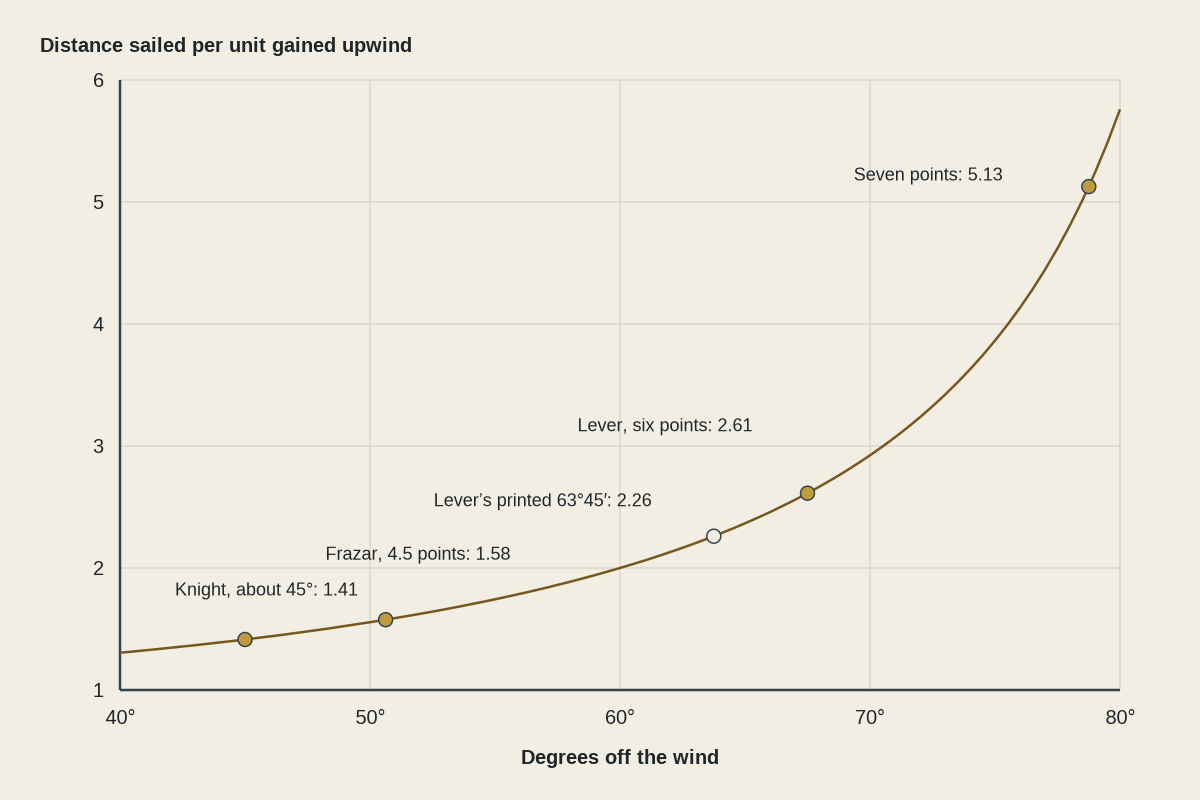
The cost of the angle. The curve is 1 divided by the cosine of the angle off the wind. The open circle is the figure printed in Lever’s 1843 edition.
Keel, Rail & Spoke, CC BY 4.0
Data: Lever, The Young Sea Officer's Sheet Anchor, 1843 American edition, https://archive.org/details/youngseaofficers00leve, retrieved 2026-11-07; Frazar, Practical Boat-Sailing, 1879, https://www.gutenberg.org/ebooks/39805, retrieved 2026-11-08; Knight, Sailing, 1889, https://www.gutenberg.org/ebooks/56394, retrieved 2026-11-08
Reuse this diagram: credit to copy
"Distance sailed per unit gained upwind" by Keel, Rail & Spoke, https://keelrailandspoke.com/ships/how-sailing-ships-sail-upwind/, licensed under CC BY 4.0 (https://creativecommons.org/licenses/by/4.0/).
Six points works out to 13.07 km/h, about 7 knots, through the water just to keep level with someone walking directly upwind. The manuals read here give no close-hauled speed for these ships, so this page’s working speed stays unknown, and so does its walking multiple.
At each stated angle, and in still water, these multiples are a floor, because the calculation assumes a perfectly straight track. Lever lists “the ground lost to leeward” among the faults of the older way of tacking, and Frazar warns that a yacht hauled closer to the wind “in an increased ratio loses its speed.” He still counts a narrow angle as the advantage, other things being equal, since a yacht that cannot lie as close “will have to pass over much more water to arrive at the same place.” Where the zigzag had actually taken a ship was a separate question, answered from the sky with a sextant.
What stops the wind pushing the ship sideways?
Nothing stops it entirely. Lever’s glossary defines lee-way as “The lateral movement of a ship to leeward.” Knight gives the mechanism. The pressure of the wind on the sails means the boat “is propelled forward and also sideways away from the wind, making leeway, as it is called.”
The hull’s resistance in the water decides how much of that happens. “If a boat has a deep keel,” Knight writes, “her lateral resistance to the water will cause the leeway to be insignificant.” A very shallow boat with little resistance, he says, “will not go ahead at all,” and shallow boats were fitted with lee-boards or centerboards to prevent it.
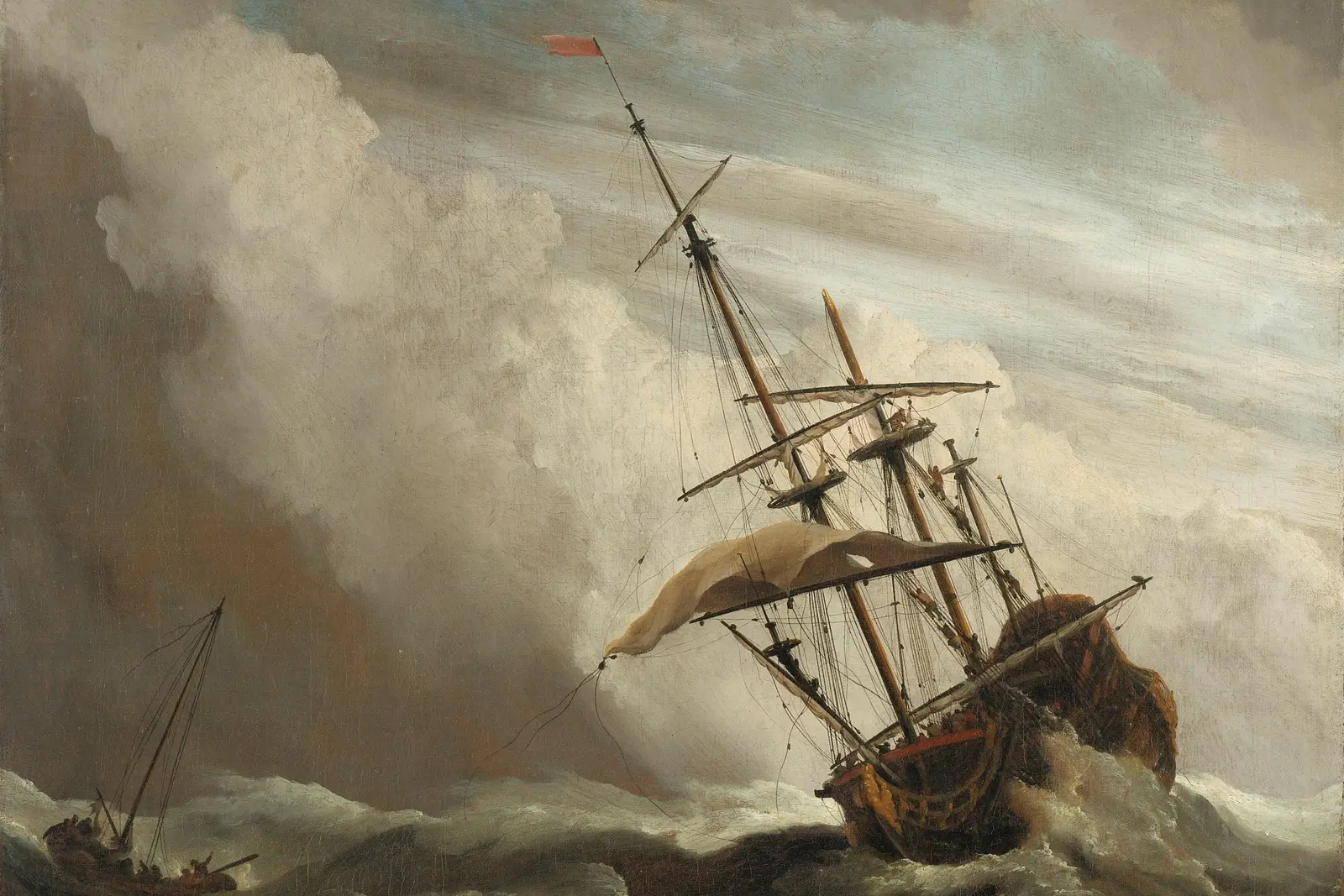
A Ship on the High Seas Caught by a Squall, known as The Gust, by Willem van de Velde the Younger, about 1680, cropped to a landscape frame. It shows a three-masted ship in a storm, not a ship working to windward.
A Ship on the High Seas Caught by a Squall, Known as ‘The Gust’ by Willem van de Velde the Younger, Public domain
Full credit
"A Ship on the High Seas Caught by a Squall, Known as ‘The Gust’" by Willem van de Velde the Younger — https://commons.wikimedia.org/wiki/File:Een_schip_in_volle_zee_bij_vliegende_storm,_bekend_als_%E2%80%98De_windstoot%E2%80%99_Rijksmuseum_SK-A-1848.jpeg — Public domain (US: painted about 1680, every term expired; elsewhere: creator died 1707, life+70 term expired; Commons file page shows Rijksmuseum public domain and CC0 marking); modified: cropped: upright canvas cut to a landscape frame, sky above and sea below removed; full width kept

The same pressure also heels a boat over, Knight adds, which is why designers relied on a beamy hull or on ballast placed low. A hull can resist only so much of it. That is where the Vasa inquiry begins.
Sails also turn the ship, and Lever treats the hull as though it rotated around a vertical axis through “the centre of gravity or rotation.” Sails ahead of that axis swing the head away from the wind, and sails behind it swing the head toward the wind, while both drive her ahead along the keel. Knight’s two-sail boat behaves the same way: with the after sail stronger, “the head of the boat will run up into the wind.” Lever uses the phrase “lateral resistance” for a ship under way in this same discussion of balance, describing a heeled ship pressed down at the bow, which “meets the same lateral resistance under her bows to leeward.”
These accounts stop at pressure and resistance. They do not explain how air moving around a sail produces that pressure, and this page does not offer a modern account of the flow.
Did a fore-and-aft rig sail closer to the wind?
The books say so. They are not reporting a single measured contest, though. A square rig hangs its sails from yards set across the ship, while a fore-and-aft rig sets them along the line of the keel. Frazar’s rule for fore-and-aft vessels is “usually within four points and a half,” and Knight, ten years later, gives a properly constructed boat about 45°, with each tack “at about right angles to the last.”
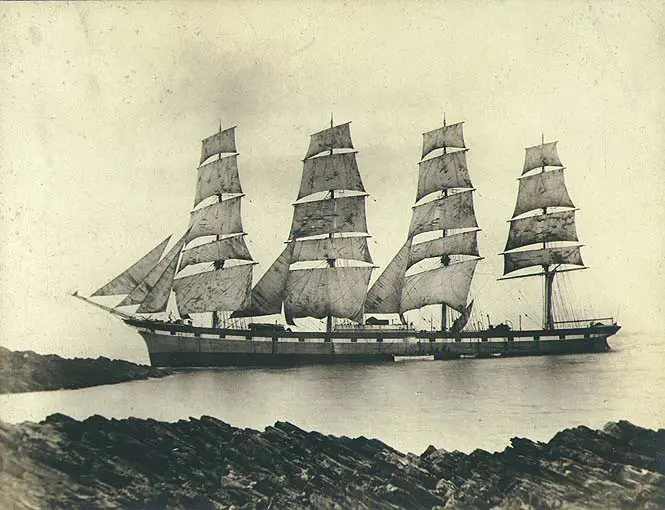
The four-masted ship Liverpool under sail, about 1904, as identified by the Wilhelm Hester collection. Her sails hang from yards across the hull, the rig Lever’s six points describe.
Four-masted sailing ship LIVERPOOL under sail, Washington, ca 1904 by Wilhelm Hester, Public domain
Full credit
"Four-masted sailing ship LIVERPOOL under sail, Washington, ca 1904" by Wilhelm Hester — https://commons.wikimedia.org/wiki/File:Four-masted_sailing_ship_LIVERPOOL_under_sail,_Washington,_ca_1904_(HESTER_80).jpeg — Public domain (US: Commons file page states published before 1931; also, creator died 1947, so an unpublished work would be past life+70; elsewhere: creator died 1947, life+70 term expired)

Worked through the same geometry, those figures reduce the distance from 2.61 times to 1.58 or 1.41. They come from different writers, boats and decades, and Frazar admits that some craft “seem to eat up into the wind,” whether from their model, their balance of sail “or some other unknown cause.” Lever makes a similar admission about square-rigged ships, since “all vessels differ so materially in their working” that he recommends no single method until the vessel’s construction and trim are known.
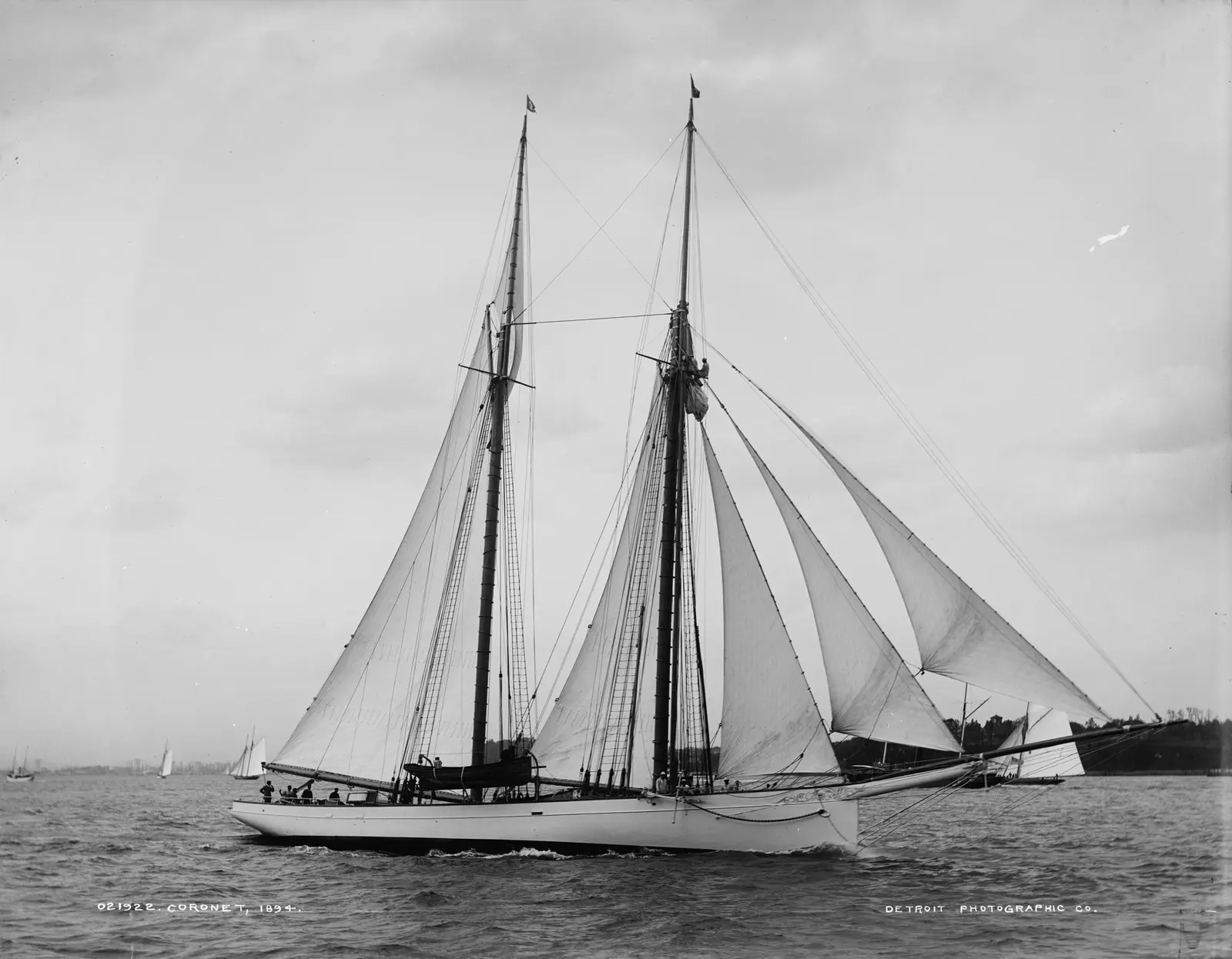
The schooner Coronet in 1894. Her main sails run along the line of the hull, the arrangement Frazar and Knight describe.
Yacht Coronet (1885), Detroit Publishing Co., 1894 by John S. Johnston, Public domain
Full credit
"Yacht Coronet (1885), Detroit Publishing Co., 1894" by John S. Johnston — https://commons.wikimedia.org/wiki/File:Yacht_Coronet_(1885)(Detroit-Publishing_Co_1894-LOC).jpg — Public domain (US: dated 1894 with Detroit Photographic Co. plate lettering; Commons file page says most of this collection was published before 1931; publication of this print not traced; creator died 1899, so even an unpublished work would be past life+70; elsewhere: creator died 1899, life+70 term expired); modified: reduced from 3,840 to 2,000 pixels wide; plate lettering kept

How did a ship turn from one tack to the other?
Lever takes one example ship through the maneuver, and his compass headings make a cycle that can be plotted. She begins close-hauled with her head north and the wind at E.N.E., swings toward the wind and through it, and settles close-hauled again with her head S.E., a turn of 12 points or 135°. The figure and table record what the book describes, and they are not a guide to handling a ship.
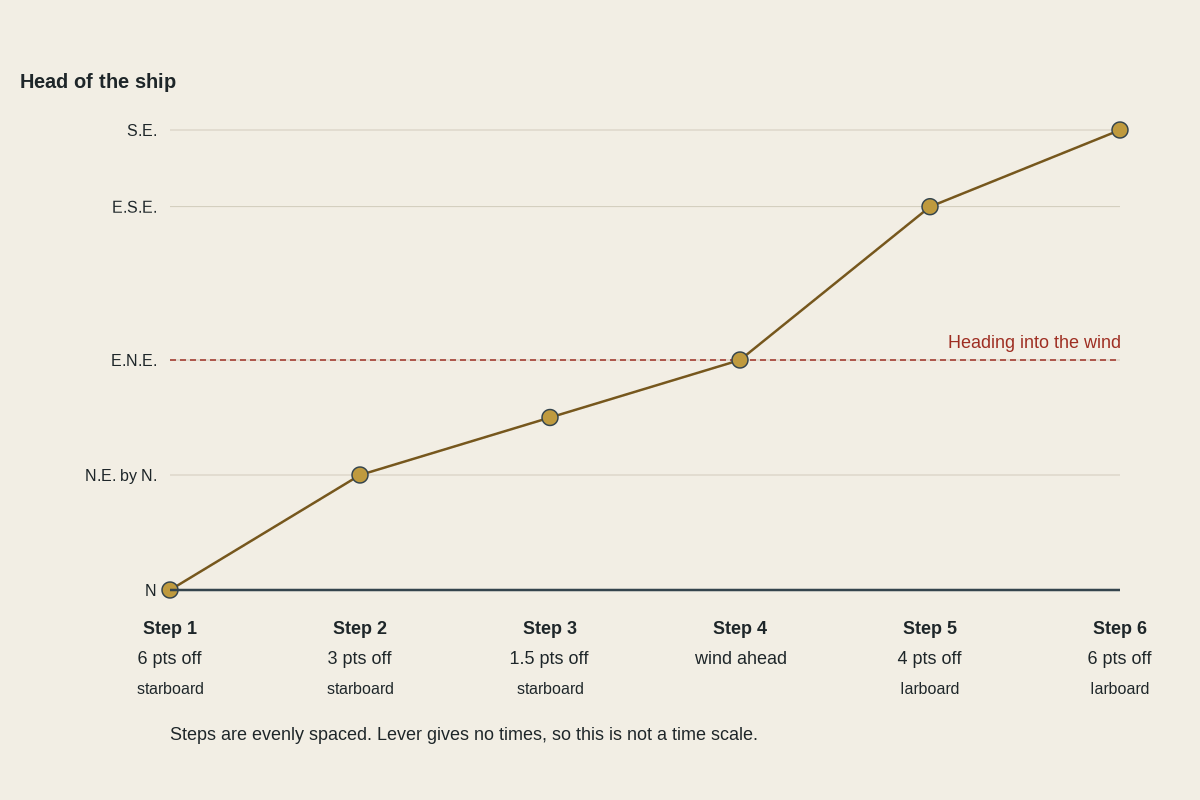
One tack by compass points, from the example on Lever’s page 77. The steps are evenly spaced because he gives no times. Some positions are worked from his wind direction, as the table says.
Keel, Rail & Spoke, CC BY 4.0
Data: Lever, The Young Sea Officer's Sheet Anchor, 1843 American edition, https://archive.org/details/youngseaofficers00leve, retrieved 2026-11-07
Reuse this diagram: credit to copy
"One tack by compass points" by Keel, Rail & Spoke, https://keelrailandspoke.com/ships/how-sailing-ships-sail-upwind/, licensed under CC BY 4.0 (https://creativecommons.org/licenses/by/4.0/).
Data behind this diagram: how-sailing-ships-sail-upwind-tack-phase.csv · Where this data came from
| Step | Head of the ship | Wind off the bow | Basis |
|---|---|---|---|
| 1 | N | 6 points, starboard | Stated |
| 2 | About N.E. by N. | 3 points, starboard | Head stated, angle worked |
| 3 | N.E. ½ E. | About 1.5 points, starboard | Stated |
| 4 | E.N.E. | Dead ahead | Worked from the wind |
| 5 | E.S.E. | About 4 points, larboard | Worked from the wind |
| 6 | S.E. | 6 points, larboard | Stated |
Larboard is the old word for the left side of a ship. The difficult moment was step 4, head to wind. A ship that had lost too much speed, Lever writes of the older method, might not get past that point, “in which case she was sure to miss stays and fall off again.” To miss stays was to fail the turn.
Could ancient ships sail against the wind?
They could at least sail with the wind on either side, although the sources read here give no angle. Cecil Torr’s Ancient Ships, published in 1895, describes rigging as “substantially the same” in every age and district of the ancient world. He begins with Egyptian ships of about 1250 B.C. that carried one large square-sail. He writes of steering gear used “to keep the ship on either tack” in a light wind, with the yard braced round in a stronger one.
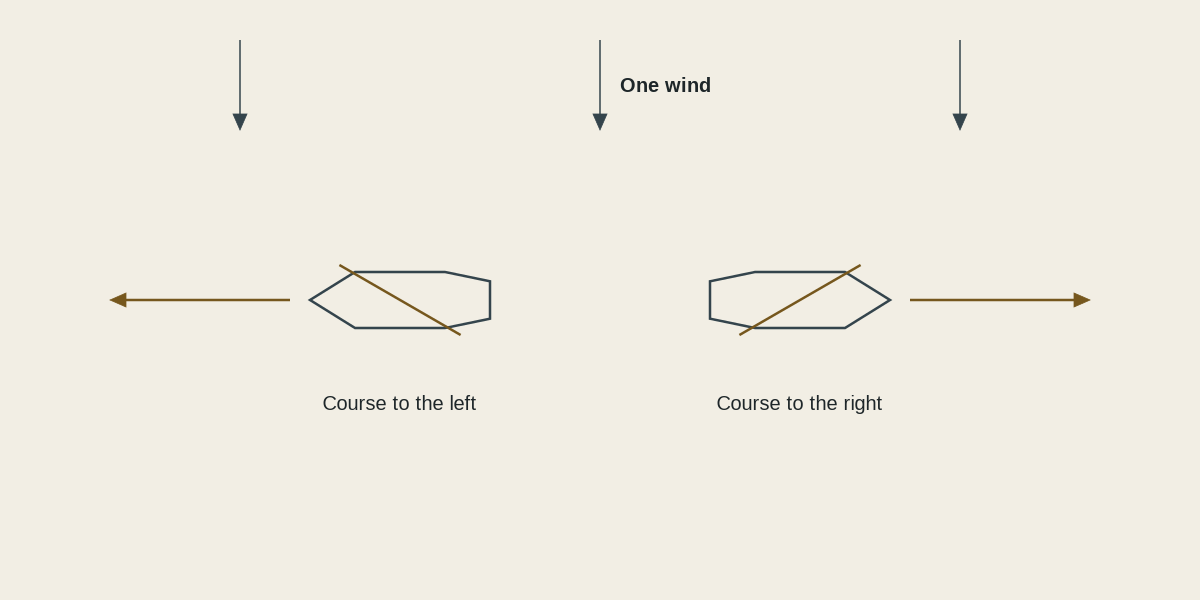
Pliny’s sentence as a sketch: one wind, two courses. A schematic, not a picture of any ancient ship.
Keel, Rail & Spoke, CC BY 4.0
Data: Pliny, Natural History, Book II, ch. 48, trans. Bostock and Riley, https://www.gutenberg.org/ebooks/57493, retrieved 2026-11-08
Reuse this diagram: credit to copy
"One wind, two courses" by Keel, Rail & Spoke, https://keelrailandspoke.com/ships/how-sailing-ships-sail-upwind/, licensed under CC BY 4.0 (https://creativecommons.org/licenses/by/4.0/).
Neither Torr nor the older witness, Pliny the Elder, says how near the wind those ships could lie, so nothing here puts a number of points on them. Pliny, in the first century, has the fact in one line of his Natural History, in the translation by John Bostock and H. T. Riley: “We are able to sail in opposite directions by means of the same wind, if we have the sails properly set.” His next words give the result at sea: “hence it frequently happens that, in the night, vessels going in different directions run against each other.”
Sources
- Lever, Darcy. The Young Sea Officer's Sheet Anchor; or, A Key to the Leading of Rigging, and to Practical Seamanship. American edition, with additions by George W. Blunt. New York: E. & G. W. Blunt, 1843. Public domain; published 1843, author died 1837. https://archive.org/details/youngseaofficers00leveRead: sections on the rudder, the sails, the compass and tacking, pp. 70 to 77, the griping passages, and the glossary entries, from the scan's text layer; printed plates not opened
- Frazar, Douglas. Practical Boat-Sailing: A Concise and Simple Treatise. Boston: Lee and Shepard, 1879. Public domain; published 1879, author died 1896. https://www.gutenberg.org/ebooks/39805Read: chapters on sailing close-hauled and on tacking and beating to windward
- Knight, E. F. Sailing. The All-England Series. London: George Bell & Sons, 1889. Public domain; published 1889, author died 1925. https://www.gutenberg.org/ebooks/56394Read: chapter III, The Theory of Sailing
- Pliny the Elder. The Natural History of Pliny, Vol. I, Book II, ch. 48. Translated by John Bostock and H. T. Riley. London: Henry G. Bohn, 1855. Public domain; translators died 1846 and 1878. https://www.gutenberg.org/ebooks/57493Read: chapter: Book II, chapter 48, in translation; Latin not read
- Torr, Cecil. Ancient Ships. Cambridge: Cambridge University Press, 1895. Public domain; published 1895, author died 1928. https://archive.org/details/ancientships00torruoftRead: chapter pages 78 and 95 to 96 with note 206, from the scan's text layer; the Greek and Latin quoted in the notes not read for this page
Cite this page
Keel, Rail & Spoke. "Tacking: How a Square-Rigged Ship Sailed Against the Wind." Published 2026-11-08. https://keelrailandspoke.com/ships/how-sailing-ships-sail-upwind/. Accessed on the date you read it.
How facts are checked · Corrections · Contact
Found a mistake on this page? Write to contact@keelrailandspoke.com.
More from Ships & Wrecks
Ships & Wrecks
Vasa Ship, 1628: Stability Test Stopped, Then She Sailed
The Vasa ship sank about 1,300 m into her 1628 maiden voyage. About a month before, her master testified, thirty men rolled her so far the test was stopped.
Picture credit
"Vasa 2" by MLeb — https://commons.wikimedia.org/wiki/File:Vasa_2.jpg — Public domain (released into the public domain worldwide by the photographer)
Ships & Wrecks
Mutiny on the Bounty: 3,618 Miles in 41 Days, by Bligh’s Log
After the 1789 mutiny on the Bounty, William Bligh logged 3,618 miles to Timor in 41 days in an open launch. His noon positions rechecked, and 44 men's fates.
Picture credit
"The Mutineers turning Lt Bligh and part of the Officers and Crew adrift from His Majesty's Ship the Bounty" by Robert Dodd; State Library of New South Wales, DL Pf 137 — https://commons.wikimedia.org/wiki/File:Mutiny_HMS_Bounty.jpg — Public domain (US: published 1790, before 1931; elsewhere: creator died 1815, life+70 term expired); modified: cropped: paper margin and printed text below the image removed; reduced to 2,400 px wide
Ships & Wrecks
Spanish Armada, 1588: One Undated Spanish List Says 65 Lost
One English report of 1588 said the Spanish Armada had lost at least 16 ships; an undated Spanish list printed in 1899 totals 65. Each count, with who gave it.
Picture credit
"The Spanish Armada off the English Coast in 1588" by Cornelis Claesz van Wieringen; Rijksmuseum, SK-A-1629 — https://commons.wikimedia.org/wiki/File:The_Spanish_Armada_off_the_English_Coast_in_1588_(by_Cornelis_Claesz_van_Wieringen)_-_Rijksmuseum,_Amsterdam_(SK-A-1629).jpg — Public domain (US: painted about 1620 to 1625, every term expired; elsewhere: creator died 1633, life+70 term expired; Rijksmuseum marks it public domain)


